Indian employers contribute an average of 16.75% of each employee’s CTC to statutory schemes, on top of the salary itself. Most founders discover this number after the first payroll run, not before.
That is before you account for payroll tax deductions from the employee side, which run another 18.08%. Together, the statutory burden on an Indian payroll is closer to 35% of salary cost once you add both sides, and that figure changes if you operate in multiple states, employ more than 20 people, or have workers crossing the ₹21,000 ESI wage threshold mid-year.
The Indian Payroll Tax is not a unified tax. Rather, it is a system of five different taxes that are regulated by three distinct government agencies with their own computation systems, payment deadlines, and penalties. This document will go through all the details, including precise percentages, deadlines, and penalties for non-compliance.
What Is Payroll Tax in India?
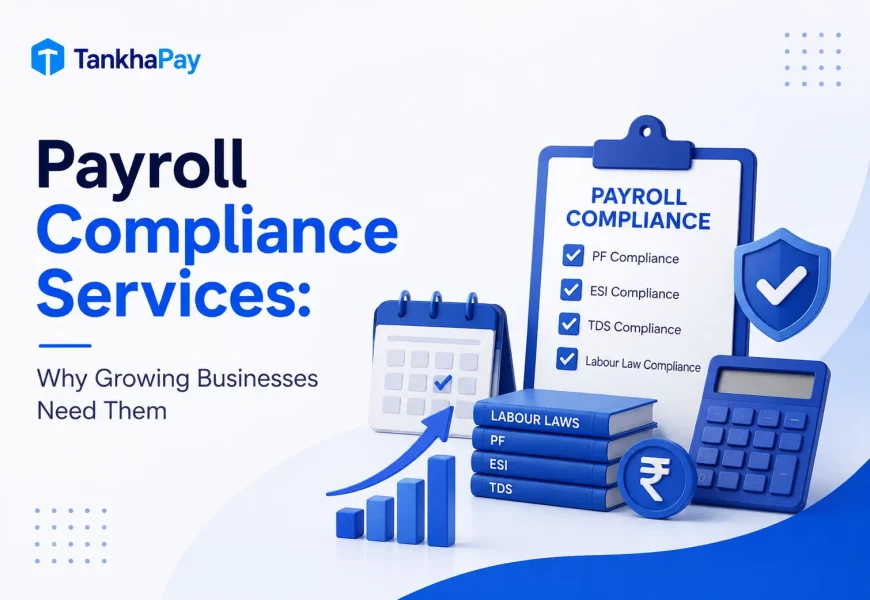
In India, payroll tax refers to the statutory deductions and contributions that employers must calculate, deduct from employee salaries, add their own contribution to, and deposit with the relevant government authorities every month. The primary components are the Employees’ Provident Fund (PF), Employees’ State Insurance (ESI), Tax Deducted at Source (TDS), Professional Tax (PT), and the Labour Welfare Fund (LWF).
Unlike income tax, which is the employee’s personal liability, payroll tax compliance involves both the employer and employee contributing to schemes that fund social security, healthcare, and retirement. The employer is the responsible party in all cases. If the calculation is wrong or the deposit is late, the penalty notice comes to the company, not the employee.
5 Payroll Tax Deductions Every Indian Business Must Handle
1. Provident Fund (PF)
Mandatory for all establishments with 20 or more employees.
Both the employer and employee contribute 12% of basic salary plus Dearness Allowance every month. The employer’s 12% is split: 3.67% goes to the employee’s PF account, 8.33% goes to the Employee Pension Scheme (EPS, capped at ₹15,000 wage), and 0.5% is an administrative charge.
As per the 2025 Labour Codes, basic pay should be at least 50% of the total CTC. As you had earlier structured the salaries such that your basic would be less, so as not to have high PF contribution, it might be wrongly calculated now.
Due date: 15th of the following month.
2. Employee State Insurance (ESI)
Mandatory for establishments with 10 or more employees where any employee earns up to ₹21,000 per month in gross wages.
- Employee contribution: 0.75% of gross wages
- Employer contribution: 3.25% of gross wages
After gross wages exceed ₹21,000 per month, there will be no more deductions for ESI contributions, but this applies after the period for contributions, i.e., from April to September, or from October to March ends.
Due date: 15th of the following month.
3. Tax Deducted at Source (TDS)
TDS provision is for all salaried individuals. The employer calculates the estimated annual income, finds out the tax slab applicable, and deducts the appropriate amount monthly.
In the case of the new tax regime (default regime from fiscal year 2023-2024), the standard deduction is ₹75,000, and the effective tax is ₹0 up to ₹12 lakh annually under Section 87A. In the old regime, the standard deduction is ₹50,000 along with many other deductions.
The Income Tax Act 2025 (effective from April 1, 2026) has shifted the TDS on salaries from Section 192 to Section 392(1). Form 24Q will be superseded by Form 138. Form 16 will be superseded by Form 130. Any payroll software giving out old form numbers from April 1, 2026 will not be compliant.
Payment deadline: 7th of the following month. TDS of March should be paid before 30th April. Filing return: Quarterly – July 31, October 31, January 31, May 31.
4. Professional Tax (PT)
State tax on salaries, which is Constitutionally fixed as a ceiling of ₹2,500 per head per annum as per Article 276. Imposed in 18 States including Maharashtra, Karnataka, West Bengal, Andhra Pradesh, Telangana, Tamil Nadu, and Gujarat. Not imposed in Delhi, Haryana, Uttar Pradesh, Rajasthan, Punjab, and Uttarakhand.
The employer deducts PT from the employee’s monthly salary and deposits it with the state PT authority. The employer also pays a separate annual enrolment fee out of company funds.
Maharashtra’s February quirk: Employees earning above ₹10,000/month pay ₹200 for 11 months and ₹300 in February, totalling ₹2,500/year. This is the most commonly missed adjustment in Maharashtra payroll runs.
Due date: End of the following month (varies by state).
5. Labour Welfare Fund (LWF)
A state-level contribution to a fund that supports employee welfare programmes. Not all states have LWF. Rates range from ₹6 to ₹75 per employee per period depending on the state. Typically paid half-yearly or annually.
The state of Karnataka lowered the number of employees for applying LWF from 50 to 10 in 2025. There are many companies which may be eligible but unaware.
What Changed in 2026: The Two Updates That Affect Every Payroll
Change 1: The Labour Codes (effective November 2025)
The four new Labour Codes consolidated 29 old laws into one framework. For payroll tax compliance, the key change is the 50% basic wage rule: basic salary (including DA) must now be at least 50% of total CTC. Companies that structured salaries to minimise PF by keeping basic low are now non-compliant. The PF contribution base has increased for most employees, which also raises the employer’s total cost.
Change 2: The Income Tax Act 2025 (effective April 1, 2026)
The Act replaces the Income Tax Act of 1961. For payroll, the critical changes are:
- TDS on salary moves from Section 192 → Section 392(1)
- Quarterly TDS return changes from Form 24Q → Form 138
- Annual TDS certificate changes from Form 16 → Form 130
Systems that are still producing form numbers based on the old form will be submitting a non-conforming return. Ensure your payroll software/system is up-to-date.
“Automate your computations, tax schedules, and benefit withholding – but never bypass post-run verification. Once you have completed your payroll processing, perform a review. Review payroll summary reports, examine a few employee files, and verify your figures before any disbursements are made.”
BJ Anderson, Director of Payroll & Leave Management, Humareso
What Happens When You Miss a Deadline
Missing a payroll tax compliance deadline is not a single cost. It is a compounding liability across multiple authorities simultaneously.
Manual payroll compliance costs Indian SMBs an average of ₹2 to 8 lakh annually in penalties, interest, and accountant fees, which roughly costs what automated or managed payroll systems eliminate.
The Bottom Line
Indian payroll tax is manageable when every component is tracked, calculated correctly, and deposited on time. The complication is that five separate obligations run on three different deadlines, are governed by three different authorities, and have all been updated in the last twelve months.
Businesses that have this under control have one thing in common: they are not tracking it manually. Either payroll software handles the calculations and generates the returns automatically, or a managed payroll service processes everything and takes on the compliance responsibility. The penalty exposure from one missed deadline typically costs more than a full year of either option.