New Labour Laws 2026: Key Changes in Labour Laws in India and Their Impact on Workers and Employers
Updated on May 26, 2026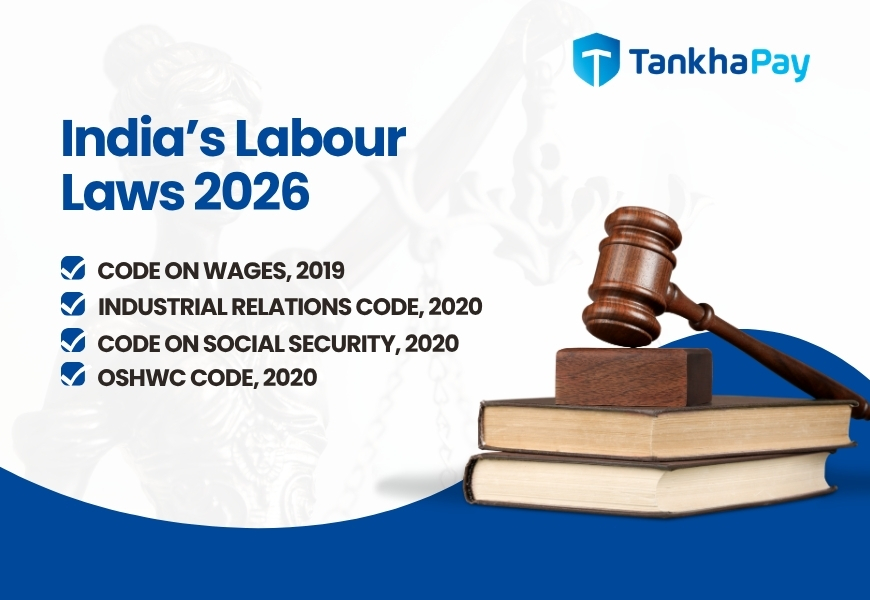
India’s employment regulatory system is undergoing one of the most significant transformations in decades. The New Labour Law in India, often referred to as the New Labour Laws 2026, restructures labour laws in India by consolidating 29 existing laws into four comprehensive labour codes.
The new labour law in India is intended to update the Labour Law Act framework and make regulatory compliance easy for organizations with labour regulations. Along with social security benefits to a broader segment of the workforce, including gig and platform workers.
While the labour codes were passed between 2019 and 2020, the new changes in labour laws in India are moving closer to full implementation as central and state governments finalize operational rules and compliance mechanisms.
- Fast Facts: New Labour Laws in India
- Policy Reform: Consolidation of labour laws
- Total Laws Replaced: 29 central labour laws
- New Framework: 4 labour codes
- Coverage: Wages, social security, industrial relations, workplace safety
- Key Objective: Simplify compliance while expanding worker protection
What Is the New Labour Law in India?
The New Labour Law framework entails a new set of four labour codes that seek to transform the existing framework of labour laws in the country by creating a new unified structure for the existing labour laws in the country.
The Four Labour Codes
- Code on Wages, 2019
- Industrial Relations Code, 2020
- Code on Social Security, 2020
- Occupational Safety, Health and Working Conditions Code, 2020
Together, these codes create a consolidated legal framework governing employment practices in India. Policy analysts say the reforms represent the most comprehensive overhaul of labour laws in India in recent decades.
Why Were Labour Laws in India Reformed?
For decades, India’s labour system consisted of multiple overlapping laws that governed wages, workplace safety, and industrial relations.
This fragmented structure often leads to complexities for employers and employees. The new changes in labour laws in India are aimed at solving the problems faced by employers and employees by:
- Standardizing definitions across employment regulations
- Reducing compliance burdens for businesses
- Expanding social security benefits
- Encouraging formal employment practices
- Improving workplace safety standards
- Basic pay must constitute at least 50% of total salary
- Statutory contributions such as provident fund and gratuity will be calculated based on this revised wage definition
- Social security benefits for gig and platform workers
- Wider coverage under provident fund and insurance schemes
- Digital registration of workers for easier access to benefits
- Portability of benefits across states
- Companies with up to 300 employees can lay off workers without prior government approval
- Legal recognition of fixed-term employment contracts
- Establishment of a reskilling fund for retrenched employees
- Issuing of appointment letters for all workers
- Uniform safety standards for all industries
- Maximum work hours: 48 hours/week
- Permission for women to work in night shifts with safety precautions
- Universal Minimum Wage
- The 50% Wage Definition Rule
- Equal pay for equal work extended to all genders, including transgender persons.
- Overtime must be paid at a minimum of double the normal rate.
- IT/ITES salaries must be paid by the 7th of every month.
- First-time violations result in fines, not imprisonment.
- Retrenchment Flexibility
- Fixed-Term Employment (FTE)
- Trade Union Recognition
- Work-from-home is formally recognized in the service sectors.
- Standing Orders threshold raised from 100 to 300 employees.
- Two-member Industrial Tribunals for faster dispute resolution.
- Gig and Platform Workers Get Recognition
- Life and disability insurance
- Health benefits
- Old-age protection
- Accident insurance
- Expanded ESIC Coverage
- EPF Reforms
- Five-year limit on inquiries (no more decades-old cases)
- Reduced appeal deposit: 25% (down from 40-70%)
- Cases must be completed within two years
- Gratuity Changes
- Benefits Portability
- The One-Worker Rule
- Women's Empowerment
- Women can work night shifts in all establishments with consent and safety measures (lighting, CCTV, transportation).
- Work is allowed in all industries, including hazardous jobs.
- Proportional representation in grievance committees.
- Simplified Compliance
- Factories: 10 to 20 workers (with power), 20 to 40 (without power).
- Contract Labour: 20 to 50 workers.
- Standing Orders: 100 to 300 employees.
- Migrant Worker Protection
- Annual travel allowance for one trip home.
- PDS portability across states.
- Portable social security benefits.
- Health and Formalization
- Free annual health checkups for all employees.
- Mandatory appointment letters specifying wages and benefits.
- Working hours capped at 8/day, 48/week; overtime requires consent at double pay.
- Single Registration: One registration replaces six separate ones.
- One License, One Return: Unified licensing and return filing systems.
- Inspector-Cum-Facilitator: Inspectors now focus on guidance and awareness, not just finding violations. Web-based, randomized, algorithm-driven inspections replace arbitrary surprise visits.
- Digital Processes: Everything online, reducing paperwork and physical office visits.
- 2-Day Full and Final Settlement: Faster exit processes reduce administrative burden.
- 300-Worker Threshold: No government approval needed for layoffs until you hit 300 employees (up from 100).
- Fixed-Term Employment: Hire for specific projects without converting to permanent staff.
- Work-From-Home: Formally offer remote arrangements.
- Standing Orders Relief: Smaller firms (with fewer than 300 employees) are exempt from Standing Orders requirements.
- Higher PF Contributions
- Employee earning ₹10 lakh CTC
- Old basic: ₹3.5 lakh → Employer PF: ₹42,000/year
- New basic: ₹5 lakh → Employer PF: ₹60,000/year
- Additional cost per employee: ₹18,000/year
- Gratuity for FTE After One Year
- Reskilling Fund
- Worker earning ₹30,000/month = ₹1,000/day
- Reskilling fund contribution: ₹1,000 × 15 = ₹15,000
- This is in addition to standard retrenchment compensation
- Aggregator Contributions (Platform Companies)
- Expanded Dependent Coverage
- Monthly reduction: ₹750
- Additional retirement savings: ₹18,000/year
- Monthly reduction: ₹1,500
- Additional retirement savings: ₹36,000/year
- Monthly reduction: ₹2,250
- Additional retirement savings: ₹54,000/year
- Monthly reduction: ₹3,000
- Additional retirement savings: ₹72,000/year
- Additional PF contributions: ₹10.8 lakh
- With 8% returns: Approximately ₹40.8 lakh at retirement
- August 8, 2019: Code on Wages notified.
- September 29, 2020: Three other codes notified.
- November 21, 2025: Codes fully enforceable nationwide.
- Next 3 months: States finalizing rules.
- Central provisions are in effect
- State-specific implementations vary
- Some compliance requirements remain unclear
- 7.7 million additional jobs expected over the medium term.
- 1.3% reduction in unemployment rate.
- Increased formalization of the informal sector.
- Boost to manufacturing investment and competitiveness.
- Payroll Restructuring
- Reworking CTC components.
- Recalculating PF contributions.
- Adjusting gratuity provisions.
- Communicating changes to employees.
- Higher Statutory Costs
- Reducing hiring
- Offering lower gross salaries
- State-Wise Variations
- Lower Take-Home Pay
- Job Security Concerns
- Getting to Know New Benefits
- Compliance Costs
- Maintain digital records.
- File returns online.
- Provide formal appointment letters.
- Meet safety standards (even one-worker establishments in hazardous work).
- Increased Labor Costs
- Staying under thresholds.
- Continuing informal arrangements (risking penalties).
- Reducing workforce size.
Government officials have described the reform as an effort to balance worker welfare with economic growth and investment.
What Are the Key Changes in the New Labour Laws 2026?
Several structural changes are expected under the New Labour laws 2026, affecting wages, employment contracts, workplace safety, and social security coverage.
How Will the New Labour Law Change Salary Structures?
One of the most widely discussed provisions in the New Labour Law in India relates to the definition of wages. Under the new rules:
|
Compliance Area |
Earlier Framework (29 Laws) |
New Framework (4 Labour Codes) |
|
Regulatory Rules |
1,436 scattered rules |
Streamlined to 351 rules |
|
Filings |
31 separate returns |
One unified electronic return |
|
Official Forms |
181 forms |
Reduced to 73 forms |
|
Record Registers |
84 registers |
Just 8 registers |
|
Registrations |
8 different registrations* |
A single, consolidated registration |
|
Licensing |
4 separate licenses |
One comprehensive license |
|
Compounding |
Not available |
Introduced for the first time |
|
Improvement Notices |
Not available |
Now formally enabled |
*Earlier registrations included: Factories Act, BOCW, Contract Labour, Plantation, Motor Transport, ISMW, ESI, and EPF.
Source: Ministry of Labour & Employment
How Do the New Labour Laws Expand Social Security?
The Code on Social Security introduces one of the most significant expansions of welfare coverage under the New Labour Law framework.
Key ProvisionsThis expansion will result in millions of workers being brought under the fold.
What Changes Will Affect Hiring and Layoffs?
The Industrial Relations Code introduces several reforms affecting employment flexibility and workforce management.
Key ChangesSupporters say the measures improve labour market flexibility, while labour unions have raised concerns about potential impacts on job security.
How Will Workplace Safety Rules Change?
The Occupational Safety, Health, and Working Conditions Code is a consolidation of all laws on workplace standards.
Key Safety ProvisionsThe reforms aim to ensure consistent workplace standards across sectors ranging from factories to service industries.
When Will the New Labour Laws 2026 Be Fully Implemented?
Although the labour codes were enacted earlier, full implementation depends on rulemaking and administrative readiness at both the central and state levels.
As of 2026, several states are finalizing compliance rules, digital systems, and enforcement frameworks required for nationwide implementation of the New Labour Law in India.
Many companies have already begun adjusting HR policies and salary structures to align with the new framework.
Code on Wages: The 50% Rule That Changes Everything
The Code on Wages merged four separate acts and introduced two game-changers:
Every worker in India, whether you're a factory hand, farm worker, or freelance consultant, now has a statutory right to minimum wages. The government will set a national floor wage, and states cannot set a wage below it.
Your basic pay must form at least 50% of your total compensation. Allowances cannot exceed 50%. This matters because Provident Fund (PF), gratuity, and other benefits are calculated on your basic pay.
Here's what this means in real numbers:
|
Component |
Old Structure |
New Structure |
|
Total CTC |
₹1,00,000 |
₹1,00,000 |
|
Basic Pay |
₹35,000 (35%) |
₹50,000 (50%) |
|
Allowances |
₹65,000 (65%) |
₹50,000 (50%) |
|
Employee PF (12%) |
₹4,200 |
₹6,000 |
|
Monthly Take-Home |
Higher |
Lower by ₹1,800 |
|
Annual PF Contribution |
₹1,00,800 |
₹1,44,000 |
Your monthly take-home decreases by ₹1,800, but your retirement corpus grows by ₹43,200 more per year. Over a 30-year career, that's an additional ₹12.96 lakh just in contributions, plus compounding returns.
Other Key Provisions:
Industrial Relations Code: The 300-Worker Threshold
This code consolidated three major acts and introduced critical flexibility:
Companies with up to 300 workers (previously 100) can now lay off employees, retrench, or close operations without prior government approval. The trade-off? A Reskilling Fund—employers must contribute 15 days' wages for each retrenched employee.
Companies can hire workers on fixed-term contracts with full parity to permanent employees. The big win? These workers get gratuity after just one year instead of five.
Clear rules now exist: a union with 51% membership becomes the "Negotiating Union" with exclusive bargaining rights. If no union hits 51%, a "Negotiating Council" forms with representatives from unions having at least 20% membership.
Other Highlights:
Code on Social Security: Finally Including the Excluded
This code merged nine Social Security Acts and made history by recognizing gig and platform workers.
For the first time, Uber drivers, Swiggy delivery partners, and Urban Company service providers are legally defined and covered. Aggregators must contribute 1-2% of annual turnover (capped at 5% of payments to gig workers) to a social security fund providing:
The Employees' State Insurance scheme is now pan-India with no "notified areas" restriction. Coverage has expanded to 740 districts.
Fixed-term employees get gratuity after one year. And calculations now use the higher basic pay from the 50% rule.
|
Example: Old: Salary ₹50,000 (Basic ₹17,500) × 5 years = ₹50,480 gratuity New: Salary ₹50,000 (Basic ₹25,000) × 5 years = ₹72,115 gratuity That's a 43% increase |
All benefits are Aadhaar-linked. Move states? Your PF, ESIC, and other benefits move with you seamlessly.
Occupational Safety, Health & Working Conditions Code
This code consolidated 13 acts and introduced universal safety standards.
The government can now apply these rules to any establishment, even one with only a single employee, if the work is hazardous. In short, no business can avoid safety compliance by staying small.
"One registration, one license, one return" replaces six separate registrations. Key threshold changes:
All inter-state migrants, whether employed directly, through contractors, or self-migrated, get:
Who Benefits? The Impact Breakdown
|
Worker Category |
Key Benefits |
Trade-offs |
|
Salaried Employees |
Higher PF, mandatory appointment letters, wage protections |
Lower monthly take-home salary |
|
Fixed-Term Employees
|
Gratuity after 1 year, equal pay, full benefits |
None significant |
|
Gig Workers |
Recognised first time, social security, and insurance |
Implementation unclear |
|
Women Workers |
Equal pay, night shifts, safety provisions |
None |
|
Migrant Workers |
Portability, travel allowance, PDS access |
None |
|
Unorganized Sector |
Universal minimum wage, social security |
Transition challenges |
Employer Perspective: Costs v/s Benefits
Compliance Gets Simpler
Flexibility Increases
But Costs Increase
Here's where employers feel the pinch:
With basic pay jumping from ~35% to 50% of CTC, employer PF contributions increase proportionally.
Example:
Multiply this across hundreds or thousands of employees, and the numbers become substantial.
Previously, fixed-term contracts avoided gratuity liability if they lasted less than 5 years. Now, even one-year contracts trigger gratuity payments.
For a project-based workforce, this adds high costs.
When retrenching employees, companies must contribute 15 days' wages per worker to the Reskilling Fund.
Example:
For companies like Swiggy, Uber, or Urban Company, the 1-2% turnover contribution (capped at 5% of gig worker payments) represents a new cost line.
Coverage now includes maternal grandparents and, for women employees, their parents-in-law, which may push up insurance and benefit expenses.
What Your Paycheck Will Look Like?
₹5 Lakh CTC:
₹10 Lakh CTC:
₹15 Lakh CTC:
₹20 Lakh CTC:
The 30-Year Impact (₹10L CTC):
You're trading ₹1,500/month today for ₹40+ lakh at retirement.
Implementation Timeline
The State-Level Challenge
Here's the complication: labour is a "concurrent subject" under India's constitution, meaning both central and state governments have jurisdiction.
The central government has enacted the codes and framed the rules. But for full implementation, each state must draft and notify its own rules in accordance with the central framework.
Most of the states have completed draft rules, but some are still finalizing details. This creates a transition period where:
The Labour Secretary has indicated the entire exercise should be complete within three months, but until then, businesses and workers navigate a dual compliance environment.
What is the Expected Economic Impact?
According to SBI Research (November 25 report):
The government points to employment growth as evidence that the strategy works: employment rose from 475 million (2017-18) to 643.3 million (2023-24), while unemployment dropped from 6.0% to 3.2%.
Challenges Ahead
For Employers
Every company must recalculate salary structures to comply with the 50% wage rule. This involves:
For large organizations with thousands of employees across multiple states, this is a massive undertaking.
The increased PF, gratuity, and other costs are real. Small and medium enterprises with tight margins face particular pressure. Some may respond by:
Shifting to more contract/gig arrangements (though even these now carry obligations)
Until all states finalise rules, compliance remains uncertain. A company operating across multiple states must track different implementation timelines and possibly different interpretations of central provisions.
For Workers
The immediate sting for salaried employees is a reduction in monthly income. For those living paycheck to paycheck or servicing EMIs, even ₹1,500-3,000 less per month matters.
The increased retrenchment threshold of 300 workers allows firms to reduce their workforce without needing government permission. During periods of economic difficulty, this could result in quicker and more extensive job cuts.
Many informal sector workers lack knowledge about the benefits they qualify for and how to apply for them. There is a need for better outreach programs.
For Small Businesses
Even with simplified procedures, formalization isn't free. Small businesses must now:
For a neighborhood shop or small contractor, these requirements represent new administrative burdens.
The combination of minimum wages, social security contributions, and safety requirements raises the cost of formal employment. Some businesses may respond by:
Quick Reference: Major Changes at a Glance
|
Provision |
Old System |
New System |
Impact |
|
Wage Definition |
No standard; Basic often 30-40% |
Basic must be ≥50% |
Higher PF, gratuity, bonus |
|
Minimum Wage Coverage |
30% of workers |
100% of workers |
Universal protection |
|
Gratuity for FTE |
After 5 years |
After 1 year |
Earlier benefits |
|
Retrenchment Threshold |
100 workers |
300 workers |
More employer flexibility |
|
Factory Threshold (with power) |
10 workers |
20 workers |
Reduced compliance burden |
|
Factory Threshold (without power) |
20 workers |
40 workers |
Reduced compliance burden |
|
Contract Labour Threshold |
20 workers |
50 workers |
Fewer establishments covered |
|
Standing Orders Threshold |
100 employees |
300 employees |
Simplified for mid-size firms |
|
EPF Inquiry Limit |
No limit |
5 years |
Certainty for employers |
|
EPF Appeal Deposit |
40-70% |
25% |
Lower financial barrier |
|
Registrations |
Multiple (6+) |
Single registration |
Significant streamlining |
|
Gig Worker Coverage |
None |
Formal recognition + social security |
Historic inclusion |
|
Women's Night Work |
Restricted |
Allowed with safety measures |
Expanded opportunities |
|
First-Time Violations |
Imprisonment possible |
Monetary fines only |
Decriminalization |
|
Full & Final Settlement |
Variable timeline |
2-day settlement |
Faster exit process |
|
Dependent Coverage |
Limited scope |
Extended to maternal grandparents, in-laws (female employees) |
Broader family benefits |
The Bottom Line
India's labour codes modernize a century-old system with comprehensive consolidation and historic coverage. But trade-offs are real, workers gain safety nets yet face lower take-home pay; employers gain flexibility yet bear higher costs.
Success depends on execution, not legislation. For Rajesh, it's scaling beyond 100 workers without compliance chaos. For Amit, it's his first safety net; whether both actually benefit depends on how states, inspectors, and employers bring these codes to life.
The codes are law. The real work begins now. India's rewritten labour rulebook could be a milestone or a missed opportunity; 643 million workers hope it's the former.
TankhaPay handles your everyday HR operations and helps you make better business decisions. Adjust payroll for the 50% rule, stay compliant, and prepare your business for what's next. Book your free demo and see the difference!