
In this edition
Ask most CHROs how many people work at their company, and they'll give you a number within seconds. Ask how many of those people are contractors, which entity actually employs them, or what changed since last quarter, and the confident number starts to wobble.
That's the real problem. Not "you have too many employees to track." Most enterprises have built systems that are very good at producing a headcount figure and much worse at representing the workforce that figure is supposed to describe.
Why it gets harder as organizations scale
Complexity does not have to wait until a second legal entity comes along. It develops in relation to each added dimension, in terms of entities, countries, locations, and employment models, and even a single one is sufficient to put pressure on an information management system designed for a simpler situation. An organization that manages a workforce with different employment models in multiple locations within the framework of a single-entity operation can be just as difficult to understand as a firm with business in five different countries. Introduce another entity or another country, and you multiply the complexity problem, rather than doubling it.
Each additional dimension further increases the number of locations where employee and cost information resides, in different formats, definitions, and update cadences. Various geographies mean various payroll schedules. Variations in employment types such as full-time, contract, contingent, remote, field, and shift work mean that the population is no longer one but several populations residing in different systems. The decentralized nature of HR functions makes things worse, where each unit establishes its own set of local reporting practices never designed to aggregate up centrally.
None of this is a failure of any one team. It's what happens when the workforce grows more dimensions than the systems tracking it were ever built to hold.
The hidden cost of not knowing who's actually working
The consequences rarely show up as one dramatic failure. They show up as friction, over and over, in places leadership doesn't connect back to the same root cause.
Start with the number itself. Deloitte's research, drawing on a 2022 MIT Sloan Management Review study, found that contingent workers now make up 30% to 50% of the overall workforce at many organizations. That's not a rounding error. It means the official headcount figure many enterprises report can systematically exclude close to half the people actually doing the work, because contingent workers are frequently absent from the systems that generate that number in the first place.
Here is an example of this very same process: Cisco. Having 50,000-plus contingent contributors worldwide acquired through multiple mergers, the Human Resources department of the company takes care of both full-time and part-time employees only, and no further than that. The contingent employees are managed in units independently from each other since the business had developed in such a manner that did not allow a different perspective to emerge.
Even with the availability of data, there is underutilization of the same in ways that are of importance. According to an analysis carried out by Gartner in July 2024, which polled more than 1,400 HR professionals, 66% of them stated that their workforce planning was restricted to headcount planning, which was not able to show any ROI on workforce planning. No location, no costs, no changes in structure, just numbers.
This disconnect goes beyond planning. Just like the inconsistency that makes the contingent worker invisible within the headcount report, the same issue is behind inconsistencies in payroll processes, whereby the contingent worker is paid under a completely separate process, cycle, and reporting system that lacks any consistent identification of the worker, his/her location, and even pay owed. This is not a separate problem. It is the same lack of single source of truth reappearing further downstream with the real-world consequence of improper payments, deductions, or regulatory noncompliance until the problem emerges during an audit requiring a certain number.
Put the two together, and the real picture is worse than either number alone suggests. A significant share of the workforce isn't in the count to begin with, most of what does get counted still isn't being planned around, and the parts that are invisible in one system are usually inconsistent in the next one too.
Knowing your headcount vs. understanding your workforce
These sound like the same thing. They aren't.
With your headcount, you will have the capacity to produce a figure. With your understanding of your workforce, you will have the capacity to provide the answer to the next question, the ones which are waiting behind that one figure at any time, not just when someone poses it. Headcount is a moment in time. Workforce knowledge stands the test of inspection, whatever that may be.
Most enterprises have the first. Fewer have the second.
What leaders actually need to see
Understanding your workforce, rather than just knowing its headcount, comes down to five questions, answered together, not one at a time.
- WHO: Who is actually part of the workforce? Every worker, regardless of employment type or which entity technically holds their contract.
- WHERE: Which country, location, business unit, or entity are they connected to, updated as it changes rather than reconstructed after the fact?
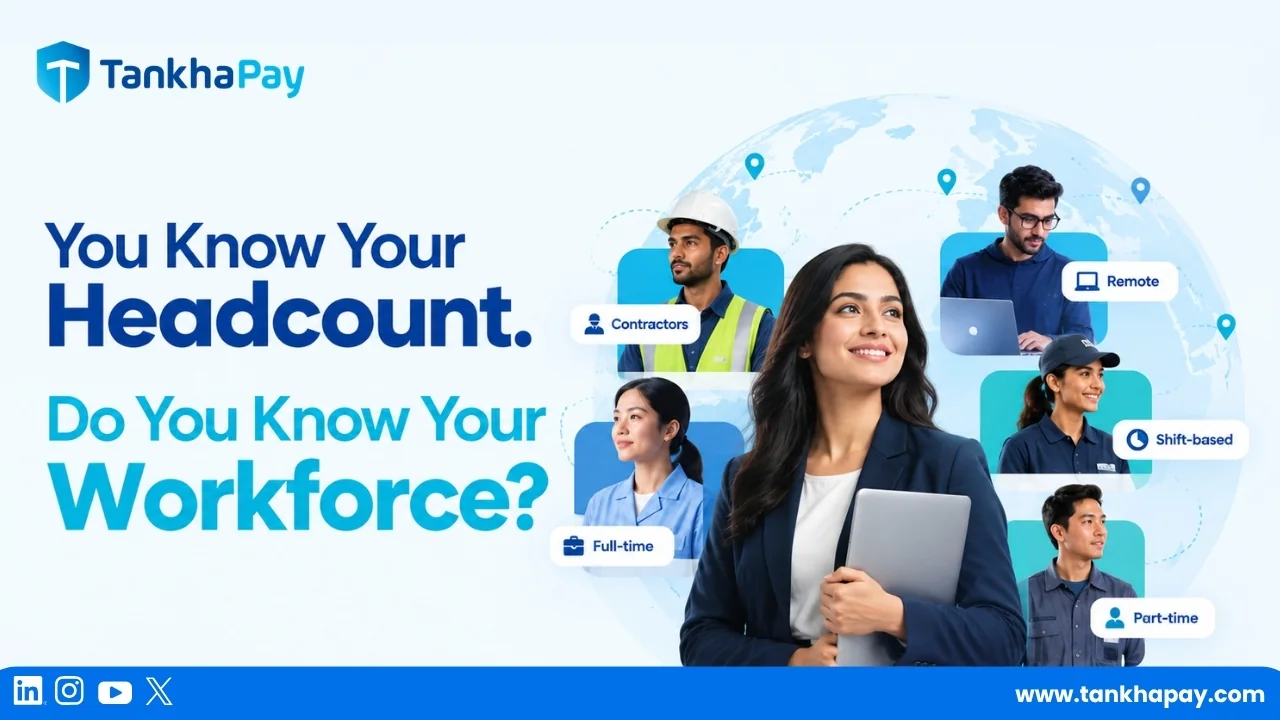
- WHAT: What type of worker are they: employee, contractor, contingent, remote, field, or shift-based? The answer changes what obligations, costs, and risks come with them.
- COST: What does the workforce actually cost, broken down by entity, location, and worker type, not blended into one number that hides where the cost is really coming from?
- CHANGE: Who joined, left, transferred, or changed status, and when?
Go back to the questions at the start of this piece, how many contractors, which entity, what changed since last quarter, and each one maps to exactly one of these five. That's not a coincidence. Those are the questions leaders get asked precisely because WHO, WHERE, WHAT, COST, and CHANGE are the actual dimensions of a workforce, and most systems today only answer one or two of them well.
None of this needs exotic technology. It needs the workforce treated as one connected system instead of a collection of records that happen to describe people.
The pattern behind the better model
Organizations that get this right don't necessarily have simpler structures. They've stopped treating workforce data as something each unit manages locally and started treating it as one asset that HR, finance, and operations all draw from, without five spreadsheets standing between them.
Given that the labor force is dispersed across entities, locations, and employment systems, the representation of such a labour force would have to be equally complex and would need to address all five questions together and not in separate reports from five different sources.
TankhaPay is a global HRMS built as that kind of system, bringing employee records, payroll, compliance, roster management and organizational structure into one platform so multi-entity, multi-country operations can see their workforce as one picture instead of a patchwork of local ones. Because every worker, shift and entity sits in the same record, headcount planning and workforce forecasting run on the actual workforce rather than on a count reconstructed from five spreadsheets. It's backed by Akal Information Systems' 26+ years of experience in HR, payroll, and compliance and built on ISO 27001, ISO 9001, ISO 20000, and ISO 14001 certifications, alongside a CMMI Maturity Level 5 appraisal.
Curious how this shows up in your own organization? Drop a comment, we'd like to hear where the gap actually bites hardest for you.
Sources: Gartner, survey of 1,403 HR leaders, July 2024, reported October 2024. Deloitte Insights, "Bridging the management gap," March 2023, citing MIT Sloan Management Review research, May 2022, including the Cisco example.
Does this change anything in your own payroll setup?
Our team can review your current payroll and compliance process against the rules covered in this edition. You get a clear view of where you stand, with no obligation to switch anything.