
In this edition
- India Is No Longer Just a Talent Source. It's a Talent Hub.
- How Global Talent Mobility Is Actually Changing
- Growth Is Rising. But So Is the Complexity of Moving People.
- Hiring global talent is one thing, making it work is another
- The Shift Smart Organisations Are Making
- Compliance in Global Mobility Isn't Back-Office Work. It's Business-Critical
- What Mobility Leaders Should Be Watching
- The Shift Smart Organisations Are Making
- TankhaPay's Perspective
- Final Thought
India's talent market just had its strongest year in three years. Naukri's JobSpeak Index closed FY26 at +8% annual growth, up from just +2% in FY25. The AI/ML segment alone grew +45% year-on-year. Hiring intent for Q2 2026 has hit a record 68%, the highest net employment outlook ever recorded for India by ManpowerGroup.
But here's what most reports don't tell you.
It’s not simply the amount of talent that is produced. It’s about where that talent needs to go, how quickly organisations can move it, and how few companies are actually built to do that at scale.
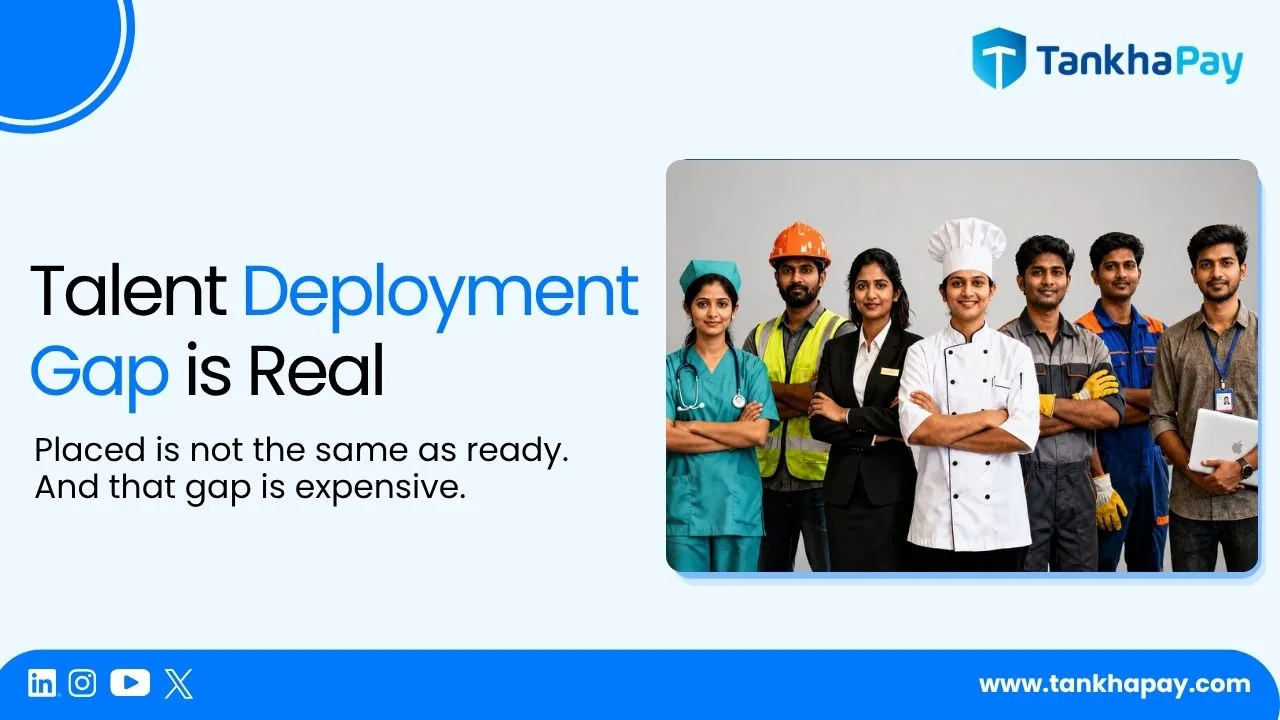
Global talent mobility doesn't fail at identifying people. It fails at deploying them.
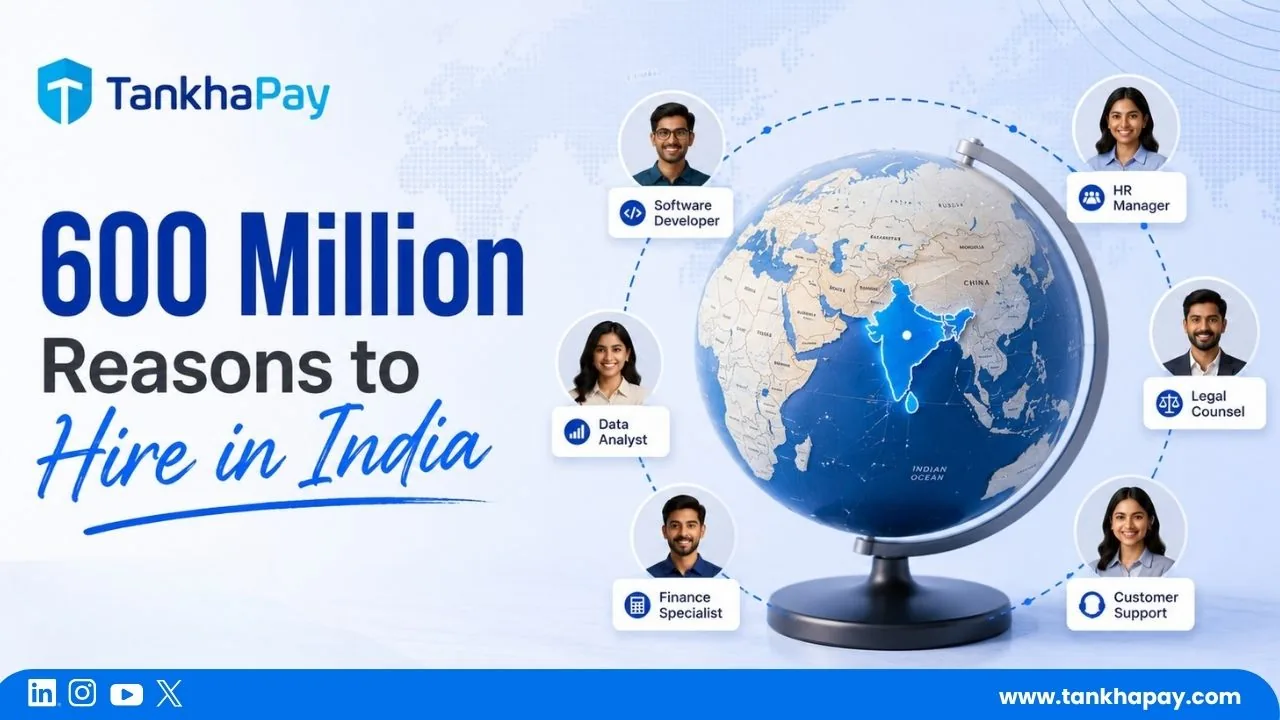
India Is No Longer Just a Talent Source. It's a Talent Hub.
2025 was the year global talent flows fundamentally changed.
Nearly 50 Global Capability Centres were established in India in just the first six months of the year. Cities like Bengaluru, Hyderabad, Pune, and NCR are no longer just delivery locations, they are origin points for globally mobile professionals.
By 2026, there will be 4.25–4.5 lakh new jobs in the GCC, and by 2030, that number could reach 1 million. There are already more than 2.4 million people working in the GCC, and many of them are eligible for cross-border assignments, rotational roles, and permanent relocations.
The conversation has shifted. Global organisations are no longer asking: "Can we find talent in India?"
They're asking, "How do we move the right talent to the right market at the right time?"
How Global Talent Mobility Is Actually Changing
The mobility landscape is evolving fast and not always in predictable ways.
Capability is outpacing credentials. Close to 80% of businesses now prioritise skills over qualifications. Yet only 16% of IT professionals carry relevant AI skills, and over 50% of AI/ML roles globally remain unfilled. This gap isn't a hiring problem it's a mobility problem. The talent exists. It's just not where the demand is.
AI is in the process, but not in the decisions. About 87% of AI is used in some part of the hiring or onboarding process. But it mostly just helps with filtering resumes. It still takes a lot of manual work to figure out if someone is ready to move, when their visa will be ready, or if they are following the rules for moving across borders.
Tier-2 cities are becoming mobility origin points. Not just metro hires, but also professionals from Coimbatore, Jaipur, and Surat are becoming more and more part of global talent pipelines. Companies that don't pay attention to this area are missing out on a lot of talented people who could work for them.
Time-to-mobility is a real business constraint. It can take 4 to 9 months to move talent across borders, taking into account visa processing, relocation, notice periods, and compliance. That's not a delay for businesses that need to fill important global positions. It's a risk to the business.
Growth Is Rising. But So Is the Complexity of Moving People.
One of the most underestimated realities in global talent mobility is structural friction.
Attrition in India's tech sector sits at 18–22% annually. 60% of open roles are replacement roles, not new ones. Organisations aren't just moving talent to grow, they're moving talent to maintain continuity across time zones, functions, and geographies.
And every time a cross-border move stalls, a business somewhere loses momentum.
Hiring global talent is one thing, making it work is another
India has the best potential for mobility:
2.5 million graduates in science, technology, engineering, and maths each year
There are more than 126,000 AI experts working for Fortune 500 GCC companies.
A workforce that is already in sync with global business models, languages, and time zones
The intent to mobilise this talent is strong. But execution is where things slow down.
Moving across borders means dealing with entity readiness, immigration compliance, tax equalisation, social security agreements, relocation support, and local labour law in more than one jurisdiction at the same time. Most HR teams aren't set up to handle this from start to finish.
| Stage | What Companies Plan | What Actually Happens | Business Impact |
|---|---|---|---|
| Identification | Find the right candidate | Mobility eligibility unknown | Wrong talent selected |
| Visa & Immigration | Simple process | Timelines slip by months | Role stays vacant |
| Relocation | Smooth transition | Gaps in support cause drop-offs | Talent walks away |
| Compliance | Handled locally | Multi-jurisdiction errors emerge | Legal and financial exposure |
| Productivity | Day 1 readiness | Ramp-up delayed weeks or months | Slower business impact |
This is not a talent problem. It's a mobility execution problem.
The Shift Smart Organisations Are Making
Leading companies are no longer treating mobility as a reactive, case-by-case process.
They're building mobility infrastructure that enables them to:
Assess cross-border readiness before a role is even open
Move talent within weeks, not quarters
Stay compliant across origin and destination markets simultaneously
Turn relocated employees into productive contributors from day 1.
Faster mobility. Lower risk. Better alignment with how global business actually operates.
Compliance in Global Mobility Isn't Back-Office Work. It's Business-Critical
This is where most organisations underestimate the problem.
Moving talent across borders isn't just a logistics exercise. Every international assignment or relocation involves:
Permission to work and following the rules for visas
Tax residency and equalisation
Managing social security treaties
Structures for splitting payroll
Obligations of host-country labour law
And it gets even more complicated when talent moves to different places in the same year. A company that follows the rules in one area may not be safe at all in another.
These aren't administrative details. They create real financial and legal risk and they directly affect whether talent chooses to move at all.
What Mobility Leaders Should Be Watching
Three forces that are currently transforming talent mobility worldwide:
Changes in immigration policies, which affect assignment planning periods
New tax and social security agreements, which require compliance
Changing employee needs for relocation assistance
It's not a matter of preparing for the future. It is the present reality.
The Shift Smart Organisations Are Making
They're moving them smarter. They understand that:
Mobility and compliance are not two distinct processes, they are one
Speed is not only an operational aspect but also the main reason for talent retention
Talent is not of any value in the offer phase but when productive and compliant in the destination market
Because in global mobility, a move doesn't begin with a visa application.
It begins with execution readiness.
TankhaPay's Perspective
The organisations winning at global talent mobility today aren't just better at moving people. They're better at execution.
They no longer treat mobility as a standalone HR function. They treat it as a business-critical system that combines speed, compliance, and cross-border readiness, from the moment a move is planned to the moment an employee is productive in their destination market.
At TankhaPay, we understand that:
Mobility and compliance are not separate workflows, they are the same process, running in parallel across origin and destination markets
Speed isn't just operational efficiency; it is a direct driver of whether top talent accepts a move or walks away
Talent isn't valuable at the relocation offer stage, it's valuable when it's compliant, settled, and contributing from Day 1
Because in global talent mobility, a successful move doesn't begin with a visa application or a relocation package.
It begins with execution readiness. And the organisations that get this right don't just move talent faster.
They scale globally, faster.
Final Thought
India boasts one of the best pools of internationally deployable talent. There is no greater demand for this talent pool than there is today in Europe, the Middle East, and Southeast Asia.
But access is no longer the advantage. Execution is.
The organisations that win won't be the ones with the largest mobility budgets. They'll be the ones who can:
Find mobility-ready talent early
Move people quickly and compliantly
Help them through every step of the change
Make relocation a retention and growth strategy, not a cost centre.
Because in today’s talent landscape:
Speed is the strategy. Execution is the differentiator. Compliance is the infrastructure.
The real question is no longer "Should we build a global talent mobility programme?"
It's "How quickly can we do it right?"
Does this change anything in your own payroll setup?
Our team can review your current payroll and compliance process against the rules covered in this edition. You get a clear view of where you stand, with no obligation to switch anything.