In this edition
- The Opportunity Is Bigger Than You Think
- The Problem Nobody Talks About
- What Deployment-Readiness Actually Means?
- Why Is Certification Not the Same as Readiness?
- Who Actually Pays When an International Hire Goes Wrong?
- What Structured Pre-Departure Training Actually Changes?
- This Is Where TankhaPay Comes In
- Stop Thinking About Hiring. Start Thinking About Readiness
"Global employers spend $15,000–$30,000 per international hire on recruitment alone, before a single flight is booked. Most never ask the one question that determines whether that investment pays off: Is this candidate ready to work in their destination country, or just ready to travel?"
Every year, thousands of Indian professionals board flights to Japan, the UAE, Germany, Saudi Arabia, and Southeast Asia with a job offer in hand and a visa approved.
The recruitment firm marks the hire as a success. The employer onboards a new team member. And then, quietly, reality sets in.
Breakdown in communication during the first 90 days. Failure in productivity that does not get fixed. Employees who quit after just a year in the job. Companies that discreetly discontinue hiring talent not because they are incompetent but because the process through which they were sourced wasn’t meant for preparing them.
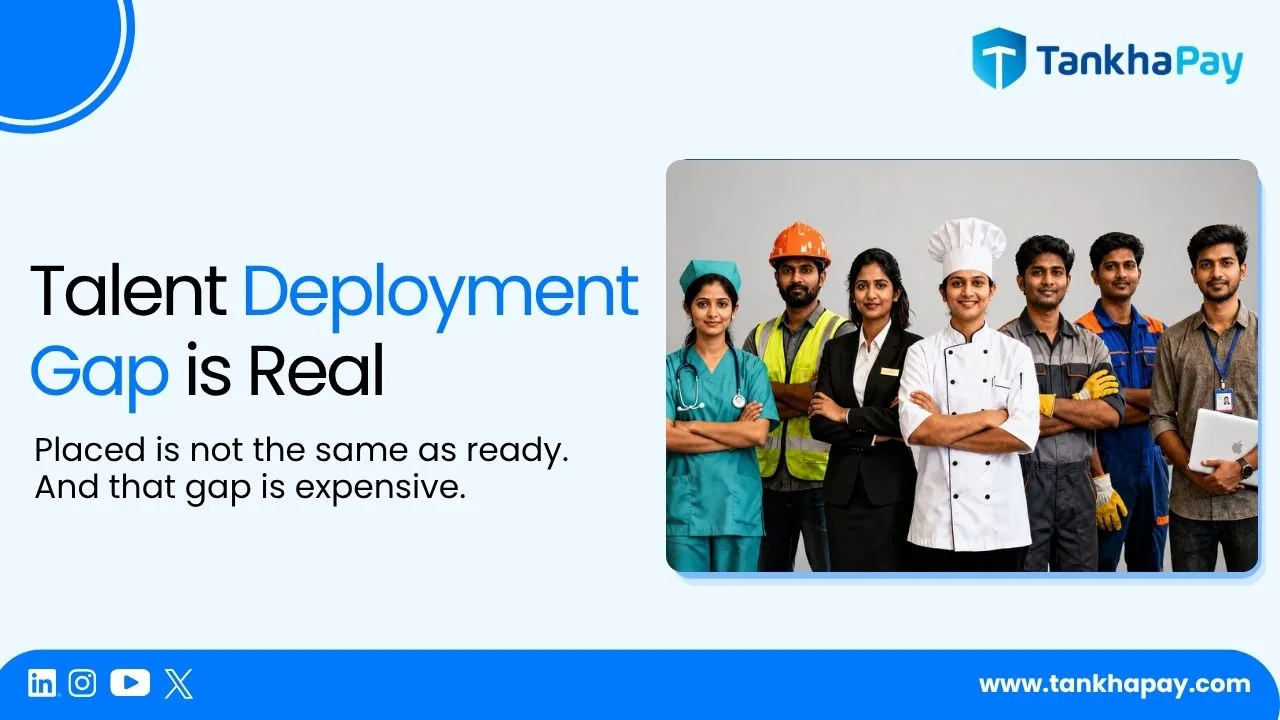
This is what we call the Deployment Gap. And the numbers suggest it is costing everyone, employers, workers, and the broader ecosystem of talent global mobility, far more than most HR and business leaders realise.
The Opportunity Is Bigger Than You Think
Before examining the problem, the scale of the opportunity needs to be understood.
As of 2024, at least 18.5 million Indians were working overseas, with these workers collectively sending home a record $129.4 billion in remittances, quietly underwriting India's economic stability. Japan has committed to accepting 50,000 Indian workers annually through its August 2025 Action Plan. Germany has raised its skilled worker visa quota for Indians under the 2024 Skilled Immigration Act. India has now signed labour mobility agreements with over 20 countries across Europe, Asia, and the Gulf since 2014.
The opportunity pipeline has never been bigger or more formally structured.
Yet against this backdrop is a stubborn, uncomfortable statistic that almost nobody in the mobility industry discusses openly: the international assignment failure rate has stayed at 30-40% for more than four decades, according to INSEAD research drawn from multiple workforce studies. That number rises to 70% in postings in developing countries.
KPMG and International SOS conservatively estimate the direct cost of a single failed international assignment to be anywhere from $250,000 to over $1 million. The annual losses from expat failures at US companies alone are estimated at $2 billion. And critically, technical skill gaps are almost never the root cause of failure.
They are adaptation failures.
The Problem Nobody Talks About
The global mobility industry has invested enormous energy in one question: how do we get talent from Point A to Point B faster?
Visa processing timelines. Documentation checklists. Attestation workflows. Faster employer matching. These are truly important. The industry has gotten better at all of them.
But almost nobody has invested comparable energy in a different question: what happens after the candidate lands?
According to INSEAD's research on expatriate failure, the five primary reasons international assignments fail are:
Inability to adapt to the new culture
Lack of support from the local organisation
Personal or family adjustment problems
Inadequate pre-departure preparation
Skills mismatch with the actual role requirements.
Technical skill gaps are not on that list.
The candidate passed the technical interview. Their skill was never the issue. The issue is that skill and deployment-readiness are not the same thing, and the industry has largely chosen to measure one while ignoring the other.
What Deployment-Readiness Actually Means?
The term gets used loosely, so it is worth being precise.
A deployment-ready candidate is not simply someone with the right qualifications for a role. They are someone who has been prepared, deliberately and systematically, to perform in a specific country's work environment from Day One.
That preparation has four non-negotiable layers:
Language proficiency, not simply conversational English, but the exact language required in the host country at the professional standard needed for the job. The Japanese caregiving position requires a JLPT N4 qualification in Japanese. The German construction supervision position requires A2 proficiency in German. The UAE hospitality position requires proficiency in workplace Arabic. Language is the foundation for the day-to-day tasks involved.
Cultural orientation, understanding how decisions get made, how hierarchy functions, how feedback is given, what workplace punctuality means in that country, and how to express disagreement without creating conflict. These are entirely learnable skills. But only if someone takes responsibility for teaching them before the flight, not after.
Role-specific skill validation, ensuring that the credentials of the applicant are in line with both a job description and the operational reality at the destination firm. For example, a welding professional who possesses a certificate from India must be made aware of whether or not his/her certification will be honoured in Germany. The same is applicable for a healthcare provider working in Japan.
Compliance and documentation literacy, the candidate should understand their own rights, their visa conditions, their employment contract, and what to do if something goes wrong. This protects both the worker and the employer and reduces the HR escalations that erode employer confidence over time.
None of this is exotic. All of it is teachable. The question is simply whether anyone has taken responsibility for doing it.
Why Is Certification Not the Same as Readiness?
This is the point that surprises most employers when they first encounter it.
A candidate can be certified, they hold the qualification, the diploma, and the skill verification and still not be deployment-ready. Because certification answers the question "Can they do the job?" while deployment-readiness answers a different question: "Can they do this job, in that specific place, for that specific employer, on Day One?"
Consider two candidates with identical welding certifications being placed at a manufacturing facility in Japan.
Candidate A has completed a structured pre-departure programme. They have basic Japanese (JLPT N5). They understand that Japanese workplaces value quiet competence over vocal self-promotion. They know the safety protocol terminology used in Japanese manufacturing. They have read and understood their employment contract.
Candidate B has the same welding certification, but no language preparation, no cultural orientation, and minimal documentation literacy.
Both candidates qualify on paper. The employer's experience of them will be completely different, in productivity in the first quarter, in manager friction, and in whether they are still there at the 12-month mark.
This is not hypothetical. It has been found consistently through research that while 97% of the employees who were given coaching before deployment performed well, 35% of those who had not been coached performed badly.
Who Actually Pays When an International Hire Goes Wrong?
When an international placement fails or underperforms, the cost is distributed across three parties, and very few of them are talking to each other about it.
The employer pays for the entire relocation, including visa fees, travel, lodging, and onboarding time. If the new hire doesn't do well, the employer also loses productivity. In industries with tight margins, like hospitality and manufacturing, a failed international hire can cost three to five times the annual salary of the job. When a company in Silicon Valley had a 35% failure rate for expats, each early departure cost an average of $185,000, which added up to more than $4 million in losses each year.
The worker often carries personal debt from relocation costs. In cases of unsuccessful placement, or if the environment does not match the expectations of the worker, the result is disastrous: the worker is placed in an unknown environment, unable to express himself, without an escape plan.
The ecosystem suffers quietly. Employer perception of Indian talent erodes. Bilateral mobility corridors become politically difficult to expand. Policymakers face pressure to restrict programmes. The failure of unstructured placement makes structured, well-prepared talent pipelines harder to build for everyone, at exactly the moment when bilateral agreements are creating the most favourable conditions in decades.
What Structured Pre-Departure Training Actually Changes?
Employers reporting the most consistent success with Indian international talent are not necessarily those who pay the most or hire the most. They are the ones who have a training-first partner, not a placement-first partner.
The practical difference is measurable. According to findings from studies conducted on expatriation programmes, expatriate failure rates dropped by as much as 64% in organisations that instituted pre-departure coaching programmes. Job performance improved by 60% in six months among individuals who underwent pre-deployment training. Every dollar spent on pre-deployment preparation yields a profit of $4.
Language-trained candidates are productive in the first week, not the first quarter. Culturally adept workers can navigate the hierarchy of the workplace effectively from the start, avoiding friction with managers. Documentation-smart workers know their contract and HR escalations are reduced. Employees realistically prepared for transfer experience less psychological attrition and stay longer.
This is not a soft argument about worker welfare, though that matters enormously. It is a hard commercial case about the return on an investment that most CHROs and CFOs have already approved the moment they signed the international hiring budget.
This Is Where TankhaPay Comes In
Most mobility companies are set up to handle the transaction: find the candidate, process the visa, and fill the seat. TankhaPay operates as a full deployment-readiness partner, which is a big difference in practice, not just in words.
With 26 years of experience in labour management through Akal Information Systems, TankhaPay addresses all stages of the employee life cycle:
Candidate screening and pre-qualification
Structured language and cultural training
Role-specific skills validation
Full visa facilitation and attestation
Post-placement support even after the flight lands.
The methodology is tried and tested with real placement results and not just in a brochure, with over 1,500 trained candidates and partnerships with 200+ global employers in Japan, the UAE, Saudi Arabia, Germany and Southeast Asia.
Stop Thinking About Hiring. Start Thinking About Readiness
The global talent shortage is real. India's Overseas Mobility Bill (2025) signals a paradigm shift from being a passive observer of its workforce dispersing to an active negotiator of the terms of its mobility. The formal infrastructure for structured global placement is more mature than it has ever been with bilateral agreements now in force with 20+ countries.
But opportunity without structure is movement. And movement is not the same as mobility.
Before your next hire from India, the most useful question to ask your mobility partner is not: "How quickly can you get this candidate here?"
It is: "What have you done to make sure this candidate will actually work, in my country, in my environment, on Day One?"
The answer to that question tells you everything about whether you are working with a placement firm or a deployment partner.
If you are planning an international hiring programme and want to understand what the deployment-readiness process looks like in practice, including how it reduces first-year attrition and employer escalations, the conversation starts at www.tankhapay.com or +91-9891988811.
Does this change anything in your own payroll setup?
Our team can review your current payroll and compliance process against the rules covered in this edition. You get a clear view of where you stand, with no obligation to switch anything.