In this edition
Your legal risk did not change. What changed is the paperwork that proves it. That's the part to read.
On 29 June 2026, the government brought in a new rule book for provident funds: the Employees' Provident Funds Scheme, 2026. It sits under the Code on Social Security, 2020. It replaces the 1952 Scheme, which had run PF in India for more than 70 years.
Most people read the summary and stopped there. That's fair, because the main numbers stayed the same.
Employer and employee still pay 12% each. (Some establishments the government has specially listed pay 10%.) The wage ceiling is still INR 15,000 a month. Old accounts, balances, UAN numbers and service records all carry over on their own. Nobody has to sign up again.
The Scheme also states clearly that PF on wages above INR 15,000 is voluntary for the employer and the employee both. That isn't really new either. Ajay Singh Solanki, Partner at AZB & Partners, points to the Supreme Court's decision in Marathwada Gramin Bank v. Management of Marathwada Gramin Bank Employees Union, which had already settled that employer contributions above the ceiling are optional. The Scheme just puts it in writing.
Worth doing one thing about it now: show voluntary PF as a separate line in your CTC breakdown, because employees can raise it, lower it or stop it depending on whether they want more salary in hand or a bigger retirement fund. And budget for the extra administrative charges you pay on wages carrying voluntary PF.
So on the face of it, there was nothing urgent to do.
But one thing did change. And if you use contract workers, it lands on you.
What changed for contract workers?
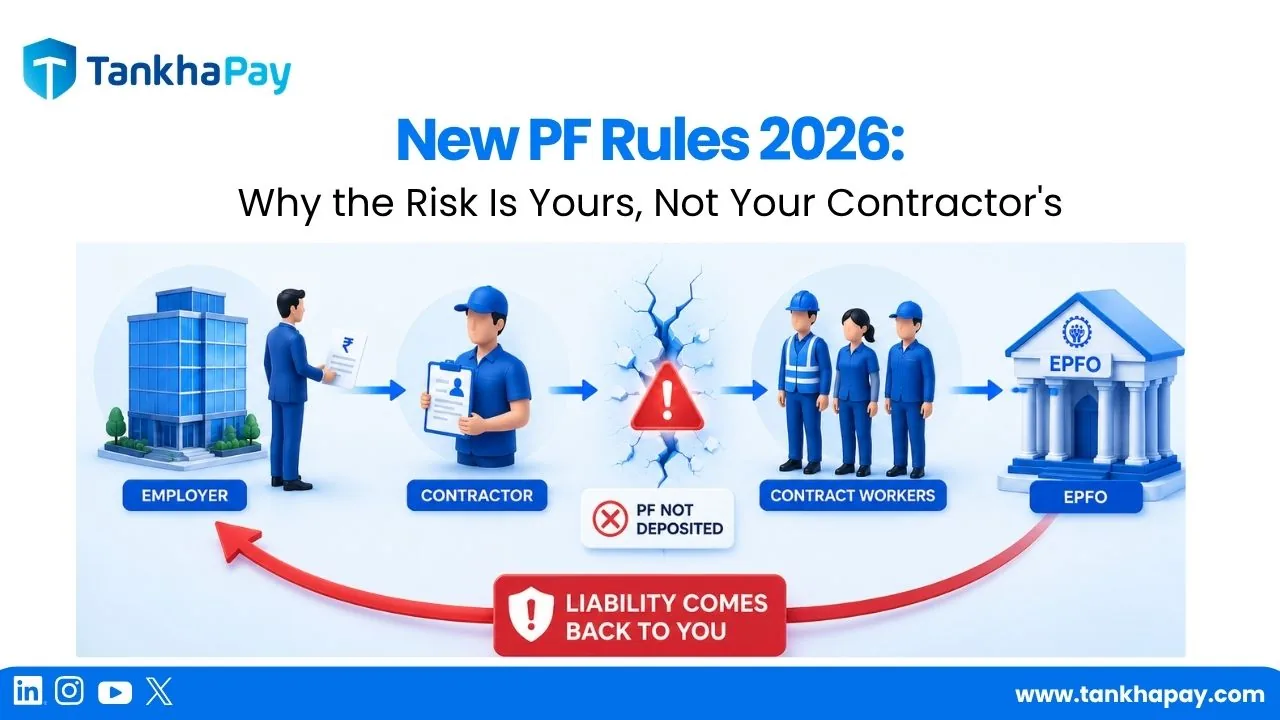
First, what did not change. Your legal risk is exactly where it was. Under the old rules and the new ones, if a contractor doesn't deposit PF, the principal employer pays for it. That was always true.
What's new is the paperwork built around it. Solanki calls it a structured reporting system. It runs on three forms.
Form X is yours. You list every contractor you have hired on the EPFO portal.
Form XI is your contractor's. Within 10 days of each month ending, they must send you the name, UAN, wages, and PF amount due for every contract worker they have placed with you. It has to be sent electronically.
Form XII comes back to you. Within 20 days of the month ending, you file a monthly summary with the Commissioner. It shows the total PF cut from contract workers' wages and the total employer share.
Why does this matter more to you than to your contractor?
Because the thing that used to protect you is being taken away.
Solanki explains that employers often got into trouble during EPFO inspections for a simple reason: they did not have full records showing whether a contractor had paid PF for each worker. No record meant nothing to find. That missing record was working like a shield.
Sowmya Kumar, Partner at Cyril Amarchand Mangaldas, points out that the new forms link each contractor to the principal employer who hired them. That means officials can compare what you filed against what your contractor filed. She expects tighter checks and stronger enforcement as a result.
Minu Dwivedi, Partner at JSA Advocates & Solicitors, reads it the same way. You now get much better visibility into whether your contractors are paying. You also carry much more responsibility for it.
In plain terms: your contractor's PF gap was always your problem. Now it is your problem in writing; on a form an officer can hold up next to another form.
Which contractors are the bigger risk?
Your contractors are not all in the same position.
If a contractor is not registered with EPFO on their own, then you handle their workers' PF directly. Calculating PF, deducting it, and depositing it. All of it is your job, not theirs.
If the contractor is registered but fails to pay, EPFO comes to you for the money. You then have to get it back from the contractor separately. That is not an easy conversation six months later.
Either way, it comes out of your pocket. The only difference is whether you find out at the start or at the end. So pull up your vendor list this week, staffing, security, housekeeping, facilities, transport, and check each name's registration status.
Can a spreadsheet handle this?
Say you have fifteen contractors and four hundred contract workers between them.
Every month you have to chase Form XI data from fifteen different parties within 10 days. Then check it against what you think was actually deposited. Then roll it into your Form XII summary. Then file before day 20.
Do that on email and spreadsheets, and three things go wrong.
You lose sight of problems, because a missing deposit stays invisible until an inspection finds it. You lose the matching, because comparing hundreds of records contractor by contractor and worker by worker stops being spreadsheet work very quickly. And you run out of time, because filing late now costs INR 500 a day. That amount is capped at the month's administrative charges, which sounds small, but the late filing itself goes on your record.
Solanki's wider point is that the labour codes have always tried to reduce paperwork by moving it online, and the 2026 Scheme continues that by building on the existing Shram Suvidha system. Whether it actually feels easier, he warns, depends on how well it is put into practice.
Already have gaps? One window shuts on 31 October
However, before you make your process in the future, you might have certain gaps that need to be filled. There are three opportunities available for you at present.
The "Employees' Enrolment Drive" allows you to enrol your employees who have been employed from 1st April 2009 till 31st March 2026 and have never been enrolled under EPFO. The damage fee for this opportunity is fixed at INR 100 per establishment irrespective of the percentage-based rate, and that will satisfy your requirements for EPF, EPS and EDLI. The deduction on behalf of the employee is forgone if you have not made any.
Two conditions catch people out. You have to generate a face-Authentication UAN through the UMANG app for every employee you declare and send it through an Electronic Challan-cum-Return. So this is not a paperwork-only exercise, and it takes longer than a week. Also, any declaration made through misrepresentation is cancelled from the start. Declare honestly or don't declare.
That window closes on 31 October 2026.
Parallel to this, there are two other schemes which have come into operation. The Vishwas 2026 scheme deals with outstanding penalty notices and any defaults that may be occurring prior to 14 June 2024. The Amnesty 2026 Scheme is for companies administering recognised PF Trusts without an official exemption from the EPF Act.
Take all three to your legal team before they close, not after.
So how do you actually keep track of all this?
Closing old gaps is a one-time job. Staying clean from here is a monthly one, and that is the harder part.
Look again at what the scheme asks of you. Know every contractor you have engaged. Receive worker-level data from each of them inside 10 days. Check that data against money that was actually deposited. Roll it into one filing and send it inside 20 days. Then do it again next month, and the month after that.
Notice what that really is. It is a system where your compliance depends on information that you do not own, provided by people whom you have no control over, concerning payments that you cannot monitor. That is the true issue at hand.
There are two ways to close that distance, and most companies need both.
Get the data under one roof. TankhaPay is designed for enterprises whose payroll, PF, and contract worker management is done using a single software platform, as opposed to having everything spread out through multiple vendors and e-mails.
Shrink the exposure itself. This is what most businesses tend to overlook. Each one of the contractors who work for you is a stakeholder whose PF deposits you need to take on faith and verify subsequently. The TankhaPay system is a System of Record in which employees can be hired via a third party where PF, ESI and other statutory filings are made internally and not guaranteed by any vendor. This way, there is no need for a Form XI and nothing for you to verify. There is no possibility of a default at all.
Most enterprises will run a mix. Keep the vendors that work, get real visibility on them, and move the workers carrying the most risk onto ground you control.
None of this removes the human. Automate the tracking, and keep one named person accountable for the filing. AKAL Information Systems has spent 26 years on payroll and statutory compliance in India, which is the kind of depth that matters when a regulator is holding one of your filings up against another. CMMI Level 5, ISO 9001, ISO 20000 and ISO 27001 certified, with a registered presence in pan-India.
The bottom line
The 2026 Scheme did not restart the old arguments about rates, ceilings or who is liable. What it did was make compliance continuous, written down, and easy for a computer to check.
The gaps that manual payroll used to hide are exactly what this system was built to find.
So find your contractor gaps before 31 October. Or find out how the regulator does it.
Does this change anything in your own payroll setup?
Our team can review your current payroll and compliance process against the rules covered in this edition. You get a clear view of where you stand, with no obligation to switch anything.