In this edition
This is not a compliance update. This is a warning.
If you are a business owner, a founder, a CFO, or an HR leader in India and you have even a single employee on your payroll, what you are about to read is directly relevant to you. Not theoretically. Not eventually. Right now.
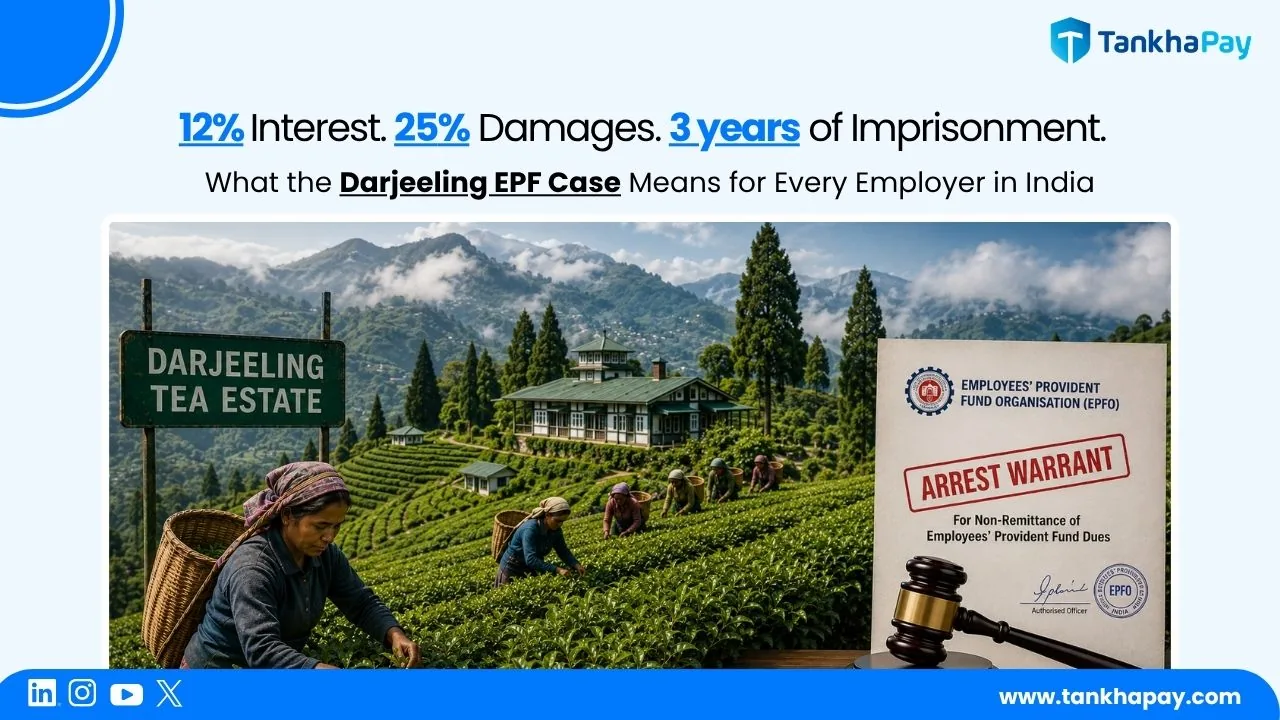
First: The director of Darj Tea Estate in Darjeeling was issued an arrest warrant by EPFO for non-remittance of employees' Provident Fund dues.
Second: On May 13, 2026, Central Provident Fund Commissioner Ramesh Krishnamurthy announced at an ASSOCHAM event that the EPFO is launching a Risk-Based Digital Inspection System. A technology-driven compliance engine that will profile every registered establishment in India and flag defaulters automatically, without any human intervention.
One is a consequence. The other is the system being built to deliver more of those consequences, faster, at scale, to every corner of the country.
Let's talk about both. And let's talk about what it means for you.
An Arrest Warrant in Darjeeling Sends a National Warning to Employers
The Darjeeling hills have around 87 operational tea gardens spread across approximately 19,000 hectares of land. These estates collectively employ about 52,000 permanent workers and an additional 15,000 contract workers during the peak plucking season. These are some of India's most economically vulnerable workers that have seasonal income, physical labour, remote locations, and minimal savings. Their EPF contributions are often the only financial safety net they have.
When an employer has made PF deductions for his employees and yet the said amount never gets credited to the EPFO, then the bottom line is that the employees' pension accounts become unfunded. Their promises become nullified. Their future becomes robbed quietly. This is not a matter of documentation. This is an act of betrayal against them.
EPFO's response to the Darj Tea Estate case was not a letter. It was not another notice. It was an arrest warrant, issued under the powers granted to EPFO by the EPF & MP Act, authorising the police to physically execute the order. The director would be produced before the recovery officer and released only after depositing the full dues on the spot.
Here is what makes this case a signal, not an anomaly:
This is exactly how EPFO has been escalating enforcement across the country, steadily and systematically. In Faridabad and Palwal alone, 70 companies were issued arrest warrants in a single financial year, and INR 6.16 crore was recovered as a direct result. Of that, five major defaulters paid INR 1.70 crore only after the warrants were executed.
In the same recovery drive, 120 bank accounts were frozen. Another crackdown saw 37 FIRs registered against 29 companies of both the districts under Sections 406 and 409 of the Indian Penal Code for criminal breach of trust and dishonest misappropriation of property. These are not civil penalties. These are criminal charges that follow directors personally, that show up in background checks, that can end careers and destroy reputations.
And this was before the digital system.
EPFO's New Digital Surveillance System
For a long time, EPF enforcement in India had a structural vulnerability:
It depended on human enforcement officers who had to physically visit establishments,
who worked within limited jurisdictions, and
whose decisions were inherently discretionary.
A clever employer could delay, negotiate, or, in some cases, simply outlast the process. This is the reality that many businesses knowingly or unknowingly built their compliance posture around.
That model is being dismantled.
At the ASSOCHAM National Conference on May 13, 2026, CPFC Ramesh Krishnamurthy announced the incoming Risk-Based Digital Inspection System in terms that should be read very carefully by every employer in India:
"The new inspection schemes are purely going to be risk-based and based on thorough analysis. They will assess the risk posed to the organisation by non-compliance. The system will quantify the risks arising from non-compliance, and establishments will be selected for inspection based on the level of risk identified."
Let's break down what this actually means in operational terms.
Data profiling at scale. EPFO will build risk profiles for every registered establishment using historical compliance data, your ECR filing history, your contribution patterns, gaps between deductions and deposits, delayed payments, and unresolved notices. This data already exists. EPFO has been collecting it. The new system organises it into a risk score.
Cross-dataset linking. Labour Secretary Vandana Gurnani confirmed that the system is being built by linking EPFO's datasets with data from other government databases. What does that mean? It means inconsistencies between your EPF filings, your GST returns, your income tax records, and your payroll reported to different agencies all of it can be cross-referenced. If you report 200 employees to one authority and 80 to another, the algorithm notices.
No more discretionary inspections. The old model, where an enforcement officer chose which establishment to visit and where relationship, geography, or luck played a role, is being replaced by algorithmic selection. The system identifies risk. The system decides who gets inspected. "The primary focus will be on facilitation, with the first step being to request compliance and guide firms to comply. Only after repeated non-compliance or reluctance to comply will there be an inspection," Krishnamurthy said.
Web-based, electronic enforcement. Physical visits will become the exception, not the rule. Inspections will largely be conducted digitally, through electronic records and web-based systems. The new Labour Codes have already redesignated enforcement officers as "inspector-cum-facilitators", a dual role that combines compliance guidance with violation detection. The codes explicitly enable web-based inspections and computerised inspection systems.
Self-compliance as the cornerstone. Labour Secretary Gurnani was emphatic: "The overarching principle of the new framework will be self-compliance." EPFO is signalling that the era of reactive enforcement is giving way to a system where your compliance posture is continuously monitored and gaps are flagged before they escalate or precisely when they escalate.
Know These EPF Deadlines, Penalties and Legal Risks
Let’s get this straight: insufficient awareness of "EPF compliance" is not enough. Here are the exact numbers that govern your obligations and your exposure:
Your mandatory contribution: Every employer is required to contribute 12% of basic wages + dearness allowance + retaining allowance from the salary of the employee as EPF, with an equal contribution of 12% from the employer. That’s 24% of basic wages going into EPF every month, half deducted from the employee and half borne by the employer.
Your deadline: Contributions must be deposited with EPFO by the 15th of the following month. The Electronic Challan cum Return (ECR) must be filed by the 25th of the following month. Miss either, and you are in default even if the amount is fully deposited later.
The penalty escalation:
Section 7Q: Interest at the rate of 12% per annum on the amount due, from the date of default. This starts immediately, not when EPFO notices but when you miss the deadline.
Section 14B: Damages ranging from 5% to 25% per annum, depending on the default period length. If it is overdue by more than 4 months, that's 25% per annum damages on top of the principal and interest.
Section 8B & 8G: EPFO can issue a warrant of arrest against the employer. Police are authorised to execute the warrant.
Sections 406 / 409 IPC: Criminal breach of trust and misappropriation. If you deducted PF from employee salaries and did not deposit it, you have, in the eyes of the law, taken money that was never yours and used it for something else.
Section 14 of the EPF Act: Wilful default or making false statements is punishable with imprisonment of up to 3 years and/or a fine.
Property attachment: EPFO can attach and sell the property of defaulting companies. Bank accounts can be frozen. Payments owed to your company by third parties can be redirected to EPFO.
And the most important thing to understand about this escalation path is that it is not sequential in the way most people think. Businesses think they’ll get a notice, then a demand, then a warning, then maybe something serious. In reality, EPFO can quickly move from issuing a notice to getting an arrest warrant, particularly once the new digital system flags your establishment as high-risk and a record of repeated non-compliance is on record.
The Three Dangerous Assumptions
There is a dangerous assumption that runs through many Indian businesses, especially in sectors like plantations, textiles, construction, hospitality, and MSMEs: "EPFO is too slow and too overwhelmed to come after us specifically."
This assumption has three parts, and all three are collapsing simultaneously.
"We're too small to matter." The Faridabad-Palwal recovery drive issued warrants against 70 companies. Not 70 large corporations. Small units, local businesses, and companies that assumed they were below the radar. The new risk-based system does not have a size threshold. Your ECR data is in EPFO's system whether you have 20 employees or 2,000.
"We can negotiate our way out." Negotiations happen in the notice phase and demand phase. Once a warrant is issued or the new system flags you as a repeat defaulter, the window for facilitation is closed. Krishnamurthy was explicit that inspections come after "repeated non-compliance or reluctance to comply." It is no longer a strategy to be difficult to reach.
"We'll deal with it when it becomes a real problem." For the Darj Tea Estate director, it already is a real problem. For the 29 companies that faced FIRs in a two-district crackdown, it is a real problem. The average employer who receives an EPF demand notice and files it away is accumulating interest at 12% per annum and damages at up to 25% per annum every single day. The problem does not stay the same size while you wait. It grows.
Your EPF Compliance Health Check Starts Here
If reading this has made you uncertain about your own compliance position, here is a practical checklist to work through immediately:
1. Run an ECR audit for the last 24 months. Pull every Electronic Challan cum Return filed in the last two years. Verify that the contribution amounts match your payroll records. Verify that the deposit dates are on or before the 15th. Any month where there's a gap is a liability that's already accruing interest.
2. Check your UAN health. All employees must have an active Universal Account Number. EPFO can directly view UAN activation status and passbook visibility. Any risk-profiling system will show a high level of inactive UANs in your establishment.
3. Never confuse "deducted" with "deposited". This is the most common and serious mistake of all. Many small businesses, especially those struggling with cash flow, will deduct the PF from employees’ salaries but then delay depositing it, treating it as a short-term float. This is not a cash flow management tactic. The money is deducted from the salary of the employee and credited to the EPF account of the employee. Even using it for a month for any other purpose is misappropriation under the IPC.
4. Clear all outstanding demand notices before the new system goes live. A pending demand notice in your history is what constitutes your past compliance failures and what will go directly to building your risk profile within the new system. Address them. If you disagree with a demand or dispute a demand, respond formally and document that response. Silence is treated as non-compliance.
5. Check employee passbooks. Under EPFO's digital infrastructure, employees can verify their monthly PF credits through the EPFO e-Passbook and the UMANG app. If your employees are checking their accounts and more of them are, every year a missing credit is a complaint waiting to happen. Complaints from employees are the fastest way to trigger enforcement action.
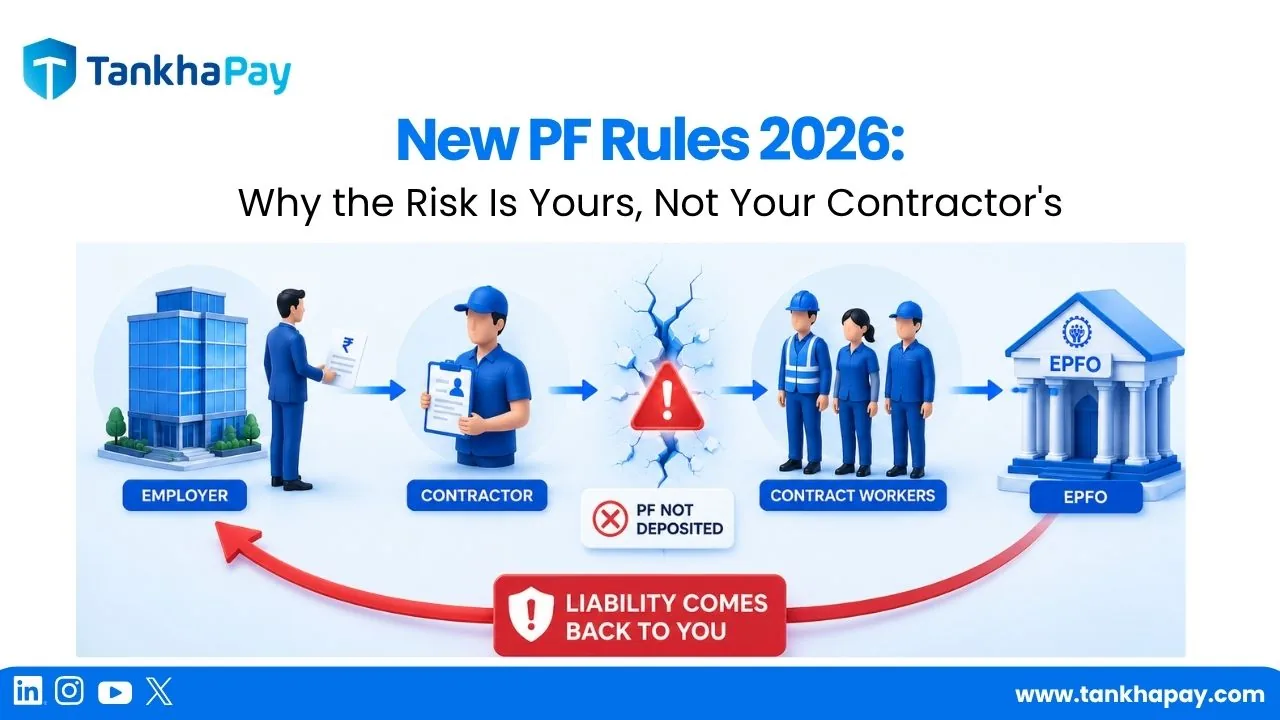
6. Review contractor PF compliance. If you engage contract labour, you could be a principal employer as per EPF Act. In such a case, you will be responsible for any lapses on the part of your contractor in not depositing PF contributions for his employees. This could be one exposure that most employers miss out on.
New Era of India's Labour Compliance Framework
It's worth stepping back and understanding why this is happening now and why it is irreversible.
India has been implementing the four Labour Codes, which consolidate 29 central labour laws into a unified framework. One of the core principles of this reform is the shift from physical, inspector-driven enforcement to digital, data-driven, self-compliance-orientated enforcement. The new inspection scheme under the codes is explicitly built around risk-based selection, web-based inspections, and the concept of the inspector-cum-facilitator.
It is a structural transformation of how the Indian state monitors and enforces labour compliance. And EPFO, which manages over INR 20 lakh crore in corpus covering nearly 7 crore active members across India, is at the centre of this transformation.
The direction of travel is clear: more automation, more data linkage, more cross-referencing, faster flagging, and, when non-compliance persists, enforcement that is faster and more targeted than anything India's labour administration has deployed before.
For employers, the shift also changes how compliance is handled internally. Digital compliance workflows are increasingly taking the place of processes that were once monitored through spreadsheets, manual reconciliations and periodic reviews. As regulatory monitoring becomes increasingly data-driven, many organisations are investing in workforce and payroll compliance platforms like TankhaPay to improve visibility, maintain accurate statutory records and reduce the risk of compliance gaps before they become enforcement issues.
The digital inspection announcement and the arrest warrant at Darj Tea Estate are not two separate pieces of news. These events are two parts of one story, a story of an organisation that at once shows you what the consequences are and builds the infrastructure to bring those consequences into reality.
One Final Thought
The EPF Act has long been viewed as social welfare legislation designed to protect workers by ensuring they have financial security through provident fund savings during retirement.
That framing is important. When EPFO takes aggressive action, issues arrest warrants, freezes accounts or files FIRs, it is acting in defence of workers who have no other institutional advocate. That is the moral and legal weight that lies behind every enforcement action.
When an employer views PF as something optional, a cost that can be avoided, or merely another form of administrative nuisance, it means someone’s pension fund lacks money, their application for benefits gets delayed, and their economic well-being is put in jeopardy.
The new digital system is being built to protect those workers. And to find every employer who isn't.
Your compliance posture today will determine where you sit in that system's risk rankings tomorrow. Make sure you're on the right side of that line, not because you fear the warrant, but because the people whose PF you manage have earned that protection.
Does this change anything in your own payroll setup?
Our team can review your current payroll and compliance process against the rules covered in this edition. You get a clear view of where you stand, with no obligation to switch anything.