In this edition
- A Quick Word on What PF Is, In Case You Need It
- The Setup and the Hole In It
- One Payslip Tells the Whole Story
- Then the Audit Found People Who Don't Exist
- How It Actually Got Caught
- The Cleanup, and Where It's Heading
- Now, Why Any of This Should Keep You Up at Night
- Is Your Staffing Agency Legitimate? The Paperwork That Proves It
- Every month after, follow the money:
- A Last Word
It’s not about a bad company. This is a system that looked good on paper, but the money was quietly disappearing.
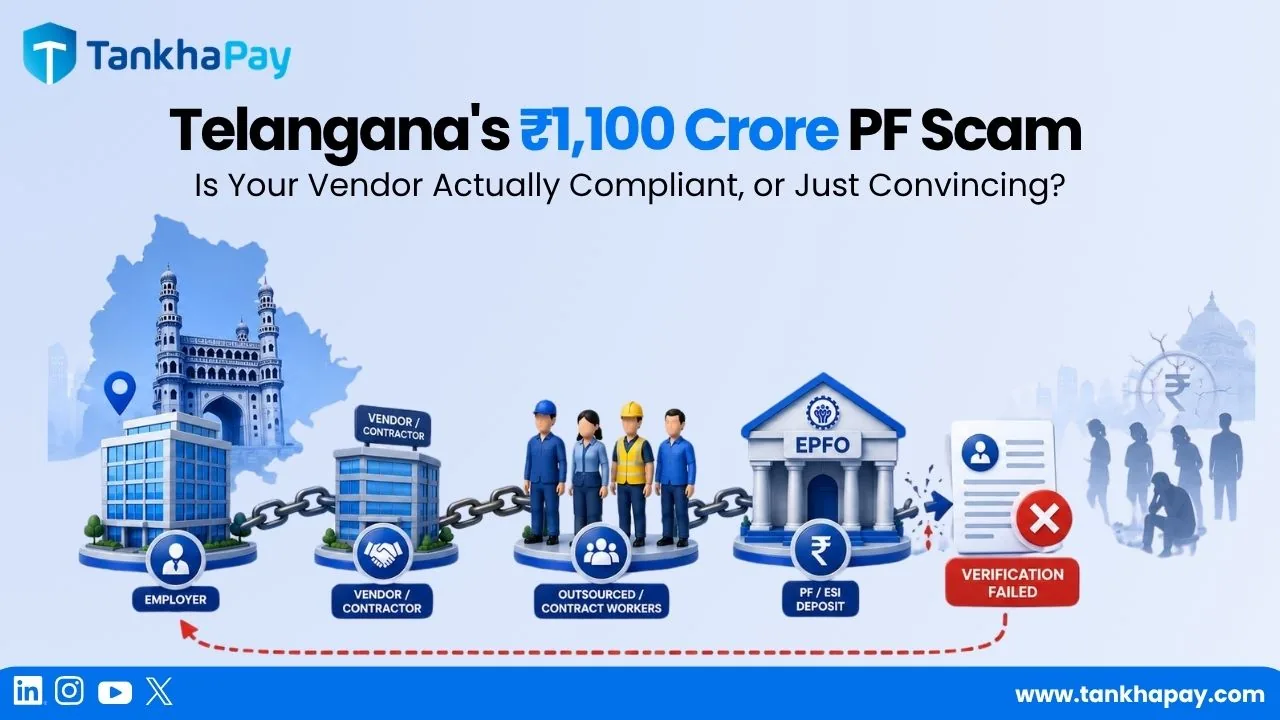
On 14 August 2026, the Times of India published a story that should put every Indian employer on their feet. The Telangana state government audit, verified through Aadhaar, revealed that private outsourcing firms have reportedly diverted more than INR 1,100 crore of PF and ESI money from around 1.6 lakh outsourced employees.
Read that number again. Not INR 11 crore. Not INR 110 crore. More than INR 1,100 crore.
And here is the finding that should worry you even more: over 60% of these workers either had no PF account at all or had accounts with no matching deposits in them. For years, nobody noticed.
If you own a business, run HR, or approve vendor invoices, and your company uses staffing agencies, contractors, or outsourcing firms for even a part of your workforce, this story is for you.
A Quick Word on What PF Is, In Case You Need It
Provident Fund is a silent saving. Every month, a part of the employee's salary gets deposited into the PF account, which is contributed to equally by the employer out of his own pocket. ESI is the counterpart to health coverage, in which contributions are made and, in return, treatment is provided.
Two things make this money different from salary. It belongs to the worker even while the employer is holding it. And holding it, briefly, on its way to the account, is all an employer is permitted to do. The law calls it money held in trust, a phrase worth keeping in mind for the rest of this story.
The Setup and the Hole In It
Telangana's departments don't directly employ everyone who keeps them running. Around 1.6 lakh outsourced workers are deployed across departments, organisations and institutions in the state, supplied by somewhere close to 4,500 private agencies. To pay for all this, the government releases up to INR 352 crore every month. That lump sum covers the salaries, the employer's share of PF and ESI, a 4% agency commission, and 18% GST on the commission. The agency pays the workers, deposits the statutory money with EPFO and ESIC, and keeps its cut, done. The annual bill for the whole arrangement crosses INR 4,500 crore, per the reports.
Now for the hole. Departments, it turns out, were not keeping complete records of what happened to the money once it left their accounts. They paid, filed the invoice, and moved on. Nobody followed the money to its destination.
What the inquiry says happened next is depressingly simple.
Multiple agencies deducted the workers' PF contribution, collected the employer's share from the government on top, and for years credited neither to the accounts they were meant for. Officials are unable to find records of over INR 1,000 crore in payments. Also, the audit and the Aadhaar investigation suggest that the amount allegedly diverted by the agencies could exceed INR 1,100 crore. And even this might not be the total amount, since the inquiry is still underway. A rough estimate of the monthly amount that should have been flowing in: INR 38.56 crore.
One Payslip Tells the Whole Story
Numbers in crores go numb after a while, so the reports helpfully break it down to individual salaries.
A worker on a basic salary of INR 15,600 costs the government INR 22,136 once contributions and commission are loaded on. The worker's take-home is INR 13,611. So there is a gap of roughly INR 8,500 per worker that exists purely to fund PF, ESI, and the agency's fee. If the PF never gets deposited, you can guess where much of that gap ends up.
Two more instances from the reports:
Based on a base of INR 19,500, the government's expenditure is INR 36,979, and the salary of the worker becomes INR 17,404 with a deduction of INR 1,800 towards PF. For INR 22,750, the expenditure becomes INR 31,092, whereas the salary of the worker comes to INR 20,579.
Projecting this forward at the same rate over several years, a single worker earning INR 15,600 could be sitting on close to INR 4.68 lakh in missing PF, and that's before interest.
Sit with the INR 4.68 lakh for a second. For a family running on INR 13,611 a month, that is likely the largest sum they will ever hold in one place. The college admission and hospital bill don't sink the household. And somebody, allegedly, was using it as working capital.
Then the Audit Found People Who Don't Exist
The missing PF was only half of it. After matching the employee details with their Aadhaar number, salary slips and PF bills began to appear under the names of those who exist on paper but not anywhere else.
The strangeness kept spreading from there. Sanctioned posts didn't match the actual headcount. There were cases of one person's name on the rolls while a different person did the job. Some outsourced workers were allegedly posted at officials' private residences, even as the files showed them working in departments. A few employees lacked the qualifications their posts required, including degrees from out-of-state universities in completely unrelated subjects. The government is now checking whether the same pattern repeats elsewhere as part of the ongoing internal inquiry.
A payment system everyone assumed was fine, quietly carrying ghost workers and vanished retirement money for years. That's the picture.
How It Actually Got Caught
Not by an inspection. Nor was there any whistleblowing, at least on account of what is reported. It was found out because the finance department raised a very boring question and would not let go: how does the INR 352 crore flow out every month?
For about 6 months, the department collected the Aadhaar, PAN, and phone number of every outsourced employee on the state's IFMS portal (Integrated Financial Management System, for the acronym-averse). A high-level committee was set up to examine how the agencies functioned. And when that committee asked the 4,500-odd agencies for complete records of salaries and PF and ESI payments, a large number of them had nothing to show.
Aadhaar seeding is what exposed the ghosts, and the payment trail exposed the missing deposits. Databases that were linked together accomplished in months what was not accomplished by normal oversight in years. This is perhaps the one valuable lesson to be learned from the entire controversy.
The Cleanup, and Where It's Heading
The state's response is worth reading closely, because every tool being used against these agencies sits in the same EPF rulebook that applies to your company.
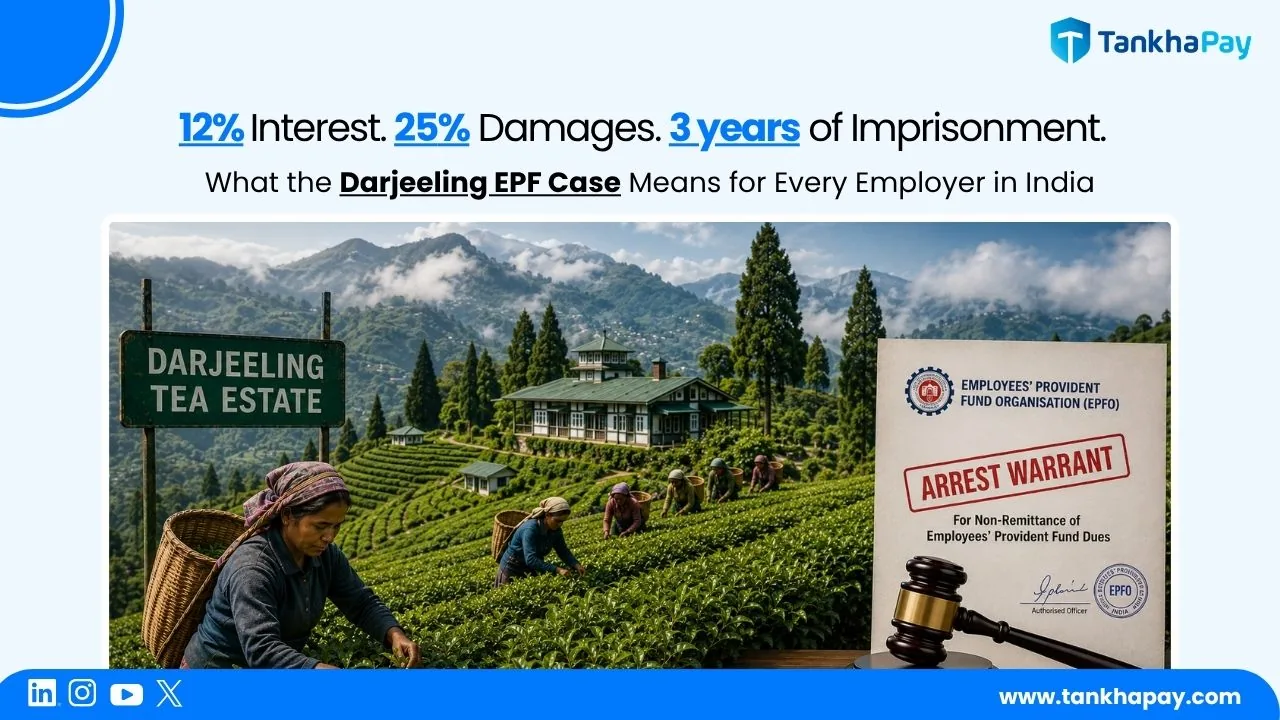
Legal action has been recommended not just against agencies that broke PF rules but also against the ones that quietly shut shop without clearing dues. The PF commissioner has been asked to recover the money, attach agency assets where needed, and collect details from every department on whether their agencies actually deposited what was owed. The state also wants faster movement under Section 7A, an official EPFO investigation that determines precisely how much is owed by the employer, and Section 14B, which imposes damages graded from 5% to 25% per annum depending on how long the default ran. On top of that, 12% simple interest per annum applies under Section 7Q, calculated separately from the damages.
Meanwhile, the agencies are behaving exactly how you would expect. Hundreds have reportedly shut down or restructured since the audit surfaced. Officials suspect some are moving business into fresh company names to stay ahead of action, and the reports allege that certain political leaders and officials are working to shield agencies under scrutiny.
The unions have raised the question nobody in the system wants to answer: PF authorities were supposed to be reviewing monthly challans and ECR filings all along, so how did this run for years? They want the monitors held accountable along with the agencies. There is also a revived demand to scrap the private agency model altogether, and the arithmetic behind it is hard to ignore. Drop the agencies and the 4% commission disappears, along with the 18% GST charged on it. Doing the math on the report's own figures, the INR 15,600-basic worker's take-home rises from INR 13,611 to INR 17,601. The INR 19,500 worker moves from INR 17,404 to INR 22,299, and the INR 22,750 worker from INR 20,579 to INR 26,232.
Now, Why Any of This Should Keep You Up at Night
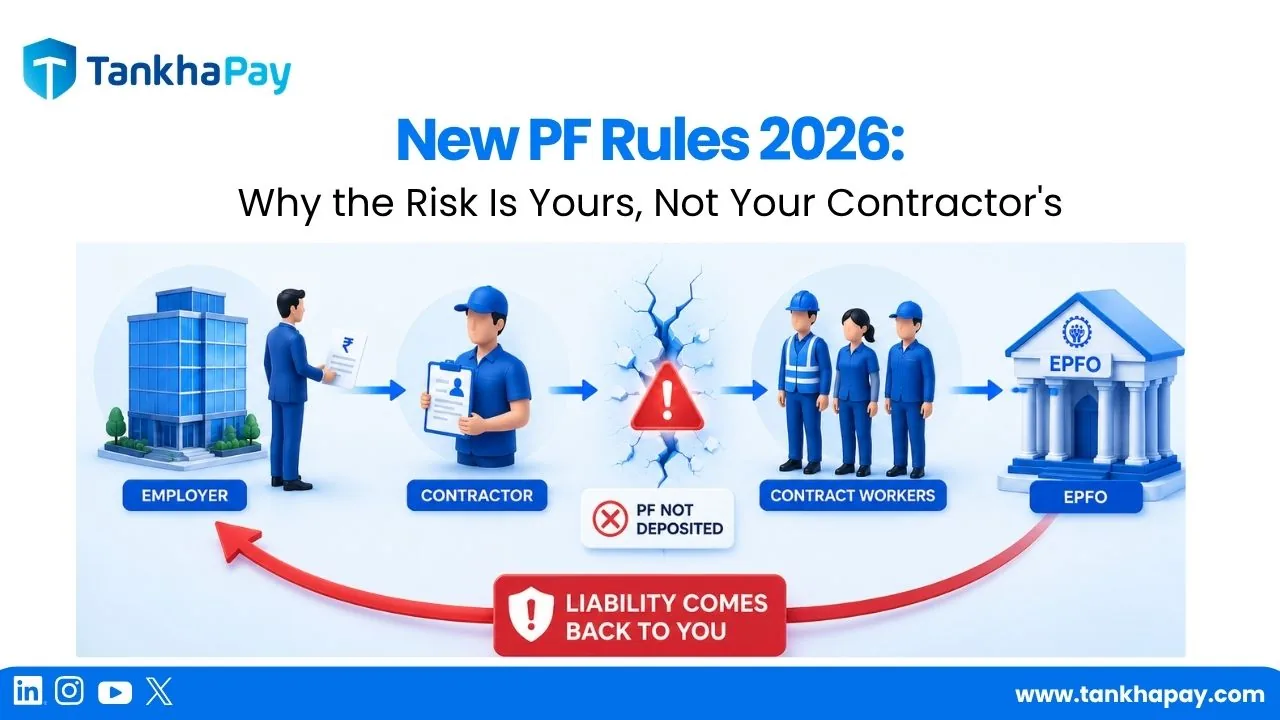
Two words: principal employer. And one habit: paying contractor invoices without ever looking underneath them.
Under Section 2(f) of the EPF Act, workers who come in through an agency or contractor can still count as your employees for compliance purposes. It becomes even more apparent when your contractor does not have an independent PF code, or when you do not have one because you haven't taken the time to check. Courts have made actual distinctions: (a) if your organisation has its own code that's filed in time, that's who's responsible, but if it's an agency and there's no other way for you to know, then it's your responsibility. (b) If your security contractor or cleaning agency is deducting PF for your workers and you have not asked for a challan, well, that could be a problem for you.
Not every agency is the problem. Plenty of them work perfectly clean, with registered PF codes, on-time ECR filings, and a track record that they will provide you on request. The difference is not always noticeable on the sales pitch; it comes down to being able to verify the operator independently. A registered PF code, which you can easily verify through the EPFO portal. An ISO 27001 certification for your payroll processing. A CMMI Level 5 process maturity rating, if it operates at any kind of significant scale. These things are not just window dressing. They are there because somebody outside of the organisation has already performed a due diligence review on it. The ones that cannot provide you with anything are what this story is about.
Now let us look at the current position of the Telangana departments. They have paid each and every rupee as per the monthly calendar. However, the same departments are now at the heart of a Rs. 1,100 crore scam, simply because the payment process is where their hard work has ended. Any company that clears contractor bills without checking the PF trail is running the same experiment, with its own name on the eventual notice.
Is Your Staffing Agency Legitimate? The Paperwork That Proves It
There was one thing that united the agencies involved in the Telangana scandal, nobody examined their basics before giving them workers along with a crore per month. Legitimacy does not have to do with how slickly presented your sales pitch is. It is a small stack of certificates and licences, most of which can be verified in one day from the government websites.
Here is what a real one carries:
Its own EPFO establishment code. An agency employing your outsourced workers must be registered with EPFO in its own name, and its remittance history is visible through EPFO's public establishment search. An agency operating on somebody else's code, or hesitant to share its own, has answered your question already.
Its own ESIC registration. Same logic, same test. The health cover your workers are entitled to runs through this code.
A contractor licence under the OSH Code. This is the licence that replaced the old Contract Labour Act licence after the Labour Codes took effect in November 2025. Ask for it for every state where your people are deployed.
A GSTIN that matches the entity on the invoice. Verifiable on the GST portal in two minutes. A freshly issued GSTIN on a "renamed" agency is exactly the manoeuvre Telangana's absconding agencies are accused of attempting right now.
A traceable corporate identity. Check the registration number on the official Ministry of Corporate Affairs website for the date of incorporation, active status, and past directors.
Certifications nobody bothers faking for a shell company. ISO 27001 is important for you since your organisation holds data related to Aadhaar, PAN, and bank account numbers of your employees, as per the DPDP Act, 2023. ISO 9001 is an indication of good processes, while the bigger providers have CMMI certification done. None of these is legally required, and that is the whole idea. Nobody would waste years of auditing and certification for a company they wish to close.
Every month after, follow the money:
Pull the full list of agency-deployed workers along with their UANs. Everyone on your premises should have an active Universal Account Number.
Make last month's ECR and payment challan a condition for clearing the invoice. Put it in the contract.
Match ECR names against the humans on your floor.
Open a few PF passbooks with the workers themselves, via the EPFO e-passbook or UMANG app.
Tighten the paper. Audit rights, indemnity for any default of the statutory requirements, and the right not to pay till the proof of compliance is in place.
Treat a sudden agency name change as a red flag.
Keep your own copies. ECRs, challans, worker lists, all of it.
Run both lists on every vendor you have. A provider with nothing to hide answers them with attachments, not excuses. TankhaPay is built by AKAL Information Systems, a CMMI Level 5-appraised, ISO 27001, ISO 20000-1, and ISO 9001-certified company that has served over 1,000 client organisations, and we would rather you verify every word of that than take this paragraph on trust. That, after all, is the entire argument of this article.
A Last Word
Once you remove the crores, you will find that what is left is just a line of individuals taking the assumption that someone else had checked. Workers took the assumption that the deduction from the payslip was going to be deposited in the account. Departments assumed that a full invoice meant compliance of the agency. The money has escaped through that loophole, with an amount exceeding INR 1,100 crore taken from the lowest-paid workers in the entire system.
Here is how enforcement has evolved: interconnected databases, Aadhaar verification, and the transaction flow that cannot be covered up by any vendor relationship anymore. This is the same risk-based inspection approach which EPFO is implementing on a national scale. Spreadsheets and "this is an issue of the agency" will not survive through that transition. This is where TankhaPay fits in: payroll management and compliance done with all the proofs available without any need for additional verification of anything.
Does this change anything in your own payroll setup?
Our team can review your current payroll and compliance process against the rules covered in this edition. You get a clear view of where you stand, with no obligation to switch anything.