
Best Payroll Accounting Software for Accurate Salary & Tax Management
We provide comprehensive payroll accounting solutions that take care of the entire compensation process, from wages and taxes to benefits and deductions. Our services make sure your employees are paid accurately and on time, help your business stay compliant with legal and tax regulations, and deliver clear, detailed reports on labour costs for smarter financial planning and reporting.
How is Payroll Accounting Managed in India?
In India, payroll accounting involves calculating employee compensation, which includes salaries and statutory deductions such as income tax, EPF, ESI, and professional tax, as well as employer contributions to social security benefits like EPF and ESI.
 The payroll cycle begins with registering the organization and obtaining a TAN (Tax Deduction and Collection Account Number).
- Formulate a well-defined pay scale, collect employee data, and remit pay through online transfer, which also facilitates recording.
- Labour laws, such as the Income Tax Act and the EPF Act, must be fully complied with to gain maximum trust.
Offers accurate and effortless payroll processing by leveraging TankhaPay's technology in automation, compliance, and payroll disbursement, including across all businesses in India.
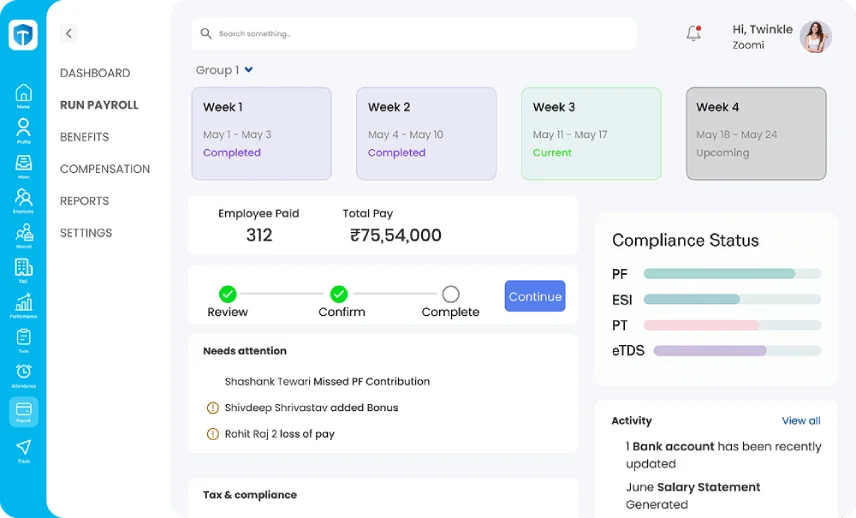
What Are the Key Steps in TankhaPay’s Payroll Accounting Workflow?
Components for Payroll Accounting
Verify Employee Documentation
Calculate Employee Net Compensation
Record Expense Transactions
Components for Payroll Accounting
Competitively pay salaries by looking at industry rates and internal budgeting.
- Employee remuneration includes salaries, wages, bonuses, and commission payments.
- Get business registration done and also obtain PAN, TAN, and GST.
- Decide on the frequency of our pay: monthly, bi-weekly, or weekly.
- Define the benefits pool for employees, covering insurance, EPF, ESI, gratuity, and various allowances.
Streamline your payrolls, perks, and compliance needs with TankhaPay’s accounting solution, designed for the growing businesses of India.

Verify Employee Documentation
Collect required forms for payroll accounting and compliance:
- PAN Card and Aadhaar Details: For income tax and identity verification.
- Form 16 / Form 12BA (Employee Declaration): For tax calculation and exemptions.
- EPF Registration or Nomination Form for Provident Fund contributions.
- ESI Enrolment Form for the employees covered under ESI.
- Bank account details and direct deposit authorisation for salary payment.
- Any other declarations, such as insurance, retirement plans, or voluntary deductions.
TankhaPay helps you seamlessly collect, verify, and manage all essential employee documents to ensure smooth, compliant payroll processing.

Calculate Employee Net Compensation
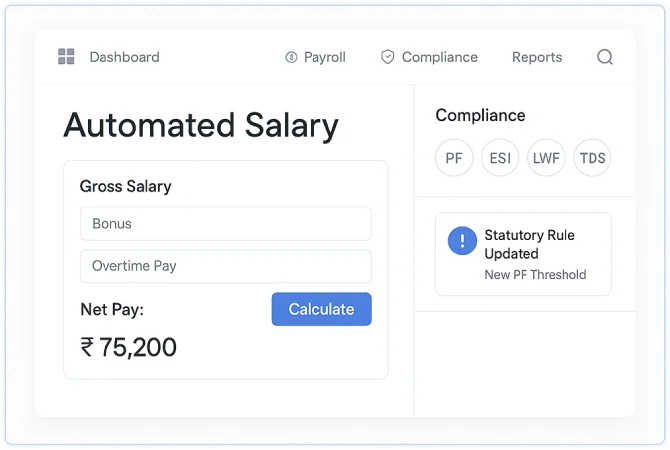
- To determine each employee's net income, it is first necessary to ascertain their gross salary by adding their basic salary, overtime, bonuses, or incentives.
- Then, deduct all the TDS, EPF, ESI, professional tax, etc., from their gross salary.
TankhaPay provides an end-to-end solution that makes this extremely effortless by covering everything through proper deductions and contributions.
Record Expense Transactions
- Keep payroll organized and above board in your accounting system.
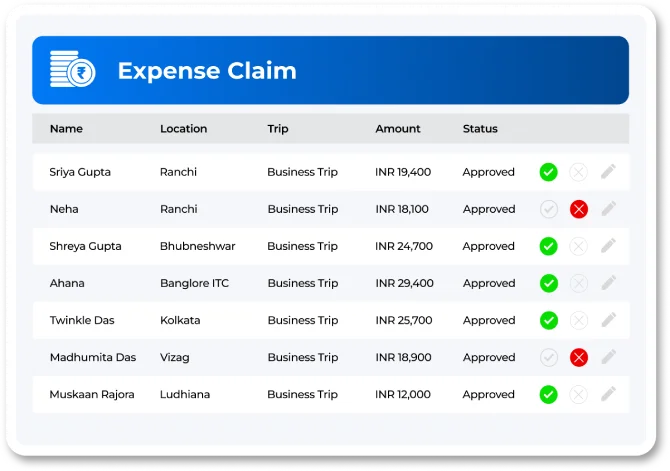
- Track wages, deductions, contributions, and benefits to ensure transparency and smooth reporting.
- Timely deposits of TDS, EPF, ESI, and professional taxes to their respective authorities.
- Generate payslips for each employee and prepare annual statements. Maintain all payroll records to ensure compliance with Indian labour laws and audits.
With TankhaPay's all-in-one payroll management, you can relax while maintaining accurate records and filing on time for simplified reporting.
Unlocking the Value of Payroll Accounting for Your Business
Payroll accounting is the backbone of a compliant, financially healthy, and people-centric organization. It's about precisely understanding what employees are being paid: wages, deductions, taxes, and benefits, so that the organization remains on top of operational and regulatory needs.
The Global Payroll Complexity Index 2023 data also shows that the payroll scenario itself has increased in complexity, rising from a ranking of 25 in 2021 to 21 in 2023, indicating higher regulatory and administrative requirements. With the complexities attached to payroll functions, their importance also begins to register.
- Regulatory Compliance- Accurately calculates, withholds, and submits payroll taxes to ensure full compliance with all applicable tax codes and labour regulations.
- Financial Integrity- Tracks payroll expenses with precision, enabling accurate financial reporting and smarter, data-driven planning for long-term business growth.
- Promoting Employee Satisfaction- Delivers timely and accurate pay, helping build employee trust, boost morale, and support a more engaged, motivated workforce.
- Payroll Documents- Keeps payroll records organized and compliant, streamlining audit preparation and ensuring transparency during financial inspections or reviews.
How to Calculate Payroll Expenses?
Payroll expenses are calculated by adding together all elements of an employee’s compensation, including gross salary, bonuses, and employer-paid benefits. This total excludes deductions for employee contributions such as taxes and retirement plans, which are only factored in when determining the employee’s net pay.
Example Calculation:
Let there be an employee who takes home a gross monthly salary of ₹ 1,50,000. The company contributes 12% of the employee's basic pay, amounting to ₹ 18,000, while the employee also pays 12% of the basic salary from their end, that is, ₹ 18,000. TDS is deducted at 15% of the wage earner's gross pay, amounting to ₹ 22,500. The following is how payroll cost will be calculated:
- Gross Salary: ₹1,50,000
- Employer Contributions: ₹18,000 (Provident Fund)
- Total Payroll Expense: ₹1,50,000 + ₹18,000 = ₹1,68,000
- Net Pay: ₹1,50,000 – ₹18,000 (Employee PF) – ₹22,500 (Tax Withholdings) = ₹1,09,500
The company records payroll expense for ₹1,68,000, and the employee goes home with ₹ 1,09,500

Trusted by Top Businesses Across India
Join the growing community of businesses leveraging TankhaPay’s advanced technology, expert payroll support, and actionable insights.




























How Can TankhaPay Help You in Payroll Accounting?
TankhaPay automates payroll, keeps each and every rule updated, and consolidates all employee data in one place. The final result would bring less administrative hassle and higher accuracy. With over 25 years of experience under its sleeve, supported by over 1,000 businesses across India, payroll becomes smooth and strategic for the business.
- We are talking about ensuring payroll runs seamlessly across various locations while fully adhering to the varying regulations.
- This also means simplifying HR by standardizing workflows, reducing administrative work, and accessing expert payroll support without hiring full-time staff.
- Being on top of changing labour and payroll laws, integrating attendance and leave data for accurate payroll calculations.
- You will have access to all centralized employee records at any time via a secure cloud-based system, and the payroll solution should scale with ease as your organization grows.
Streamline your payroll accounting with TankhaPay and see how our HR technology can turn a routine task into a strategic advantage that drives your business forward.
FAQs
01. What is payroll accounting?
Payroll accounting is the organized process of calculating, recording, and managing employee compensation and related expenses. It ensures timely and accurate payments to employees while effectively overseeing the company’s tax, benefit, and other payroll-related obligations.
02.How to do payroll accounting?
To execute payroll accounting, organizations need to gather employee and tax information, calculate gross pay along with all applicable deductions, and determine net income. Then record these transactions as journal entries, disburse payments to employees and tax authorities, and maintain accurate payroll records to ensure compliance and support reporting and audit.
03. What are the three types of payroll accounting?
The primary types of payroll accounting include Initial Recording (or originating entry), which captures gross wages and associated taxes; Accrued Wages (or accrued payroll), representing earnings not yet disbursed; and Manual Payments, used for off-cycle disbursements or final settlements.
04.What is the payroll accounting method?
The payroll accounting process involves every detail regarding how the company compensates its employees, i.e., salaries, bonuses, and taxes withheld by the company. The accounting must be precise and comply with regulatory requirements, keeping things simple and transparent within the entire organization.