Quick Answer
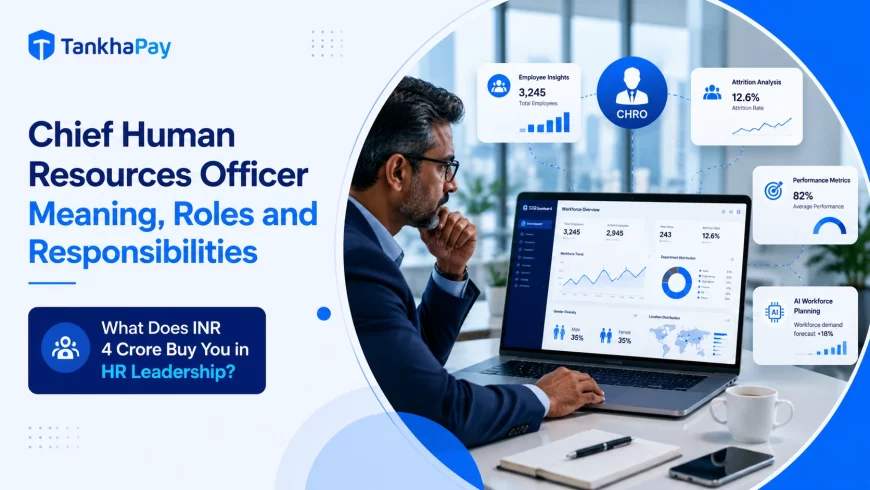
A CHRO (Chief Human Resources Officer) is the senior-most HR executive in an organization, responsible for workforce strategy, talent leadership, compliance and increasingly, AI-driven HR transformation. In India, full-time CHRO compensation ranges roughly from INR 1.2 crore at high-growth startups to INR 4 crore or more at listed mid-cap companies, with fractional CHRO arrangements available at INR 15 to 35 lakh annually for smaller firms.
- CHRO full form: Chief Human Resources Officer
- What they do: Own workforce strategy, talent acquisition, employee experience, HR technology and compliance, and report directly to the CEO
- Why the role matters now: CHROs sit in strategy and board discussions alongside the CEO and CFO, not just in HR meetings
- Core skills: Strategic planning, people analytics, change management, AI fluency, stakeholder communication
- India salary range: INR 15 lakh (fractional, small companies) to INR 4 crore+ (listed mid-cap, full-time)
- 2026 focus areas: AI-driven HR transformation, leader and manager development, workforce redesign
- Career path: HR Executive → HR Manager → HR Business Partner → HR Director → CHRO, typically 15–20+ years
What Is a CHRO?
CHRO stands for Chief Human Resources Officer. It is the top HR position in a company, sitting at the executive level alongside the CEO, CFO and COO.
A CHRO does not just run the HR department. The role covers workforce strategy, organizational design, leadership development, culture and increasingly, how AI changes the way work gets done.
The term “CHRO meaning in business” gets searched often because the title is sometimes used loosely. A true CHRO reports directly to the CEO, has board exposure and owns HR as a business function, not just an administrative one. Smaller companies sometimes call their most senior HR person a CHRO even when the role is closer to an HR Director. That distinction matters for salary benchmarking and hiring, and we cover it in the comparison section below.
Some organizations use “Chief People Officer” (CPO) instead of CHRO. The titles are close to interchangeable in most companies, though CPO tends to signal a stronger emphasis on culture and employee experience over traditional HR administration.
How the CHRO Role Evolved
The CHRO title is newer than the function itself. HR started as “personnel administration,” a compliance and payroll-focused back-office job through most of the 20th century.
The shift began in the 1990s, when HR scholar Dave Ulrich’s HR Business Partner model pushed HR leaders to align with business strategy instead of just processing paperwork. That model is still the basis for how most large companies structure their HR function today.
By the 2010s, digital HR platforms and people analytics gave HR leaders access to workforce data comparable to what finance had for years. That data access is a big part of why HR earned a genuine seat at the strategy table.
Today’s CHROs are expected to speak the language of the board: revenue impact, cost efficiency, risk management, not just employee satisfaction scores. The Deloitte India Executive Performance and Rewards Survey 2026 shows this shift in compensation terms too. CHRO pay is increasingly benchmarked against the CEO and CFO roles, not against mid-level HR positions, which was not the case a decade ago.
Core Responsibilities of a CHRO in India
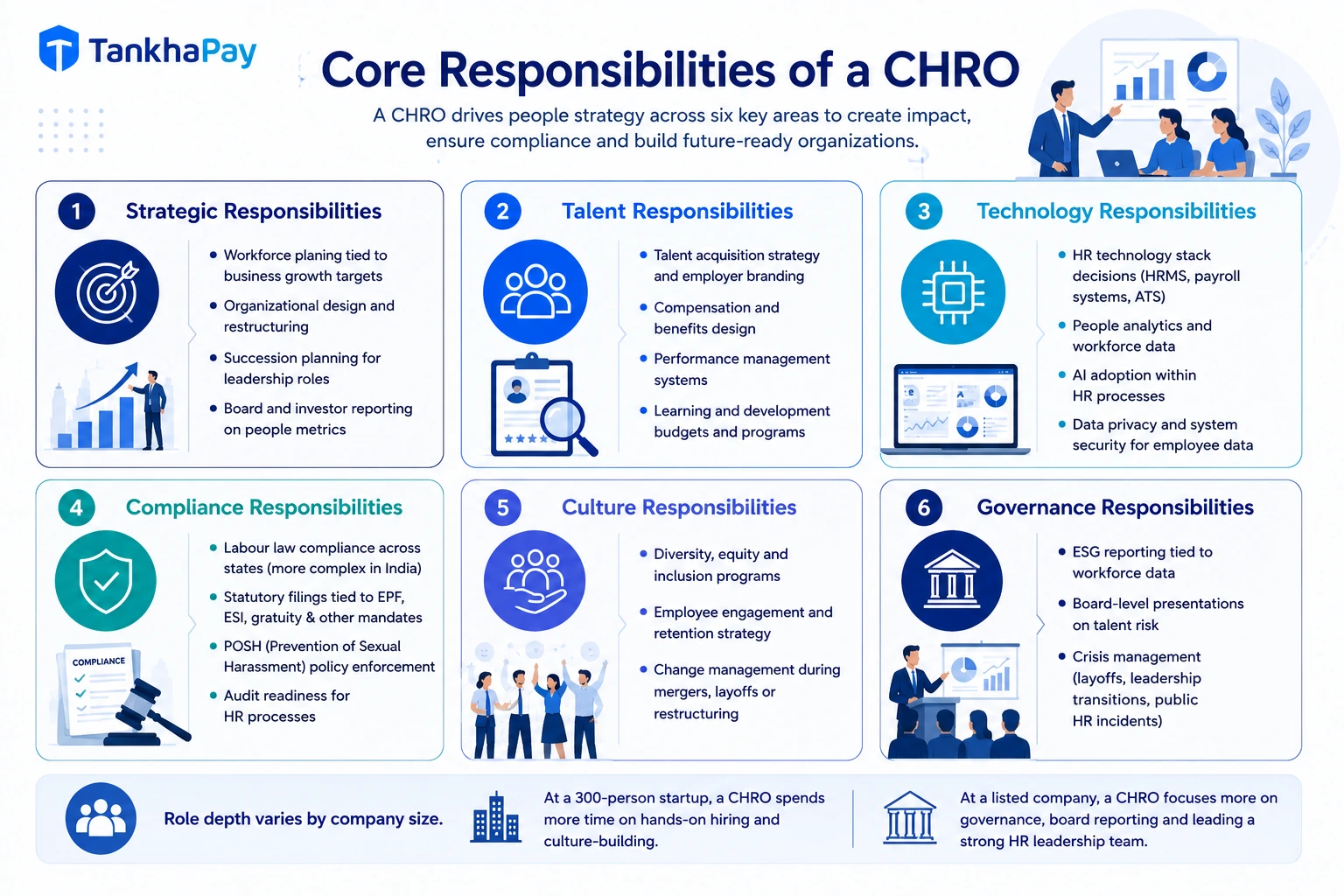
A CHRO’s job spans six broad areas. Each one carries different weight depending on company size and industry.
Strategic responsibilities
- Workforce planning tied to business growth targets
- Organizational design and restructuring
- Succession planning for leadership roles
- Board and investor reporting on people metrics
Talent responsibilities
- Talent acquisition strategy and employer branding
- Compensation and benefits design
- Performance management systems
- Learning and development budgets and programs
Technology responsibilities
- HR technology stack decisions (HRMS, payroll systems, ATS)
- People analytics and workforce data
- AI adoption within HR Automation
- Data privacy and system security for employee data
Compliance responsibilities
- Labour law compliance across states (this is more complex in India than in single-jurisdiction markets)
- Statutory filings tied to EPF, ESI, gratuity and other mandates
- POSH (Prevention of Sexual Harassment) policy enforcement
- Audit readiness for HR processes
Culture responsibilities
- Diversity, equity and inclusion programs
- Employee engagement and retention strategy
- Change management during mergers, layoffs or restructuring
Governance responsibilities
- ESG reporting tied to workforce data
- Board-level presentations on talent risk
- Crisis management (layoffs, leadership transitions, public HR incidents)
A CHRO at a 300-person startup will spend more time on hands-on hiring and culture-building. A CHRO at a listed company spends more time on governance, board reporting and managing a large HR leadership team below them.
CHRO Skills, Education and Certifications
Core skills
| Skill | Why it matters |
|---|---|
| Strategic planning | Ties workforce decisions to business outcomes |
| People analytics | Data-backed decisions on attrition, hiring, performance |
| Change management | Leading teams through restructuring, M&A, AI adoption |
| Financial literacy | Reading P&L impact of HR decisions, defending HR budgets |
| AI and HR tech fluency | Evaluating and deploying HR technology responsibly |
| Stakeholder communication | Translating HR data into board-level language |
| Labour law knowledge | Navigating India’s multi-state compliance landscape |
Education Most CHROs hold a postgraduate degree, commonly an MBA with HR specialization or a Master’s in Human Resource Management. A pure HR background is common but not required. Several CHROs in India move into the role from operations, finance or general management, which often strengthens the business-side credibility of the function.
Certifications that add weight
- SHRM-SCP (Senior Certified Professional)
- HRCI’s Global Professional in Human Resources (GPHR)
- CIPD Level 7 (UK-based, respected in MNCs)
- People analytics or HR technology certifications from platforms like LinkedIn Learning or Josh Bersin Academy
Certifications matter more for career transitions into the CHRO role than for CHROs already in seat. Track record with measurable business outcomes carries more weight at the top.
KPIs Every CHRO Tracks
| KPI | What it measures |
|---|---|
| Employee attrition rate | Voluntary and involuntary turnover, usually tracked monthly and annually |
| Time-to-fill | Days from job requisition to offer acceptance |
| Cost-per-hire | Total recruiting cost divided by number of hires |
| Employee engagement score | Usually from quarterly or annual pulse surveys |
| Revenue per employee | Business efficiency metric, tracked with the CFO |
| Internal promotion rate | Signals succession bench strength |
| Training completion / L&D ROI | Whether learning investment translates to skill or performance gains |
| DEI representation metrics | Gender, category and role-level diversity tracking |
| HR tech adoption rate | How much of the HR stack is actually used by employees and managers |
| Compliance incident rate | Statutory filing errors, POSH cases, audit findings |
These KPIs get reported to the CEO and board, usually on a quarterly cadence, alongside financial metrics.
CHRO Salary in India (2026)
CHRO salary data online is inconsistent, and it is worth knowing why before quoting a number. Aggregator sites like Payscale and Glassdoor pull from self-reported data that often mixes actual CHROs with HR Heads or HR Directors carrying the CHRO title informally. That is why you will see figures ranging from roughly INR 6 lakh to well over INR 1 crore for the “same” title on different sites.
The more reliable benchmark comes from named compensation surveys rather than crowdsourced job sites.
Full-time CHRO compensation in India, by company stage:
| Company profile | Annual compensation (INR) |
|---|---|
| High-growth startup (~300 employees) | 1.2 crore+ |
| Listed mid-cap company | 4 crore and above |
| Fractional CHRO (sub-150 person companies) | 15–35 lakh |
Source: Deloitte India Executive Performance and Rewards Survey 2026, as reported by Crescendo Global’s 2026 CXO compensation guide.
Three factors push CHRO compensation above the median in India:
- Transformation experience. CHROs who have led a company through a digital transformation, M&A integration or major restructuring earn a measurable premium over those with tenure alone.
- Second-line leadership strength. CHROs who have built and retained a strong VP/Director-level HR team are valued higher than those who are a single point of failure.
- GCC and global exposure. With over 1,900 Global Capability Centres operating in India and roughly 500,000 new GCC positions projected by the end of 2026, CHROs who understand multi-geography and offshore-to-onshore talent models command a clear premium over domestic-only profiles.
Fractional CHRO arrangements are becoming more common at smaller companies that need senior HR strategy without a full-time executive cost. This is worth knowing if you are budgeting for HR leadership at a growth-stage company.
CHRO vs Related Titles
| Title | Reports to | Scope | Typical seniority |
|---|---|---|---|
| CHRO | CEO / Board | Enterprise-wide HR strategy, board reporting | 15–20+ years |
| Chief People Officer (CPO) | CEO | Similar to CHRO, stronger culture/experience focus | 15–20+ years |
| HR Director | CHRO or CEO | Functional HR leadership, one region or business unit | 10–15 years |
| VP HR | CHRO or CPO | Operational HR leadership under CHRO/CPO | 8–12 years |
| CEO | Board | Full business ownership, HR is one function among many | Varies |
The clearest distinction: a CHRO owns HR as a strategic function with direct board visibility. An HR Director executes HR strategy within a defined scope and usually reports to the CHRO. A VP HR sits below both, running day-to-day HR operations.
Why AI Is Reshaping the CHRO Mandate in 2026
Gartner’s 2026 CHRO priorities research, based on a survey of 426 CHROs across 23 industries and four global regions, identifies four focus areas for the year: using AI to reshape HR itself, redesigning the workforce for a human-machine mix, building leadership readiness amid uncertainty, and embedding culture into performance.
A separate Evanta survey of over 400 CHRO community members found “Leader and Manager Development” as the top priority for the second year running, with “HR Tech and AI Strategy” climbing to the second-highest priority, up from outside the top five the year before.
The practical shift: CHROs are no longer just evaluating whether to adopt AI tools. They are being asked to define what parts of HR, especially recruiting, should stay human-led and which parts can move to AI-assisted workflows, and to defend that split to the board in terms of cost and risk.
“The CHROs we work with are not asking whether AI belongs in recruitment anymore. They are asking where the human judgment has to stay, and building the guardrails around that.” — TankhaPay Payroll Advisory Team
This is a real shift in how recruiting budgets get allocated, and it is why AI-assisted hiring has moved from an experimental line item to a standing part of workforce planning conversations.
Challenges CHROs Face in India
Talent scarcity in specialized roles. Demand for AI, data and specialized tech talent continues to outpace supply, particularly at GCCs and product companies.
Multi-state compliance complexity. Labour law varies by state in India. A CHRO managing a workforce spread across five or more states is managing five or more sets of statutory obligations, not one.
Proving HR’s ROI to the board. HR budgets face more scrutiny than they used to. CHROs increasingly need to show revenue or cost impact, not just engagement scores, to defend headcount and technology spend.
Balancing AI adoption with employee trust. Rolling out AI in recruiting, performance reviews or workforce planning without clear communication tends to create anxiety and pushback from employees, which can undercut the efficiency gains AI was meant to deliver.
Retaining second-line leadership. As noted in the salary section above, CHROs who cannot build and retain a strong team below them are treated as a higher-risk hire and priced accordingly.
Building AI-Ready Talent Pipelines
The four Gartner priorities above (AI, workforce redesign, leadership readiness, culture) point to the same underlying problem for most CHROs: recruiting fast enough for the roles AI is creating, while filtering out the noise AI has added to hiring itself. AI-generated resumes and automated applications have made high-volume roles harder to screen manually, not easier.
This is the specific gap AI-assisted recruiting and staffing tools are built to close: faster candidate screening without losing the human judgment CHROs still want in the final decision, particularly for leadership and specialized technical roles.
Book a Strategy Call with the TankhaPay AI Recruitment team to walk through how AI-assisted screening fits into your current hiring workflow, and where it should not.
Conclusion
The CHRO role has moved from a support function to a board-level strategic partner in the space of about two decades. Compensation, scope and expectations have all shifted accordingly, and the pace of that shift is accelerating as AI reshapes how HR teams operate. Companies evaluating their own HR leadership structure, whether that means hiring a full-time CHRO, a fractional CHRO, or investing in AI-assisted tools to extend the capacity of an existing team, are working through a genuinely new set of tradeoffs that did not exist five years ago.