- All-in-one HRMS automates solutions, attendance, compliance, and ESS in one platform. India-specific obligation
- PF, ESI, PT, and TDS must auto-calculate natively—no manual exports, no third-party workarounds
- PF and ESI apply from your first eligible employee: A 10-person startup is not exempt. Most companies discover this after their first compliance notice.
- Never run HR and payroll on separate systems: Every manual data transfer between them is a direct source of payroll errors and statutory deduction mistakes.
- Best fit by size: TankhaPay’s automated HR software for businesses in India and globally — ideal for startups, enterprises, EOR providers, and compliance-heavy organizations with (50–500+) employees.
- BambooHR cannot meet Indian statutory requirements— no EPFO challan, no ESIC filing, no PT. It needs a full replacement, not a workaround.
- Darwinbox is only justifiable above 500 employees: Below that, cost and implementation timelines do not work in its favour.
- Before signing any HRMS: perform one full parallel payroll cycle with a mid-month joinee, an ESI eligible staff, and a PT liable employee.
This article covers:
- What HRMS software is and how it differs from HRIS and HCM
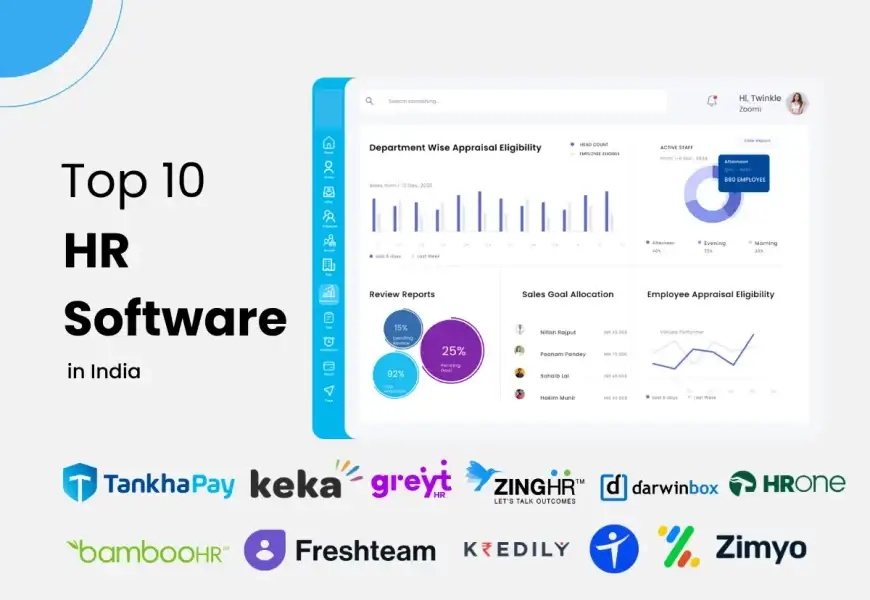
- A comparison of the top 10 HRMS platforms available in India
- Best integrated HR and payroll software for Indian businesses
- HR automation software, benefits, features, and industry use cases
- Industry-specific recommendations for IT companies, startups, BPO, manufacturing, and healthcare
- Honest alternatives to BambooHR, Darwinbox, and Keka
- 15 FAQs with answers optimised for AI search
What Is HRMS Software in India? Full Form, Meaning & Key Functions
HRMS stands for Human Resource Management System. It is a software platform that brings payroll processing, attendance management, leave tracking, statutory compliance, performance management, recruitment, and employee self-service under a single digital system. In India, HRMS software must handle statutory obligations, including Provident Fund (PF) deductions, Employee State Insurance (ESI), Professional Tax (PT), and TDS under Section 192 of the Income Tax Act, making it fundamentally different from HR tools built for Western markets.
HRMS Full Form and What It Means for Indian Businesses
HRMS stands for Human Resource Management System. The terms ‘HR Software’, ‘HR Management Software’, and ‘Human Resource Management Software’ are also referred to as ‘HRMS’. Although all these terms refer to the same thing in India, HRMS can be considered to be the most comprehensive name amongst all. HRMS combines all functionalities that are covered by HRIS as well as payroll management.
For a company that has 50 employees in India, the HRMS takes away the need for having manual sheets for calculating payroll, maintaining attendance records, and using Excel sheets for tracking compliance. It ensures the monthly payroll process, generates EPFO challans, submits ESIC returns, and issues payslips without needing any compliance department at all.
What Does an HRMS System Do?
A fully functional HRMS software in India covers these core functions:
- Employee data management — digital records, document storage, and organisation hierarchy
- Payroll automation — salary calculation, PF (12% employer + 12% employee contribution on eligible wages, capped at ₹15,000/month), ESI (3.25% employer + 0.75% employee on gross wages up to ₹21,000/month), PT as per state slabs, and TDS under Section 192
- Attendance management and leaves management – integration with biometric devices, attendance through geo-tagged mobile application, scheduling of shifts and leave balances
- Performance management – goal setting, performance cycles, and 360-degree feedback
- Recruitment and onboarding – recruitment management and induction management
- Statutory Compliance – generating EPFO challans, ESIC contributions, TDS deposits and compliance with Labour Codes
- Employee self-service (ESS) — payslip download, leave applications, reimbursement submissions via mobile
- HR reporting and analytics — headcount dashboards, attrition reports, payroll cost summaries
Who Uses HRMS Software in India?
Any organization with a payroll to run and statutory obligations to meet needs cloud-based hr software. This covers startups from their first eligible employee onwards, mid-size companies (50–500 employees), and large enterprises managing thousands of people across multiple locations. Industries including IT, manufacturing, BPO, healthcare, retail, and logistics all deploy HRMS platforms to manage their workforces with the compliance accuracy India’s regulatory framework demands.
What Is HR Software?
HR software is a digital system that enables organisations to automate and manage the operational and strategic tasks of a human resources department. It covers the full employee lifecycle, from job posting and candidate screening through onboarding, payroll, compliance, performance reviews, and eventual separation.
The Indian businesses have a set of criteria that must be met in their HR software in India, and this might not be met by some international HR software. In fact, the Indian payroll has a complicated statutory framework wherein the filing of challans is made compulsory on a monthly basis, till the 15th of every succeeding month, by the EPFO. The ESIC mandates the making of contributions on a fortnightly basis. The collection of professional tax is done every month through various slabs in all the 16 states in which it is levied.
The market broadly groups HR technology into three tiers:
- HRIS: Data handling and storage systems
- HRMS: Automation of operations such as payroll along with compliance
- HCM: Strategic level where talent management and workforce analytics have been incorporated.
Indian companies searching for HR software would generally require an HRMS and not an HRIS. The reason being that HRIS is not capable of dealing with PF, ESI, and PT.
HRIS vs HRMS vs HCM: Key Differences for Indian Businesses
HRIS, HRMS, and HCM describe three different tiers of HR software capability. Indian businesses often buy the wrong tier. Either they end up paying for HCM features they will not use for years or they buy HRIS tools and discover there is no payroll compliance module.
HRIS (Human Resource Information System) stores and manages employees’s’ crucial data, like personal records, job history, documents, and organisation charts. It does not process payroll or handle statutory compliance filings.
HRMS (Human Resource Management System) incorporates everything in HRIS plus full payroll automation, attendance management, leave tracking, statutory compliance (PF/ESI/PT), performance management, and employee self-service. This is the tier most Indian businesses need.
HCM (Human Capital Management) adds strategic capability on top of HRMS: advanced talent management, succession planning, learning management systems, and predictive analytics.
Workforce analytics – this is typically relevant for companies with 500+ employees and HR strategy teams.
| Feature | HRIS | HRMS | HCM |
|---|---|---|---|
| Employee data management | ✓ | ✓ | ✓ |
| Payroll automation | Limited | ✓ | ✓ |
| PF / ESI / PT compliance | ✗ | ✓ | ✓ |
| Attendance and leave | Basic | ✓ | ✓ |
| Performance management | ✗ | ✓ | ✓ |
| Recruitment and ATS | ✗ | ✓ | ✓ |
| Talent management and succession | ✗ | Limited | ✓ |
| Workforce analytics and AI | ✗ | Basic | ✓ |
| Best for | Small teams (data only) | SME to Enterprise | Large Enterprise |
| India examples | Basic data tools | TankhaPay, Keka, greytHR | Darwinbox, PeopleStrong |
The recommendation for Indian businesses is clear: if you have more than 10 employees and any employees in the PF coverage bracket, you need HRMS, not HRIS. The compliance obligation exists for the first eligible employee regardless of company size, and HRIS platforms do not satisfy it.
Why Indian Businesses Need HR Software in 2026
If you’re managing HR operations manually in 2026, it will create three compounding problems:
- Compliance risk
- Data inaccuracy
- Workforce management gaps
That grows more expensive as headcount increases.
Some of these are the fixed aspects within the Indian statutory structure, such as its need for month-to-month submission of EPFO challans, ESIC reporting, TDS payment, and professional tax payments. Each of which comes with different deadlines as well as penalties in case of late submission. If an HR software system is not being used automatically, this task will be taken care of by HR as well as the finance department dealing with spreadsheets.
Beyond compliance, 2026 introduces additional structural pressures. The four Labour Codes:
- The Code on Wages 2019,
- The Industrial Relations Code
- The Social Security Code
- The Occupational Safety Code
These are progressively being implemented across states. Certain codes still have final rules pending in a number of states until this article was last reviewed. It is important to confirm the current position in your state before making any changes to the payroll system. Modern HRMS software automatically incorporates these regulatory changes, which spreads to all clients.
The requirements of HR software have also undergone changes because of the remote/hybrid model of work. Geo-fencing, mobility of the Employee Self Service Portal, shift scheduling solutions, and integration of communication apps are not add-ons anymore but essential features.
Top 10 HR Software in India: 2026 Comparison
There is a broad spectrum of HRMS software in India across costs, features, and company size targets. The following chart ranks the 10 most popularly used HRMS software solutions in India based on the four crucial criteria for Indian businesses – Payroll Automation, Compliance with India Statutes, Attendance Solutions, and Costing.
| Software | Best For | Built-in Payroll | PF/ESI/PT | Attendance | Starting Pricing |
|---|---|---|---|---|---|
| TankhaPay | Startups to Enterprise | ✓ | ✓ Automated | Biometric + GPS + App | Contact for demo |
| Darwinbox | Large Enterprise (500+) | ✓ | ✓ | Biometric + Face | Enterprise pricing |
| Keka | Growing SMEs (50–500) | ✓ | ✓ | Biometric + App | ~₹6,999/month (50 employees) |
| greytHR | Mid-size businesses | ✓ | ✓ | Biometric + App | ~₹3,495/month (50 employees) |
| HROne | SME to Mid-enterprise | ✓ | ✓ | Biometric + GPS | Contact for pricing |
| ZingHR | Enterprise | ✓ | ✓ | Biometric + AI Face | Enterprise pricing |
| Zoho People | Startups to SME | Requires Zoho Payroll | Basic | App-based | ₹60–₹150/employee/month |
| Kredily | Small startups | Free plan limited | Basic | App | Free / paid plans |
| PeopleStrong | Large Enterprise | ✓ | ✓ | Multi-mode | Enterprise pricing |
| FactoHR | Mid-size to Enterprise | ✓ | ✓ | Biometric + App | Contact for pricing |
1. TankhaPay
Best Suited For: Startups to large enterprises hr software, specifically for those managing contract, apprentice, or distributed workforces.
Core Features: It combines all-in-one AI-powered HRMS automation, attendance tracking, digital onboarding, and employee self-service, With built-in support for statutory compliance, including PF, ESIC, Professional Tax, and TDS, TankhaPay HRMS helps organizations streamline HR operations, improve payroll accuracy, and efficiently manage both regular and contract employees.
2. Darwinbox
Best Suited For: Large enterprises and MNCs (with 500+ employees).
Core Features: An enterprise-grade Human Capital Management (HCM) platform. It focuses heavily on advanced strategic modules like AI-driven workforce analytics, comprehensive talent management, and succession planning.
3. Keka
Best Suited For: Growing SMEs (50 to 500 employees).
Core Features: Extremely popular due to its highly intuitive user interface design. Keka offers powerful payroll functions, complete leave management functionality, and highly efficient ESS portals.
4. greytHR
Best Suited For: Small to mid-size businesses prioritizing compliance depth.
Core Features: One of the oldest HR systems. It specializes in complicated statutory compliance mechanisms, calculating Professional Tax (PT) based on the rules of different states, and preparing correct statutory registers such as Forms 14 and 17.
5. HROne
Best Suited For: SMEs to mid-market enterprises looking for automation.
Core Features: It is well known for its “Inbox-for-HR” concept. That automates operational workflows. It features a highly rated mobile app for field-force tracking via GPS-enabled attendance.
6. ZingHR
Best Suited For: Large enterprises seeking AI and cutting-edge tech.
Core Features: Delivers an advanced cloud workforce management solution incorporated with mobility support, featuring AI-powered facial recognition attendance and live productivity analytics.
7. Zoho People
Best Suited For: Startups and SMEs already invested in the Zoho ecosystem.
Core Features: Great choice for core HR tasks, shift planning and employee evaluations. Please note that an additional licence is required to manage payroll processing using Zoho Payroll automation.
8. Kredily
Best Suited For: Micro-startups (5 to 20 employees).
Core Features: They have a free basic plan for very small teams. That needs rudimentary attendance tracking and basic payslip generation, though it has material limitations regarding deep compliance automation.
9. PeopleStrong
Best Suited For: Large enterprises needing heavy talent management.
Core Features: A prominent participant in the enterprise space along with Darwinbox, offering some of the best talent acquisition models, internal mobility tracking and complicated multi-cadre payroll systems.
10. FactoHR
Best Suited For: Mid-size Mid-size manufacturing firms and corporations.
Core Features: Excellent integration with hardware such as biometrics and access control equipment. It is very good in handling shift scheduling and overtime processing as per the Factories Act.
>Keka and greytHR offer the strongest cost-to-feature ratio for mid-size Indian companies (50–500 employees) that need solid payroll and compliance without enterprise-grade implementation.
>Darwinbox and PeopleStrong are enterprise platforms built for 500+ employee organisations with dedicated HR tech implementation resources and budgets.
>Kredily is a option for very small startups but has material limitations in compliance depth, particularly around ESIC and statutory reporting automation.
Best HR and Payroll Software in India: Integrated HRMS + Payroll Solutions
Indian businesses should not run HR and payroll through separate systems. Keeping them separate creates data creation inconsistencies between human resource data (attendance, authorized leaves, and authorized reimbursements) and payroll data. The inconsistencies will lead to salary calculation errors, PF deduction errors, and ESIC contribution errors.
Why Indian Businesses Need Integrated HR and Payroll Software
The payroll calculation process in India cannot be considered to be independent in its execution. This payroll calculation depends upon data that is clean, which can come from attendance management (how many days have the employees worked during the current month?), leave management (which leaves are going to be paid or not paid?), and reimbursement management (what claims have been approved?). and HRM (Have there been any salary changes? New joinees? Full and final settlement?), among others. If payroll and HRM are executed using two different processes, then each of these data sources will need manual transfer, usually in CSV format.
Integrated HR and payroll software eliminates this entirely. The payroll engine runs on the same database as the attendance and leave engine. No CSV transfers, no reconciliation steps, no payroll runs delayed because the HR team forgot to export attendance data before the payroll team ran the calculation.
Integrated HR and payroll management software resolve this entirely. This means that both the payroll module and the leave and attendance tracking module operate on the same database. No importing from CSV, no reconciliations, no delays in payroll due to forgetting to export attendance records from the HR side.
For statutory compliances in particular, accuracy is a must. PF calculations would be on basic + DA but only with a maximum of ₹15,000 per month as wages that are eligible for PF contribution. The ESI calculation would be done on gross wages capped at ₹21,000 per month. PT rates vary with the state, where Maharashtra imposes ₹200 per month for salary above ₹7,500 per month, whereas states like Rajasthan don’t impose any PT at all. Calculation of TDS under Section 192 would be based on the tax regime and investments declared by the employee.
Top Integrated HR and Payroll Software in India
| Software | Payroll Engine | PF/ESI/PT Auto | EPFO Challan | ESIC Returns | Best For |
|---|---|---|---|---|---|
| TankhaPay | Built-in | ✓ All three | ✓ Auto-generate | ✓ | SME to Enterprise |
| greytHR | Built-in | ✓ All three | ✓ | ✓ | Mid-size |
| Keka | Built-in | ✓ All three | ✓ | ✓ | SME |
| Darwinbox | Built-in | ✓ All three | ✓ | ✓ | Enterprise |
| Zoho Payroll | Built-in | ✓ PF/ESI/TDS | ✓ | Limited | Startups to SME |
| RazorpayX Payroll | Built-in | ✓ PF/ESI/TDS | ✓ | Limited | Startups |
Verify each platform’s compliance module depth directly with the vendor, particularly around Labour Code readiness and state-specific PT auto-calculation, before purchasing.
HR Automation Software in India: Benefits, Features and Use Cases
HR automation software replaces manual, repetitive HR tasks, such as payroll runs, attendance collection, leave approval workflows, compliance filings, and payslip generation, with automated processes that execute on a schedule or trigger. In India, the value of HR automation is amplified by the volume and regularity of statutory obligations: EPFO challans due monthly, ESIC returns due fortnightly, and TDS deposits due by the 7th of the following month. An HR team managing these deadlines manually for even 100 employees carries significant error and penalty risk every single month.
What Is HR Automation Software?
‘HR automation software‘ refers to a module within an HRMS platform that identifies routine, rule-based HR tasks and executes them without the need for a human.
Where ‘payroll automation’ calculates net pay directly from attendance inputs, applying current statutory rates and approved deductions. ‘Workflow automation’ is responsible for sharing leave requests with the correct approver, sending reminders before pending appraisal deadlines, and triggering onboarding checklists when a new hire joins.
And ‘compliance automation’ generates EPFO challans, ESIC contribution statements, and PT payment challans on schedule, pulling data directly from the payroll engine; no manual export is required.
Key Benefits of HR Automation Software for Indian Businesses
- Eliminates payroll calculation errors — engine automatically calculates PF, ESI, PT, and TDS as per prevailing rate without any manual rate search
- Reduces HR team workload on repetitive activities such as gathering attendance details, updating leave balance status, and sending payslips
- Accelerates employee onboarding within hours by using predefined digital forms and documents
- Enforces compliance deadlines automatically — the system generates challans and flags upcoming submission dates before they become overdue
- Provides real-time workforce visibility — updated dashboard for attendance information, leave balance information, and payroll cost details
- Reduces statutory penalty exposure — automated filings reduce the risk of missing EPFO, ESIC, or TDS deadlines that attract interest charges and penalties
- Improves employee experience — self-service automation lets employees download payslips, apply for leaves, and submit reimbursements without raising HR tickets
HR Automation Use Cases by Industry
IT companies: Automated attendance reconciliation for hybrid teams, project-based timesheet capture, bulk offer letter generation for frequent hiring cycles, and automated experience letters on resignation.
Manufacturing: Integration of biometrics for shift-based time and attendance, automated scheduling with an indicator of whether there is any overtime, automated payroll for contractors, including CLRA.
BPO: Automation of bulk onboarding during high recruitment periods, automated attrition monitoring per project/client, and calculation of shift differentials for night shift premiums.
Retail and logistics: GPS-based field staff attendance, automated salary disbursement by branch location, incentive pay calculation for sales staff.
Best HR Software for Different Industries in India
Each type of industry has its own unique HR demands. A manufacturing unit that runs on shifts requires biometric integration and contract labor compliance. An IT firm requires a solution for timesheets and WFH attendance. A BPO requires bulk onboarding. The following list describes the best HR software solutions for each of these industries in India.
Best HR Software for IT Companies in India
The best HR software for IT companies in India must support flexible work arrangements, like WFH, hybrid, on-site, and field consultants. Alongside project-based timesheets, variable pay structures, and ESIC/PF compliance for both full-time and contractual IT employees. TankhaPay, Darwinbox, and Keka are the most widely deployed HRMS platforms across Indian IT companies.
There are HR-related issues that are unique to IT firms, which are dealt with ineffectively by standard HR management software packages – such as recording attendance in the case of a distributed workforce without the use of GPS data; handling flexible payroll components like overtime payment and rewards for projects along with normal salary calculations; quarterly performance appraisals of big teams; and adherence to ESIC and PF laws for developers employed through hr outsourcing agencies on an external payroll.
Best HR Software for Startups in India
For startups in India, the best HR software balances between compliance coverage with low per-employee cost and fast implementation. PF and ESI obligations apply from the first eligible employee. For example, a start-up with 10 employees is legally required to remit EPFO contributions monthly from day one if wages fall within the coverage threshold. This whole situation means even a 10-person startup needs an HRMS with a proper payroll compliance module, not just an attendance tracker.
Startups like Keka, Zoho People, TankhaPay, and Kredily have been chosen among many others. ‘TankhaPay’ is unique because it does not have any limit on the number of employees needed to process PF, ESI, and PT, making it important in fast-growing companies. On the other hand, although ‘Zoho People’ performs the central HR duties effectively, it needs a different licensed module known as Zoho Payroll.
Best HR Software for BPO Companies in India
The needs of BPO organisations for HR management are at a level of magnitude that most HRMS systems do not cater to. These include high-volume staffing, attendance based on shifts over various floors and buildings, quick processes for onboarding and offboarding due to new project ramp-up, and synchronisation of shifts for attendance purposes.
Some of the best HR software in India that can be used for the benefit of Indian BPOs include TankhaPay, HROne, and greytHR, which have options for bulk uploading of new employees, multi-shift attendance recording, and payroll processing. Some of the important features needed in an HR system for the BPO HR department include:
- Bulk Upload Onboarding: 50-200 joinees per month
- Shift Automation
- Night Differential Pay Calculation
- Headcount by Shift and Location
Best HR Software for Manufacturing Companies in India
For manufacturing HR management, compliance is needed in addition to the usual PF/ESI. The compliance requirement of the CLRA (Contract Labour Regulation and Abolition Act) arises if you use contract labour with the help of contractors. As per the Factories Act 1948, it is necessary to maintain statutory records which include the Leave Register (Form 17) and the Register of Adult Workers (Form 14), among others. Biometric attendance is required for shift attendance of blue-collar workers.
TankhaPay and greytHR are two of the most commonly used HRMS systems in Indian manufacturing companies, since both systems have the capabilities to integrate biometric devices, manage shifts, and maintain statutory registers. The TankhaPay-managed HR services teams offer additional assistance with CLRA compliance at the ground level for factories employing contract workers.
Best HR Software for Finance, Retail, and Logistics
Retail: The HR processes involved in retail include the need for attendance at the branch level, computation of the sales-based incentive scheme, and payroll management involving multiple branches possibly numbering in dozens. HR processes such as onboarding for the temporary recruitment of seasonal workers during the festivals need optimization. TankhaPay has effective multi-location hr payroll processes.
Logistics: Field workers and drivers must be monitored using GPS due to limitations associated with the use of biometrics. Automated salaries can easily be disbursed based on the depot location, as many last-mile logistics companies have field employees that are distributed geographically.
Finance (BFSI): Finance sector HR requirements centre on data security and complete audit trails. ISO 27001 certification, role-based access control, comprehensive payroll audit logs, and maker-checker workflows for payroll processing are non-negotiable requirements for banking and financial services HR software selection.
Best HR Software for Healthcare and Hospitals in India
Shift work management software is an essential requirement for hospitals and healthcare organizations to meet the demands of 24-hour rotational shift schedule management of nurses, doctors, and other hospital staff. The complexities involved include:
- Managing the rotating shifts without violating compliance with overtime rules,
- Keeping records of professional registration certificates for clinical staff, and
- Managing ESIC/PF for both regular employees and contract-based staff.
Our TankhaPay Shift Management and Statutory Compliance modules are ideal for managing the healthcare workforce. The following are some of the major needs of the hospital HR software:
- Rotating shifts calendar management,
- Credential management for clinical staff, and
- Multi-cadre payroll management (doctors, nurses, and others).
Key Evaluation Criteria for HR Software in India
Selecting HR software without a structured evaluation framework leads to either overpaying for features you will not use or discovering compliance gaps after the system goes live. These are the six criteria that matter most for Indian businesses.
1. Core HR Capabilities
The platform needs to include every phase in the HR lifecycle, including onboarding, employee information management, attendance, leaves, payroll management, compliance, performance management, and offboarding processes. Assess whether all these are actually integrated modules on the same database, or just loosely coupled third-party extensions. The distinction is quite clear when it comes to payroll processing.
2. India-Specific Compliance Depth
This is the most crucial criterion while judging an Indian company. The software should calculate PF deductions (12% by employee and 12% by employer out of the eligible salary amount, capped at ₹15,000), ESI (3.25% and 0.75% from the total wage amount payable till ₹21,000), tax deducted at source (TDS) on salaries as per Section 192 and professional tax applicable in various states. Also, assess compliance with labour codes, including the Wage Code of 2019 and definition of wages.
3. Scalability
The HRMS should expand with the size of your employee base without necessitating a change of platform. Consider whether the price scheme is affordable for your company when you have 200, 500, or 1,000 employees and whether the platform continues to perform well as the amount of data increases.
4. Ease of Use and Employee Adoption
Inadequate adoption rates are by far the most prevalent reason why HRMS implementations fail – not insufficient functionality. Assess the system through the eyes of your least computer literate employee, not your IT department. Mobile application quality is critically important: if field and floor staff are unable to use the attendance application properly, attendance quality is poor from the start.
5. Integration Capabilities
The HRMS solution will need to interface with the other systems you currently have. The inclusion of biometric device integration is an absolute minimum for businesses with brick-and-mortar operations. The integration of accounting systems like ERP and others helps ensure that payroll costs are automatically transferred to accounts with no manual entry required. Always validate claims against your own systems.
6. Customer Support Quality and SLA
The payroll cycle operates on a monthly deadline. If a support ticket submitted on payday takes 48 hours to fix, it can be considered a major crisis. The evaluation process should focus on the following criteria: the vendor’s support response time, the possibility of having a personal account manager, and the type of implementation support provided.
Top HR Software Companies in India: Overview
Characterized by an established HR software market that consists of many companies competing to dominate their respective sectors, this list includes the dominant HR software providers operating in India in 2026.
TankhaPay HRMS
It comes from Akal Information Systems Ltd., a firm that has been active in the Indian HR tech landscape for the past 26 years. Confirm current user number through TankhaPay’s marketing department prior to publication. TankhaPay provides AI-powered all-in-one HRMS platform designed for the HR industry to automate core processes, centralize workforce data, and manage HR compliance, EOR, Payroll, staffing, and NATS apprenticeship management services.
Darwinbox
It is a Hyderabad-based enterprise HCM platform deployed by large Indian enterprises and MNCs. It has expanded to Southeast Asia and is backed by significant investment. Best suited to organisations with 500+ employees, a dedicated HR tech budget, and implementation resources.
Keka
It serves the 50–500 employee SME segment. Strong payroll accuracy, a clean modern interface, and competitive mid-market pricing make it a popular first serious HRMS for growing Indian companies.
greytHR
It built by Greytip Software in Bangalore, is one of India’s oldest and most widely used payroll and HRMS platforms. Particularly strong on compliance depth — PF, ESI, PT, and statutory register maintenance. Reliable choice for mid-size businesses that prioritise payroll accuracy over UI design.
HROne
It covers HRMS, payroll, and performance management for the SME to mid-enterprise segment with a strong mobile application.
ZingHR
It targets large enterprises with AI-driven workforce management, facial recognition attendance, and advanced analytics.
Zoho People
It is part of the Zoho ecosystem. Core HR is solid; payroll requires separately licensed Zoho Payroll. Best suited to businesses already invested in the Zoho product stack.
Kredily
It offers a genuinely free basic HRMS. Suitable for 5–20 employee startups needing attendance and basic payslip generation, but compliance automation depth is limited.
PeopleStrong
It is an enterprise HCM platform positioned at the top of the market alongside Darwinbox, with strength in talent management and workforce analytics.
FactoHR and Zimyo
It serves the SME segment with competitive payroll and attendance features at accessible price points.
Best Alternatives to BambooHR, Darwinbox, and Keka in India
Businesses evaluating HR software often start with a well-known platform as a reference point. Here is an honest comparison of the most commonly searched alternatives in India.
Best BambooHR Alternative in India
BambooHR alternatives in India include TankhaPay, greytHR, and Keka, based on company size and legal compliance needs. BambooHR is an HRMS software designed according to American HR principles. This software does not have native support for Indian compliance, which involves the calculation of PF deduction, ESI contribution, professional tax, and EPFO challans, among other calculations; thus, you must integrate third-party tools or manually process them, which is risky from the perspective of legal compliance.
When Indian companies consider moving from BambooHR to another software solution, they may opt for TankhaPay for its deeper compliance and EOR support, Keka due to its refined user interface which is similar to BambooHR’s design philosophy, or greytHR because of the latter’s accurate payroll calculations and statutory compliance processes. These three solutions feature identical HR functionalities but also add compliance for India, which BambooHR is not able to provide natively.
If the switch from BambooHR is compliance-driven, TankhaPay or greytHR are the better alternatives. If it is experience-driven, Keka is the closest match to BambooHR’s UI quality.
Best Darwinbox Alternatives in India
In general, the most cited cause that leads firms to seek out an alternative solution to Darwinbox is that of price and difficulty of implementation. In all honesty, Darwinbox is really well-suited for larger organisations (organisations with more than 500 employees) that have an IT budget for HR technology solutions.
TankhaPay, Keka, and HROne are some of the top alternatives to Darwinbox for midsize organizations. The three software solutions have similar payroll, attendance, and compliance features but at much lower costs per employee and a significantly shorter implementation process of weeks instead of months for larger systems.
Best Keka Alternatives for Growing Businesses
Firms search for alternatives to Keka if they want EOR services, manage apprenticeships, or need more comprehensive compliance support for manufacturing/contractor workforce management.
The best Keka alternatives in India are TankhaPay and greytHR. TankhaPay additionally offers Employer of Record services for companies managing contractual or distributed workforces and NATS Apprenticeship Management for government apprenticeship programmes – modules Keka does not currently offer. greytHR is the better alternative when statutory compliance automation and factory register maintenance are the primary requirements.
HROne and SumHR Alternatives
Among other HROne competitors, TankhaPay and ZingHR provide similar features for the same segment of enterprises. The unique aspects of TankhaPay lie in its EOR layer and apprenticeship management.
SumHR is a smaller platform primarily serving the micro-business and startup segment. Businesses outgrowing SumHR typically move to Keka, Zoho People, or TankhaPay depending on compliance depth and scalability requirements.
How to Choose the Right Human Resource Management Software in India
HRMS selection in India should not be a matter of personal choice or convenience but a business requirement. Selecting the wrong HRMS will cause several months’ worth of migration activity and keep your payroll and statutory compliances hanging in mid-air.
Use this five-step framework before committing to any platform:-
Step 1: Define your headcount and three-year growth trajectory
The software needs of a 15-member startup and 300-member business are not the same, and their price sensitivity is entirely different. Do the math based on the current number of staff, 2×, and 3×. Certain per-head prices for software appear to be affordable based on 50 employees but might be prohibitive at 300.
Step 2: List every statutory compliance obligation you currently carry
In most cases of Indian businesses: PF (EPFO challan every month and ECR form filing), ESI (if an employee’s monthly gross salary is ≤ ₹21,000), PT (find out in which states you are operating), and TDS (deduction every month and Form 24Q submission). If you have contract workers, then include CLRA in the list and Factories Act registrations if you are operating a registered factory.
Step 3: Map your integration requirements before speaking to vendors
What kind of biometric hardware have you got? What type of accounting software do you use – Tally, Zoho Books, SAP, or Oracle? Do you collect attendance via an access control system or mobile application? Make out the list before the demonstration and check for each of the claimed integrations with your actual device type and software versions.
Step 4: Calculate total cost of ownership
This amount, however, does not represent the total cost. The implementation and training costs could vary between ₹20,000 and several lakhs based on the complexity of requirements. Maintenance, annual renewal of agreements, and the time required from the internal HR staff would also need to be considered.
Step 5: Run a structured pilot on live data
Credible vendors of HRMS provide a month-long trial period or demo setup. Process one full payroll cycle using both systems side by side. See if the figures tally between the two systems for the selected employee samples. The employees must comprise an individual with ESI, one with PT, and a mid-month joiner. If the figures tally and challans come out fine, the platform works.
How HR Software Simplifies Workforce Management
HR software reduces the operational overhead of workforce management by centralising attendance data, leave balances, payroll inputs, and employee records in one system. When a manager approves a leave, the HRMS automatically reduces the employee’s available balance, marks the attendance correctly for that date, and feeds the approved leave into the next payroll run — without the HR team touching a spreadsheet.
Practical benefits to the Indian companies can be easily quantified. Reports such as attendance records, which used to take a couple of working days to prepare by an HR executive, can now be generated within minutes. Generation of salary registers, which used to take a full day when preparing spreadsheets from the payroll output, can now be done within a single payroll run.
Ways HR software makes workforce management easier:
- A centralised database of employees prevents duplicate entries from HR and payroll databases
- Attendance details automatically feed into payroll processing without need for manual reconciliations
- Leave management processes send approval notifications to the respective managers directly
- Payslips auto-generate and distribute via the self-service portal without involvement of HR personnel
- Generation of statutory reports such as Salary Register, PF register, ESI register, and form 16
- Workforce analytics enable HR leaders to track real-time headcount and payroll cost
Benefits of Using HR Software for SMBs
Small and medium businesses in India gain the most from HR software adoption because they are simultaneously most exposed to compliance risk and least able to absorb the financial and reputational cost of compliance failures. A 30-person manufacturing unit that misses EPFO challan deadlines repeatedly faces cumulative penalties and interest charges that can exceed several months of HRMS subscription cost.
Key benefits for SMBs:
- Calculation of PF & ESI contributions is automatic without the need to look up any rates or formulas
- Payslip, Form 16, and Salary Certificate production happens digitally without any paperwork hassles
- The self-service module enables employees to view their attendance records, leave balances, and payslips
- Being cloud-based, there are no IT infrastructure expenses; the provider takes care of uptime and security
- Mobile application access allows founders and HR managers to authorize leaves and check payroll from anywhere
Startups benefit from an automatic coverage of all compliance requirements from the outset. For instance, even a small startup having ten people in their payroll that come under the PF eligibility criteria requires making EPFO challan payments every month, which can be automated via an HRMS.
Integration of HRMS with Other Business Tools
A standalone HRMS that does not connect with your other systems creates the data silos it was supposed to eliminate. Modern HRMS platforms in India integrate across three categories:
Biometric and access control devices: Door access readers, fingerprint scanners, and face recognition devices sync attendance data directly into the HRMS. This eliminates daily manual data export-import cycles between the attendance system and payroll. The most common source of attendance-payroll discrepancies in organisations that have biometric devices but non-integrated software.
Accounting and ERP software: Payroll cost data, including salary costs, employer contribution towards PF, tax deducted at source, and ESI contribution, should reach your accounting team for purposes of reporting and filing returns. Integrating payroll software with Tally, Zoho Books, SAP, or Oracle will prevent double entries and ensure that information on payroll costs is always up to date.
Communication and productivity tools: HRMS platforms increasingly connect with Slack, Microsoft Teams, and Google Workspace for leave approval notifications, payslip alerts, and onboarding task reminders. This reduces the volume of routine HR queries that reach the HR team directly.
Why TankhaPay Is the Best HR Software for Indian Businesses
TankhaPay is a product of Akal Information Systems Ltd., a company that has operated in Indian HR technology for 26 years. That heritage matters in a market where compliance requirements change with every budget, and payroll accuracy carries direct legal consequences.
Additionally, the software supports the complete lifecycle of HR and workforce management, including HRMS, payroll processing, compliance (PF, ESI, PT, TDS, and Labour Code compliance), attendance management, performance management, employee self-service, and recruitment.
Moreover, TankhaPay offers several advanced capabilities beyond standard HRMS functionality. For example, it includes additional workforce management and compliance features that many other HRMS platforms do not provide, helping organizations streamline operations and improve employee management from a single platform.
Employer of Record (EOR):
The employees of TankhaPay work in India in connection with foreign firms or even with Indian firms operating in the states where they do not have their own entities registered. These include statutory compliance, payroll management, and HR services through the entity of TankhaPay, eliminating the requirement of the client firm to set up their own entities in these states.
NATS Apprenticeship Management:
TankhaPay manages National Apprenticeship Training Scheme (NATS) apprenticeships for clients — operationally relevant for manufacturing companies using the government apprenticeship programme to build trade skills and manage apprentice payroll and stipend compliance.
Global Talent Mobility:
For Indian enterprises with employees working internationally, or international companies deploying staff to India, TankhaPay manages the HR, compliance, and payroll complexity of cross-border employment.
TankhaPay compliance depth at a glance:
- In-built facility for generating challans of EPFO with online submission option
- Automatic generation of ESIC report every month
- Automatically calculate Professional Tax (PT) for states where the Professional Tax Act applies.
- Labour Code compliance information updates applied automatically for all customers
- Maintenance of statutory registers for Factories Act, Shops and Establishment Act and CLRA
Integration statements with any third-party ERP/HRMS systems require validation by the product team.
Book a free TankhaPay HRMS demo for your team →
Conclusion
Choosing the best HR Payroll software in India requires knowing your organisation’s scale, compliance requirements, and areas of gaps in your HR processes. For startups and SMEs in their early stages, the priority is having a solution that integrates PF, ESI, and PT from day one without requiring a specialized compliance team. As the business grows, its HR and payroll needs become more complex. As businesses grow, mid-sized organizations with 50 to 500 employees require efficient payroll processing, seamless integrations, and scalable HR automation. In turn, these improvements support sustainable business growth and help organizations adapt more effectively to changing workforce needs. In enterprises, the factors that determine HR software include scalability and analytics.
TankhaPay, greytHR, Keka, Darwinbox, and HROne represent the strongest options across these segments. Each has specific strengths; the comparison tables and industry-specific sections in this guide should help you identify where your requirements map best.



This is a really good tip especially to those fresh to the blogosphere.
Short but very accurate information… Thank you for sharing this one.
A must read article!
Good insights on HR software in India.
I had one question — how important is integration between HRMS, payroll, and compliance modules while selecting HR software for Indian organizations?
Hello Amar,
Integration between HRMS, payroll, and compliance is crucial for Indian organizations as it ensures accurate payroll and statutory compliance while reducing manual work and errors.
Great read—simple and practical. A salary break up calculator is a useful tool for planning finances and comparing offers, and the way you’ve broken down the steps makes it easy for anyone to follow. Thanks for sharing!