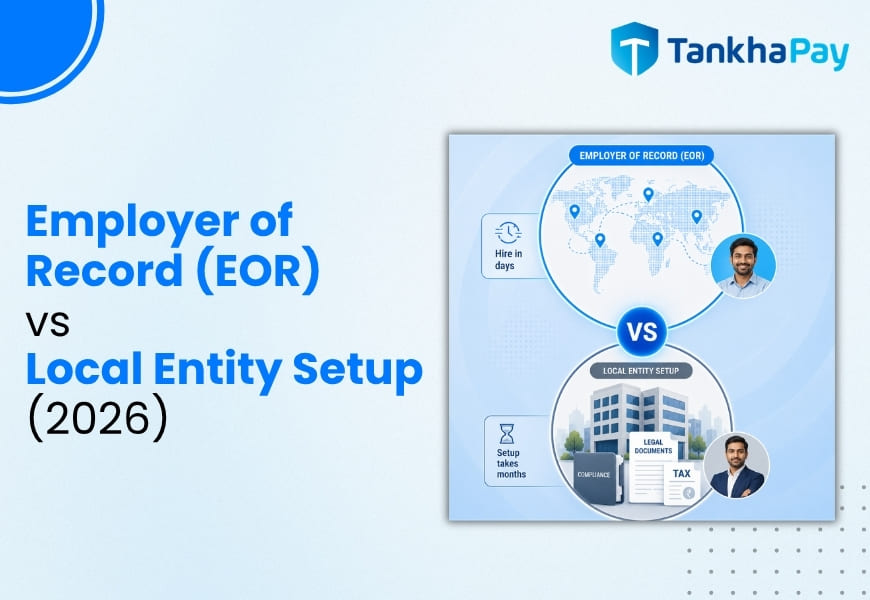
📅 Published: May 2026
🔄 Last Updated: July 2026
⏱ Reading Time: 4 minutes
TL;DR:
- Using an Employer of Record (EOR) will allow you to hire your employees in India within 5-10 business days for a cost of about ₹40,000-₹70,000 per employee monthly in services charges without creating any legal entities.
- Using a local entity such as Private Limited Company will take 30-75 days to set up the entity, with a cost of about ₹8-₹18 lakh in year one setup and compliances.
- A local entity would be ideal where you want to establish a longer presence, deal with heavy intellectual property work, provide ESOP grants, or have more than ~20 employees.
The guide comprises a breakeven analysis template, compliance checklist, explanation of the PE risk, and a 5-point decision-making process.
Last reviewed: May 2026 · Approved by a company secretary with experience in India and an international mobility expert.
Entering India or a new market is where three risks converge, legal risk, cost overruns, and time to hire. What you choose structurally in week one will decide if your entry process takes 6 weeks or 6 months, and whether the first compliance audit will be free or cost six figures.
This guide gives you the numbers, statutes, and frameworks to make that decision in a single sitting.
What Is an Employer of Record (EOR)?
An Employer of Record (EOR) is an independent agency that acts as a legal employer for your employees within another country, yet you are able to fully manage their work, output, and performance. It is because the EOR enters into employment agreements, manages payroll, pays taxes, provides contributions, and takes on labor law risks in its stead.
The Indian EOR that complies includes the following:
- Payroll processing at the end of each month in INR, including TDS calculation under Section 192 of Income Tax Act
- Contributions to EPF, which is 12% by employer and 12% by employee
- Employee State Insurance, applicable in case of ESI (3.25% employer + 0.75% employee) for wages not exceeding Rs 21,000 per month.
- Accrual of Gratuity @ 4.81% of Basic Salary
- Professional Tax
- Issuing Form 16, filing of Form 24Q every quarter
- Compliance with The Shops and Establishment Act & Code on Wages 2019 and Maternity
- POSH compliance (mandatory Internal Committee for ≥10 employees)
Types of EOR Providers
Not all EORs are equal. There are two operating models:
- Direct EORs are their own legal entities in every country they serve (e.g., the providers operating their own Indian Pvt Ltd subsidiary). Lower compliance risk, faster issue resolution.
- Aggregator/Partner EORs subcontract to local partners. Cheaper but introduces a second layer of liability and slower escalation.
For India, always verify whether the EOR holds its own PF establishment code and Shops & Establishments registration.
What Is a Local Entity Setup?
‘Local establishment’ refers to establishing a company as an individual presence within India through the registration of a Pvt Ltd company under the Companies Act, 2013, and employing employees under this organization. In this case, you will be regarded as the employer of your staff members, and it becomes your responsibility to do the rest.
Entity Options for Foreign Parents in India
| Entity Type | Typical Use Case | Setup Time | FDI Route |
| Private Limited Company (Pvt Ltd) | Operating subsidiary, full-scale hiring | 30–60 days | Automatic (most sectors, 100%) |
| Limited Liability Partnership (LLP) | Services, lower compliance requirements | 30–45 days | Automatic (with conditions) |
| Branch Office | Limited activities, RBI approval needed | 60–120 days | Approval route |
| Liaison Office | Representation only, no revenue generation | 60–90 days | Approval route |
| Project Office | Site-specific or temporary projects | 45–90 days | Approval route |
For 95% of foreign companies hiring engineers, sales, or operations talent in India, a Pvt. Ltd. subsidiary is the right answer. It permits 100% foreign ownership under the automatic route, allows revenue-generating activity, and supports ESOP issuance.
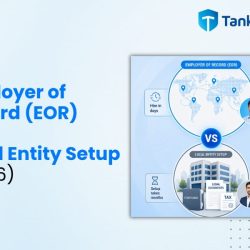
EOR vs Local Entity: Detailed Comparison
| Factor | Employer of Record (EOR) | Local Entity (Pvt Ltd) |
| Time to first hire | 5–10 business days | 30–75 days |
| Upfront setup cost | ₹0 | ₹3–6 lakh |
| Year 1 fixed compliance cost | Bundled in fee | ₹4–10 lakh |
| Per-employee monthly fee | ₹40,000–₹70,000 | None (internal cost) |
| Legal entity required | No | Yes |
| Resident director required | No | Yes (1 mandatory) |
| Bank account setup | Not required | 4–8 weeks (often the bottleneck) |
| Payroll & tax filing | Handled by EOR | Internal / outsourced |
| Statutory registrations (PF, ESI, PT, GST) | Held by EOR | Must be obtained |
| Operational control | Limited (standardized policies) | Full (custom policies) |
| ESOP / equity grants | Restricted, work around needed | Direct issuance possible |
| IP ownership | Via EOR assignment clauses | Direct, cleaner chain |
| Permanent Establishment (PE) risk | Low if structured correctly | N/A (you are the entity) |
| Termination cost & complexity | EOR manages faster. | Internal, requires legal handling |
| Wind-down cost if exiting | Contract termination only | ₹3–8 lakh + 6–12 months |
| Best for | <15 employees, market testing | >20 employees, long-term presence |
| Compliance liability | Shared (EOR primary) | 100% on the company |
Cost Comparison: Real Numbers for India Expansion
Year 1 Cost: 5 Engineers in Bangalore at ₹25 LPA Each
Employer of Record Model
- Salaries: ₹12,500,000
- The employer’s legal fees (EPF, gratuity, and administrative costs) are about ₹1,500,000.
- The EOR fee is ₹3,300,000 (₹55,000 x 5 x 12).
- Total Cost for Year 1: about ₹1,73,00,000
Local Entity Model (Pvt Ltd)
- Gross pay: ₹12,500,000
- Employer’s legal load: about ₹1,500,000 (₹150,000 for incorporation, legal, DSC/DIN, and PAN/TAN)
- ₹300,000 for registered office, accounting, and payroll software; ₹450,000 for a statutory audit, ROC filings, and a Company Secretary retainer
- HR and payroll work, whether done in-house or by a third party, costs ₹600,000.
- Director KYC and other compliance: ₹100,000
- About ₹15,600,000 for Year 1
With 5 employees, the entity is already ~₹17 lakh cheaper if you can absorb the 60–75-day setup delay. But Year 1 understates EOR savings on optionality, if the market doesn’t work, you exit in 30 days instead of winding down a company over 6–12 months.
Breakeven Analysis
Among the foreign firms which have made the changeover from EOR to entity in India, the average financial break-even point is at the level of 12 to 18 employees maintained for 18 to 24 months. At less than this number of employees, the package deal offered by the EOR and no risk of exit prevail.
A simple rule of thumb:
If (Headcount × Months in market) > 250, build the entity. Below that, stay on EOR.
Example: 8 employees × 24 months = 192 → stay on Employer of Record. 15 employees × 18 months = 270 → transition.
Permanent Establishment (PE) Risk: The Hidden Cost Most Companies Miss
It is the costliest mistake foreign employers make while recruiting in India, and there’s virtually no comparison guide discussing this issue.
“Permanent Establishment” is a concept under the tax treaty (Model Article 5 of OECD; Article 5 of India-US DTAA; Article 5 of India-UK DTAA), and if a permanent establishment is established, India can levy tax on a part of your worldwide earnings attributable to India at corporate income tax rates as high as 40% along with surcharges, regardless of your having any entity registered in India.
What Triggers PE Risk
- Fixed Place PE: maintaining an office, server, or fixed location in India for over 6 months.
- Agency PE: an India-based person who habitually concludes contracts on your behalf or negotiates the material terms of contracts (this is the most common trap with senior EOR-employed sales staff).
- Service PE: providing services in India through employees for more than 90–183 days (varies by treaty).
How EOR and Entity Models Handle PE Differently
A correctly structured EOR engagement minimizes PE risk because the EOR is the legal employer, and the worker performs services for the EOR (which then provides a service to your foreign company). However, PE risk is not eliminated; if your India-based EOR-employed VP of Sales signs MSAs on your behalf, you have an agency PE regardless of who runs payroll.
A local entity eliminates the question of PE because you have an Indian taxable entity by design. You pay Indian corporate tax on Indian-source income, and the question of treaty attribution becomes irrelevant.
Practical mitigation:
- Do not allow any EOR-related employees to sign contracts.
- Identify a scope of work which will confine Indian operations to auxiliary functions like engineering, customer success, and internal operations only.
- Ensure that no senior Employer of Record personnel have “Country Manager” positions with implied authority.
- Obtain a letter from an Indian tax advisor regarding PE risk prior to exceeding 5 employees.
EOR vs PEO vs Contractor vs Local Entity: Four-Way Comparison
Buyers regularly confuse these four models. Here’s the clean difference between EOR, PEO, and Local Entity:
| Dimension | EOR | PEO | Contractor | Local Entity |
| Legal employer | Employer of Record | Co-employer with you | Self-employed | You |
| Requires your legal entity | No | Yes | No | Yes (you are it) |
| Best country use | Foreign markets | Domestic (US-style) | Short-term, project work | Long-term presence |
| Misclassification risk | Low | Low | High | None |
| Statutory benefits | Provided | Provided | None | Your obligation |
| Typical cost | ₹40K–70K/employee/month | % of payroll | Hourly/project rate | Internal cost |
| Equity grants | Constrained | Yes | Rare | Yes |
| Termination ease | High | Moderate | Highest | Lowest |
Contractors deserve special caution in India: misclassifying an employee as a contractor invites scrutiny under the Code on Social Security 2020 and can trigger backdated PF, gratuity, and tax penalties.
Compliance Responsibility Matrix
Who handles what changes meaningfully between models. This matrix is the single most useful artefact for procurement and legal review.
| Responsibility | EOR Model | Local Entity Model |
| Drafting employment contract | EOR (using their template) | You |
| Offer letter issuance | Employer of Record | You |
| Monthly payroll processing | EOR | You / outsourced |
| TDS deduction & deposit | EOR | You |
| PF registration & remittance | EOR (under their code) | You (your own EPFO code) |
| ESI registration & remittance | EOR | You |
| Professional Tax | Employer of Record | You |
| Form 16, Form 24Q | EOR | You |
| Shops & Establishments registration | EOR | You |
| POSH Internal Committee | Generally you (workplace control) | You |
| Statutory audit (Companies Act) | N/A | You |
| ROC filings (AOC-4, MGT-7) | N/A | You |
| GST registration & returns | N/A unless you have PE | You |
| Director KYC, board resolutions | N/A | You |
| Termination handling | EOR (per labor law) | You |
| ESOP plan administration | Workaround required | You |
| IP assignment | Via EOR contract | Direct |
| Data protection (DPDP Act 2023) | Shared | You as data fiduciary |
IP Ownership, Confidentiality & Equity Grants
For software, IP, and AI companies, this section often outweighs cost. IP ownership in EOR engagements flows through a chain:
employee → EOR → your company, via assignment clauses in both the employment contract and the EOR service agreement. This chain works, but it is only as strong as the weakest contract. Insist on:
- Clear “work-made-for-hire” language; present-tense assignment language (“hereby assigns”, not “agrees to assign”)
- Release of Moral Rights to the extent permissible under law
- Confidentiality obligations surviving termination
- The enforcement rights of your firm directly against the employee (third-party beneficiary provision)
IP ownership in a local entity is cleaner because there’s no intermediary. The Indian subsidiary owns IP created by its employees and assigns it upstream to the parent under an intercompany IP assignment agreement, priced at arm’s length under transfer-pricing rules.
Equity grants, or ESOPs, make up by far the most frequent reason companies find it necessary to move from EOR to entity before the cost makes sense. No EOR can give stock option grants made by the parent company to their Indian employees without running into some sort of FEMA problem. All three alternative methods (phantom stock, cash-settled SARs, and RSUs via a dedicated plan administrator) are effective, but they aren’t as emotionally satisfying or tax-effective as an actual ESOP grant.
Setup Speed & Expansion Timeline
| Milestone | EOR | Local Entity (Pvt Ltd) |
| Provider/advisor selection | 1–3 days | 1–2 weeks |
| Documentation & KYC | 2–3 days | 1–2 weeks |
| Name reservation (RUN) | — | 2–5 days |
| Incorporation (SPICe+) | — | 7–15 days |
| PAN, TAN, bank account | — | 3–8 weeks |
| GST, PF, ESI, PT registrations | Already in place | 2–4 weeks |
| First employee onboarded | Day 5–10 | Day 45–75 |
The bank account is almost always the bottleneck for entity setup. Build a 60–75 day buffer into your hiring plan, not the 30 days that the incorporation process technically takes.
When Should You Switch From Employer of Record to Your Own Entity?
The transition usually happens 18–24 months into market entry. Use these triggers:
- A headcount above ~15–20 fixed-cost amortization flips in favour of the entity.
- Equity-heavy compensation and direct ESOP issuance become important.
- Revenue-generating activity in India, billing Indian customers or invoicing in INR, is materially easier with a local entity.
- Senior leadership hires in India, country managers, VPs of engineering, or founding India lead roles benefit from a local employer brand.
- PE risk creeping into substance, if your India team is concluding contracts or generating revenue, formalize.
- M&A or fundraising plans, investors and acquirers prefer clean ownership of Indian operations.
- Obligations under the Data Residency Clause of the DPDP Act 2023 and other sector-based guidelines.
Transition Playbook (90-Day Outline)
- Days 1–30: Incorporate Pvt Ltd; get PAN/TAN; open a bank account; do PF/ESI/PT registration; write employment agreements.
- Days 31–60: Drafting of offer letters for existing EOR employees, date of transition, equalize benefits, and setup of parallel payroll system.
- Days 61–90: Transition the entire process using the payroll cut-off date, move PF accounts, clear pending amounts to EOR, and end the EOR contract notice period.
Get an Indian employment lawyer involved from Day 1, continuity of service, gratuity accrual, and benefits parity all need to be handled correctly to avoid disputes. Companies hiring remote teams through TankhaPay often prioritize faster onboarding and payroll compliance.
Hiring in India Without a Local Entity: What You Need to Know
India is the largest source of engineering and operational talent worldwide, and EOR is the most common route for overseas companies to enter. Key details to consider:
- In India, salaries are made up of many parts (basic, HRA, LTA, special allowance, etc.) to save on taxes. This is how a good EOR will structure offers.
- It is common and legal for engineers to have notice periods of 60 to 90 days.
- Most of the time, probation lasts 3 to 6 months. Managing someone’s performance during probation is much easier than after they have been confirmed.
- Gratuity starts to build up on Day 1, but it doesn’t become available until five years later (with a few exceptions). Make sure to plan for the accrual on your books.
- Maternity leave is 26 weeks of paid leave under the Maternity Benefit (Amendment) Act 2017, non-negotiable and fully employer-funded.
- POSH compliance requires an internal committee once the workplace has ≥10 employees, regardless of Employer of Record or entity model.
Decision Framework: Choose Your Model in 5 Questions
- How many people will you hire in India in the next 12 months?
- If you’re hiring fewer than 10 → EOR. 10–20 → either, depending on Q2–Q5. More than 20 → start entity planning now.
- How long do you expect to operate in India?
- Less than 18 months or uncertain → EOR. More than 24 months committed → entity.
- Will Indian staff have contract-signing authority or generate India-source revenue?
- Yes → entity (PE risk & tax certainty). No → EOR is perfectly fine.
- Is direct parent-company ESOP issuance important to your hiring proposition?
- Yes = entity. Workaround feasible = EOR.
- Do you have internal HR, legal, and finance bandwidth to manage Indian compliance?
- No → EOR. Yes (or willing to hire a local CS/CFO) → entity.
Score: 4 or more answers favouring “entity” → start incorporation. Otherwise, begin on EOR and revisit at 12 months.
Common Mistakes Companies Make
- Considering EOR charges as the sole EOR expense. Also factor in statutory load and any upfront setup costs.
- Not considering PE risks until year two. Backdating of the tax assessment is possible.
- Misclassifying employees as contractors to avoid both EOR fees and entity setup. The cheapest model upfront, the most expensive in penalties.
- Choosing an aggregator EOR for a strategic market. Saves 10–15% in fees and costs 10× in incident response.
- Setting up a branch office instead of a Pvt Ltd because it sounds simpler. Branch offices have severe activity restrictions and require RBI approval.
- Not budgeting for the bank account delay when planning entity-based hires.
- Forgetting POSH compliance in EOR engagements (workplace responsibility usually sits with the client, not the EOR).
Which Model Is Better for You?
Apply the Employer of Record strategy if you are analyzing the Indian market, using fewer than 15 people, emphasizing speed, or are unclear about long-term commitment. If you have more than 20 employees, intend to operate for many years, make money out of India, raise funds through direct issuance of equity, or see India as the hub of R&D and GCC, adopt Pvt Ltd structure locally. At Tankhapay, businesses commonly use EOR services during early market expansion before establishing a local entity.
Frequently Asked Questions
Is an EOR cheaper than setting up a Pvt Ltd company in India?
Under 15 people for a period of about 18-24 months, yes. Over this mark, it makes more economic sense to use Pvt Ltd subsidiary because of the per-person charge of Employer of Record compared to the mostly fixed cost of having an entity.
At what headcount should I switch from EOR to a local entity?
Economically, this happens around 12 to 18 people, while strategically this decision needs to be made sooner if there are stock grants, concentrations of IP, or revenues generated out of India.
How long does it take to set up a Private Limited Company in India?
The legal incorporation process will take about 7-15 days, while the operational preparation (PAN, TAN, bank account, etc.) takes around 45-75 days.
What is the key difference between an EOR and a PEO?
An EOR is the sole legal employer and is used when you have no entity in the country. A PEO is a co-employer used in countries where you already have a legal entity (most commonly the US). In India, the relevant model for foreign companies without a subsidiary is EOR, not PEO.
Does using an EOR create permanent establishment risk?
The risk is generally low if structured appropriately; however, it is not completely nonexistent. There would be a significantly higher risk of PE if the employees hired by EOR had the right to sign contracts, created Indian-sourced income, or held senior positions.
Who owns the IP created by an employee hired through an EOR?
Your company, provided the EOR’s employment contract and your service agreement with the EOR both contain present-tense assignment language (“hereby assigns”) and the chain of assignment is unbroken. Insist on reviewing the EOR’s standard contract before signing.
Can an EOR sponsor work visas in India?
For foreign nationals working in India, yes, most established EORs can sponsor Employment Visas. The compensation threshold is currently USD 25,000 per year for non-specified categories.
What will happen to my workers if I end the EOR agreement?
My employees can either stay with the Employer of Record and be moved to a new local entity (keeping their jobs), or they can be let go with statutory notice. Give yourself at least 60 to 90 days to get used to the change.
Is EOR appropriate for employing senior executives in India?
Yes, for the heads of engineering, customer success, and operations. But for the country manager, VP of sales, and others who need to sign contracts, the risks of PE and branding usually make the case for setting up an entity.