If you have ever asked the question “Who is eligible for ESIC?” and got a vague answer such as “employees earning up to ₹21,000”, you have only just begun. In reality, the eligibility for ESIC is much more layered than a single salary figure. Moreover, with the new Labour Codes coming into force from November 2025 in India, the game has quietly but significantly shifted.
This guide breaks it all down from the foundational ESI criteria to the brand-new wage definition that’s pulling thousands of previously excluded employees into the coverage net.
What Is ESIC and Why Does Eligibility Matter?
Before getting into the ESIC eligibility criteria, let’s quickly get the context right.
ESIC (Employees’ State Insurance Corporation) is a statutory organisation established under the Ministry of Labour & Employment, Government of India. It administers the ESI (Employees’ State Insurance) Scheme, a self-financed, comprehensive social security programme that protects workers and their families against financial hardship arising from sickness, maternity, disability, workplace injuries, and death.
In short, ESIC works as a safety insurance, and as an employer, your decision to cover your employee under the ESIC scheme directly determines if they can walk into an ESI hospital, claim cash benefits during illness, or receive maternity pay without your company bearing additional costs.
Moreover, misinterpreting the ESIC qualification criteria incorrectly leads to non-compliance, penalties, and, most importantly, denies workers the benefits they are entitled to.
How Salary Structure Affects ESIC Eligibility
Here’s something most HR articles and compliance blogs haven’t addressed directly:
For many years, a large number of employers have been keeping the basic pay on the lower side to avoid ESIC liability. In simple terms, if allowances (HRA, conveyance, and special allowance) were inflated and basic pay + DA were kept below ₹21,000, the employee technically fell outside ESIC coverage. The employee lost benefits, the employer saved on contributions.
As per the new wage code under Section 2(88), wages must account for at least 50% of remuneration.
An employee earning ₹40,000 per month, with only ₹10,000 listed as “basic”, can now have ₹20,000 treated as wages, bringing them squarely within ESIC’s ₹21,000 threshold.
This is the story most companies haven’t yet fully processed. Let’s now map out all the ESI eligibility for employees from scratch, because this context matters enormously.
ESIC Eligibility Criteria and How It Works
While checking for ESIC eligibility criteria, it may appear quite simple. However, ESIC works on a structured framework. Eligibility is not only based on the individual employee but also on the organisational membership to the ESIC programme.
-
Establishment-Level Eligibility
However, for any employee to benefit from ESIC coverage, the organisation employing him/her must first qualify. In other words, ESIC can be likened to a double-key lock that has to be opened by two keys. For instance, if the organisation does not qualify, an employee earning ₹10,000/month will not be eligible for ESIC coverage.
Under Sections 1(3) and 1(5) of the ESI Act, 1948, the scheme is applicable to:
|
Type of Establishment |
Employee Threshold |
|---|---|
|
Non-seasonal factories (using power) |
10 or more persons |
|
Non-seasonal factories (without power) |
10 or more persons |
|
Shops, commercial establishments |
10 or more persons |
|
Hotels and restaurants |
10 or more persons |
|
Road motor transport undertakings |
10 or more persons |
|
Newspaper establishments |
10 or more persons |
|
Private educational institutions |
10 or more persons |
|
Private medical institutions |
10 or more persons |
|
Cinemas and preview theatres |
10 or more persons |
|
Maharashtra & Chandigarh (all categories) |
20 or more persons |
How is the employee count calculated?
The headcount for determining ESIC applicability includes all persons employed on the premises and its precincts, not just those on the permanent rolls. That means:
- Permanent workers
- Contractual and casual workers
- Trainees (who do not come under the Apprentices Act)
- Part-time workers
- Directors rendering services and drawing salaries
- Even employees who may be personally exempted from contributing (for example, those who earn more than ₹21,000) can also be included in the headcount
So a company with 6 permanent staff, 3 contract workers, and 2 trainees has 11 people and is firmly within ESIC’s ambit, even if most of them earn above the wage ceiling.
What counts as “premises”?
The ESI Act defines premises broadly. Multiple buildings used for one continuous manufacturing or business process, even if located at a distance from each other, can constitute a single “premises”. The area ordinarily accessible and adjacent to the main structure is also included. This matters for businesses with warehouses, annexes, or satellite offices.
- Once covered, always covered (mostly)
Once an establishment comes under the ESI scheme, it will remain in that category until the government allows the company an exemption from it, even if at some point it falls below the prescribed limit for the time being. It is pertinent, especially in regard to seasonal companies or those that have a volatile workforce.
- Seasonal establishments are an exception
Factories that operate for fewer than 7 months in a year and are classified as “seasonal” are outside mandatory ESIC coverage. However, the appropriate government may extend coverage to them through a separate notification.
2. ESI Criteria: Employee-Level Wage Limit
Once the establishment qualifies, it goes to the employee filter. But not all employees within an ESIC establishment automatically fall under ESIC, but rather it is based on their monthly earnings.
The Wage Ceiling
|
Category of Employee |
Monthly Wage Ceiling for ESIC Coverage |
|---|---|
|
Regular employees |
₹21,000 per month |
|
Persons with Disability (PwD) |
₹25,000 per month |
|
Daily wage workers (earning ≤ ₹137/day) |
Covered, but exempt from employee contribution |
The ₹21,000 wage ceiling has been in effect since January 1, 2017, when it was revised upward from ₹15,000. There has been no further revision since, though the new Labour Code framework is expected to functionally expand coverage without technically changing the ceiling.
What happens when an employee’s salary crosses ₹21,000 mid-year?
It is one of the least understood criteria for eligibility under ESI. The criterion states that if the earnings of an individual rise above ₹21,000 in the midst of a contribution period, they will not automatically become ineligible for coverage. The person remains eligible for coverage until the end of that contribution period.
For example, if an employee gets a salary hike in July that takes them to ₹23,000, but the contribution period runs from April to September, both the employer and employee must continue ESIC contributions through September. Coverage exists only from October 1, when the new contribution period begins.
The reverse also applies: if a new employee joins mid-period and their salary is ₹19,000, they are covered for the rest of that contribution period and the following benefit period, even if they get a hike before the period ends.
- Daily wage workers and the ₹137 threshold
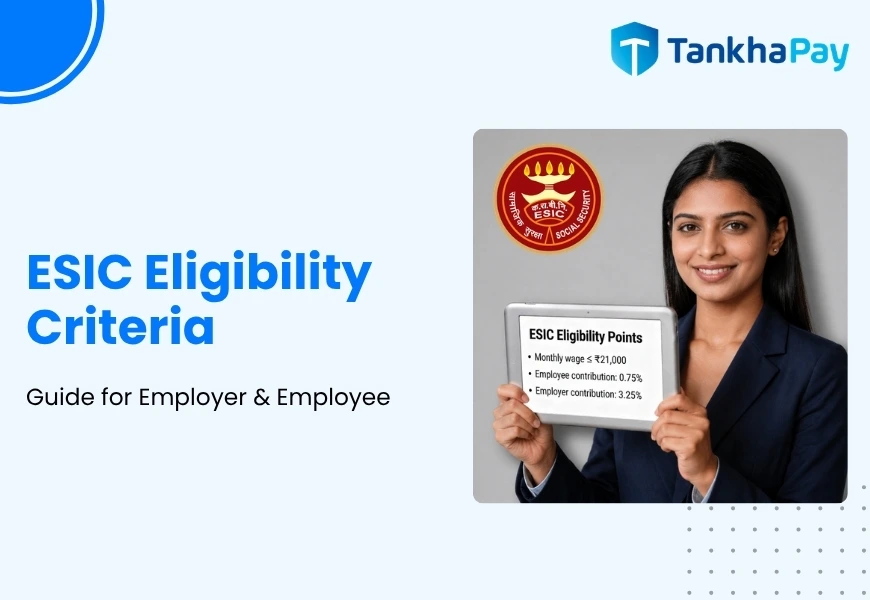
If employees’ average daily wage is ₹137 or less, then they will be exempted from the employee’s contribution of 0.75%. However, and this is very important for the employer to understand, the employer’s contribution of 3.25% will be applicable. This makes sure that even low-wage earners are covered by the ESIC scheme.
- No age-based restriction on coverage
Unlike some other benefit schemes, ESI Eligibility for Employees does not impose any minimum or maximum age limit for coverage. A 55-year-old employee earning ₹18,000 is just as eligible as a 22-year-old fresher earning the same. Age simply doesn’t factor into individual ESI eligibility.
- PwD employees, a special carve-out worth noting
Moreover, the ₹25,000 ceiling for employees with disabilities not only raises the threshold but also reflects the policymaker’s intent to ensure that individuals with disabilities, who often face higher medical expenses and job insecurity, do not lose social protection merely because their salaries are slightly higher. Additionally, it is important to note that before April 2016, no wage ceiling applied to employees with disabilities.
3. ESIC Eligibility Criteria for Employee: What “Wages” Includes
If there’s one area of ESIC compliance where even experienced payroll teams get it wrong, it’s the definition of “wages”. What counts as wages determines whether an employee crosses the ₹21,000 threshold and, therefore, whether they’re covered. Getting this wrong in either direction has consequences: over-deduction erodes employee trust, and under-coverage invites compliance action.
What is included in wages for ESIC purposes?
Under the ESI Act, “wages” have a specific meaning. The following components are treated as wages and are factored into ESIC contribution calculations:
|
Wage Component |
Included in ESIC Wages? |
|---|---|
|
Basic Salary |
Yes |
|
Dearness Allowance (DA) |
Yes |
|
House Rent Allowance (HRA) |
Yes |
|
City Compensatory Allowance |
Yes |
|
Night Shift Allowance |
Yes |
|
Overtime Wages |
Yes (included in wages for contribution, but not for determining coverage threshold) |
|
Incentives are paid at regular intervals |
Yes |
|
Production or attendance bonuses (if payable under contract) |
Yes |
|
Meal Allowance / Food Allowance |
Yes (if paid in cash) |
|
Uniform Allowance (if paid in cash) |
Yes |
What is NOT included in wages for ESIC purposes?
Not every payout to an employee counts as “wages” under ESIC. Here’s a quick look at the components that are specifically kept outside its scope and why they don’t qualify.
|
Component |
Excluded |
Reason |
|---|---|---|
|
Annual bonus (statutory or ex-gratia) |
Excluded |
Not part of contractual salary terms |
|
Gratuity |
Excluded |
Post-employment benefit |
|
Retrenchment compensation |
Excluded |
One-time settlement, not recurring wage |
|
Encashment of leave |
Excluded |
Leave is time off, not service wages |
|
Travelling allowance for official duty |
Excluded |
Reimbursement of expenditure |
|
Daily allowance (for outstation duties) |
Excluded |
Expense reimbursement |
|
Employer’s PF contribution |
Excluded |
Statutory employer cost, not employee wage |
|
Gifts, souvenirs (non-cash) |
Excluded |
Not wages by nature |
|
Gratuity paid at the time of death |
Excluded |
Compassionate payment |
- The overtime nuance often missed
Overtime wages are included in “wages” for the purpose of calculating ESIC contributions, but they are explicitly excluded when determining whether an employee crosses the ₹21,000 coverage threshold. This means if an employee’s regular salary is ₹19,000 but they earn ₹4,000 in overtime, taking their total to ₹23,000 in a given month, they are still covered under ESIC (because their regular wages don’t exceed ₹21,000). However, that month’s ESIC contribution will be calculated on the full ₹23,000.
This distinction is commonly misread in payroll systems that automatically exclude an employee from ESIC the moment their gross pay crosses ₹21,000 in any given month, that’s incorrect.
- The new 50% wage rule under Labour Codes (2025 onwards)
Under the Code on Social Security, 2020, wages (basic + DA) must constitute at least 50% of total remuneration. If allowances push the total compensation beyond the point where basic pay + DA is less than 50% of gross, the excess allowances are reclassified as wages. This directly impacts whether an employee is considered as earning “within” the ₹21,000 threshold — even if their gross salary looks higher on paper. See the detailed breakdown in the 2025–2026 update section of this guide.
Who All are Eligible for ESIC?
ESIC coverage isn’t limited to just full-time employees. The scheme extends to multiple categories of workers, depending on their wages and the nature of employment within a covered establishment.
-
Permanent Employees
An employee of any covered establishment who earns ₹21,000/month or less is eligible for ESIC. Medical facilities under ESIC start immediately from Day 1, without waiting.
-
Contract and Casual Workers
Employees hired under a contract who are working in or in relation to the activities of any factory or establishment will be eligible. Even if they are paid by another company, the responsibility still lies with the main employer.
-
Fixed-Term Employees
Under the new Labour Codes, fixed-term employees are explicitly brought under social security coverage. They are eligible for all ESIC benefits on par with permanent employees.
-
Trainees and Apprentices
Apprentices engaged under the Apprentices Act, 1961, are excluded from ESIC coverage. However, trainees on regular company rolls (not under the Act) are counted.
-
Directors Receiving Remuneration
Directors who render services and receive remuneration from the company are counted toward the headcount and may be covered if their remuneration falls within the wage ceiling.
-
Gig and Platform Workers (The New Frontier)
The Code on Social Security, 2020, officially includes gig workers in the ambit of the social security system. Although inclusion under the ESIC scheme is not automatic for gig workers at present, the legislative framework exists. In relation to “aggregators”, the question of contributions to welfare funds is getting sorted out.
ESIC Qualification: What Does the “Contribution Period” Mean?
ESIC operates on a contribution period and benefit period cycle. Understanding this is critical, because eligibility for cash benefits isn’t just about being enrolled.
|
Contribution Period |
Corresponding Benefits Period |
|---|---|
|
April 1-September 30 |
January 1- June 30 (of next year) |
|
October 1-March 31 |
July 1-December 31 (of next year) |
For most cash benefits (like sickness benefits), an employee must have contributed for at least 78 days in a contribution period to become eligible during the corresponding benefit period.
Medical benefit, however, starts from Day 1, no minimum contribution is required.
ESI Benefits Eligibility: What Covered Employees Get
Once an employee meets the ESIC eligibility criteria, here’s what they (and their family) are entitled to:
- Medical Benefits
Firstly, full medical care from Day 1 of insurable employment, for both the insured employee and their family. Importantly, there is no cap on medical expenditure under the scheme. Treatment can be availed at any of ESIC’s hospitals, dispensaries, or empanelled private facilities.
- Sickness Allowance
- 70% of salary for 91 days in a year when sick
- Should have contributed at least 78 days within 6 months
- Furthermore, ESIC extends sickness allowance up to 2 years at 80% of salary for any one of 34 long-term or cancerous illnesses
-
Maternity Benefit
- Full salary for 26 weeks maternity leave
- Can be extended by 1 week upon medical advice
- Should have contributed for 70 days within the last two contribution periods
-
Disablement Benefit
- Temporary Disablement: 90% of wages, payable from Day 1 of employment injury, no minimum contribution needed
- Permanent Disablement: 90% of wages as a monthly payment for life, based on the extent of earning capacity lost (certified by a Medical Board)
-
Dependants’ Benefit
In case of death due to an employment injury, the family receives 90% of wages per month, shared among dependants. This is a lifelong benefit.
Unemployment Allowance (RAJIV GANDHI SHRAMIK KALYAN YOJANA)
In case of the loss of employment on account of closure of establishment, retrenchment, and permanent incapacity:
- 50% of salary for a period of 2 years
- Medical attention during unemployment period
- Training costs under ESIC
- Qualification criteria: At least 3 years of insurable employment
-
Funeral Expenses
To ease the immediate financial burden during a difficult time, ESIC offers support for last rites. A lump sum of ₹15,000 is provided to the family or person who performs the last rites.
-
Post-Retirement Medical Benefit
Retired insured persons and permanently disabled employees, along with their spouses, can continue to receive ESIC medical benefits on payment of a nominal annual premium of ₹120.
ESIC Family Members Eligibility: Who Is a “Dependent”?
A lot of employees get confused at this stage. The ESI scheme extends benefits not just to the insured worker but to their dependent family members. Here’s who qualifies:
|
Family Member |
Condition for Eligibility |
|---|---|
|
Spouse |
No additional condition required |
|
Children (legitimate or adopted) |
Up to age 25; no age limit if physically/mentally challenged |
|
Widowed mother |
Wholly dependent on the insured person |
|
Parents |
Wholly dependent, no other means of income |
|
Minor brothers/sisters |
Wholly dependent, no parents alive |
|
Widowed daughter-in-law |
Wholly dependent |
|
Minor children of a pre-deceased son |
Wholly dependent |
|
Grandchildren |
Wholly dependent, parents deceased |
Key point: “Wholly dependent” means the family member has no independent income or income that is substantially less than what is required for their sustenance. There’s no income ceiling defined in absolute terms, it’s assessed contextually.
No separate registration or premium is needed for dependants. Their coverage is an automatic extension of the insured person’s coverage.
ESIC Out of Coverage Rules: When Does an Employee Exit the Scheme?
Understanding ESIC out-of-coverage rules is just as important as knowing who qualifies. Here’s when an employee exits ESI coverage:
-
Wage Exceeds the Ceiling Mid-Year
For instance, if an employee’s wages cross ₹21,000 after a contribution period has already started (e.g., they receive a mid-year hike), they remain covered until the end of that contribution period. In other words, coverage doesn’t stop the month their salary crosses the ceiling. The employer must continue to deduct and deposit contributions until the period ends.
-
Establishment Falls Below Employee Threshold
Generally, an organisation becomes ineligible for ESIC when its number of employees falls below 10 (or 20 in some states). But when an organisation is under the ESIC ambit, it cannot just come out of it.
-
Exempted Establishments
The appropriate government may grant an exemption to an establishment if employees are already receiving benefits “substantially similar or superior” to those under the ESI Act. Notably, this exemption is granted for one year at a time and must be renewed before expiry.
-
Excluded Employment Categories
These employees have been excluded from ESIC benefits:
- Under the Apprentices Act of 1961, apprentices employees
- Miners working under the Mines Act
- Employees of Railways eligible under the Railway scheme equivalent to ESI
- Seasonal workers in factories
- Service contractors (consultants, freelancers)
Contribution Rates: What Employers and Employees Pay
ESIC contributions are shared between the employer and employee at prescribed rates, calculated as a percentage of wages, as outlined below.
|
Contributor |
Rate |
|---|---|
|
Employer |
3.25% of wages |
|
Employee |
0.755 of wages |
|
Total |
4% of wages |
For employees with daily wages of ₹137 or less, the employee contribution is zero, but the employer still pays their 3.25%. This ensures that even the lowest-paid workers remain under coverage without any deduction from their wages.
Contribution deadline: 15th of the following calendar month. Both shares (employer + employee) are deposited together.
The 2026 Shift: How New Labour Codes Change ESIC Eligibility
Here’s the critical update that most blogs haven’t fully dissected:
-
The Old Problem: “Salary Splitting” to Avoid ESIC
As a matter of fact, before November 2025, there existed the method of maintaining a relatively lower figure of basic plus dearness allowance so as to avoid ESIC applicability. For instance, an employee having an aggregate gross salary of ₹35,000, where basic wages are ₹9,000, was ineligible for ESIC coverage.
-
The New Rule: 50% Wage Floor
Section 2(88) of the Code on Social Security, 2020 provides that wages comprising of Basic plus DA should form at least 50% of remuneration. All allowances that would increase the remuneration above the 50% mark become wages.
Practical Example:
|
Scenario |
Old Wage Calc |
New Wage Calc |
|---|---|---|
|
Total CTC: ₹40,000/month |
Basic: ₹10,000 → Not covered |
50% of ₹40,000 = ₹20,000 → Covered |
|
Total CTC: ₹44,000/month |
Basic: ₹12,000 → Not covered |
50% of ₹44,000 = ₹22,000 → Not covered |
In addition, this implies that workers making gross salaries up to about ₹42,000 can now come under the ESIC scheme despite no changes in the nominal salary limit of ₹21,000.
What employers need to do: Audit existing salary structures against the new wage definition. Therefore, employers must now enroll employees whose “wages” fall at or below ₹21,000, even if their gross CTC is higher.
ESIC Registration: A Quick Checklist for Employers
Furthermore, if you qualify as an establishment for ESIC registration, the following should be performed:
- Registration of your establishment on the ESIC employer portal within 15 days of qualifying
- Register all eligible employees (those earning ≤ ₹21,000) at the time of joining
- Generate ESIC cards (insurance cards) for enrolled employees and their dependants
- Deduct employee contribution (0.75%) from monthly wages
- Deposit total contribution (employer + employee) by the 15th of the following month
- File half-yearly returns through the ESIC portal
Documents required for registration:
- Registration certificate under Factories Act or Shops & Establishments Act
- PAN of the establishment
- Details of employees and their wages
- Bank account details
- Address proof of the establishment
Key Takeaways
The ESIC eligibility framework is both a compliance obligation and a genuine employee benefit. Thus, the two shouldn’t be treated as separate conversations. To summarise, here’s a quick recap:
- Firstly, establishments with at least 10+ workers (majority of states) should register with ESIC.
- Employees drawing up to ₹21,000 per month (₹25,000 for PWD) are automatically insured.
- Medical benefit starts from Day 1, no minimum contribution required
- Cash benefits (sickness, maternity, disablement) require a minimum contribution over a period
- Additionally, family members, such as spouses, children, and dependent parents, are automatically covered
- ESIC now covers all 740 districts in India, geography is no longer a limitation
Therefore, the next logical step for HR personnel, the payroll department, and business owners is not just understanding the rules and regulations. Instead, it is to make sure that the payroll system aligns with these requirements and that the salary structure complies with the new 50% wage regulation.