In this edition
- Why EOR Is Winning the First-Move Advantage?
- 1. Speed Is Now a Competitive Advantage
- 2. Compliance Risk Has Become Investor Sensitive
- 3. Global Talent Arbitrage Is Now Normalised
- When Scale Changes the EOR Equation
- When Should You Stop Using EOR?
- 1. Stable, Scaled Headcount in One Market
- 2. Need for Full Strategic Control
- 3. Long-Term Cost Optimisation
- A Phased Growth Strategy
- Phase 1: Market Validation & Speed
- Phase 2: Structural Commitment & Ownership
- Phase 3: Hybrid Optimisation (Optional but Increasingly Common)
- Where Does TankhaPay Fit Into This?
- So, is EOR Becoming the Default?
Over the last five years, something fundamental has shifted in global hiring.
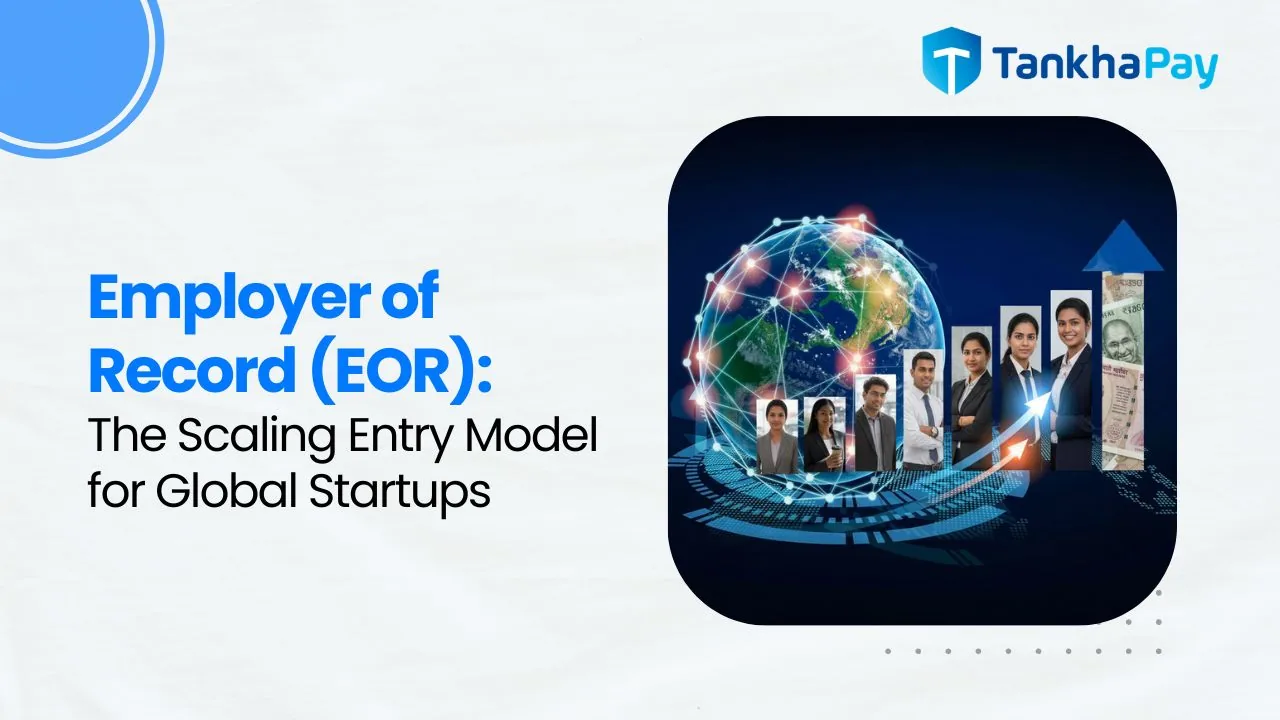
Startups no longer ask, “Should we hire internationally?” They ask, “How fast can we?” That shift is precisely why the Employer of Record (EOR) model has moved from being a niche compliance solution to a mainstream hiring infrastructure.
According to employer records, the EOR market is set to rise to an estimate of 7.45 billion USD by the end of 2026, having been approximately 6.8 billion USD in 2025. This is an indication of the rise in the use of EOR services as businesses seek to hire quickly and compliantly in the face of the ongoing trend in remote working.
2025–26 usage data also indicates that roughly 35% of companies hiring internationally were using EOR models by 2024, and nearly 47% of mid-sized firms had adopted EORs to manage remote teams or payroll, signalling that EOR is moving into mainstream workforce strategies rather than remaining a niche solution.
So the real question isn’t whether EOR is growing.
The real question is:
Is EOR becoming the standard hiring model for multinational startups?
Well, yes, more and more in the early stages of expansion. Constancy, however, is a different matter.
Why EOR Is Winning the First-Move Advantage?
Three structural realities explain the rise:
1. Speed Is Now a Competitive Advantage
In markets such as India, the process of establishing a business, which includes labour compliance, payroll, bank account opening, tax registration, and company registration, can take months. EOR helps in completing and accelerating the whole process in a few days or weeks. This is more than just a procedure for a startup rushing to meet Series B objectives or product-market fit; it's a competitive advantage.
2. Compliance Risk Has Become Investor Sensitive
Payroll non compliance, the prospect of a permanent establishment and misclassification have become significant HR challenges that can’t be overlooked. These issues demand careful attention, as they can affect valuations and M&A transactions. With regulatory scrutiny increasing around the world, founders are leaning more towards risk mitigation rather than taking chances. An EOR provides the necessary employment infrastructure without the hassle of hiring a separate in-house legal team.
3. Global Talent Arbitrage Is Now Normalised
Remote-first operations are no longer experimental. Engineering hubs in India, Eastern Europe, and Southeast Asia are core to global operating models. For startups without the capital or certainty to open subsidiaries in every geography, EOR offers a capital-efficient bridge. And this is why, for early-stage global hiring, EOR is increasingly the default. But default does not mean destination.
When Scale Changes the EOR Equation
EOR is structurally designed for market entry and risk mitigation. It is not designed for long-term structural ownership.
At small scale: 3, 5, even 10 employees, EOR is efficient.
At larger scale: 25+ employees in one jurisdiction, the economics and control dynamics begin to shift. This is where leadership teams must reassess. Because the question evolves from: “How do we hire fast?” to “How do we build sustainably?”
When Should You Stop Using EOR?
1. Stable, Scaled Headcount in One Market
When the country moves from being just another experiment to being another key operating location, ownership makes sense.
2. Need for Full Strategic Control
Equity structures and benefits packages are designed to meet each other’s needs. Leadership appointments are made locally. EOR may run the operations, but only they have the right to employ. And when you scale, this becomes important.
3. Long-Term Cost Optimisation
EOR fees are often presented as flat monthly fees or as a percentage of payroll. They’re inexpensive at the outset, but as time progresses, the cost can become more than it would take to operate a compliant local entity. This isn’t the model’s fault; it’s simply the natural progression of the life cycle.
A Phased Growth Strategy
The most strategically evolved businesses don’t look at EOR as a binary decision. They see it as part of a phased infrastructure.
Phase 1: Market Validation & Speed
When to use EOR:
You are testing a new market
Your headcount is still experimental
Speed is more important than rigid structures
You need compliance without setting up an entity
In this phase, EOR helps remove friction and save capital. It’s a ‘wait and see’ approach, deciding if this market is strategic or a 'one-off'.
Phase 2: Structural Commitment & Ownership
When to transition to a local entity:
Geography is now operationally critical
Your headcount is now stable and scalable
You need more complex equity structures
Cost efficiency is more important than flexibility
In this phase, ownership is more important than flexibility.
Phase 3: Hybrid Optimisation (Optional but Increasingly Common)
Generally, mature global firms operate with a combination of
Entity structures centred on their primary hubs
EOR structures for their secondary or exploratory markets.
This allows them the strategic flexibility of tight control when it matters most and flexibility when it’s uncertain.
Where Does TankhaPay Fit Into This?
It is not easy to go from the framework to real execution. Going from EOR to a real entity or even opting for a hybrid solution involves more than just the structure and entails:
Moving employment contracts
Ensuring statutory transfers are made
Ensuring payroll operations are smooth
Tax considerations
Ensuring employee consent is managed properly
Managing risks in the process of restructuring
This is where many businesses have found the first major roadblock in implementing their lifecycle strategy. The lifecycle strategy will only pay off if the operations have been designed from the get-go to support it. This is where platforms like TankhaPay have found the first major advantage over the traditional approach of considering EOR as an isolated solution.
So, whether a company is:
Testing the waters in India through an EOR
Making the leap toward transitioning to an entity
Or managing a hybrid structure across different markets
The key to keeping operations running smoothly is that global hiring isn’t just about stepping into a new market. It’s about growing and adapting within it, all without missing a beat.
So, is EOR Becoming the Default?
For international startups in their early stages? Yes, more and more.
For global architecture in the long run? Not always.
Instead of being the permanent chassis, EOR is now the standard entry vehicle. Also, founders who are aware of this distinction create more strong international organisations. The error is not in applying EOR but rather in never reevaluating it.
Talent access is no longer the only factor in global expansion. Using talent strategically as you grow is the key to global expansion. EOR makes it easier to get started, which is very important. But you have to expand if you want to truly expand. Knowing when to switch from flexible staffing to direct ownership is what separates strategic expansion plans from casual hiring.
Does this change anything in your own payroll setup?
Our team can review your current payroll and compliance process against the rules covered in this edition. You get a clear view of where you stand, with no obligation to switch anything.