TL;DR
- Attendance and payroll software is one calculation chain: punch-in → paid days → gross wage → PF, ESI, PT and TDS → payslip and statutory registers.
- It becomes much more important in 2026 than it was when most guidelines were written because the Labour Codes became applicable from 21st November 2025, providing double wages for overtime work and appointment letters that become necessary.
- Loss of pay has two accepted calculation conventions that produce different deductions for the same absence, which is the single largest source of payroll disputes.
- PF registration becomes mandatory at 20 employees; shifts, field staff, or contract workers make integrated software necessary well below that.
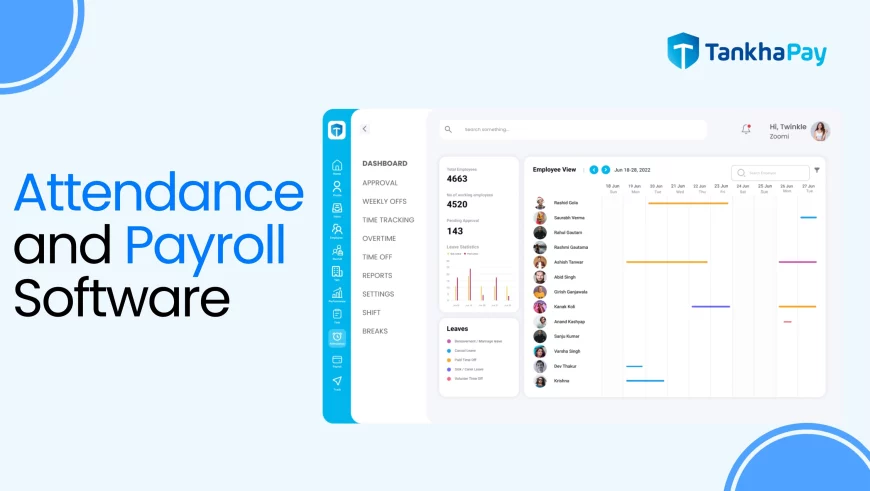
Attendance and payroll software link employee time data directly to salary calculation. Attendance decides paid days, loss of pay, overtime and leave deductions, and payroll turns those into a wage figure with the correct statutory deductions. When the two run as separate systems, someone re-enters the data by hand every month, and every re-entry is a chance for a wrong salary.
What does attendance and payroll software do?
The table below covers the full function set. The last two rows are where most systems separate: a tool that tracks attendance well but produces no statutory register is an attendance system, not an attendance and payroll system.
| Function | What it handles |
|---|---|
| Time capture | Punch-in and punch-out via biometric, GPS, facial recognition or mobile app |
| Leave and absence | Casual, sick, earned and comp-off balances, applied to payroll automatically |
| Loss of pay | Unpaid absence converted into a salary deduction |
| Overtime | Hours beyond the statutory limit, paid at double the ordinary rate under the Labour Codes |
| Shift and roster | Night shifts, split shifts, shift differentials |
| Salary computation | Paid days multiplied by rate, minus deductions |
| Statutory deduction | PF, ESI, Professional Tax and TDS calculated on attendance-linked wages |
| Payslip and register | Payslips for employees, statutory registers for inspection |
Why does attendance need to connect to payroll at all?
Attendance is not a report. It is an input to a wage calculation, and in India it is also evidence. Three things depend on it directly.
- Paid days: salary is computed on days actually worked plus paid leave, and attendance decides that number.
- Statutory wages: PF and ESI are calculated on wages actually paid, so if loss of pay reduces the wage, it reduces the contribution.
- Proof: during a labour inspection, the attendance record is what supports the wage figure you filed.
What changed under the Labour Codes that affects attendance and payroll?
All four Labour Codes took effect on 21 November 2025, replacing 29 central labour laws, and three of their provisions run straight through attendance data.
First, overtime. The Ministry of Labour and Employment states that the new codes guarantee double wages for overtime, and the only way to prove overtime hours is a time record created when the work happened, not reconstructed later.
Second, the wage definition: A minimum of 50% of the total salary must include the base salary as well as the dearness allowance. This affects the calculation basis of PF/ESI deduction as per attendance. The third requirement is that every employee must have an appointment letter, and the full and final settlement should be done within two days of leaving the company. The two-day deadline applies to updated records of attendance and leave on the day of leaving.
“These reforms are not just ordinary changes but the Government’s Guarantee of Dignity for Every Worker.”
— Dr. Mansukh Mandaviya, Union Minister of Labour and Employment, on the Labour Codes, 21 November 2025
Another 2026 amendment you should be aware of is the introduction of the Income-tax Act of 2025 into effect from 1 April 2026. Also, it should be noted that according to the Income-tax Act, payroll forms have been renumbered. Form 16 has been renamed to Form 130, whereas Form 24Q is now Form 138.
What breaks when attendance and payroll are separate?
This is the part most guides skip, and it is the reason companies switch.
- Cut-off problem. The payroll department requires that final attendance be provided on a specific day, usually the 25th. Any delay results in two scenarios: the attendance is processed without final details, and corrections are made the following month, or payment is delayed. Usually, the latter is chosen, which implies that every month brings corrections from the previous one.
- Mismatched periods. Attendance operates in terms of calendar months. Payroll operates from the 26th to the 25th. Thus, if overtime is worked on the 28th, it ends up in a separate period than the salary.
- Two versions of a leave balance. HR’s leave tracker says four days left. Payroll’s sheet says two. Whichever one processes the salary becomes the truth, and the employee finds out from the payslip.
- No single audit trail. An inspector asks how a wage figure was derived. With separate systems, the answer requires reconciling a biometric export against a spreadsheet against a payslip. With an integrated system, it is one record.
- Overtime computed on the wrong base. The overtime rates are twice that of the usual rate of pay under the labour codes. When the time registration system records the hours but does not record the base for the pay, there will be manual multiplication done, which leads to errors.
How does attendance data become a payslip?
Six steps, and one of them deserves scrutiny before you buy anything.
- Capture: The employee punches in and out.
- Validation: missed punches, regularisation and authorised leaves get sorted out, which takes up maximum manpower, not the calculations.
- Paid Days: Present days + Leave days + Holidays; absence without leave gets adjusted into loss of pay.
- Salary Calculation: Paid days are converted into gross salary, and overtime gets doubled.
- Statutory deductions: PF, ESI, Professional Tax and TDS get deducted on the attendance-based salary, not on the cost-to-company (CTC) salary as stated in the offer letter.
- Output: Payslip for the employee and statistical records for filing.
Step two is the one to ask vendors about. Every platform does step four well. Not every platform makes step two quick.
How is loss of pay actually calculated?
Loss of pay is the single largest source of payroll disputes in India, because two accepted conventions exist and companies do not always state which one they use.
- Calendar days method: monthly gross divided by total days in the month, multiplied by LOP days. Gross of ₹30,000, month of 31 days, 2 LOP days: per-day rate ₹967.74, deduction ₹1,935.48.
- Working days method: monthly gross divided by working days only. Same gross, 26 working days, 2 LOP days: per-day rate ₹1,153.85, deduction ₹2,307.69.
The same absence costs the employee ₹372 more under the second method, and the gap widens in months with more holidays. Neither method is wrong. What creates disputes is applying one convention in the policy document and the other in the spreadsheet. An integrated system applies one rule consistently and shows it on the payslip. Ask any vendor which method their system uses and whether it is configurable or not.
Which attendance capture method should you use?
Most companies need two methods, not one. The manufacturer will conduct biometric scanning at the gate while GPS tracking is done by the managers who move around different sites. Ensure that the system allows for mixed data collection in a single payroll cycle, since most cannot.
| Method | Best for | Watch out for |
|---|---|---|
| Biometric fingerprint | Factory floor, single fixed site | Fails with worn fingerprints, common in manual trades |
| Facial recognition | Hospitals, food handling, anywhere touch is discouraged | Needs adequate lighting, higher device cost |
| GPS and geofencing | Field sales, logistics, site supervisors | Requires a smartphone and a clear policy on location data |
| Mobile app punch-in | Office and remote teams | Easiest to misuse without geofencing or photo capture |
| Card or RFID | High-volume entry points, large factories | Cards get shared, which defeats the purpose. |
| Manual or Excel import | Very small teams, or migration | No audit value, since the record can be edited after the fact |
Do you actually need attendance and payroll software?
Headcount is the wrong first question; complexity is the right one. But three thresholds genuinely change the answer.
- If under 15 employees, one office location, same fixed salaries, and no shift duties: register and spreadsheet continue to serve if maintained well by an individual.
- If 20 employees or more: PF registration becomes an important contribution per month as per the EPF Act of 1952 (and ESI becomes applicable from 10 employees in most states), and attendance ceases to remain internal accounting and starts appearing in statutory returns.
- At the second location or the first shift roster, this is the actual trigger, which happens regardless of numbers. A factory having 40 employees operating on two shifts with overtime has more challenging attendance payroll than an office of 150 employees.
Regardless of size, software is the practical choice if you employ contract workers alongside direct employees, any part of your workforce does not report to a fixed location, you have received an EPFO, ESIC, or labour department notice, or overtime is regular rather than exceptional.
What do attendance records have to prove under Indian law?
This is where attendance and payroll stop being an efficiency question.
Establishments under the Factories Act framework maintain a muster roll and register of workers in the form prescribed by state rules; establishments under a state Shops and Establishments Act maintain attendance and wage registers, with state-wise variation. The Labour Codes are progressively consolidating these registers, with central and state rules still being notified, until your state’s rules arrive, and the existing register requirements continue to apply.
The inspection will normally include the following:
- the accuracy of the attendance record in relation to the amount of salary paid out,
- Whether the overtime was recorded and payment was made at twice the rate of normal,
- adherence to statutory time limitations on working hours,
- the presence of contract labor on the premises in the register, and
- the availability of the register on request in the required format.
The last-mentioned factor is significant, since the ability to provide a document next week does not mean the ability to provide it during the inspection.
For the full statutory calendar, see the payroll compliance checklist. For which Acts apply to your sector, see how payroll compliance changes across industries.
How does this differ by industry?
The core calculation starts from punch-in to paid days to wage, and it is the same everywhere, but the capture method and the compliance stakes shift with the workforce. Here is what changes sector by sector in payroll.
- Manufacturing. Biometric attendance, shift differential pay, overtime pay at the statutory rate, and contract staff whose attendance you will be accountable for.
- Healthcare. 24/7 maintaining rosters, differential for night shifts, and a large contract workforce within housekeeping and security. Facial recognition beats fingerprint here.
- Logistics. Drivers and field staff not having a stationary office to come to. GPS is not just an option but the only acceptable way to keep attendance records.
- Retail. Multiple stores, store-wise Professional Tax, high turnover, and full and final settlements that now have a tight statutory window.
- Construction. Site-based daily wages, migrant workers, and attendance that has to be captured where there may be no fixed infrastructure.
- IT and software. Remote and hybrid teams, no biometrics, and Professional Tax by each employee’s registered work state rather than the office location.
What does attendance and payroll software cost in India?
There is no single price for attendance and payroll software in India because the market runs on two very different pricing structures. What you pay depends on your headcount, whether you need hardware at your sites, and which of the two models the vendor follows. Both are explained below.
- Per employee per month. For most cloud-based solutions. The cost increases with the number of employees, with no initial setup fee, and this is how SME payroll is structured in India
- License plus implementation. Enterprise systems and on-premise deployments. Higher first-year cost, lower per-employee cost at scale.
Two costs that are usually quoted separately and should be asked about upfront: biometric or facial recognition hardware and any per-device charge for attendance terminals. A quote that covers software but not devices is not a complete quote.
For a fuller breakdown across platforms, see payroll software pricing in India.
How do you choose the right system?
Most platforms look identical in a demo. They all show a punch-in screen, a payslip, and a dashboard, so the demo alone will not tell you which one fits your workforce. The difference shows up in the specific questions below, and any vendor worth signing with should answer all six without hesitation.
- Which punch-in & out methods does it support, and can it mix them in one payroll run? Most workforces need two.
- Which loss-of-pay method does it apply, and is it configurable? First thing to ask before you sign.
- Does it generate the statutory registers your Act requires, or only reports? These are different things.
- Does it compute overtime at the statutory rate automatically, or does it export hours for someone to multiply?
- How long does attendance validation take in a normal month? Ask for the real number, not the demo number.
- Does it handle contract workers alongside direct employees on separate, correct tracks?
Conclusion
Attendance and payroll software are not two different tools that are locked in together. They are just part of one formula that goes from an employee clocking in to determining their pay to filling out their mandatory forms, and as of 21 November 2025, all those filings will have to abide by new standards regarding double time, letters of appointment, and exits within two business days.
Not whether they have biometric capability or payslip generation, since everyone else does this. The questions are what their loss-of-pay process is and whether they can produce the register forms you require under your Act; and how long the actual validation process takes in a regular month.
If you are unsure which capture method and which statutory framework apply to your workforce, Book a Strategy Call and we will map it against your locations, shift patterns and workforce mix.
FAQs
What is attendance and payroll software?
It is a system that links employee time data to salary calculation. Attendance determines paid days, loss of pay and overtime, and payroll converts those into wages and statutory deductions, without anyone re-entering data between the two.
What is the difference between attendance software and payroll software?
Attendance software tracks who comes to work. Payroll software computes their salaries. Attendance and payroll software link these two processes in such a way that attendance information enters into salary calculation automatically instead of being exported manually each month.
How does attendance data affect salary?
It impacts the number of paid days, which in turn impacts gross salary. It impacts the number of losses of pay, overtime and leave. Since PF and ESI deductions are based on salary, attendance impacts these deductions as well.
How is loss of pay calculated?
There are two approaches. One divides the monthly gross by the number of calendar days, and the other divides by the number of working days. The latter results in a higher loss of salary for the same period of absence. Check which approach your system follows.
Is attendance and payroll software required by law in India?
No. What the law mandates is accurate records of attendance and wages in the prescribed form, not software. This is just the means by which employers comply with the law after manual records become impractical.
How is overtime paid under the new Labour Codes?
The Labour Codes, in force since 21 November 2025, provide for double wages for overtime. The attendance record is what proves the hours, which is why overtime and time capture must sit in one system.
Which attendance method is best, biometric or GPS?
There is no single answer; biometrics works well for stationary facilities, while GPS is more suitable for mobile workers. Most organizations that have both require a combination of both systems in one platform.
At what headcount should we get attendance and payroll software?
With twenty employees, it becomes necessary to register under PF rules. But other factors such as shift work or multiple locations can make it essential before then.
Can it handle contract workers?
Good systems process contractors on a different path from the others since the principle employer will be liable and attendance must therefore be recorded even if you don’t pay them directly.
What happens to our data if we switch systems?
We export our history of attendance, payroll, and master data for employees and import it during parallel runs. Verify the export format before contracting since portability differs vastly among vendors.
TankhaPay is a global HR platform by AKAL Information Systems Ltd., delivering HRMS, payroll, and Employer of Record (EOR) solutions to businesses worldwide since 2000. Backed by AKAL, a CMMI Maturity Level 5 appraised and ISO 9001, ISO/IEC 20000-1, and ISO/IEC 27001 certified technology company. TankhaPay serves over 1,000 organizations with secure, scalable, and compliance-driven workforce solutions.