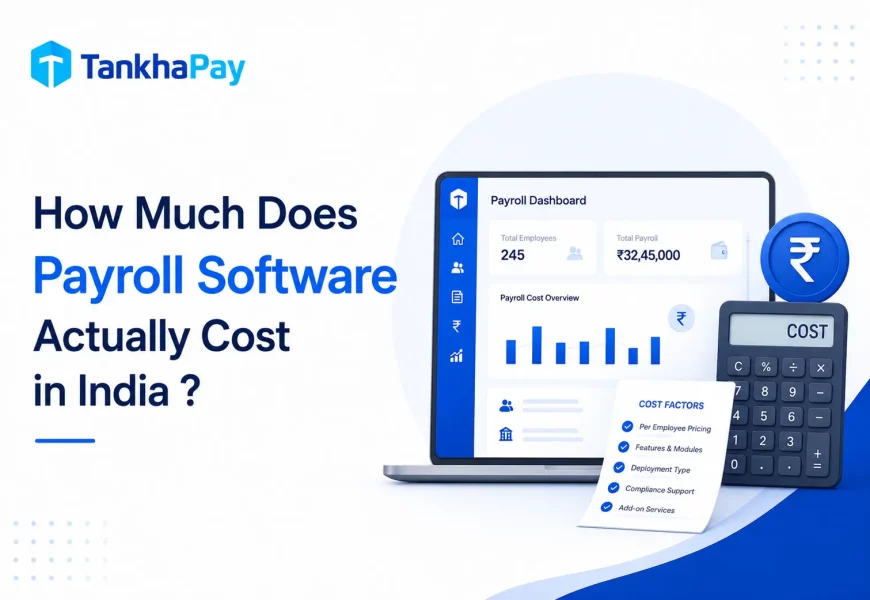
Payroll software cost in India varies by deployment type and compliance coverage. It typically runs INR 30-100 per employee per month for cloud-based payroll software, and INR 100-250 per employee per month for HRMS platforms with full compliance automation.
If you choose to outsource the entire process, then it will be costlier than the above. It will cost INR 150 per month per employee for basic payroll processing, whereas it can even go up to INR 800-2,500 or more for a complete service. The cost of setting up and implementing the payroll software will be one-time at INR 5,000-30,000.
This guide breaks down what drives that range, what most vendors don’t mention upfront, and how to calculate whether a given price is actually good value for your business, not just low.
What Affects Payroll Software Price?
Six factors do most of the work in determining what you’ll actually pay, more than any single “per employee” headline figure on a pricing page usually suggests. Knowing these upfront makes it easier to tell whether a quote is genuinely competitive or just cheaper-looking on paper.
- Employee count: Almost all vendors charge per user per month, although pricing may vary based on the number of users. For example, a portal that charges Rs 80/user/month when the count is 50 may charge Rs 50/user/month when the number is 500.
- Compliance scope: Basic salary calculation costs less than a platform that also files PF, ESI, TDS, and Professional Tax returns on your behalf. This is the single biggest driver of the gap between the affordable and most expensive options in this category.
- Number of states you operate in: Professional Tax and Labor Welfare Fund rules vary by state. A platform covering one state’s rules costs less to build and maintain than one covering all 28.
- Integration requirements: Whether the software needs to connect to an existing HRMS, attendance system, or accounting platform affects both the subscription price and the implementation cost.
- Workforce type: Platforms built only for salaried, on-roll employees are cheaper than those handling contract, off-roll, and project-based workers who receive different compliance treatment.
- Support model: Self-service platforms with ticket-based support cost less than platforms offering a dedicated account manager or compliance specialist.

What’s the Average Price of Payroll Software in 2026?
Vendor pricing pages do not allow for easy comparison because each vendor packages and prices its services in different ways. Below is a market pricing structure based on published prices by leading payroll vendors in India:
| Tier | Typical Price | What’s Included |
|---|---|---|
| Basic cloud payroll | INR 30-100/employee/month | Salary calculation, payslips, basic statutory calculation |
| Full-suite HRMS + payroll | INR 100-250/employee/month | Payroll, attendance, leave, self-service portal, compliance filing |
| Enterprise/custom | Custom quote | Multi-entity, multi-state, dedicated support, SLA-backed |
| Fully managed outsourcing | INR 800-2,500+/employee/month | Software plus a compliance team running the entire process |
For the full vendor-by-vendor pricing comparison across 16 platforms, see Payroll Software in India.
One thing most pricing pages don’t make clear: the headline per-employee rate is rarely the full cost. Setup fees, minimum billing thresholds, and add-on charges for features like multi-state PT or contract worker payroll are often quoted separately, sometimes only after you’ve already started evaluating a vendor.
What Pricing Models Do Payroll Vendors Actually Use?
It is not necessarily true that all the vendors price the same, and even more so that the pricing model counts more than the actual rate. What may be a very low rate when applied to 20 people can be a very costly one when applied to 60 people. There are basically four models you will encounter on the market:
- Per Employee Per Month (PEPM). The most widely used model. It scales up or down with the number of employees, but the per-unit rate usually changes depending on volume.
- Flat monthly fee. Common for smaller vendors serving businesses under 50 employees. Simpler to budget, but can become expensive relative to PEPM pricing once headcount grows past the tier it was designed for.
- Tiered pricing. Rates changed at defined employee-count brackets (for example, up to 25, up to 50, and up to 100 employees). So, it is worth checking exactly where your business sits relative to the next tier boundary before signing, since crossing it mid-year can trigger a re-quote.
- Custom enterprise pricing. Negotiated directly for large, complex, or multi-entity organisations. No published rate, which means comparing quotes across vendors requires asking for a full breakdown, not just a single number.
What Hidden Costs Do Businesses Often Miss?
The published subscription price is rarely the total cost, and this is where most budget surprises actually come from. Based on categories that consistently show up in vendor contracts but rarely appear on marketing pages, here’s what to budget for beyond the sticker price:
- Implementation and data migration. Moving employee records, historical payroll data, and salary structures from a legacy system or spreadsheets into a new platform. For a business of 50-200 employees, budget two to four weeks for this specifically, or longer if existing data quality is poor. See the Payroll Software Implementation Guide for the full phase-by-phase breakdown.
- Integration costs. Integrating payroll to an existing attendance system, HRMS, or accounting software isn’t always added to the base subscription. Ask whether API integration is a standard feature or a paid add-on.
- Training time. No matter if it is formal or informal. Someone on your team spends real hours learning a new system, and that time has a cost even when the vendor doesn’t itemize it.
- Off-cycle processing fees. Running an unscheduled payroll cycle, for a bulk exit event or an error correction, sometimes carries a separate charge not visible in the standard monthly quote.
- Compliance updates that aren’t automatic. In some of the lower-tier plans, there may be an additional fee to keep up to date on compliance changes. As TDS forms have been renumbered in the Income Tax Act, 2025 (for example, Form 24Q is now Form 138, and Form 16 is now Form 130), check if this update comes free in your vendor’s core plan.
- The cost of a compliance penalty from a vendor error. This is the one and only actual “hidden cost”, which is related to risk rather than cost. Under Section 14B of the EPF Act, failure to make PF payments will attract penalties in the form of damages. Damages at 1% per month on the amount outstanding, starting from a change in rates in June 2024, besides 12% interest annually under Section 7Q. The maximum outer statutory limit of the damage as per the Act is 100% of the arrears, which can only be achieved in a scenario of default for more than eight years. In any case, if there is no clear agreement within the contract specifying who should pay this cost in case of vendor delay, then the very absence of clarity amounts to a cost.
How Does the Price of Payroll Software Break Down by Business Size?
The number of employees, functionality (just payroll or also HR & payroll), and how the software provider charges for its product will all impact the true cost, which explains why two companies with the same number of employees can end up paying vastly different sums. Below is a rough estimate by company size:
| Business Size | Typical Monthly Cost |
|---|---|
| Up to 10 employees | Free to INR 1,500 |
| 10-25 employees | INR 1,000-3,000 |
| 25-100 employees | INR 3,000-10,000 |
| 100+ employees | Custom pricing or INR 50-200 per employee/month |
Startups (under 25 employees)
Several platforms offer free or near-free tiers at this size, greytHR and Zoho Payroll both offer a genuinely free plan for very small teams, and Zoho’s paid Standard tier is priced around INR 1,000/month for up to 25 employees (worth confirming directly, since vendor pricing moves). The real cost driver at this stage isn’t the software, it’s whether you have the internal capacity to run it correctly every month without a dedicated payroll resource.
SMEs (25-200 employees). Here comes the significance of per-user pricing over fixed pricing, as well as the difference in price between basic and all-inclusive solutions. You should prepare for annual expenses of about INR 60,000-400,000 depending on the number of employees and functionalities.
Enterprises (200+ employees). Custom pricing is the rule, and here the comparison is made not in terms of “price per employee” but in terms of the total cost of ownership (implementation, integration, maintenance), because a lower per-user price may be offset by a longer implementation process or worse support of multiple entities.
Payroll Software or Payroll Outsourcing: Which Costs More?
Software and outsourcing aren’t priced the same way, and comparing a software subscription directly against an outsourcing quote without adjusting for scope produces a misleading comparison.
Payroll software (roughly INR 30-250/employee/month) gives you the platform; your team still runs it. Payroll outsourcing spans a much wider range depending on tier, from around INR 150/employee/month for basic processing up to INR 800-2,500+/employee/month for fully managed service and includes a provider’s team actually executing the process, carrying more of the compliance workload as part of what you’re paying for.
The wider cost gap at the high end reflects real, different services, not the same thing priced differently. A INR 2,500/employee/month managed outsourcing quote and a INR 100/employee/month software subscription aren’t comparable line items unless you also account for what an internal payroll resource would otherwise cost you to run that software correctly.
For the full comparison, see Payroll Software vs. Payroll Outsourcing.
How Do You Actually Calculate the ROI?
The following is an illustrative example to demonstrate the calculation method, not a universal benchmark to compare yourself against directly. Your actual numbers will depend on your current process, headcount, and error rate; the method matters more than these specific figures.
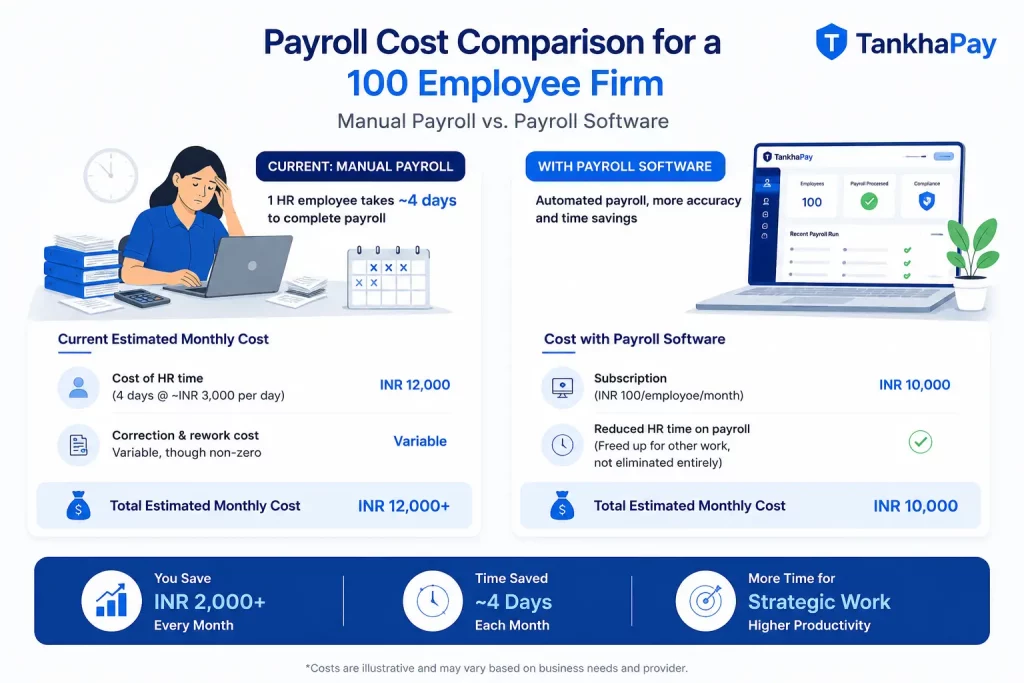
In this case, the direct subscription fee is pretty much equal to just the estimated time cost right now, without even taking into account reduced risk of errors and the value of freed-up time of the HR department in doing other things. That’s when it gets real for an ROI calculation – not from huge reductions in direct cost per month.
What Should You Actually Ask Vendors About Pricing?
It is very rare for the quoted rate to tell you all that there is to know until you probe a little bit on certain questions and see what answers pop up. The responses generally offer more insight into overall cost than the quote itself does. Be sure to clarify before signing anything:
- Is the rate quoted per employee, per month, or is it a fixed rate, and does it scale up at certain headcount thresholds?
- Does compliance filing come under the same cost, or is it additional?
- What is the cost of implementation, and does it include data migration?
- Are off-cycle payroll runs charged separately?
- Does the price include updates for regulatory changes, such as the recent TDS form renumbering?
- What happens to pricing if you cross into the next tier mid-contract?
- Is multi-state Professional Tax support included, or does each additional state cost extra?
- What’s the cancellation or switching process, and are there exit fees?
For the fuller version of this checklist covering more than pricing, see Questions to Ask a Payroll Provider.
What Mistakes Do Businesses Make When Comparing Pricing?
Most pricing comparisons go wrong in a handful of predictable ways, and those ways tend to favour whichever vendor’s marketing page is best at hiding scope rather than the vendor that’s actually the better fit. These are the mistakes worth watching for specifically:
- Comparing the headline rate without checking what’s included. A platform that charges a premium for compliance filing, INR 40 per employee, could actually be costlier than a system with filing already included for INR 100 per employee.
- Ignoring the cost of your own team’s time. The cheapest software still requires someone to run it. If that person’s time isn’t factored into the comparison, the “cost” of the cheap option is understated.
- Not asking about multi-state pricing upfront. A quote based on single-state operations can change significantly once you expand, and finding this out after signing is a common source of budget surprises.
- Treating implementation as a one-time sunk cost outside the pricing conversation. That’s included in the total cost of ownership, and it may well be that a vendor with lower subscription costs and high-cost implementation isn’t the less expensive alternative overall.
- Assuming a higher price always means better compliance coverage. In most cases, that’s true. But there are situations where an enterprise price is charged by the vendor for a solution that has compliance coverage equal to or even inferior to a mid-range competitor.
When Does It Make Sense to Move Off Spreadsheets?
Cost comparisons only matter once you’ve confirmed you actually need dedicated software rather than a well-run spreadsheet. For the specific signals that indicate you’ve outgrown manual processing, see Signs You Need Payroll Software and Running Payroll: Excel vs. Software.
A business that is expanding into a new state or rapidly increasing its workforce usually surpasses this number sooner than expected. For details on this transition, see Payroll Challenges During Business Expansion.
Have More Questions About Pricing?
How much does payroll software cost per employee in India?
Basic cloud payroll platforms run INR 30-100 per employee per month. Full-suite HRMS platforms with compliance automation run INR 100-250 per employee per month. Payroll outsourcing spans a wider range depending on scope, from around INR 150 for basic processing up to INR 800-2,500+ per employee per month for fully managed service.
Is payroll software worth the cost for a small business?
The answer is yes, but depending on the number of hours invested by a particular individual into performing payroll manually.
What’s included in the price, and what’s usually extra?
The calculations and payslip creation are generally always included. The most common extra-cost services include statutory compliance submissions, multistate support, and out-of-cycle transaction processing.
Does payroll software pricing include implementation?
No. Installation and migration are often charged as a standalone one-off cost of about INR 5,000 to 30,000 in addition to the monthly subscription.
Is cloud payroll software cheaper than on-premise software?
Generally, yes, on upfront cost since on-premise requires purchasing and maintaining your own infrastructure. Cloud pricing is usually subscription-based with no separate hardware or IT maintenance cost.
How do I calculate the total cost of ownership for payroll software?
The formula for determining this is the cost of subscription, cost of implementation, cost of integration, and internal labor cost. The sum should be compared with the total cost of the existing process and not the price of the software alone.
What’s the Real Takeaway on Cost?
The published cost per employee is just a point of departure and not the whole story. The real question is what is included in that cost and what is excluded, and also how many internal hours does the software save rather than move from place to place?
Ready to see actual pricing for your specific headcount and compliance needs? Explore TankhaPay’s Payroll Software.