The reason most companies become aware of their payroll issues through expansion is the same – via a notice. This could be an EPFO issue discovered when setting up another branch. It could be an underpaid PT discovered during a labor inspection in Karnataka. It could be an ESI issue for a group of employees crossing ₹21,000.
The problems were not created by expansion. They were created earlier by processes that worked at one scale and quietly stopped working at another. Expansion just made them visible.
“Payroll is no longer a function that organisations consider after decisions are made. It has become a starting point for planning, enabling more informed and timely decisions while ensuring the accuracy and compliance that employees rely on.”
Rahul Goyal, Managing Director, ADP India & Southeast Asia, ADP Future of Pay 2026
The six challenges outlined below are not just a random checklist. Each challenge comes with a certain trigger, the particular growth point at which your payroll is manageable but falls outside of compliance requirements. Know the trigger, and you’ll know how to construct a solution.
What Are Payroll Challenges During Business Expansion?
Payroll problems in case of business expansion can be attributed to lack of compliance, process issues, and system problems resulting from a company growing bigger than the capabilities of the existing payroll process. In the case of India, there are certain thresholds and compliance requirements based on geographical and growth triggers.
The key distinction: most payroll challenges during expansion are not new problems. They are old problems that the business’s growth has made inescapable.
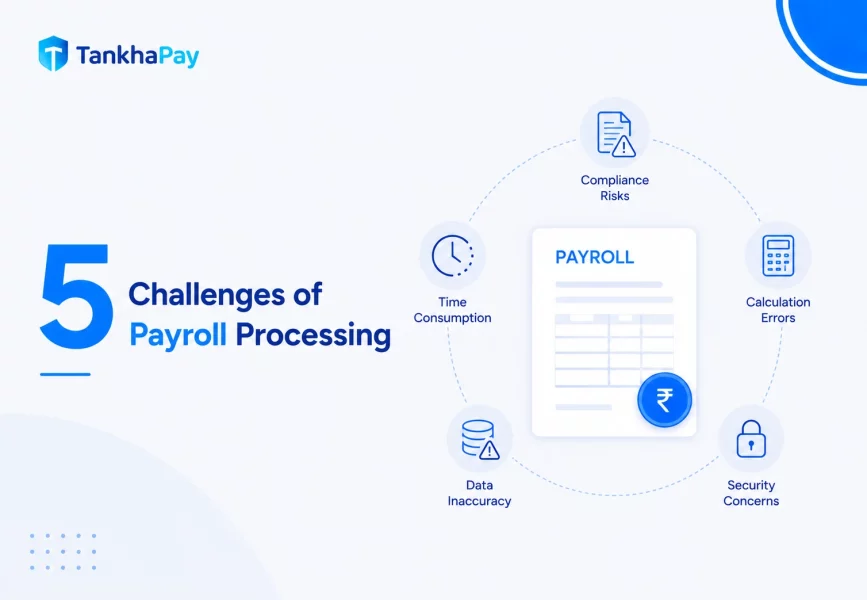
6 Payroll Challenges That Scale With Your Business
Challenge 1: Crossing 20 Employees – First Major Compliance Jump
It’s the legal cutoff that catches most Indian entrepreneurs off guard.
If there are fewer than 20 people working, then PF registration is voluntary. Once there are 20 people, however, registration becomes compulsory and it becomes compulsory retrospectively from the day that the threshold was crossed and not the day of registration. “We realised that we were required to register at that time and did it” will not wash with an EPFO inspector.
The full compliance change at 20 employees:
- PF registration and monthly ECR filing become mandatory
- ESI applicability is confirmed for employees earning ₹21,000 or less
- Basic salary must meet the Labour Codes 50% rule for every employee
Companies who do this right are those who have set the threshold for EPFO registration to be at 18 members rather than 20. Two members in buffer time are sufficient to complete the EPFO registration process and file the first ECR on time. [Link: signs you need payroll software]
What breaks: The payroll process manually, which was working fine for 15–18 people.
Challenge 2: Entering Your Second State – Compliance That Multiplies
This is the payroll challenge Indian founders consistently underestimate.
Going from one state to two does not double the payroll complexity. It multiplies it because each new state brings its own Professional Tax slab, its own Labour Welfare Fund rules, its own minimum wage schedule, and its own revision calendar.
But Maharashtra and Karnataka have their own PT ceilings (₹2,500 versus ₹2,400), LWF contribution formulae, and wage revision timelines. In Karnataka, for example, there was an increase in the LWF threshold from 50 to 10 employees in the year 2025. This is a modification that saw thousands of companies fall into compliance with LWF without any formal announcement.
For any firm that opens branches in Delhi, Pune, Bengaluru, and Chennai during the same fiscal year, as is common practice among scaling companies, there are essentially five different payroll compliance streams operating within one month.
What breaks: A national payroll format that uses a single set of rules for states. This payroll format can’t be universally used; every employee profile should have a state tag that is responsible for using proper statutory rules.
The fix: Payroll setup in the state-wise manner, starting from the first hire at each new location, and not as a remedy after the company becomes sufficiently large in Bengaluru.
Challenge 3: Rapid Hiring With Non-Compliant Salary Templates
This is a 2026-specific challenge that most SERP articles have not caught up to.
The Labour Codes went live in November 2025. Every salary structure loaded into your payroll system since then must have a basic salary plus DA equal to at least 50% of the total CTC. Businesses that designed their salary templates before November 2025 and have been using the same templates for new hires since are loading non-compliant structures into the system one hire at a time.
With 10 employees being hired each month, an organization that did not comply with the change in the Labour Codes in November 2025 has built up more than 80 structures that are in violation of this new requirement. These structures cause incorrect PF computation every cycle, and the correct liability is the amount less the deductions made.
What breaks: Fast recruitment programs using a pre-existing onboarding template that does not include a step for compliance checks. The template that was compliant in October 2025 becomes non-compliant.
The fix: Adding a compliance check to the onboarding process verifying the salary structure against the new definition of the Labour Codes.
Challenge 4: Data Fragmentation Across Office Locations
At one office, the attendance system, HRMS, and payroll engine are usually connected or at least manageable manually. At three offices, the connections start breaking.
Each new location adds a local attendance system, a local HR contact managing leave approvals, a local finance team handling reimbursements and a payroll team in the head office trying to reconcile data from all of them before the 22nd of the month.
The consequence is a payroll system which needs four days to close with 50 employees and eight days with 150, not due to the increase in the number of employees but due to the problem with the data pipeline. And flawed data pipelines generate the same types of mistakes as flawed configuration – miscalculated ESI, failure to reflect increments, and LOP on wrong attendance.
Data fragmentation is the root cause of most payroll errors at scaling businesses, and it gets significantly worse, not gradually better, as the business grows.
What breaks: Manual systems for gathering data that work well enough at one site. An attendance report through emails from three government departments which is then collated by one individual prior to payroll is definitely a system that cannot withstand pressure.
Challenge 5: Employee Classification at Scale
With only 25 people, everybody will be following the same employment pattern. But with 150 people, there is definitely going to be an employee classification issue involving permanent employees, temporary employees, third-party contractors and maybe gig economy employees.
The Labour Codes introduced a specific change here: fixed-term employees are now eligible for gratuity after one year, not five. For a business that has been running fixed-term contracts as a way to manage gratuity exposure, this requires an immediate structural review.
Third-party contractor liability is the other growing exposure at scale. If your contracted staff agency defaults on PF contributions, the principal employer, your business, absorbs the arrears. As the business grows and relies more heavily on contract staff for operations, warehousing, or facility management, this secondary liability grows proportionally.
What breaks: A payroll process designed around a single employee type. At scale, the payroll engine must correctly distinguish each classification and apply the right statutory rules automatically.

Final Thought
Payroll challenges during business expansion in India are not caused by growth. They are caused by a payroll process that was designed for a smaller, simpler version of your business and was never updated as the business changed.
It is the firms which clean scale, meaning they are able to revamp their payroll structure before each milestone: before the firm reaches its 20th employee, before opening a new state office and before they hire internationally. Those that revamp after the fact do so with debt already piling up.
TankhaPay’s managed payroll and compliance service scales with your business across all six challenge points, from the first PF registration to multi-state compliance to international payroll coordination for employees abroad.