Quick answer: The EOR is the legal employer in India and holds the TDS obligation when an engineer’s ESOP is exercised or RSU vests, under Section 17(2)(vi) of the Income Tax Act 1961. TankhaPay, India’s only EOR specialist since 2000, manages perquisite calculation, vest date FMV sourcing, monthly TDS under Section 192, and Form 16 accuracy for 500+ client companies with zero compliance penalties. Most global EOR platforms fail IT companies at the GCC RSU scale because they process this through manual payroll entries rather than a systematic vesting tracking infrastructure.
TL;DR – ESOP and RSU for India Tech Teams: What Your EOR Must Handle
- The EOR holds the TDS obligation, not the engineer. Under Section 17(2)(vi) of the Income Tax Act, 1961, ESOP exercise and RSU vesting create a taxable perquisite in that month. The legal employer must deduct TDS under Section 192 and deposit it by the 7th of the following month. Late deposit triggers Section 201(1A) interest at 1.5% per month.
- The vesting date FMV, not the grant date FMV, determines the perquisite value. Using the wrong FMV date produces an incorrect Form 16 cost-of-acquisition figure, which triggers an income tax notice for the engineer when they file capital gains on a share sale.
- RSU is harder to manage than ESOP at GCC scale. RSU vesting is schedule-driven and company-controlled. A GCC with 200 engineers on quarterly cliff vesting creates 800 separate TDS calculations per year. Most global EOR platforms process this through manual payroll entries and miss vest months.
- Joining bonus clawback must be a contractual debt, not a salary deduction. Salary deductions beyond the list permitted under the Payment of Wages Act, 1936, are void. A clawback, drafted as a contractual debt under the Indian Contract Act, 1872, is recoverable from full and final settlement.
TankhaPay publishes this guide. We provide EOR services for IT and tech companies in India. All compliance information reflects our direct operational experience managing equity compensation for India tech teams since 2000 across 500+ client companies.
The EOR becomes responsible for the TDS liability in case of vesting of RSUs or exercise of ESOPs of an Indian engineer, not the engineer himself. Section 192 of the Income-tax Act, 1961, provides that TDS shall be deducted by the employer from the perquisite value of RSUs/ESOPs in the month in which such perquisites arise. In the case of GCC, with 150 engineers having RSU vesting quarterly, there are 150 individual perquisite computations each quarter. These are done manually through the payroll system.
Why ESOP and RSU Management Is the Defining Test for Any EOR Claiming to Serve IT Companies in India
Equity-based remuneration makes the technology industry distinct from all other verticals employing EOR in India. Companies belonging to manufacturing pay their employees through a fixed salary along with shift allowances. Healthcare firms have defined salaries along with statutory bonuses. The funded product companies, US SaaS firms, and GCCs creating India offices offer engineers a share of stock-based remuneration in addition to salaries, such as RSUs of the parent company or ESOPs from a US-based plan.
Taxation of equity compensation in India is certainly not the example which most CTOs would have in mind while considering such a situation. In the USA, the individual would exercise an ISO and pay capital gains tax on selling it sometime down the road. In India, however, the taxation happens upon the exercise or vesting and not upon the sale of the stock. The EOR would have to make the TDS deduction upon the perquisite value during the month in which it arises, per Section 17(2)(vi) of the Income Tax Act of 1961.
Global EOR platforms covering 150 to 180 countries build payroll systems for average client complexity. A US startup’s India team with quarterly RSU vesting is not average complexity. A GCC with 200 engineers on quarterly cliff vesting creates 800 separate TDS calculations per year, each requiring the FMV on that specific vest date from the exchange or RBI reference rate. No global platform with India as one of 150+ markets builds the India-specific tracking infrastructure for this volume. The providers that handle it correctly operate exclusively in India and have built equity compensation management as a core process function, not a manual payroll add-on.
If an EOR cannot pass the ESOP and RSU test, it should not be the EOR for any serious IT company’s India team. To understand the full picture of what EOR covers for India tech teams, see our India Employer of Record service.
The Perquisite Event: Why ESOP and RSU Create a TDS Obligation on the EOR, Not the Engineer
The EOR is responsible for TDS when an Indian engineer’s ESOP is exercised or RSU vests, because the perquisite value is taxable income in that month, and the employer must deduct and deposit TDS by the 7th of the following month.
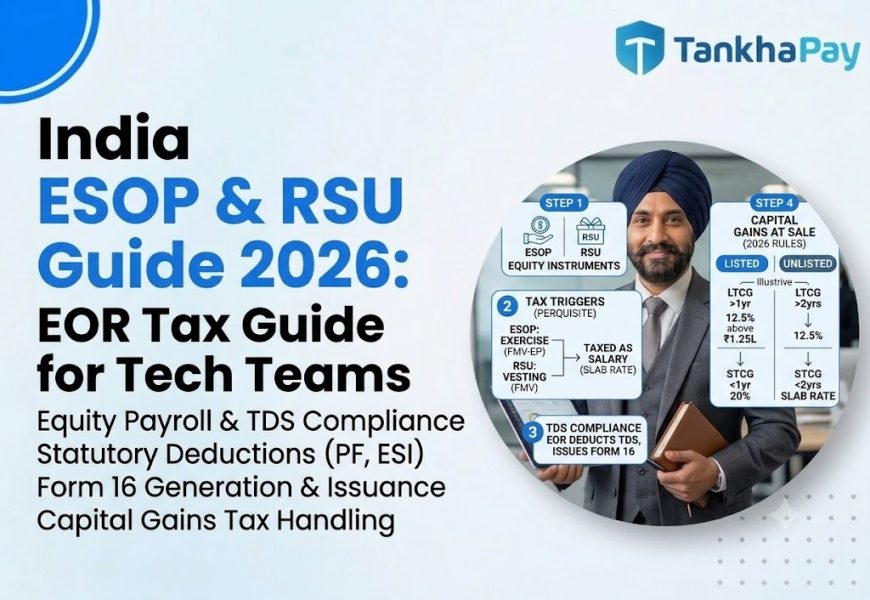
Under Section 17(2)(vi) of the Income Tax Act 1961, the value of any ESOP or RSU received from the employer is a perquisite in the employee’s hands. The perquisite value is: Fair Market Value (FMV) on the exercise date for ESOP or the FMV on the vesting date for RSU, minus the exercise price paid by the employee. This is taxable income in the year of exercise or vesting, not the year of grant.
Under Section 192 of the Income Tax Act 1961, the legal employer must deduct TDS on this perquisite in the month it arises and deposit it with the Income Tax Department by the 7th of the following month. TDS is calculated at the engineer’s marginal tax slab rate applied to their total estimated annual income, including the perquisite value.
How Perquisite Value Is Calculated at Each Vest Event Under Section 17(2)
For RSUs from a US-listed parent company, FMV is the average of the opening and closing price of the share on the National Stock Exchange or Bombay Stock Exchange on the vesting date. If the share is listed only on NYSE or NASDAQ, the closing price in USD on the vesting date converted at the RBI reference rate for that date applies. For pre-IPO unlisted shares, FMV must be certified by a category I merchant banker under Rule 3(8)(c) of the Income Tax Rules 1962. The merchant banker certificate must be dated within the financial year of the vested event.
GCC Setup in India At financial services and tech companies using Carta, Shareworks or E*Trade for equity plan administration should realize that these platforms give them the vest schedule and share count, but not the Indian perquisite valuation or Indian TDS data. Calculation of that should be done by the EOR.
Type 3 GCCs and Type 2 funded product companies are particularly vulnerable since RSU vestings are regular and under the control of the company: every quarter on the cliff date there is an obligatory TDS event regardless of when the EOR learns about it from the client.
What the EOR Must Do at Every Vest Date and Why Monthly TDS Timing Matters
EOR is expected to get the vest date notification and FMV of the perquisite from the client company prior to or on the vest date, calculate the perquisite value of each engineer who vests, add it to the salary of that month, deduct TDS at the appropriate slab rate, deposit within 7 days from that month, and report the same in Form 12BA and Form 16 at year-end.
Delay in TDS payment entails a certain cost. Interest at the rate of 1.5% per month under Section 201(1A) of the Income Tax Act 1961 is applicable from the day when it becomes liable for deduction till the day when it is paid. On a perquisite value of INR 20 lakhs for a senior engineer in a Series B product company, a delay of just one month involves an interest cost of INR 30,000 under Section 201(1A). This applies to a GCC with 200 engineers vesting quarterly, where the US equity team gives informal notification to India’s EOR.
There are three specific instances where EOR mistakes will occur in this scenario. Failure to use vest date FMV as compared to grant date FMV will result in the incorrect calculation of TDS and the cost of acquisition for the capital gains computation on the part of the engineer. Failure to process TDS in the vesting month and treating TDS as a year-end payroll processing issue will result in a penalty for Section 201(1A). This is compounded by the lack of an active vest date calendar.
A properly managed EOR will maintain an independent vest date calendar, calculate FMV upon each vesting date, and process TDS within the statutory period.
FEMA and RBI Compliance When Indian Engineers Receive Foreign Company Stock
When a US company grants equity to Indian resident employees, the share allotment is governed by the Foreign Exchange Management (Transfer or Issue of Any Foreign Security) Regulations 2004, referred to as FEMA Notification 120 under FEMA 1999. The foreign company must file Form FC-GPR with the RBI within 30 days of each allotment, or report through the Annual Return on Foreign Liabilities and Assets (FLA return) for equity allotments made during the preceding financial year.
Type 1 US SaaS startups carry the highest exposure here. A pre-Series B startup grants ISOs or NSOs to its first India engineers through an EOR. The equity plan was drafted for US employees by a US law firm. FEMA compliance was not in scope when the plan was structured. The foreign share allotment creates RBI reporting obligations the startup does not know exist. This goes undetected until a Series B investor’s legal team runs cross-border equity due diligence and discovers years of unreported Form FC-GPR obligations flagged as a material compliance risk.
The EOR, as an Indian employer, is not the FEMA reporting entity for the foreign company’s share allotment. The foreign company manages Form FC-GPR. The EOR’s role is to ensure the employment contract reflects the equity arrangement in a FEMA-consistent way: the equity must be characterised as compensation (a perquisite taxable under Section 17(2)(vi)) and not as a separate financial arrangement that triggers different FEMA treatment for India residents acquiring foreign securities.
Apart from ensuring that the employment contract doesn’t result in any creation of a security interest, pledge or lien on the foreign shareholding in favour of the Indian EOR organization, there are other issues which arise under FEMA.
Global EOR platforms use employment contract templates built for multi-jurisdiction use. The FEMA alignment language required for India cross-border equity arrangements is India-specific and not present in multi-jurisdiction templates designed for 150 to 180 countries. For a US SaaS startup, this means the Indian employment contracts do not align with the FEMA structuring the equity arrangement requires. The misalignment sits undetected for years and surfaces at the least convenient moment: during a funding round.
Capital Gains After Share Sale: How the EOR’s Form 16 Accuracy Determines the Engineer’s Tax Liability
The EOR’s Form 16 directly determines the Indian engineer’s capital gains tax liability when they sell their shares, because the perquisite value at vesting becomes the cost of acquisition for capital gains purposes.
In case an Indian engineer sells ESOP or RSU shares, such a gain would be considered capital gains. In the case of sale of listed shares after more than 12 months of ownership, the rules for Long-Term Capital Gains apply at the rate of 10% on gains exceeding INR 1 lakh under Section 112A of the Income Tax Act 1961. In the case of sale of listed shares after less than 12 months of ownership, the rules for Short-Term Capital Gains apply at the rate of 15% under Section 111A. The cost of acquisition for capital gains purposes is the fair market value as on the date of vesting or exercise: the same amount used by the EOR in determining perquisites.
Type 3 GCC engineers holding RSUs in US-listed parent company shares create the most complex interaction here. GCC engineers frequently sell shares on the same day they vest, a same-day sale creating a short-term capital gain equal to the difference between the sale price and the FMV at vesting. If the EOR calculated the perquisite using the wrong FMV date, the cost of acquisition in Form 16 does not match the actual vesting date price. The engineer files capital gains using the Form 16 figure. The tax department’s cross-referencing system compares the declared cost of acquisition against the actual sale price. When the numbers do not reconcile, the engineer receives an income tax notice.
The EOR does not deduct TDS on capital gains: that is the engineer’s personal obligation when filing their annual return. But the EOR’s Form 16 accuracy is the engineer’s only source of the correct cost of acquisition figure. An engineer who received an incorrect Form 16 from their EOR has no way to correct their capital gains filing without the EOR issuing a revised Form 16, which requires the EOR to acknowledge the calculation error.
This is because the duty of the EOR does not end with TDS deduction; it ends when the issuance of Form 16 happens with the right perquisite value that correctly sets the cost of acquisition of the shares.
Three Tax Events When an India Engineer Holds Equity — Who Pays What and When
| Tax Event | When It Occurs | Governing Provision | Who Pays | Rate |
|---|---|---|---|---|
| Perquisite Tax (ESOP exercise) | Month of exercise | Section 17(2)(vi), Income Tax Act 1961 | EOR deducts TDS from engineer’s payroll in exercise month | Engineer’s marginal slab rate |
| Perquisite Tax (RSU vesting) | Month of each vest date | Section 17(2)(vi), Income Tax Act 1961 | EOR deducts TDS in vest month; deposit by 7th of following month | Engineer’s marginal slab rate |
| Capital Gains Tax (listed shares held 12+ months) | Year of share sale | Section 112A, Income Tax Act 1961 | Engineer pays directly in annual tax return; EOR not involved | 10% on gains above INR 1 lakh |
| Capital Gains Tax (listed shares held under 12 months) | Year of share sale | Section 111A, Income Tax Act 1961 | Engineer pays directly; cost of acquisition = FMV from EOR’s Form 16 | 15% |
| Phantom Equity Payment | Date of cash payment at trigger event | Section 17(1), Income Tax Act 1961 (salary income) | EOR deducts TDS under Section 192 at time of payment | Engineer’s marginal slab rate |
Cost of acquisition for capital gains purposes is the FMV used by the EOR for perquisite calculation at exercise or vesting. An incorrect EOR perquisite calculation directly affects the engineer’s capital gains filing accuracy.
ESOP vs RSU for India IT Teams: Why RSU Is the Harder Management Problem at GCC Scale
The RSU vesting is an organized process controlled by the company that leads to repetitive obligations on account of TDS without any input from the employees. The ESOP exercise is employee-driven. In case of an employer outsourcing a sizeable team of technology professionals from India, this factor makes the difference.
ESOP: the employee receives an option to buy shares at a preset exercise price. The tax event occurs when the employee chooses to exercise. An engineer at a Series A startup might hold their options for three years before exercising. The EOR processes TDS when notified of an exercise but does not need to proactively track a calendar of future events.
RSU: the employee receives a right to shares that transfer automatically when vesting conditions are met. No exercise price. No employee action required. Shares transfer on the vesting date, and TDS must be deducted in that month. RSUs typically vest in tranches: monthly, quarterly, or annual cliffs. For quarterly cliff vesting, TDS applies four times per year per engineer. For a GCC with 200 engineers all on the same quarterly cliff schedule, the EOR processes 200 TDS calculations on the same date, every quarter: 800 TDS calculations per year requiring 800 individual FMV lookups and 800 payroll adjustments within the same payroll cycle.
Type 2 funded product companies and Type 3 GCCs use RSU programs because these companies are typically subsidiaries of US-listed or late-stage private companies that administer RSU programs through Carta or Shareworks. The RSU schedule is fixed at grant. The equity platform provides a vest file, but the FMV calculation and TDS processing are the EOR’s obligations.
As per an example of a US technology company shifting from ESOP to RSU when scaling from 20 to 200 employees in India, the EOR would need to move from an event-based approach to an automated approach. None of the platforms developed for 150 countries’ use have the India-specific vest-tracking infrastructure needed for this. The failure scenario here would be a systematic quarterly TDS delay with accrued 201(1A) interest.
An efficient EOR for the RSU scheme will have an independent vest calendar in sync with that of the client’s equity program, determine FMV from exchange price/RBI reference rate on vest dates, process TDS in the vesting month, and generate a perquisite reconciliation report for Form 16 at year-end.
Joining Bonus Clawback for India Engineers: What the Employment Contract Must Say Under Indian Law
A joining bonus clawback is enforceable against an Indian engineer only if it is drafted as a contractual debt under the Indian Contract Act 1872, not as a salary deduction under the Payment of Wages Act 1936.
The Payment of Wages Act of 1936 restricts deductions from salary to PF, ESI, TDS, Professional Tax, Labour Welfare Fund contribution, and other deductions that have been authorized by law. The joining bonus repayment clause is not included in the list. Making the repayment via salary deduction is not acceptable and thus null and void. In a labour court case, the engineer will definitely win, leaving no room for appeal.
The imposition of the clawback obligation through a contractual debt, based on the Indian Contract Act 1872, results in another legal obligation. The engineer gets an amount paid as a forgiveness loan dependent on the completion of the clawback obligation period, and the EOR can obtain it through a mechanism other than that provided by the Payment of Wages Act.
Type 2 and Type 3 companies utilise joining bonuses extensively. Senior engineers in India in 2026 will be paid joining bonuses ranging between INR 5 lakh and INR 25 lakh. At such levels, an unenforceable clause on clawback for leaving the engineer becomes a loss to the client company.
The clause on clawback in the employment contract should state the total amount that can be clawed back; the period for which the clawback can be done; whether the period for which the notice period is served by the employee will be counted for or against the clawback period; and the method for recovery of the difference between FnF settlement and the rest of the clawback amount under the Indian Contract Act 1872.
The EOR must draft this provision because the EOR is the legal employer issuing the contract. A client company that provides a clawback template from its US employment counsel and asks the EOR to copy it into the India contract is taking a compliance risk. US clawback structures do not map to Indian statutory frameworks, and the Payment of Wages Act 1936 violation is not visible in the contract language until the clawback is triggered and challenged.
Many international EOR contract templates contain joining bonus repayment either as a salary reduction clause or do not specify the process of repayment. If an engineer has been subjected to joining bonus clawback and his FnF team starts to recover the repayment, it will lead to a conflict that the client company will not be able to win.
Phantom Equity and SAR: When Direct ESOP Is Not Possible and What the India Alternative Looks Like
Phantom equity refers to a contractual payment of cash equivalent to the increase in the value of the shareholding from the grant date to the triggering event, which shall be treated as income from salary and not from perquisites under Section 17(1) of the Income Tax Act 1961 instead of being charged as perquisites under Section 17(2)(vi). The reason for this is that this will affect the trigger for TDS, not the vesting date but the cash payment.
There are three circumstances where granting equity directly via EOR would be difficult. The foreign company’s ESOP scheme does not have the authority to provide benefits to participants who are not residents of the United States; such ISO schemes under the US Internal Revenue Code Section 422 are common. The company is a pre-IPO firm, and hence unlisted equity valuation will require a Category I Merchant Banker certificate, which would need to be provided quarterly, an arrangement that the company finds difficult to manage. The FEMA cross-border equity scheme has not been put in place yet.
In all three cases, phantom equity or Stock Appreciation Rights (SARs) give the engineer equity-like economic participation without the regulatory complexity of actual share grants.
Type 1 pre-Series A startups and Type 4 India-founded startups are most likely to use phantom equity. These companies want to retain engineers with equity economics but lack the legal infrastructure for compliant share grants. Type 4 companies specifically have a different regulatory pathway: SEBI (Share Based Employee Benefits and Sweat Equity) Regulations 2021 under the Companies Act 2013 govern India-founded startup ESOPs, a framework that most global EOR platforms, having built their systems for US equity structures, do not recognize as distinct.
Functionally, the concept of phantom equity is easier to implement by the EOR compared to real equity. There is no requirement for reporting to FEMA across the border; there is no need for a Merchant Banker’s FMV certificate, and no Form FC-GPR filing. The client calculates the phantom equity on the basis of the formula decided upon – normally, the increase in value of shares from the grant date to the trigger date (liquidity event or annual settlement). TDS is deducted on the income treated as salary income under Section 192.
Phantom Equity Clause needs to be attached as an annexe in the employment agreement. In the absence of an annexe, such compensation will amount to a one-time bonus and not a structurally safeguarded arrangement for the retention of the engineer in the company.
Most international EORs do not have any structured phantom equity process in place. What most of the international EORs have is a provision for handling regular bonuses and perquisites of ESOP, but there is nothing in the way of handling SAR computation, trigger event reporting, and structurally different treatment in Form 16 of the salary income and equity perquisite income. Such a US startup using the services of an international EOR will book this as an irregular bonus. And while at times this may be correct from the perspective of taxation, it will certainly be incorrect from the perspective of contractual enforceability.
ESOP and RSU Compliance Reference Table for IT and Tech Companies
ESOP and RSU in India: EOR Compliance Reference for IT and Tech Companies
| Compensation Type | Most Common IT Company Type | Tax Event | Governing Provision | TDS Obligation | Key EOR Action | Most Common EOR Failure |
| ESOP from US company (listed shares) | Type 1: US SaaS startup | Exercise date | Section 17(2)(vi), Income Tax Act 1961 | Deduct TDS in exercise month; deposit by 7th of following month | Source FMV on exercise date from exchange; calculate perquisite per engineer; process TDS in payroll | Using grant date FMV; incorrect Form 16 cost-of-acquisition figure for engineer’s capital gains |
| ESOP from US company (unlisted/pre-IPO shares) | Type 1: US SaaS startup | Exercise date | Section 17(2)(vi) and Rule 3(8)(c) Income Tax Rules 1962 | Deduct TDS; use Merchant Banker FMV certificate dated in current financial year | Coordinate Merchant Banker FMV certification; calculate perquisite; process TDS | Using outdated Merchant Banker certificate from prior year; delaying TDS to year-end |
| RSU from US parent company (listed shares, GCC) | Type 3: GCC | Vesting date | Section 17(2)(vi), Income Tax Act 1961 | Deduct TDS in vest month; deposit by 7th of following month | Maintain independent vest calendar; calculate FMV at each vest; process 200+ TDS entries per quarter | Processing TDS at year-end not vest month; Section 201(1A) interest liability accumulates each quarter |
| RSU quarterly cliff vesting | Type 2: Funded product company | Each quarterly vest date | Section 17(2)(vi), Income Tax Act 1961 | TDS in month of each vest event | Sync vest file from Carta or Shareworks; calculate per-engineer perquisite each quarter; process within payroll cycle | Missing individual vest tranches; Form 16 perquisite value understated for entire year |
| Phantom Equity or SAR (cash settled) | Type 1: Pre-Series A startup; Type 4: India-founded startup | Payment date | Section 17(1), Income Tax Act 1961 (salary income, not perquisite) | TDS at time of cash payment under Section 192 | Annex phantom equity agreement to employment contract; process as salary income not perquisite under Section 17(2) | Treating as ad hoc bonus without contractual structure; incorrect Form 16 category; no retention protection for engineer |
| Joining Bonus with clawback | Types 2 and 3 | Bonus payment date for TDS; departure date for clawback recovery | Section 192 for TDS; Indian Contract Act 1872 for clawback enforceability | TDS at payment date | Draft clawback as contractual debt not salary deduction; specify recovery from FnF settlement in contract | Drafting clawback as salary deduction void under Payment of Wages Act 1936; unenforceable when triggered |
Five Things the Best EOR for IT Companies in India Does That Most Providers Do Not
The EOR that handles ESOP and RSU correctly for IT companies demonstrates five specific capabilities that most global providers cannot match. These are operational processes requiring India-specific compliance infrastructure built for IT sector equity complexity.
- Tracks RSU vest dates independently, without waiting for client notification.
The EOR ensures that the vesting calendar is consistent with the client’s equity administration system and deals with TDS in the right vest month based on Section 192 without having to be notified informally by the US equity team. This way, the EOR avoids accruing the Section 201(1A) interest rate of 1.5 percent per month. - Uses vesting date FMV, not grant date FMV, for every perquisite calculation.
Section 17(2)(vi) is unambiguous: the perquisite value is determined at the exercise or vesting date. Using grant date FMV overstates or understates the perquisite depending on share price movement, produces an incorrect Form 16, and establishes a wrong cost-of-acquisition figure for the engineer’s capital gains filing. This creates an Income Tax Department reconciliation notice for the engineer. An EOR with correct FMV sourcing produces Form 16 accuracy the engineer can rely on. - Includes India-specific FEMA structuring language in employment contracts for cross-border equity.
For US SaaS startups and multinational GCCs granting equity to Indian engineers, the employment contract must characterize the equity as compensation under Section 17(2)(vi), not as a foreign security arrangement, and must create no security interest in the shares. Generic multi-jurisdiction templates do not include this language. Missing it creates FEMA compliance gaps that surface during funding round due diligence. - Drafts joining bonus clawback as a contractual debt under the Indian Contract Act 1872, not as a salary deduction.
Salary deduction claw backs are contrary to the provisions of the Payment of Wages Act 1936, and are hence, void. The debt structure under the contract is capable of recovery during full and final settlement. Whether the claw back is enforceable will depend on one sentence in the employment contract where an engineer who has taken a joining bonus of INR 20 Lakh resigns in month four. - Offers a structured phantom equity and SAR process with Section 17(1) salary income treatment.
Pre-Series A startups and India-founded tech companies that cannot offer direct share grants need a compliant retention tool. The EOR that maintains a phantom equity annexure process, correct TDS treatment under Section 192, and Form 16 salary income classification gives these companies a retention mechanism that ad hoc bonus processing cannot replicate. For an independent comparison of which providers meet these criteria, see our review of the best EOR companies in India 2026.
This is what it means for an EOR to be built for the technology sector. See EOR for IT and tech companies in India for the full picture of how TankhaPay applies these capabilities across GCC setup, IP protection, moonlighting compliance, and multi-state remote work management.
Your India Tech Team Deserves an EOR That Understands Their Compensation
Issues of ESOP and RSUs can be felt by the engineers themselves. If there is an incorrect perquisite value on the Form 16, then there is an income tax notice that the engineer will not be able to settle without help from the EOR. A non-enforceable clawback provision means that any losses incurred as a result of an engineer leaving in the fourth month are borne by the organization itself.
Since 2000, TankhaPay has been providing equity compliance services for Indian technology teams. More than 500 clients. No statutory penalty ever imposed. Process discipline of CMM I appraised a model used to track RSU vesting, perquisites, and Form 16 correctness. ISO 27001 certification for the information security of compensation data as sensitive as source code before an IPO.
Government of India technology bodies including the National Informatics Centre (NIC), National e-Governance Division (NEGD), and STPI trust TankhaPay with their workforce compliance and data security. If TankhaPay’s standards satisfy the organisations that build and operate India’s government digital infrastructure, they are built for the requirements of a GCC’s pre-IPO equity records.
Request a Risk Assessment to review your current ESOP or RSU arrangement in India for compliance gaps before the next vest date.
For the full IT sector EOR capability including IP protection, GCC onboarding at scale, moonlighting compliance, and multi-state remote work management, see EOR for IT and tech companies in India.
Frequently Asked Questions: ESOP and RSU Management for India IT and Tech Teams
Who is responsible for TDS on ESOP vesting for Indian IT employees?
The legal employer, not the employee, is responsible for deducting TDS on the ESOP perquisite value under Section 192 of the Income Tax Act 1961. When an Indian engineer exercises an ESOP or receives vested RSU shares, the perquisite value calculated under Section 17(2)(vi) as FMV on the exercise or vesting date minus the exercise price is taxable income in that month. The EOR as the legal employer must deduct TDS at the engineer's marginal slab rate in that month's payroll cycle and deposit with the Income Tax Department by the 7th of the following month. TDS processed in any month other than the vest or exercise month creates Section 201(1A) interest at 1.5% per month from the due date, regardless of whether the client company failed to notify the EOR in time.
How does an EOR handle RSU vesting for a GCC in India?
For a GCC using EOR, the EOR must receive the vest schedule from the client's equity administration platform, calculate the FMV of the parent company's shares on each vest date using the exchange closing price or the RBI reference rate for USD-denominated shares, compute the perquisite value for each vesting engineer, process TDS in the vest month's payroll cycle, deposit TDS by the 7th of the following month under Section 192, and reflect the perquisite in Form 12BA and Form 16. In case of GCC having 150 engineers for quarterly cliff vest, the EOR would process 150 individual perquisites calculations each quarter, 600 each year, where each one has a separate calculation of per engineer’s slab rate. In case of an EOR that does not have any proactive vest calendar synced up to its equity platform, TDS is processed late.
What is the difference between ESOP and RSU tax treatment in India for tech employees?
Both ESOP and RSU create a perquisite taxable under Section 17(2)(vi) of the Income Tax Act 1961, but the timing and trigger differ. ESOP Perquisite comes into effect once the engineer decides to exercise the option: The difference between Fair Market Value on the exercise date and the exercise price will give you the perquisite value, which will be taxed during the exercise period. RSU Perquisite comes into effect automatically for each vesting date: The Fair Market Value of all the shares transferred will be the perquisite value. For the EOR, ESOP TDS is event-triggered by employee action while RSU TDS is schedule-triggered by the vest calendar. RSU is the harder management problem at scale because it creates multiple recurring TDS obligations per year per engineer regardless of employee action, requiring the EOR to maintain an independent vest tracking system rather than responding to individual employee exercise notifications.
Does TankhaPay manage ESOP and RSU for foreign tech companies with Indian teams?
Yes. TankhaPay manages the complete ESOP and RSU compliance stack for foreign tech companies employing Indian engineers through EOR. This will have the most recent date coordination with respect to the date management system of the client’s equity management system, fair market value in terms of exchange or RBI rates on vesting dates, and computation of perks of an engineer per vesting date under Section 17(2)(vi) of the Income Tax Act 1961. Deduction of TDS and deposit under Section 192; preparation of Form 12BA for each perquisite occurrence; issue of Form 16 with separate perquisite income from basic salary at year end. For unlisted shares, TankhaPay works in coordination with a Category I Merchant Banker to verify the FMV of the securities under Rule 3(8)(c) of IT Rules 1962. TankhaPay has done so for more than 500 clients starting from year 2000 through Akal Information Systems Ltd, an ISO 27001 certified and CMMI appraised organization, without any Section 201(1A) interest notice on ESOP or RSU TDS.
How does FEMA apply to a SaaS startup's Indian engineers receiving stock options?
The share issuance from the foreign company to the employees of India will be covered by the Foreign Exchange Management (Transfer or Issue of Any Foreign Security) Regulations 2004 under FEMA 1999 which is called as FEMA Notification 120. The foreign company is obligated to file form FC-GPR with RBI within 30 days of the issuance of shares or through the Annual Return on Foreign Liabilities and Assets (FLA return) if the issuance was made during the previous financial year. The India EOR is not the one who reports this under FEMA, the responsibility lies with the foreign company. However, the responsibility of the EOR here is to ensure that the employment agreement includes the equity as compensation under section 17(2)(vi) of Income Tax Act 1961 and does not include any security interest in the shares, thus creating another compliance obligation under FEMA for the India residents. Compliance problems in ESOPs before series B usually arise during due diligence because of the number of years of unreported Form FC-GPR obligation.
Can a joining bonus clawback be enforced against an Indian software engineer?
Indeed, provided that the clawback clause is structured as an Indian Contract Act 1872 debt rather than as a salary deduction, which violates the Payment of Wages Act 1936. Permitted salary deductions include PF, ESI, TDS and other specific authorized deductions according to the Payment of Wages Act 1936. Since the clawback of joining bonus is not one of them, any salary deduction structure is null and void and unenforceable once challenged before a Labour Court. The correct structuring of the clause as a debt in the contract makes the clawback claimable as part of the FnF settlement, provided that the engineer quits during the clawback period.
What is phantom equity and is it better than ESOP for Indian engineers hired through an EOR?
Phantom equity is a monetary consideration for the increase in the fair market value of the phantom shares from the date of grant to the date of the triggering event. This is taxable as salary income in the year of payment as per the provisions of section 17(1) of the Income Tax Act 1961. Phantom equity is neither better nor worse than ESOP in terms of retention; it is merely the right solution if the granting of equity is practically impossible due to certain structural reasons. Three situations where phantom equity should be used include exclusion of non-US participants by the ESOP of the foreign company, pre-IPO and hence lack of practicality of getting Merchant Banker FMV certification of unlisted shares for periodic vesting, and lack of compliance with FEMA Notification 120 regarding cross-border equity under FEMA. The use of phantom equity does not give rise to the obligation to pay Form FC-GPR, certification by Merchant Banker and equity platform integration for the EOR. The EOR will do TDS on salary basis as per Section 192 and show it on Form 16.