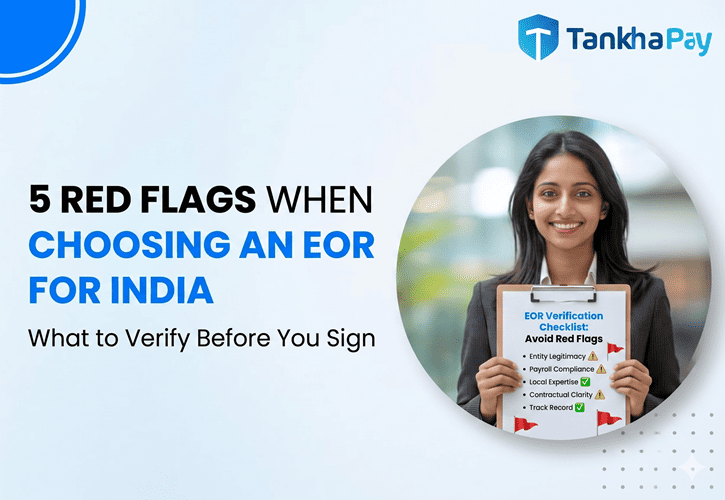
There are five red flags that mark the non-compliant EOR for India: incapability to mention the relevant acts and time frames to which they are compliant, incapability of explaining permanent establishment risks with respect to the Income Tax Act 1961, employment agreements not under Indian laws, pan-India declarations without state-by-state evidence, and pricing without considering India’s flexible statutory costs.
What is an Employer of Record (EOR) in India?
An EOR is a registered Indian legal entity that becomes the legal employer of your India employees for all purposes under Indian law. The EOR holds EPFO and ESIC registrations in its own name, issues employment contracts governed by Indian law, files all employer-side statutory returns, and carries full employer-side compliance liability. The company hiring the employees retains full operational and business direction of the team. See TankhaPay’s India Employer of Record service, or read the full guide on how Employer of Record works in India.
Here is what happens when the wrong answer to any of the five questions below is discovered after signing.
A technology company hired 12 engineers in Bengaluru through an EOR that claimed pan-India coverage. Fourteen months in, an EPFO enforcement officer issued a show-cause notice addressed to the technology company, not the EOR because the EOR had never registered as the establishment employer with EPFO in Karnataka. The technology company’s commercial agreement with the EOR did not change which entity EPFO considered the employer under the EPF and Miscellaneous Provisions Act 1952. The technology company paid the arrears, interest under Section 7Q of the EPF Act, and penalties under Section 14B. The EOR contract did not transfer the liability that the EOR had failed to operationally carry. Applying the verification checklist below before signing would have identified Red Flag 4 PAN-India coverage without state-by-state proof in the evaluation meeting.
Why Choosing the Wrong EOR in India Costs More Than Just Money
What makes an authentic India Employer of Record different from a payroll service that calls itself an India Employer of Record does not boil down to functionality. It boils down to legality.
A genuine EOR in India is the legal employer of your Indian employees for all purposes under Indian law. It holds EPFO and ESIC registrations in its own entity name. It issues employment contracts governed by Indian law. It files the EPFO electronic challan-cum-return by the 15th of each month in its name. When a compliance failure occurs, the EOR carries the liability. Your company does not.
The Payroll Bureau handles salaries. It can compute deductions and pay the remaining amount. Your company will be treated as the Employer for all legal matters. In case the Enforcement Officer from EPFO sends a notice, it will be sent to your company.
India is among the most complex EOR markets globally because compliance operates at two simultaneous levels. Central laws govern all Indian employees: the EPF and Miscellaneous Provisions Act 1952, ESI Act 1948, Income Tax Act 1961, Payment of Gratuity Act 1972, and Payment of Bonus Act 1965. State legislation differs in each of the 28 states with respect to the Individual Shops and Establishments Act; minimum wages, which get revised twice a year; professional tax; and leave/bonus regulations.
Permanent Establishment risk runs in parallel with both layers. A foreign corporation that utilizes employees working on its behalf within India is eligible for taxation under Section 5 and 9 of the Income Tax Act 1961 despite not meeting the requirement of an India-structure employer. The situation of employing employees without a structure in place would attract foreign exchange penalties according to the FEMA 1999. An established Employer of Record ensures there is no risk to foreign exchange laws.
India Labour Code Implementation Status June 2026
Parliament passed four Labour Codes between 2019 and 2020. Implementation requires each state to notify its own rules — a separate process for each Code in each of India’s 28 states.
Code on Wages 2019: Replaces Minimum Wages Act, Payment of Wages Act, Payment of Bonus Act, and Equal Remuneration Act. Many states have issued notifications. The EOR service provider is required to monitor state-wise notifications to determine the applicable floor wage.
Industrial Relations Code 2020: Deals with standing orders, dispute resolution, and termination. States at varying levels of notifications. Employers’ contracts need to be compliant with state-wise notifications when in force.
Code on Social Security 2020: Most significant for EOR. Redefines “employee” and “wages” for PF and ESIC calculation. Changes coverage criteria. States notifying their rules are creating new compliance obligations for every employer there.
OSH Code 2020: Consolidates 13 labour laws including the Factories Act 1948. State notification is ongoing. An EOR that cannot tell you the notification status of the Code on Social Security 2020 in your target state is managing India compliance with incomplete information.
EOR vs Staffing Agency in India: The Liability Difference
Numerous firms in India make use of staffing agencies pursuant to the Contract Labour (Regulation and Abolition) Act 1970. This is not an EOR. Pursuant to the Contract Labour Act, in the event that the staffing agency is unable to pay the PF, ESI, and minimum wage of the workers that the EOR provides, then the principal employer, the firm making use of such workers, becomes legally responsible. The client firm is the principal employer, while the compliance issue is an issue for the client firm.
Under an EOR relationship, the EOR is the employer. In the event that there is a filing error, it is the EOR that bears the responsibility, and not you.
| Dimension | Staffing Agency (Contract Labour Act 1970) | Genuine EOR |
| Legal employer | Client company (principal employer) | EOR entity |
| EPFO/ESIC liability if default | Falls back to principal employer | Stays with EOR |
| PE risk elimination | No | Yes (if EOR is genuine legal employer) |
| Compliance liability transfer | No — remains with principal employer | Yes — employer liability transfers to EOR |
Use the five red flags below to determine which category your prospective EOR actually falls into.
Red Flag 1: They Cannot Name the Indian Laws They Comply With
Ask a prospective EOR about their India compliance framework and note what they say. Providers who cannot clearly name specific acts respond with phrases like “We handle all Indian statutory compliance” or “We are fully compliant with Indian employment law.” Neither statement means anything verifiable. The question is not whether they are compliant, it is which laws, at which rates, with which filing deadlines, in which states.
A genuine India EOR operates under a layered compliance framework. Central obligations alone require specific operational knowledge at each tier.
The EPF and Miscellaneous Provisions Act 1952 mandates employer PF contribution at 12% of the employee’s basic salary plus dearness allowance. The EPFO Electronic Challan-cum-Return must be filed with EPFO by the 15th of each month. Failure to file on time attracts penalties under Section 14B and interest under Section 7Q.
The ESI Act 1948 requires employer contributions at 3.255% of gross wages for all employees earning up to INR 21,000 per month gross. ESI contributions must be deposited by the 21st of each month. Employees above the INR 21,000 wage ceiling are not covered under ESI.
Section 192 of the Income Tax Act 1961 deals with TDS on salary. The EOR as an employer is responsible for proper calculation, deduction, and prompt payment of TDS. Any mistake in Section 192 will be the liability of the employer and not the employee.
As per the Payment of Gratuity Act 1972, gratuity will accumulate at a rate of 4.81% of basic salary since the first day of employment and will be payable after five years of continuous employment. The Payment of Bonus Act 1965 provides a minimum bonus of 8.33% of salary.
The four Labour Codes passed between 2019 and 2020 add a third layer. State governments are individually notifying implementation rules under each Code. A provider that has not tracked which states have notified which Code provisions are operating on incomplete compliance logic in 2026.
If a provider cannot name these with rates and deadlines, they are running payroll, not genuine EOR compliance.
India Employer Compliance Filing Calendar
| Obligation | Governing Act | Rate | Filing Deadline | Filed With |
| PF Employer Contribution | EPF and Miscellaneous Provisions Act 1952 | 12% of basic + DA | 15th of each month (ECR) | EPFO |
| ESI Employer Contribution | ESI Act 1948 | 3.25% of gross wages (employees up to INR 21,000/month) | 21st of each month | ESIC |
| TDS on Salary | Section 192, Income Tax Act 1961 | Per applicable income slab | 7th of following month; quarterly return | Income Tax Department |
| Professional Tax | State PT Act (where applicable) | Up to INR 2,500/year (Maharashtra, Karnataka) | Monthly or quarterly per state rules | State Revenue Authority |
| Annual Bonus | Payment of Bonus Act 1965 | Minimum 8.33% of salary | Within 8 months of financial year close | Paid to employee |
| Gratuity Accrual | Payment of Gratuity Act 1972 | 4.81% of basic salary | Accrues from Day 1; payable after 5 years | Paid to employee |
An EOR that cannot confirm the deadline for each row above without consulting a third party does not have an in-house India compliance team.
What to verify: Ask them to provide their compliance framework for India. This document will contain all the central and state acts under which they work, the rate or due date associated with each act, the schedule for filing, and the states where they have active registrations. You can cross-check the company’s owner identity via the MCA21 public database on mca.gov.in. Search for the name of the EOR and check whether they have their India registration. After that, ask them to provide their establishment registration number with EPFO and ensure that they are registered for each of those states.
A legitimate India EOR produces their compliance framework document without hesitation because it is the operational foundation of everything they do.
Red Flag 2: They Cannot Explain Permanent Establishment Risk Under Indian Tax Law
What is Permanent Establishment risk for EOR in India? PE risks are those risks whereby the foreign company employing people in India will be found to be operating with a taxable presence in India in accordance with Section 5 and Section 9 of the Income Tax Act 1961. A foreign business may be found to have a PE in India if it is found to be using individuals to operate on its behalf in India, without the need for an official office in India.
When you ask “How does your EOR model eliminate PE risk for our company?”, note what happens. Providers who do not understand PE risk give a vague answer about being the employer of record, pivot to discussing their platform, or agree with whatever framing you offer without adding anything specific. A provider who understands PE risk cites Section 9 of the Income Tax Act 1961 unprompted and explains the mechanism by which their structure eliminates the taxable presence trigger.
A genuine EOR eliminates PE risk by becoming the legal employer for all purposes under Indian law. The EOR holds employer registrations with EPFO and ESIC in its own entity name. The employment contract is between the EOR and the employee, governed by Indian law. The EOR files all employer-side statutory returns in its name. The foreign company has a commercial services relationship with the EOR; it is not an employer in India and therefore does not trigger PE under Section 9.
A co-employment model, a managed staffing arrangement, or a payroll bureau processing model does not eliminate PE risk. The foreign company retains functional employer status in each of these structures, even if a third party handles the administration. For a direct comparison of models that do and do not eliminate PE risk, see EOR vs PEO in India.
What to verify: Raise these three questions and demand definitive responses.
- “Are you the rightful employer of our Indian employees in all respects according to Indian law?” The answer must be yes, without any reservation.
- “How does your model incorporate Section 9 of the Income Tax Act 1961 and avoid the possibility of our company getting a taxable PE status in India?” The answer should include Section 9 of the act and give an explanation of the mechanism involved.
- “Do you have all EPFO & ESIC registrations done in your own entity name and not ours?” The answer must be yes, supported by evidence.
Red Flag 3: Their Employment Contract Is Not Built for Indian Law
Ask any prospective EOR for a sample India employment agreement before you sign. Read the governing law clause. If it names a foreign jurisdiction as the governing law, or if the document is a global template with an India addendum attached, you are looking at a contract that will not hold correctly under Indian law when it matters most.
The Industrial Relations Code 2020 requires that every employer provide a written appointment letter specifying the terms of employment, including designation, CTC, and conditions of service. The Payment of Gratuity Act of 1972 states that gratuity is calculated from the very first day of joining the employment. The ESI Act 1948 mandates ESI nomination forms to be filled at the time of induction into the organization. The Maternity Benefits Act 1961 has statutory provisions for maternity benefits, and these are non-excludable from any Indian employment agreement. The State Shops and Establishment Acts have provisions for work timings, leaves, and other such matters.
What to verify: Request for a sample of an employment contract before you sign it. Ensure that the contract follows the laws of India, mentions the Shops and Establishments Act of the relevant state in which the employee works, and contains India-specific statutory provisions. Then follow the checklist below.
India EOR Employment Contract Checklist 2026
| Contract Element | Governing Requirement | What to Confirm |
| Governing law clause | Industrial Relations Code 2020 | Must say “governed by laws of India” — not Singapore, UK, or Ireland |
| State Shops Act reference | Applicable state Shops and Establishments Act | Names the specific state where the employee works — not a generic India reference |
| Gratuity entitlement | Payment of Gratuity Act 1972 | Accrual from Day 1; payable after 5 years of continuous service |
| ESI nomination | ESI Act 1948 | Completed at onboarding for employees up to INR 21,000/month gross |
| Maternity provisions | Maternity Benefit Act 1961 | 26 weeks paid leave — cannot be excluded from any India employment contract |
| Leave entitlements | Applicable state Shops Act | Earned, sick, and casual leave per the specific state Act |
| Notice period terms | State Shops Act + IR Code 2020 | Meets state minimums; IR Code requirements for standing orders where applicable |
| Overtime terms | State Shops Act / Factories Act 1948 | Rate cited to specific state Act (typically 1.5 to 2 times normal wage) |
| PF nomination + UAN | EPF Act 1952 | Form 2 completed at onboarding; UAN allotted at Day 1 |
| Designation and CTC breakdown | Industrial Relations Code 2020 | Gross CTC, basic salary, and all allowances shown separately |
Red Flag 4: They Claim PAN-India Coverage Without State-by-State Proof
“It covers all the 28 states,” is a statement made by every EOR in its presentation. Once you ask the EOR about the particular Shops and Establishments licenses it possesses, the current minimum wage of a technical profile in Telangana, and how it complies with the regulations for employees from Tamil Nadu and employees from Delhi, then the EOR’s inability to answer will prove that its “pan-India coverage” is just a marketing tool.
India’s labour laws are not uniform. Every state has its own Shops and Establishments Act with different working hours, overtime entitlements, leave rules, and termination notice periods. Professional tax exists in some states at up to INR 2,500 per year (Maharashtra, Karnataka) and does not exist in others. Minimum wages are set and revised separately by each state government, typically twice per year. An EOR with genuine pan-India coverage has current minimum wage data for every state updated at each revision cycle.
For healthcare-specific EOR across multiple states, where state nursing councils differ, clinical establishment license requirements vary by state, and minimum wages for healthcare workers are set individually, this gap is especially consequential. See TankhaPay’s dedicated coverage of EOR for healthcare companies in India for how state-by-state compliance applies to clinical staff hiring.
What to verify: But, first of all, ask them for the state-wise coverage map containing details of registration. Ask them specific questions like – what is stated in the Karnataka Shops and Establishments Act regarding the work for overtime for a 44-hour work week? What is the present minimum wage of a semi-skilled worker in the state of Tamil Nadu? How is the PT deduction different in Mumbai from Pune? You may also ask them the EPFO establishment number of theirs and check on their registration through the EPFO member portal.
Red Flag 5: Their Pricing Ignores India’s Variable Statutory Structure
EORs that charge the same rate for all employees irrespective of their salaries, states, and job types will be either not aware of the costs involved in providing services to India or will not include the statutory payments into their quote at all.
PF contribution under the EPF Act 1952 is 12 percent of basic salary plus DA. Once basic plus DA exceeds INR 15,000 per month, the statutory contribution is capped at INR 1,800 per month but many employers choose to contribute on the full basic. ESI contribution under the ESI Act 1948 is 3.25 percent of gross wages for employees earning up to INR 21,000 per month gross. Employees above this threshold are not covered under ESI. Professional Tax varies from INR 2,500 per year in Maharashtra and Karnataka to zero in states where PT does not apply.
Gratuity calculation example: An employee with a basic salary of INR 50,000 per month accrues gratuity under the Payment of Gratuity Act 1972 at 4.81 percent. Monthly provision: INR 50,000 x 4.81% = INR 2,405. Annual accrual: INR 28,860. Over five years: INR 1,44,300 becomes payable. This liability exists from Day 1 and must be provisioned in the employer’s cost model from the first month of employment. An EOR, pricing India employment without a gratuity provision line has not modelled the true cost of employment.
The Payment of Bonus Act of 1965 requires a mandatory minimum of 8.33% of salary as a bonus for eligible employees. This depends upon profitability and can go up to 20%. By failing to mention the computation and settlement of the bonus, the EOR leaves a statutory obligation open-ended.
What to verify: A full cost-of-employment statement needs to be provided for a typical worker hired on your intended salary in your chosen state. The statement should include your contribution to your employees’ PF if any, with cap if there is one, ESI contribution or a statement to the effect that your worker is above the wage ceiling of INR 21,000, state-wise Professional Tax, Gratuity fund of 4.81% of basic pay, Bonus @minimum 8.33% of pay, and TDS under Section 192.
EOR vs India Entity Setup: Cost Comparison 2026
| Cost Item | India Entity Setup | EOR Model |
| Setup cost | INR 2 to 5 lakh (incorporation, registrations) | Zero |
| Time to first hire | 3 to 6 months | 2 to 7 working days |
| Annual compliance overhead | INR 1 to 2 lakh/year minimum (CA fees, audit) | Included in EOR fee |
| Compliance liability | With your India entity | With the EOR |
| Minimum viable headcount | Makes sense above 50+ employees long-term | No minimum — works from 1 employee |
For a full comparison of costs, timelines, and compliance liability between these two models, see Employer of Record vs Local Entity in India
EOR India Verification Table: What to Check Before You Sign
| Red Flag | What to Ask | What a Genuine EOR Says | Document to Request |
| Cannot name India compliance acts | “Which specific central and state acts govern my India employees, and what are the filing deadlines for each?” | Names EPF Act 1952 (12%, ECR by 15th), ESI Act 1948 (3.25%, by 21st), Section 192 IT Act, four Labour Codes, and state Shops Acts with applicable deadlines | India compliance framework document with all acts, rates, deadlines, and states |
| Cannot explain PE risk | “How does your model address Section 9 of the Income Tax Act 1961 and FEMA 1999?” | Explains they are the legal employer under Indian law, hold EPFO and ESIC registrations in their entity name, eliminating the Section 9 PE trigger | Written confirmation of legal employer status; EPFO and ESIC registration documents in EOR’s entity name |
| Contract not built for Indian law | “Can you share a sample India employment agreement governed by Indian law?” | Provides a contract governed by Indian law, referencing the applicable state Shops Act, with clauses for gratuity, ESI, maternity, and leave | Sample India employment agreement for the target state |
| PAN-India claim without proof | “Which states do you have active Shops Act registrations in? What is the current minimum wage for my role in my target state?” | Answers immediately with specific registration details and current minimum wage figures for the named state | State coverage map with active registrations; current minimum wage schedule for target state |
| Pricing ignores statutory variables | “Can you provide a cost-of-employment breakdown for an employee at INR [salary] in [state] with each statutory component cited to its governing act?” | Produces breakdown showing employer PF with cap applied, ESI or ceiling note, PT for the specific state, gratuity at 4.81%, bonus provision at 8.33%, and TDS — each cited to its act | Sample CTC and employer cost calculation for the specific employee profile |
10 Questions to Ask Any EOR Provider Before Signing for India
These ten questions expose knowledge gaps in providers running payroll operations under an EOR label. A genuine India EOR answers all ten clearly and specifically without needing to consult anyone else during the evaluation conversation.
- Do you qualify as the legal employer of my India employees for all purposes according to Indian laws including EPFO and ESIC registrations which have been made in the name of your entity rather than mine?
- Which are the particular central and state acts applicable to your India compliance requirements? Can you please share your compliance manual detailing the same?
- How does your model address PE risk under Section 9 of the Income Tax Act 1961 and potential foreign exchange violations under FEMA 1999?
- Which states do you have active Shops and Establishments registrations in, and how do your employment contracts reflect the different requirements of each state’s applicable Act?
- Can I see a sample India employment agreement governed by Indian law, including a reference to the specific state Shops and Establishments Act for the state where my employee will be based?
- How do you account for the ESI wage ceiling of INR 21,000 per month and the PF employer contribution cap when building cost-of-employment estimates?
- What is your current position on Labour Code 2020 implementation? Specifically, which state rules have been notified for the Code on Social Security 2020 in the states where you will employ my staff?
- How many calendar days from offer acceptance to first payroll for a non-clinical employee in my target state? For a clinical employee requiring professional licence verification?
- What is your documented process when an EPFO or ESIC enforcement officer issues a notice or initiates an inspection relating to employees in your care? Who handles the response, what is the SLA, and who is the named internal contact?
- Could you please give me a cost-of-employment breakup for an employee earning INR [target salary] in [target state], consisting of PF (employer portion), ESI (if applicable), Professional Tax, gratuity liability @ 4.81% of basic pay, bonus @ 8.33%, and TDS, with the relevant act and rate?
Questions 9 and 10 are where the operational substance of a provider stands apart from mere assertions. An answer provider without a procedure for enforcement of its responses cannot answer question 9. An answer provider without the ability to correctly estimate India’s employment costs cannot give question 10’s answer immediately.
What a Genuinely Compliant India EOR Looks Like
An authentic India EOR with operational depth in all 28 states will be able to bring on board non-clinical staff such as administrators, salespeople, and techs in 2 to 3 business days after offer acceptance till their first payday. On-boarding of clinical staff that needs professional licence verification, including doctors licensed by the National Medical Commission, nurses licensed by the State Nursing Council and pharmacists licensed by the Pharmacy Council, will take 3 to 7 business days after the licence verification process is done. Any EOR offering 3 to 4 weeks for on-boarding is simply outsourcing the compliance function or handling the process manually. Speed in this case is not a feature but a sign of operational depth.
| Dimension | Warning Sign | Green Signal |
| Compliance knowledge | “We handle all Indian statutory compliance” with no specifics | Names EPF Act 1952, ESI Act 1948, Section 192 IT Act, four Labour Codes, and state Shops Acts unprompted — with rates and filing deadlines |
| PE risk | Vague assurance; pivot to commercial terms | Cites Section 9 of the Income Tax Act 1961 and FEMA 1999; confirms EPFO and ESIC registrations are in their entity name |
| Employment contracts | Global template with India addendum; foreign governing law | Indian law-governed contract citing the specific state Shops Act; all India-specific statutory clauses included |
| State coverage | “We cover all 28 states” with no supporting detail | Lists active Shops Act registrations by state; quotes current minimum wages for named states immediately |
| Pricing | Single fee regardless of salary or state; no statutory breakdown | Produces cost-of-employment breakdown with each statutory component cited to its governing act; accounts for ESI ceiling, PT variation, and gratuity accrual |
| Enforcement response | No defined process; redirects to general customer service | Named compliance team, documented SLA, clear escalation path when statutory authorities make contact |
| Onboarding speed | 3 to 4 weeks for standard onboarding | 2 to 3 working days non-clinical; 3 to 7 days clinical staff requiring licence verification |
The providers that achieve every green signal in this table share identifiable characteristics. They have operated in India long enough to hold state-level registrations across the states they serve. They have in-house compliance teams managing statutory filings rather than outsourced CA firms. Their compliance calendars do not miss deadlines because the systems and staff managing those calendars are their core product, not a service they contract out.
TankhaPay has operated as an India Employer of Record since 2000 under AKAL Information Systems Ltd. In 26 years across 500+ client companies — including Bank of Baroda, National Informatics Centre, National e-Governance Division, STPI, Ministry of Ayush, Aadhaar, and Digital India — TankhaPay has recorded zero statutory compliance penalties. ISO 27001 certification covers information security for employment data. Government of India bodies that process sensitive national data trust TankhaPay with their workforce compliance — a standard of scrutiny that applies the same verification questions this article describes.
For an independent comparison of how TankhaPay performs against other EOR providers in India across compliance depth, onboarding speed, pricing transparency, and regulated sector capability, see our analysis of the top EOR companies in India 2026.
For companies with clinical staff hiring needs, TankhaPay’s healthcare EOR framework covers mandatory NMC, State Nursing Council, and Pharmacy Council verification built into every clinical onboarding. See the full EOR for healthcare companies capability.
Frequently Asked Questions: Choosing an EOR for India
What are the red flags when choosing an EOR for India?
The five critical red flags that one needs to watch out for while assessing an EOR in India include the following: inability to specify any particular Indian compliance acts along with the rates and the time to file them; inability to articulate the risks of Permanent Establishment under section 9 of the Income Tax Act 1961; employment contract outside Indian laws; claim to be providing a pan-India service without being registered on a state-by-state basis; and lastly, the absence of pricing based on the variable costs of statutes in India, including the INR 21,000 per month ESI wage limit and gratuity at 4.81% of basic salary right from day one.
How do I verify an EOR is genuinely compliant in India?
Ask for three documents in detail: their compliance framework for India with all acts listed along with their rates and deadlines; an example India employment agreement under Indian law applicable to your target state; and the cost of employment broken down for your specific profile with all statutory items cited to the relevant act. You can independently confirm the ownership of the entity through mca.gov.in and EPFO establishment registration from the EPFO member portal. A supplier who provides all three documents instantly and answers state-level questions without checking proves operational depth.
What is PE risk in the context of EOR in India?
PE risk is a risk where the foreign company, having employees in India, is considered to have a presence in India for taxation purposes under Sections 5 and 9 of the Income Tax Act 1961. Foreign companies may be considered as having PE in India where they have employees working on their behalf in India, without necessarily having an office in India. According to the FEMA 1999, foreign exchange violations can be triggered by cross-border employment without a proper Indian employer organization. True EOR takes away the risk of PE because it legally becomes the employer registered with EPFO/ESIC in its organization’s name.
What should an EOR India employment contract include?
An India EOR employment contract must be governed by Indian law and reference the specific state’s Shops and Establishments Act for the employee’s location. It must include gratuity entitlement under the Payment of Gratuity Act 1972 from Day 1; ESI nomination under the ESI Act 1948 for employees up to INR 21,000 per month gross; maternity provisions under the Maternity Benefit Act 1961, including 26 weeks’ paid leave; leave entitlements per the applicable state act; designation and CTC breakdown per the Industrial Relations Code 2020; and PF nomination with UAN allotment at onboarding. A global template with an India addendum is not an India employment contract.
What questions should I ask an EOR provider before signing in India?
The ten most important questions: Are you the legal employer under Indian law with EPFO and ESIC registrations in your entity name? Can you name the specific acts and filing deadlines? How does your model address Section 9 of the Income Tax Act 1961 and FEMA 1999? Which states do you have active Shops Act registrations in? Can I see a sample India employment agreement for my target state? How do you account for the ESI wage ceiling of INR 21,000 per month? What is your Labour Code 2020 implementation position in my target states? How many days to first payroll for my hire profile? What is your documented EPFO or ESIC enforcement response process? Can you provide a full cost-of-employment breakdown with each statutory component cited to its governing act?
What is the difference between an EOR and a payroll bureau in India?
An EOR in India is the legal employer of the employee under Indian law. It holds EPFO and ESIC registrations in its own name, issues India law-governed contracts, files all employer statutory returns in its name, and carries employer-side compliance liability. A payroll bureau processes salary and statutory deductions on behalf of another company but does not become the legal employer. The client company remains the employer of record. PE risk under Section 9 of the Income Tax Act 1961 is not eliminated by a payroll bureau. Compliance liability for missed filings stays with the client company. A staffing agency under the Contract Labour Act 1970 is a further distinct model — the client company is the principal employer liable for the agency’s compliance failures.
How do I know if an EOR has genuine PAN-India coverage?
Ask for their state coverage map listing active Shops and Establishments registrations by state. Then ask specific operational questions: current minimum wage for your role category in your target state, the overtime rule under the Karnataka Shops and Establishments Act, and Professional Tax rates in Maharashtra versus Gujarat. A provider with genuine pan-India coverage answers immediately from institutional knowledge. You can also ask for their EPFO establishment number and verify via EPFO’s member portal that it is registered for the specific states where they claim coverage. An establishment registered only in Delhi cannot legally file PF for Karnataka-based workers.
Can an EOR in India eliminate my company’s tax exposure under FEMA?
An EOR that becomes the legal employer under Indian law addresses the primary structural issue creating FEMA exposure: a cross-border employment arrangement without a compliant India employer entity. Salary payments flow from the EOR to the employee within India as a domestic transaction. The foreign company pays a service fee to the EOR — a FEMA-compliant cross-border services payment. However, FEMA compliance depends on the specific structure of the full engagement. The EOR must be the genuine legal employer, not a nominal intermediary. Any company with India employees should take direct legal advice on its FEMA position based on its specific arrangements.
Verify Before You Sign
Every EOR in India markets the same outcomes: compliance, speed, and peace of mind. The difference between what is marketed and what is delivered is measurable at the evaluation stage using the verification checklist in this article.
The five red flags above are not theoretical. Each one reflects a structural gap that creates actual compliance exposure, Permanent Establishment risk, or financial surprises after the contract is signed. The 10 questions are written to expose those gaps before they become your problem.
If you want to run this verification checklist against your current or prospective EOR arrangement before committing, Request a Risk Assessment with TankhaPay. We will apply every checkpoint in this article to your specific hire profile, target state, and existing contractual arrangements — and show you where the gaps are before you are committed to them.
For sector-specific EOR requirements, see TankhaPay’s coverage of EOR for healthcare companies, EOR for IT and tech companies, and EOR for manufacturing companies in India.