
If your company has 30 or more employees, you are legally required to engage apprentices under the Apprentices Act, 1961. Most businesses either do not know this or have been quietly ignoring it for years.
Here are some things that they fail to recognize. An organization with 50 graduates in apprentice positions earning ₹9,000 each month gets an amount of ₹27 lakh in stipend reimbursement annually from the government, saves ₹16 to 17 lakh on PF and ESIC costs, and has a pipeline of talent where 74% of apprentices become full-time employees.
For candidates, the picture is different but equally important. A NATS scheme offer is not the same as a regular job offer. Understanding the differences in NATS and regular employment before you sign anything can change how you plan the next two years of your career.
This guide covers both sides clearly.
What Is the NATS Scheme?
The National Apprenticeship Training Scheme (NATS) is a Government of India programme under the Ministry of Education that provides on-the-job training to engineering graduates, diploma holders, and other graduates at registered companies for a period of 6 to 12 months in exchange for a monthly stipend.
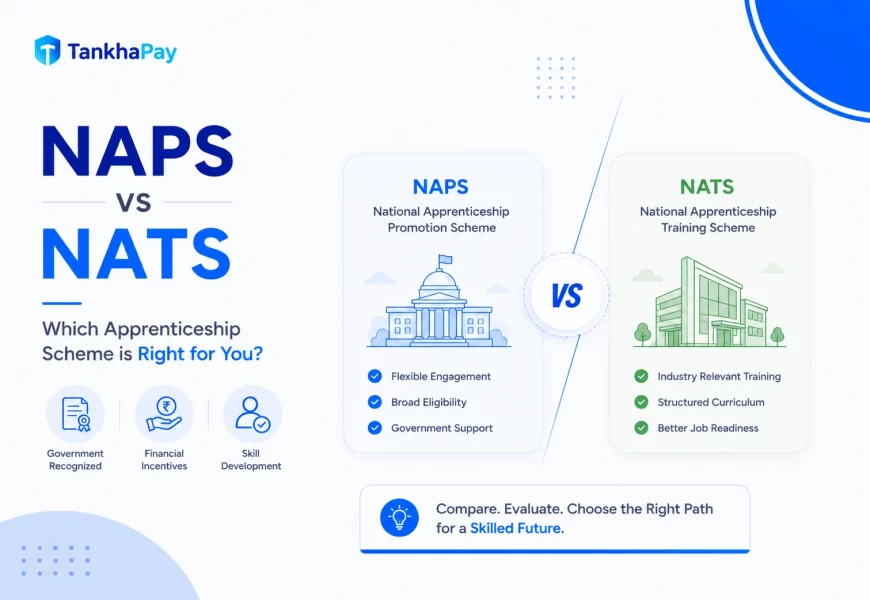
NATS is managed by the Board of Apprenticeship Training (BOAT) and is regulated by the Apprentices Act, 1961. However, it should not be confused with NAPS (National Apprenticeship Promotion Scheme), which comes under the purview of the Ministry of Skill Development. Read our full comparison of NATS or NAPS: which is better for your business.
The Certificate of Proficiency (CoP) is provided by the Government of India upon the successful completion of this course. The certificate is considered as valid work experience for all employment exchanges in India. As of 2025, 5.23 lakh apprentices have been hired under the NATS scheme in all states and union territories of India.
What Is Regular Employment in India?
A regular employment relationship is one in which both parties have an employer-employee relationship that is regulated through Indian labour laws such as the Industrial Disputes Act, Factories Act, Shops and Establishments Act, and Employees’ Provident Fund Act.
In a regular employment relationship, the employee gets a structured salary along with other perks like contributions towards PF and ESIC, leaves, gratuity after 5 years of service and statutory rights. This type of employment relationship continues till either one of the two ends it formally.
Regular vs. contract employment is a separate distinction. A contract employee works for a fixed project or term but still carries most statutory benefits. An apprentice under NATS carries almost none of these, because the legal framework is entirely different.
8 Key Differences Between NATS and Regular Employment
1. Legal Framework
Under the NATS, the employer-apprentice relationship falls under the Apprentices Act of 1961 and not under the labour laws. In this case, the entire framework of the Industrial Disputes Act, Factories Act, and Shops and Establishments Act will not be applicable to the apprentice for the entire period he/she is training.
The regular employee enjoys full protection of Indian labour law right from the first day of employment.
2. Compensation: Stipend vs Salary
The NATS apprentices are given an allowance and not a salary. The current allowance amount for the NATS apprentices after the increment of 36 % that was approved by the 38th Central Apprenticeship Council in May 2025:
- For Graduate Apprentices – ₹6,800 to ₹12,300 per month based on the organization
- For Diploma Holders – ₹6,000 to ₹10,900 per month
Employees receive a salary consisting of different elements.
3. PF and ESIC: The Biggest Compliance Difference
This is where the Nats vs regular employment India comparison becomes most significant for employers.
Apprentices under NATS are specifically exempt from both the Employees’ Provident Fund Act and the Employees’ State Insurance Act for the full duration of their training. This means:
- No 12% employer PF contribution on stipend
- No 3.25% employer ESIC contribution on stipend
- No EPF or ESIC compliance filings for apprentices
Regular employees attract both contributions from month one. For 100 apprentices at ₹9,000 per month, the combined PF and ESIC saving to the employer is ₹16 to 17 lakh per year.
4. Duration and Commitment
The duration of an NATS engagement is between six to twelve months. Once the engagement is completed, the trainee gets their Certificate of Proficiency, and the engagement ends unless the employee decides to change the engagement to permanent employment.
Permanent employment does not have any set duration. Termination of employment involves notice periods and full and final settlement, amongst others.
5. Learning vs Performance
NATS works according to performance results and not the outcome of performance itself. An apprentice is not supposed to perform at the same capacity as other employees. The emphasis here is on learning skills through practical experience.
Other employees are judged on the basis of performance results from the moment of hiring itself.
6. Employer Cost: The Real Numbers
Through apprenticeships as per the Apprenticeship Act, companies can save ₹161,040 per apprentice per year as compared to employing regular employees.
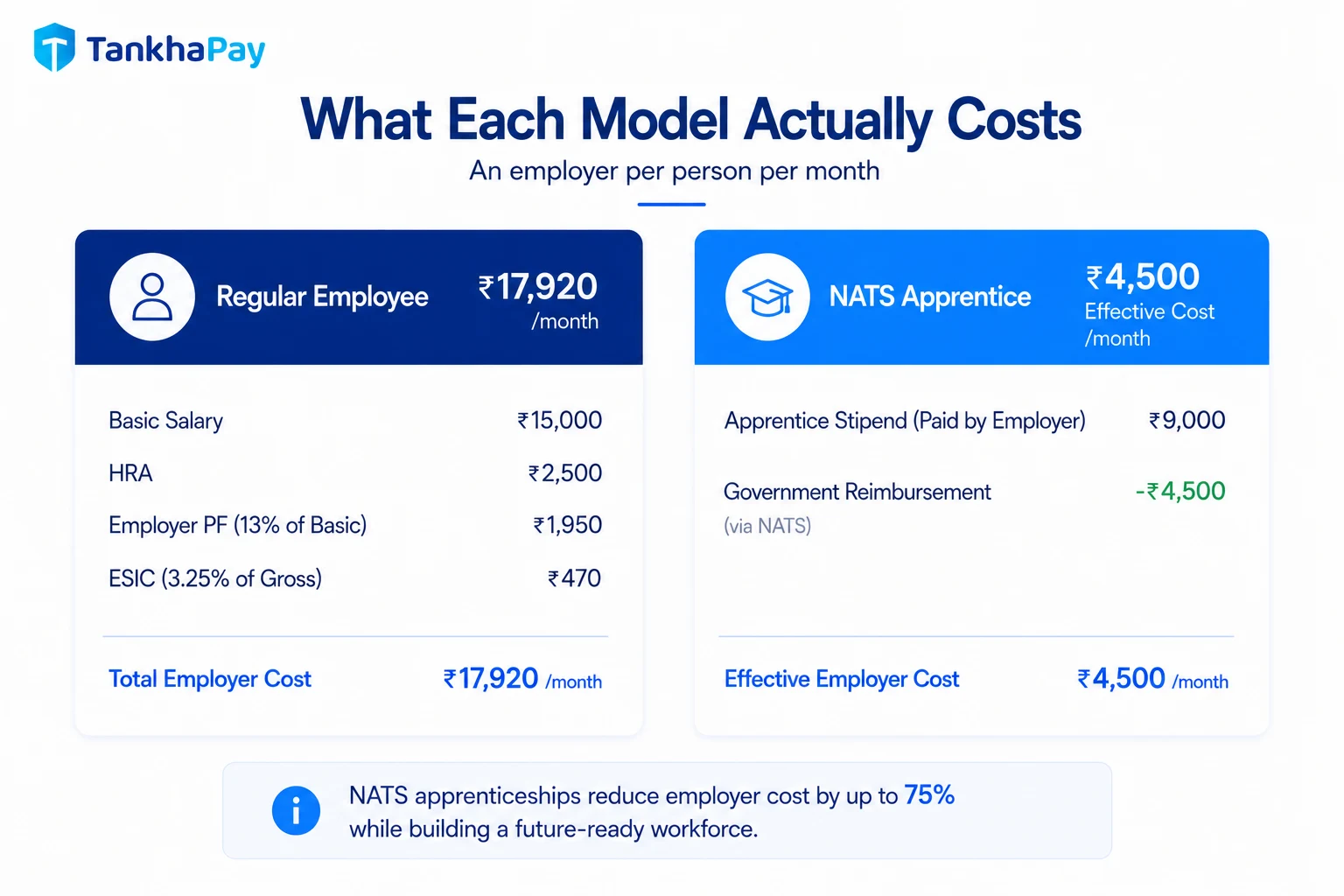
Here is an example of calculation of savings on hiring an apprentice in a company operating in Maharashtra based on minimum wages:
- Cost to the company of a regular employee per month: ₹17,920 (Includes PF, ESIC, HRA)
- Cost to NATS Apprentice after reimbursement by Government: ₹4,500 per month
- Monthly savings per apprentice: ₹13,420
- Annual savings per apprentice: ₹161,040
7. Government Reimbursement — Unique to NATS
This has no equivalent in regular employment. The Government of India directly reimburses 50% of the stipend paid, up to ₹4,500 per apprentice per month, into the employer’s bank account every quarter.
The payment is contingent upon posting monthly attendance data onto the NATS website. Failure to do so in any month of a quarter leads to rejection of the whole quarter’s payment claim. This is the most frequent cause for which payments that could otherwise have been received get forfeited. See our full nats stipend amount 2026 breakdown for the complete claims process and category-wise rates
8. Career Outcome After Training
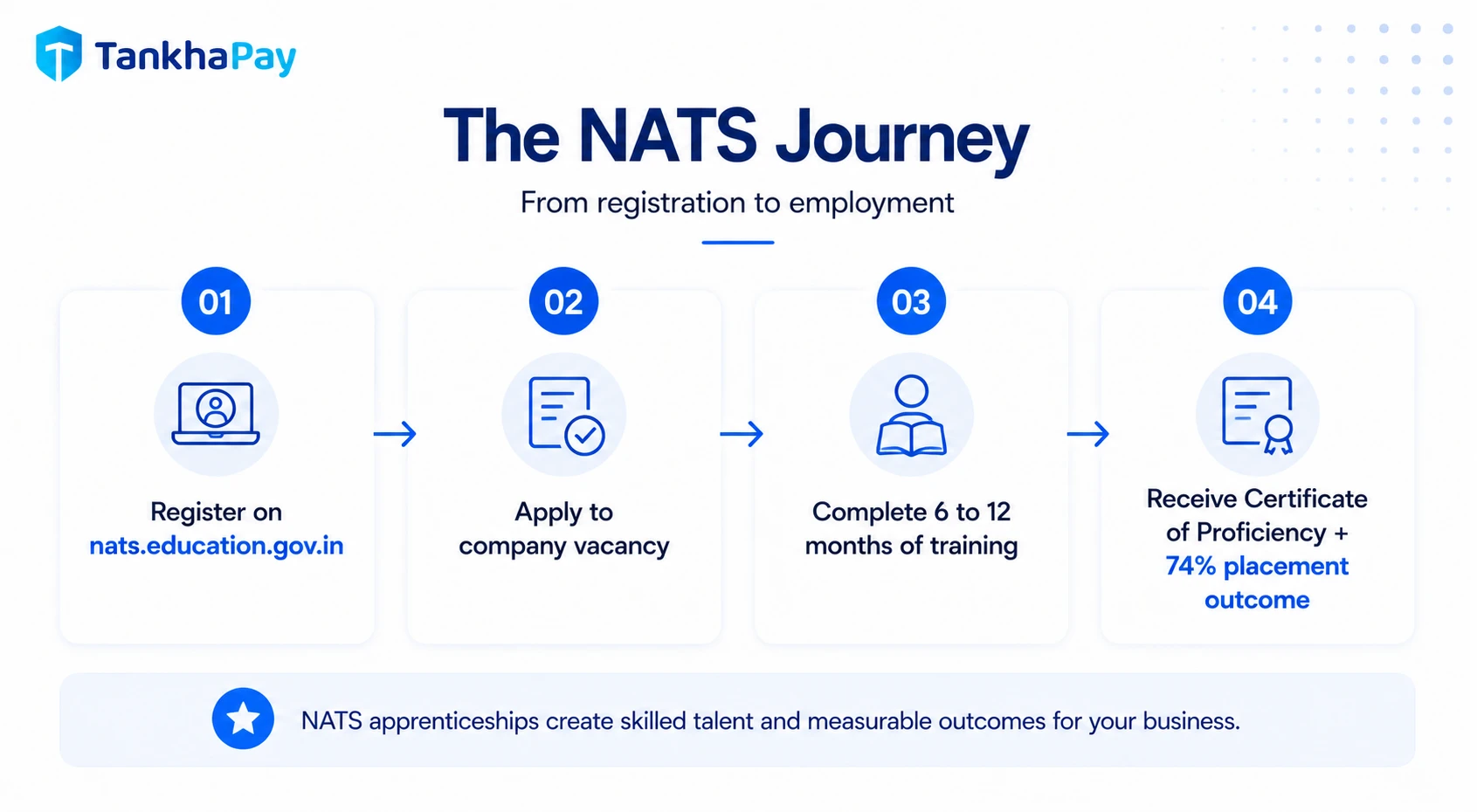
According to a third-party analysis conducted by NILERD, 74 % of NATS apprentices have found themselves jobs on completion of their apprenticeship programme. The Certificate of Proficiency holds the status of valid work experience in all job exchanges in India.
Full-time employment offers continuous job security, but it does not guarantee the experience certificate issued by the government. NATS has a better track record of securing jobs for fresh graduates than going for direct jobs.
NATS vs Regular Employment: Side-by-Side Comparison
| Factor | NATS Apprenticeship Recommended |
Regular Employment |
|---|---|---|
| Governing law | Apprentices Act, 1961 | Labour laws (IDA, Factories Act, etc.) |
| Compensation | Stipend: ₹6,800–₹12,300/month | Salary as per role and minimum wage |
| PF contribution (employer) | Not applicable | 12% of basic salary |
| ESIC contribution (employer) | Not applicable | 3.25% of gross salary |
| Duration | 6 to 12 months (fixed) | Ongoing until terminated |
| Government reimbursement | 50% of stipend (up to ₹4,500/month) | None |
| Gratuity | Not applicable | After 5 years of service |
| Job protection | None — training contract only | Full labour law protection |
| Certificate on completion | Certificate of Proficiency (GoI) | No certificate |
| Post-training employment | 74% secure full-time jobs | Ongoing — no post-training step |
Why Employers Should Consider the NATS Employment Model
The nats employment model is one of the most underused cost and talent tools available to Indian businesses. Here is when it makes the most sense for your company.
You have 30 or more employees –
Under the Apprentices Act, you are already legally required to engage apprentices between 2.5% and 15% of your total workforce. Non-compliance can attract penalties. Using NATS correctly keeps you compliant while generating actual financial benefits.
You are building a talent pipeline –
NATS gives you 12 months to assess a candidate before committing to a permanent hire. At 74% post-training placement rates, the scheme is one of the most efficient ways to fill entry-level and mid-skill roles with candidates who already know your systems and culture.
You want to reduce compliance load –
No PF filing, no ESIC filing, and no need for calculation of minimum wage for apprentices. For firms that grow in numbers, who manage payroll of employees across many states, it will definitely help ease your compliance burden.
NATS compliance from registration of portal to attendance upload, reimbursement claims, and issuance of CoP is managed by TankhaPay end-to-end, which means that your HR need not manage it on their own.
Should You Accept a NATS Apprenticeship?
If you are a fresh graduate evaluating a NATS offer alongside a regular job offer, here is an honest answer.
Choose NATS if:
- You have a degree but limited work experience and want a government-recognised certificate
- The company offering NATS is a strong brand or a PSU where the network value is high
- You are in a technical field where hands-on industry exposure is valued more than your first salary
- You understand this is a 12-month commitment, not a job, and you are planning your next move accordingly
Be cautious if:
- You already have another job offer from a company of similar standing that pays a full salary with benefits
- The NATS stipend is significantly below your financial need because, unlike a salary, it comes with no PF accumulation and no employer benefits
- The company offering NATS has no track record of converting apprentices to full-time roles
One important clarification: a NATS apprenticeship does not guarantee a permanent job. The Certificate of Proficiency, however, is valid proof of experience and is counted as such at all employment exchanges. It is your most important asset from the programme.
Wrapping Up
The NATS vs normal employment in India comparison is far from being a simple case of one versus another. There are different purposes, different regulations, and different time frames for which each type is designed.
For employers: NATS is a legally backed, government-subsidised workforce model that saves ₹161,040 per apprentice per year in direct costs. If your company has 30 or more employees and you are not using it, you are leaving money on the table while also staying outside compliance.
For candidates: NATS is a legitimate stepping stone program that is certified by the government and has an employment success rate of 74%. It is not a substitute for a job per se, but for a new candidate starting out his/her career in a tough job market, this is often the quickest way.
The NATS Management Program of TankhaPay takes care of all aspects from registering on the portal to logging your attendance and making a quarterly claim for reimbursements.