What is NATS and Why Does it Matter for Employers in 2026?
NATS, the National Apprenticeship Training Scheme, is a Government of India programme administered by the Ministry of Education through BOAT (Board of Apprenticeship Training) and BOPT (Board of Practical Training). It allows employers to engage graduate and diploma holders as apprentices for a period of up to one year, during which the government reimburses 50% of the stipend paid – up to ₹4,500 per apprentice per month.
Definition:
NATS Reimbursement The NATS stipend reimbursement is a Government of India benefit under which the Central Government pays back 50% of the monthly stipend disbursed by an employer to a registered NATS apprentice, subject to a maximum of ₹4,500 per apprentice per month. Claims are filed quarterly on the NATS portal (nats.education.gov.in) and disbursed through BOAT/BOPT regional offices directly to the employer’s registered bank account.
This is much more than a training program for the employers. This is a method of lowering workforce costs with monetary gains, legal exemption from liability, and no responsibility of hiring the apprentice after the program period.
From our experience of working with Indian firms implementing NATS programs in manufacturing, IT, logistics, and BFSI sectors, those who recover all their money on time are not the firms that have the highest number of apprentices but the ones that consider portal submission of payroll mandatory.
TL;DR
- The Government of India reimburses 50% of the stipend paid to NATS apprentices – up to ₹4,500 per apprentice per month – directly to the employer’s bank account.
- Claims are filed quarterly after three months of approved attendance and training records on nats.education.gov.in.
- Reimbursement takes 45–75 days from claim submission to bank transfer – plan working capital accordingly.
- NATS apprentices are exempt from EPF and ESIC, saving employers an additional 15.25% of stipend cost on top of the reimbursement.
- The most common reasons for missed or delayed reimbursement, skipped monthly attendance uploads, ROP left in Draft status, and bank details not pre-registered on the portal.
- Establishments with 30+ workers (including contract employees) are mandatorily required to engage apprentices under the Apprentices Act – NATS is the primary route for graduate and diploma apprentices.
How does 50% Reimbursement Work
The reimbursement structure is straightforward once you understand the three-phase cycle.
Phase 1: Monthly – The employer must pay the complete stipend to the apprentice and upload the attendance report and Record of Progress (ROP) on the NATS portal. This phase cannot be bypassed under any circumstances; even if one month’s record is not uploaded, the quarterly claim will not be allowed.
Phase 2: Quarterly – After receiving the approval of three months of attendance records consecutively, the employer needs to make a claim through the portal. This will calculate the amount payable for the specified period automatically based on apprentice category and months of participation.
Phase 3: Payment Disbursement – The claim gets verified by the Board of Apprenticeship Training/Board of Apprenticeship and Polytechnic Training, and then the Government of India releases 50% of the stipend amount paid (maximum of Rs. 4,500 per apprentice per month) into the account of the employer.
NATS Stipend Amount 2026: Rates by Category
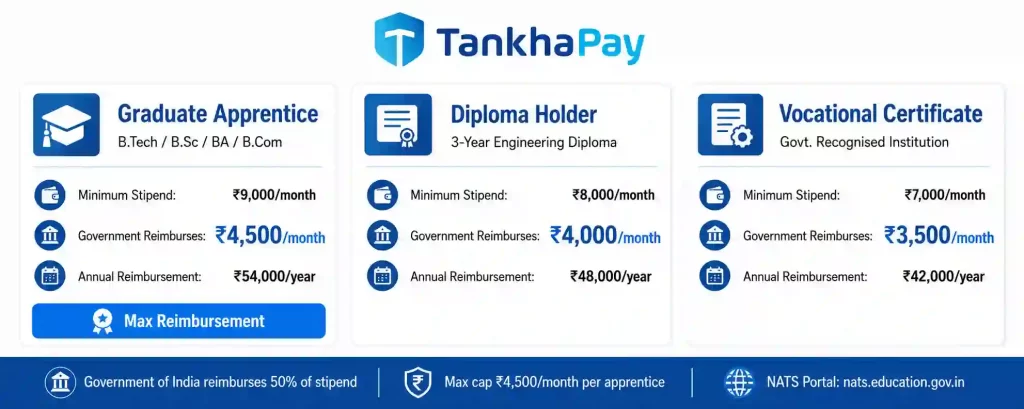
Minimum rates of stipends have been prescribed in The Apprentices Act depending on the apprenticeship qualification. If employers provide higher rates of stipends above the prescribed minimum rate, they can claim reimbursement up to the maximum limit.
| Apprentice Category | Minimum Monthly Stipend | Govt. Reimburses (50%) | Govt. Cap | Quarterly Reimbursement per Apprentice |
|---|---|---|---|---|
| Graduate (B.Tech, B.Sc, BA, B.Com) | ₹9,000 | ₹4,500 | ₹4,500 | ₹13,500 |
| Diploma Holder | ₹8,000 | ₹4,000 | ₹4,500 | ₹12,000 |
| Vocational Certificate Holder | ₹7,000 | ₹3,500 | ₹4,500 | ₹10,500 |
| Higher Stipend (e.g., ₹12,000 paid) | ₹12,000 | ₹4,500 (capped) | ₹4,500 | ₹13,500 |
Important cap rule: If you pay a graduate apprentice ₹12,000/month, you still receive only ₹4,500/month reimbursement, not ₹6,000. The cap applies regardless of the actual stipend amount paid.
Which Employers Are Eligible for NATS Reimbursement?
Basic Eligibility Conditions
To claim NATS reimbursement, an employer must meet all of the following conditions:
- Registered as an Establishment on the NATS portal (nats.education.gov.in) with a valid Establishment ID issued by BOAT/BOPT
- Type of organization: Central/State Government PSUs, private company, public limited company, partnership firm, or an organization that comes under the Apprentices Act, 1961
- The organization must have at least 30 employees or more, including contractual workers hired via third-party payroll services, to be made mandatory under the Apprentices Act, but organizations can also voluntarily register themselves under the Act.
- A valid Apprenticeship Contract executed through the NATS portal for each apprentice
- Monthly attendance and ROP submitted on time for all quarters being claimed
- Company bank account details entered and verified in the establishment profile on the portal before any claim is submitted
30-Employee Rule – A Common Source of Confusion
The 30-employee headcount includes all contract employees hired via payroll from third parties as well. If there are 20 employees who have been hired directly along with 15 contract employees, then an establishment will be eligible for engaging apprenticeship program under the Apprentices Act.
Failing to include contract workers in the headcount and then not engaging the required number of apprentices creates compliance exposure – including penalties under the Apprentices Act.
Sector Coverage
NATS covers employers across all sectors: manufacturing, services, IT, healthcare, BFSI, retail, logistics, and government/PSU units. There is no sector exclusion from the reimbursement mechanism.
Which Apprentices Qualify Under NATS?
NATS is specifically designed for technically qualified freshers. The qualification must match one of the prescribed categories.
| Category | Qualification Required | Key Condition |
|---|---|---|
| Graduate Apprentice | B.Tech, B.E., B.Sc, BA, B.Com (full-time, AICTE/UGC recognised) | Must not have completed another apprenticeship in the same trade |
| Diploma Technician | Diploma in Engineering/Technology (3-year, AICTE recognised) | The same trade restriction applies |
| Vocational Certificate Holder | Vocational or technical certificate from recognised institution | Must align with employer’s training area |
Conditions that disqualify an apprentice from the reimbursement:
- Already served as an apprentice in the same trade/category previously
- No recognition by AICTE/UGC/Government
- Agreement is not registered through official NATS website
- Achievement level is less than necessary for every month of claiming period
Financial Case: Real Numbers, Real Savings
NATS apprentices are statutorily exempt from both the Employees’ Provident Fund (EPF) Act and the Employees’ State Insurance (ESIC) Act for the entire duration of the apprenticeship. The reimbursement and the statutory savings together create a significant annual financial benefit.
Annual Savings Model – 50 Graduate Apprentices at ₹9,000/month
| Cost Component | Without NATS (50 Regular Employees) | With 50 NATS Apprentices | Annual Saving |
|---|---|---|---|
| Monthly salary/stipend | ₹9,000/person | ₹9,000/person | – |
| Employer PF (12% of basic) | ₹1,080/person/month | ₹0 (exempt) | ₹6,48,000/year |
| Employer ESIC (3.25% of gross) | ₹292/person/month | ₹0 (exempt) | ₹1,75,200/year |
| Govt. stipend reimbursement | ₹0 | ₹4,500/person/month | ₹27,00,000/year |
| Total annual benefit | – | – | ₹35,23,200 |
A company with 100 graduate apprentices sees annual benefits exceeding ₹70 lakhs. This is recurring – every year you maintain the programme at the same scale.
Quarterly Cash Flow Note
Reimbursement occurs on a quarterly basis and not on a monthly basis. Plan the 45- to 75-day delay period in disbursements as part of the working capital planning process. The total disbursement cost incurred for the first quarter is an unsupported expenditure.

Step-by-Step: How to claim NATS Stipend Reimbursement
Pre-Requisite: Monthly Attendance and ROP Upload
There should at least be 3 months’ worth of approved attendance and training uploaded in the system prior to making claims. This is the most commonly overlooked prerequisite.
Uploading documents monthly:
- Attendance report for the month (dates when present, absent, or on leave)
- Record of Progress (ROP) – activities undertaken during the training and skills taught
- Confirmation of payment of stipend (evidence that the total stipend was paid to the apprentice)
The ROP must be approved by the employer’s designated Training Manager on the portal before the month counts toward a quarterly claim.
8-Step Claim Process
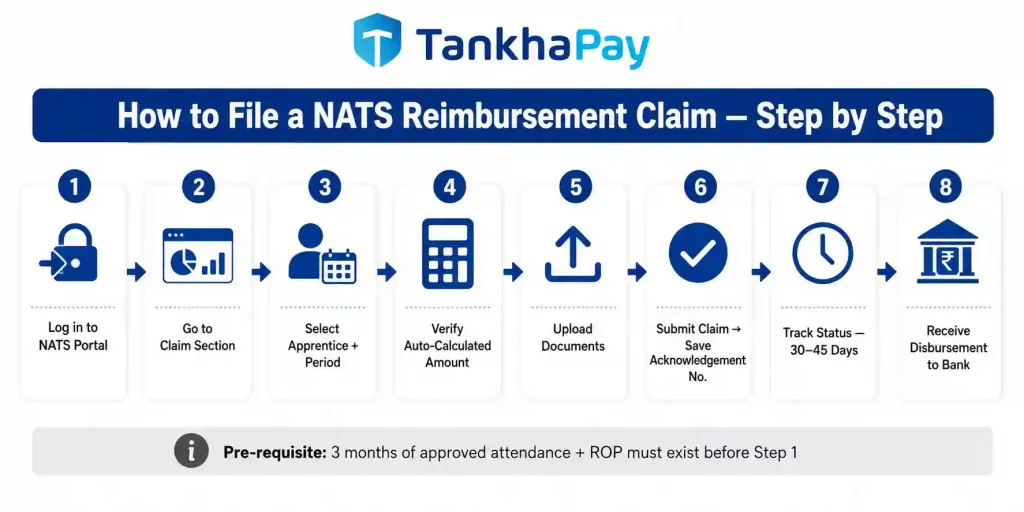
Step 1 – Log in to the NATS Portal Go to nats.education.gov.in. Use your Establishment ID and registered credentials. Ensure bank details are pre-entered and verified in the establishment profile.
Step 2 – Navigate to the Claim Section From the employer dashboard, go to the Stipend Reimbursement or Claim Management section.
Step 3 – Select Apprentice and Claim Period Select the apprentice(s) for whom you are filing. The system shows eligible months based on approved ROP records. Select the three-month claim period.
Step 4 – Verify Auto-calculated Amount The online portal automatically calculates the amount of reimbursement: (Number of months x 50% of prescribed stipend rate). Verify that it is consistent with your calculations.
Step 5 – Attach Required Documents The applicant must attach necessary documents in PDF format. File size restrictions exist – make sure to compress the files prior to upload.
Step 6 – Submit the Claim Submit and save the acknowledgement number. This number is required for tracking and any escalations with BOAT.
Step 7 – Claim Status Monitoring Monitor claim status after 30 days. The process of verification of the BOAT claims usually takes around 30-45 days.
Step 8 – Claim Disbursement The claim is disbursed by the Government directly into the company’s bank account on approval.
Documents Required for Reimbursement
Mandatory Portal Uploads
| Document | What It Should Show |
|---|---|
| Apprenticeship Contract | Portal-executed contract with apprentice name, category, start date, establishment details |
| Monthly Attendance Records (3 months) | Date-wise attendance marked and approved on portal by Training Manager |
| Record of Progress (ROP) (3 months) | Training activities, assessments, and progress – portal-approved, not in Draft |
| Stipend Disbursement Proof | Bank transfer statement or payslip showing stipend paid each month |
| Establishment Bank Details | Pre-entered in portal profile – IFSC, account number, bank name |
Documents to Maintain Offline (Audit and Escalations)
- Original appointment letter issued to each apprentice
- BOAT registration certificate of the establishment
- PAN card of the establishment
- Apprentice’s educational qualification certificates
- Training facility description (for first-time registrants)
Employer Documentation Checklist
Establishment-Level (One-time Setup)
- Registration on nats.education.gov.in having valid Establishment Id
- Bank account details including Account Number, IFSC, Bank Name registered on portal
- Training Manager registered on portal
- Description of training facility and programme provided
Per Apprentice (Every Quarter)
- Apprenticeship Contract executed through NATS portal – not just a physical agreement
- Three months of attendance records uploaded and approved on portal
- Three Records of Progress (ROP) completed, uploaded, and approved (not in Draft status)
- Stipend payment proof available for all three months
- Apprentice’s qualification certificate verified on portal
- No break in training reported during the claim quarter
Before Claim Submission
- ROPS status for all three months is “Approved” – not “Pending” or “Draft”
- Amount paid is equal to the amount claimed on the portal
- Apprentice category chosen correctly (Graduate / Diploma / Vocational)
- Claim period is the sequential quarter
- Documents in PDF format are uploaded within file-size restrictions
- Acknowledgement number obtained after uploading
Post-Submission
- Claim status verified 30 days after submission
- Reimbursement voucher validated for correct amount
- Incomes reported as taxable business receipt
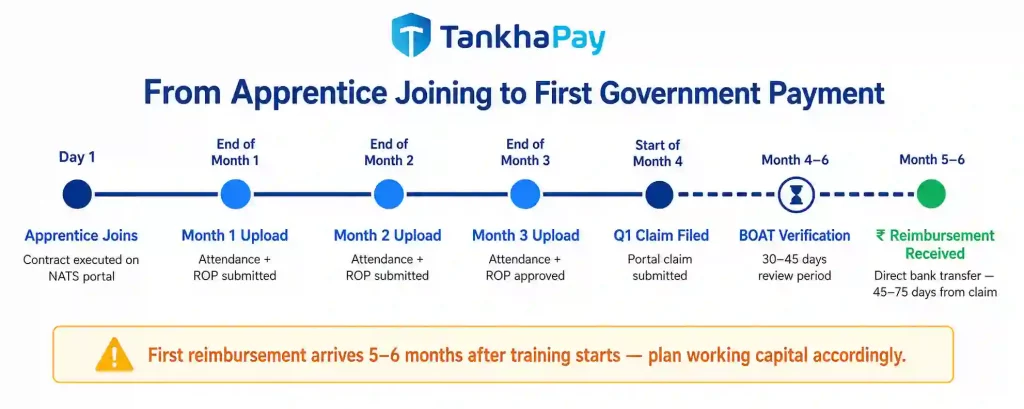
NATS Reimbursement Timeline
| Milestone | Typical Timeframe |
|---|---|
| Employer registers on NATS portal | Day 1 |
| Establishment ID received | Day 1–3 |
| Apprentice selected and contract executed | Week 1–4 |
| Month 1: Training begins, attendance uploaded | End of Month 1 |
| Month 2: Attendance and ROP uploaded | End of Month 2 |
| Month 3: Attendance and ROP uploaded and approved | End of Month 3 |
| Q1 reimbursement claim filed | Start of Month 4 |
| BOAT verification period | 30–45 days |
| Government disbursement to employer bank account | Day 45–75 from claim |
| First reimbursement received | ~Month 5 to 6 from training start |
Mistakes That Delay or Kill Reimbursement Claims
Mistake 1: Not uploading monthly attendance on time Attendance must be uploaded and approved within the same month. Uploading three months in bulk at quarter-end is not accepted – the system timestamps each upload. One missing month of approved data blocks the entire quarterly claim.
Mistake 2: ROP left in “Draft” status The Record of Progress must be formally submitted and approved by the Training Manager – not just saved. Many first-time users complete the training records but forget to change status from Draft to Submitted. BOAT does not see draft records.
Mistake 3: Bank details not entered before claim submission Claims cannot be processed to an unregistered account. Entering bank details after claim submission does not retroactively process the pending claim.
Mistake 4: Claiming the wrong apprentice category Selecting “Graduate” for a Diploma holder causes the auto-calculated amount to be incorrect. The mismatch between the claimed amount and the prescribed rate for the actual qualification triggers a flag.
Mistake 5: Apprenticeship contract not executed through the portal Some employers sign a physical contract only. The contract must be executed through the NATS portal – without this, the apprentice is not officially registered and no reimbursement can be claimed.
Mistake 6: Stipend paid amount differs from portal-recorded amount If you record ₹9,000 on the portal but pay ₹10,000 to the apprentice’s bank account, the discrepancy is flagged during verification.
Mistake 7: Claiming for non-sequential quarters NATS reimbursement must be claimed in sequential quarterly blocks – Q1, Q2, Q3, Q4. Skipping a quarter and claiming for the next one is not permitted without resolving the prior quarter first.
Mistake 8: Inactive portal access for the Training Manager The portal access for the Training Manager will need to be active; otherwise, there will be no response from the ROP.
Why Claims Get Rejected – And How to Avoid Each Reason
| Rejection Reason | Root Cause | Prevention |
|---|---|---|
| Attendance records incomplete | Missing one or more months of data | Set calendar reminder on 25th of each month for upload |
| ROP not approved | Draft status not changed to Submitted | Make Training Manager approval a mandatory monthly sign-off |
| Stipend not paid in time | Apprentice not paid before claim filed | Process stipends before 30th of each month |
| Contract not portal-executed | Physical-only contract | Execute contract through NATS portal on day of joining |
| Bank details not verified | Details entered but verification not completed | Complete bank verification immediately during establishment setup |
| Qualification mismatch | Apprentice category incorrectly selected | Verify qualification documents at onboarding and match to portal category |
| Claim period error | Non-sequential claim months selected | File claims in order – Q1, then Q2, then Q3, then Q4 |
Industry-Specific Scenarios and Worked Examples
Manufacturing Company – Diploma Apprentices at Scale
A car components manufacturing firm located in Pune, employing 680 employees, hires 50 diploma-holding apprentices at ₹8,000 per month to fulfill the statutory requirements under the Apprentices Act.
- Quarterly reimbursement: 50 × ₹4,000 × 3 = ₹6,00,000
- PF saved annually: 50 × 12% × ₹8,000 × 12 = ₹5,76,000
- ESIC saved annually: 50 × 3.25% × ₹8,000 × 12 = ₹1,56,000
- Total annual NATS benefit: ₹31,32,000
IT Services Company – Graduate Fresher Pipeline
A leading IT services provider based out of Bengaluru hires 80 B. Tech graduate apprentices at ₹9,000 per month undertake a rigorous 12-month-long training program before hiring top candidates.
- Government reimbursement annually: 80 × ₹4,500 × 12 = ₹43,20,000
- PF saving: ₹10,36,800/year
- ESIC saving: ₹2,80,800/year
- Total annual benefit: ₹56,37,600 – for training the company would run anyway
BFSI Company – Closing a Compliance Gap
An NBFC with 500 employees gets itself audited and is found to be non-compliant with the Apprentices Act owing to a lack of a sufficient number of apprentices. The company registers itself with NATS, hires 25 graduate apprentices and starts earning ₹13,50,000 annually from reimbursements.
Compliance Requirements Employers Must Meet
Annual Compliance Calendar
| Compliance Obligation | Frequency | Consequence of Non-Compliance |
|---|---|---|
| Monthly attendance upload to NATS portal | Monthly | Reimbursement claim blocked for that quarter |
| Record of Progress (ROP) approval | Monthly | Claim rejected; BOAT may flag establishment |
| Apprenticeship contract renewal or closure | On completion / termination | Open contracts past completion date are a compliance risk |
| Headcount reporting under Apprentices Act | Annual | Penalties under Apprentices Act, 1961 |
| Stipend revision if minimum rates are updated | When Ministry revises | Paying below revised minimum is a statutory violation |
Record-Keeping and Audit Readiness
Establishment inspections by BOAT regional offices take place at intervals. Employers unable to provide any documents during the inspection stand to lose reimbursement claims and will be penalized accordingly.
Minimum Records to Maintain (3-Year Retention Recommended)
- Photocopies of all Apprenticeship Contracts (from portal and paper)
- Attendance register on a monthly basis for all apprentices
- Logs of training and ROPs (from portal and paper)
- Records of stipends paid (bank statements indicating transfer to individuals)
- Receipts of the reimbursement received from the government (bank credits)
- Income recognition recorded in accounts as reimbursement being income
- Qualification certificates of the apprentices (photocopies)
- Copies of NAC when the programme is completed
Audit Readiness Checklist
- All active Apprenticeship Contracts in the portal and physical form
- All attendance records are without any unaccounted-for breaks
- Each ROP has an approval stamp by the Training Manager
- All stipend payments made bank to bank (cash payments cannot be traced)
- Income from reimbursement recorded accurately in the books
- Count of apprentices in line with those in the portal
- No apprentice registered with the company’s PF while undergoing apprenticeship
Financial Planning: Budgeting for NATS at Scale
Build the Disbursement Lag Into Your Plan
The first reimbursement arrives approximately 5–6 months after the first apprentice joins:
- Months 1-3: Training and upload of monthly data
- Month 4: Claims filing
- Months 4-6: Verification of claims and receipt of BOAT payments (45-75 days)
For the CFO and the Finance team, the complete amount for the quarter spent on stipends is an unbacked cash expenditure. For quarters 2-4 and thereafter, reimbursements start coming in and partially cover the expenses
Tax Treatment of Stipend and Reimbursement
It is a business expense deduction of the entire allowance made to the NATS apprentices. The allowance reimbursement from the government is considered taxable income in “Business Income”. The net cost incurred by the employer is 50% of the amount paid as an allowance after reimbursement.
Take guidance on an entity-based approach from a chartered accountant, particularly if you are operating in a tax holiday/SEZ scenario.
When to Review Stipend Levels
The Ministry of Education periodically revises minimum stipend rates. Continuing to pay below the revised rate after a notification is a compliance violation. Monitor the NATS portal for rate revision announcements.
Frequently Asked Questions
What is the maximum reimbursement an employer can receive per apprentice under NATS?
The maximum is ₹4,500 per apprentice per month, regardless of the actual stipend paid. For a 12-month apprenticeship, the maximum reimbursement per graduate apprentice is ₹54,000. Diploma holders are capped at ₹4,000/month and vocational certificate holders at ₹3,500/month – based on 50% of their respective minimum stipend rates.
How often can a reimbursement claim be filed?
Once every quarter – meaning once every three months. Claims for months 1–3, 4–6, 7–9, and 10–12 are filed sequentially. Each claim requires three months of approved attendance and ROP data before it can be submitted. Claims cannot be filed in advance or out of sequence.
Are NATS apprentices entitled to PF and ESIC contributions?
No. NATS apprentices are exempt from both the Employees’ Provident Fund Act and the Employees’ State Insurance Act for the full duration of the apprenticeship. This exemption is automatic – no separate application is needed. Do not enroll NATS apprentices on your PF register.
What happens if I miss uploading attendance for one month in a quarter?
The quarterly claim for that quarter cannot be filed until the missing month’s data is resolved. If the portal upload window has passed, contact your BOAT regional office – in some cases a late upload request can be accommodated. Prevention is better: set a firm monthly upload deadline before the 30th.
What documents does BOAT inspect during an establishment visit?
BOAT inspectors normally require the following: apprenticeship agreement, monthly attendance list, training record and ROP, bank statements proving that stipend was paid to each apprentice and reimbursement receipts. Failure to provide these documents upon request exposes establishments to loss of reimbursement and penalties under the Apprentices Act.
Is NATS the same as NAPS?
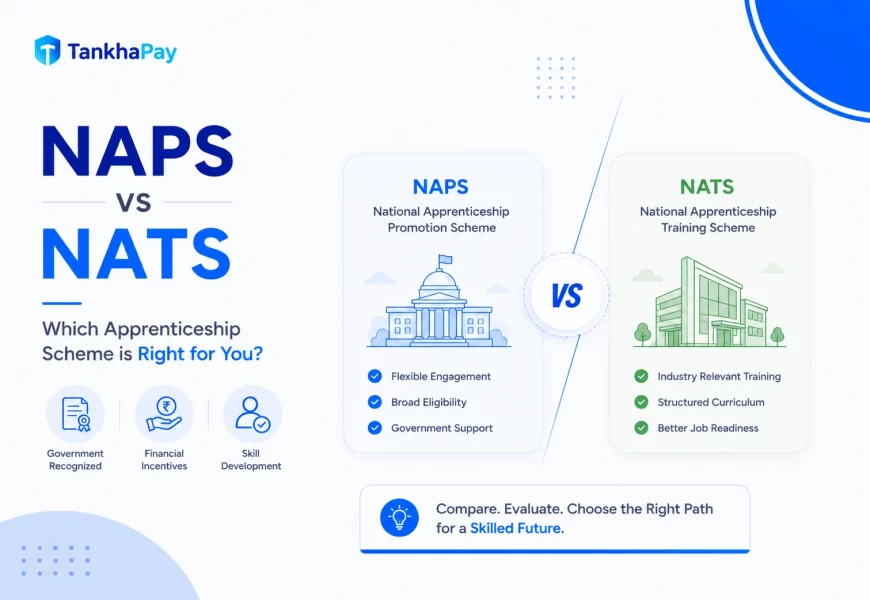
No. NATS falls under the Ministry of Education and is administered through BOAT/BOPT, while NAPS (National Apprenticeship Promotion Scheme) falls under the Ministry of Skill Development. See NATS or NAPS which is better for the full comparison.
Key Takeaways
- A company with 50 graduate apprentices at ₹9,000/month receives ₹27,00,000/year in government reimbursement – plus over ₹8 lakhs in statutory savings from PF and ESIC exemptions.
- The full stipend paid is a deductible business expense; the reimbursement received is taxable income.
- Every quarterly claim requires three months of approved attendance and ROP on the portal – this is the single most critical pre-requisite most employers fail to maintain consistently.
- There is no legal obligation to hire an apprentice as a permanent employee after the apprenticeship ends.
- Audit readiness means maintaining three years of attendance registers, training logs, stipend payment records, and reimbursement receipts.
- The first reimbursement arrives approximately 5–6 months after the first apprentice joins – build this disbursement lag into your working capital plan.
Conclusion
NATS is one of the most financial ways for Indian employers to make use of the government programs. This program combines several aspects into one system: cash repayment, mandated savings, low-risk recruitment, and compliance fulfillment. Employers who receive their money back promptly are not those who have many apprentices; these are employers who treat regular monthly uploads to the portal as a calendar-based task. Make your uploads correct, implement contracts through the portal, keep your banking data updated, and submit claims in the right order. The government will take care of its side if you do yours.
How TankhaPay Can Help
TankhaPay is responsible for handling the entire process of NATS Apprenticeship Cycle for employers in India – right from the first step of registration in the NATS Portal up until attendance uploads, ROPs, claiming and reimbursements.
For employers running NATS at any scale, the compliance risk is not in understanding the rules – it is in operationalising them consistently across every apprentice, every month, without gaps. TankhaPay’s NATS management service does this as part of a broader payroll and statutory compliance mandate, ensuring monthly uploads are completed on time, ROPs are approved before quarter-end, and claims are filed in the correct sequence.
Whether you are a manufacturing company meeting mandatory quotas, an IT firm building a fresher pipeline, or an MSME exploring NATS for the first time, TankhaPay provides the infrastructure and expertise to make the scheme generate real returns.

TankhaPay, developed by Akal Information Systems (est. 2000, CMMI Level 5, ISO 27001), is India’s only payroll platform combining payroll software, managed payroll outsourcing, domestic and international EOR, NATS apprenticeship management, and global talent mobility under one platform. Trusted by 1,000+ enterprise clients including Bank of Baroda and UIDAI.