Most HR professionals who enquire about whether to go with NATS or NEEM tend to believe that the question revolves around the nature of candidates or the training period. But the real question is the following:
Does the scheme you choose put your trainees under the Apprentices Act, 1961?
If yes, your trainees are legally classified as trainees, not workers, and you are exempt from EPF and ESI contributions for them. If no, that exemption does not automatically apply.
NATS puts trainees under the Apprentices Act. NEEM does not.
“According to Section 18 of The Apprentices Act, 1961, every apprentice receiving training as an apprentice in a notified or optional trade will be considered a trainee but not a worker, and any labor law will not apply to or in connection with such apprentice.”
Apprentices Act, 1961 (as amended 2014), Section 18, Ministry of Skill Development and Entrepreneurship
That is the legal basis for the EPF and ESI exemption under NATS. NEEM trainees are not covered by this section. The difference, at scale, is significant.
What Is the Difference Between NATS and NEEM?
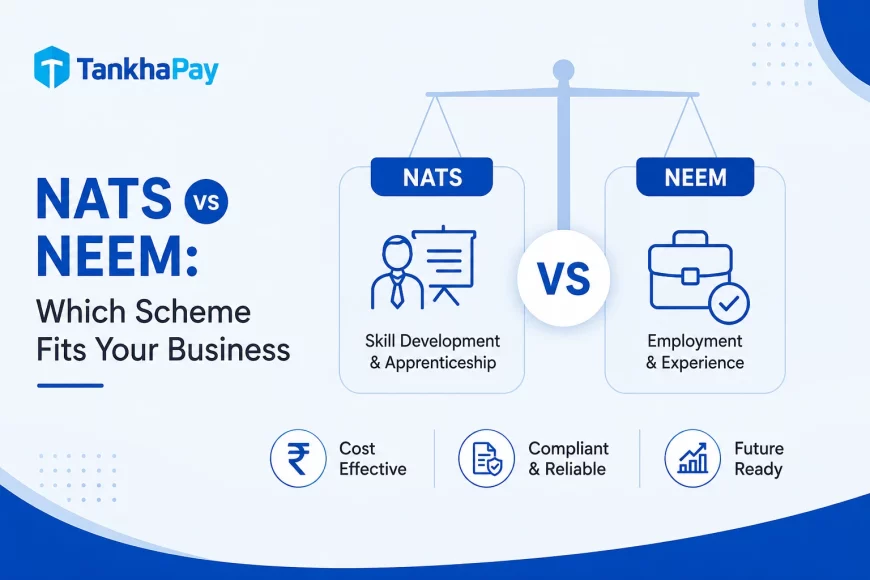
NATS (National Apprenticeship Training Scheme) is an apprenticeship scheme introduced by the government under the Ministry of Education based on the Apprentices Act 1961, providing systematic training for engineering graduates, diploma holders and general stream graduates possessing a government-certified Certificate of Proficiency.
NEEM (National Employability Enhancement Mission) is a skilling programme under AICTE (All India Council for Technical Education), not governed by the Apprentices Act, designed to provide industry exposure to candidates, including dropouts and mid-course leavers, through AICTE-approved NEEM Facilitators.
The very definitions are enough to understand the difference between them: while one is confined to an Act that is more than 60 years old, which provides for legal protection and exemptions, the other is just an administrative structure of AICTE without any statutory existence.
NATS – National Apprenticeship Training Scheme
What It Is and Who Governs It
NATS is administered by the Board of Apprenticeship Training (BOAT) under the Ministry of Education, operating through four regional boards in Chennai, Kolkata, Kanpur, and Mumbai. The official portal is nats.education.gov.in.
It falls squarely within the Apprentices Act, 1961. This is the most important structural fact about NATS.
Who Qualifies
NATS covers:
- Engineering graduates (BTech, BE)
- Diploma holders in engineering and technology
- From 2026, BA, BSc, and BCom general stream graduates (expanded under NATS 2.0)
No NEEM facilitator is required. Employers register directly on the NATS portal and engage apprentices under a formal apprenticeship contract with a unique contract number.
Employer Benefits Under NATS
EPF and ESI exemption: Confirmed under Section 18 of the Apprentices Act and verified by both the EPF Act, 1952 and the ESI Act, 1948, which explicitly exclude apprentices registered under the Apprentices Act from the definition of “employee”.
Government stipend support: The government deposits ₹4,500/month directly to the apprentice’s bank account via DBT, effectively subsidising the employer’s stipend burden.
Formal certification: On successful completion, apprentices receive a Certificate of Proficiency (CoP) issued by the Government of India – recognised at all employment exchanges as valid work experience.
Employment outcomes: An evaluation conducted by NILERD revealed that 74% of the apprentices trained under NATS were able to find employment post-training. NATS trained 5,23,024 apprentices in all States and UTs in 2025.
NEEM – National Employability Enhancement Mission
What It Is and Who Governs It
NEEM was launched by AICTE in 2013 to bridge the gap between industry and candidates who fall outside formal degree completion categories. The scheme allows employers to provide structured on-the-job training to a broader candidate pool than NATS covers.
Critically: NEEM does not come under the Apprentices Act, 1961. NEEM functions according to the administration regulations of AICTE. This is the core structural distinction.
Who Qualifies
NEEM’s wider eligibility is its key advantage:
- Students who have dropped out from a graduation course
- Candidates who do not have a formal degree
- Those non-engineering candidates who are not eligible for NATS
- Candidates looking for skill development outside the scope of Apprentices Act
For candidates who do not meet NATS eligibility criteria, NEEM may be the only formal government-backed option.
NEEM Facilitator Requirement
NEEM is not a direct employer-to-trainee arrangement. Every NEEM engagement must be routed through an AICTE-approved NEEM Facilitator. A third-party organisation that registers, manages, and contracts the trainees on behalf of the employer.
This is a structural cost and compliance layer that NATS does not require.
The NEEM Facilitator:
- Registers trainees on the AICTE NEEM portal
- Manages stipend disbursement routing
- Handles NEEM compliance documentation
- Charges a service fee, typically 10–15% of the monthly stipend paid to trainees
This fee is not optional. It is the cost of operating under the NEEM framework.
EPF and ESI Under NEEM
This is the most consequential difference and the most frequently misunderstood.
NEEM trainees are not apprentices under the Apprentices Act, 1961. They do not benefit from Section 18’s classification of apprentices as “trainees, not workers”. This means:
- The EPF Act, 1952’s exclusion of “apprentices engaged under the Apprentices Act” does not apply to NEEM trainees
- The ESI Act, 1948’s parallel exclusion does not apply to NEEM trainees
- Whether EPF and ESI apply to NEEM trainees depends on how the engagement is structured and classified. A compliance grey area that many businesses do not resolve correctly
This implies that NEEM trainees are able to make deductions for EPF and ESI. This is an expense that NATS trainees are not supposed to pay according to the law. Consult a labour compliance specialist to find out how this will work in your particular NEEM system.
When NEEM Is the Right Choice
Despite the higher cost structure, NEEM serves a genuine need for specific employer scenarios:
Scenario 1: Your candidates are dropouts or mid-course leavers NATS requires completed degrees or diplomas. A candidate who studied engineering for two years but did not complete their degree does not qualify. NEEM does not have this restriction. If your workforce pipeline includes candidates without formal degree completion, NEEM may be your only structured option.
Scenario 2: You need a training duration under 6 months NATS apprenticeships have a minimum duration of 6 months. NEEM allows programmes as short as 3 months. For short induction or pre-employment training programmes, NEEM provides the framework that NATS cannot.
Scenario 3: Niche skills outside NATS trade categories NEEM’s framework allows more flexibility in what skills are trained, outside the structured NATS trade and course categories registered with BOAT.
Outside these three scenarios, NATS is the structurally superior option for any candidate who meets its eligibility criteria.
Wrapping Up
NATS vs NEEM differences come down to one foundational question: are your trainees under the Apprentices Act or not?
In case of that, via NATS, you can avail statutory EPF/ESI exemption, cost-free facilitation, government DBT funding for the trainees, and a nationally recognized certificate. In case of that, via NEEM, you get exposed to EPF/ESI, pay facilitation charges, and receive an AICTE certificate with relatively lower standing.
The right choice is NATS for every candidate who qualifies. The right choice is NEEM for candidates who do not qualify for NATS and still need a structured training framework.

TankhaPay’s NATS Apprenticeship Management service handles portal registration, APAAR ID verification, contract management, stipend processing, and compliance monitoring, so your team gets the full benefit of the NATS framework without managing it manually.