
| NATS full form | National Apprenticeship Training Scheme |
| Launched | 1973, under the Apprentices Act, 1961 |
| Administered by | Ministry of Education, via BOAT (Board of Apprenticeship Training) and BOPT (Board of Practical Training) |
| Current portal | NATS 2.0 at nats.education.gov.in, live since 30 July 2024 |
| 2026 minimum stipend | ₹9,600–₹12,300/month depending on category, revised from 1 April 2026 |
| Age limit | 18–27 years |
| Certificate issued | Certificate of Proficiency (CoP) |
| Scale (2025) | 5.23 lakh apprentices engaged, 16,400 participating establishments |
National Apprenticeship Training Scheme (NATS) has changed more in the last two years than in the previous decade. A new portal, a revised stipend structure, an expanded skilling mandate, and a compliance framework that’s currently being rewritten under the Jan Vishwas 2.0 Bill.
This guide covers what NATS is; how NATS 2.0 registration and login work, current 2026 stipend amounts, eligibility criteria, including the age limit; how general skills are assessed alongside technical training; and how NATS compares to the National Apprenticeship Promotion Scheme (NAPS). The scheme employers most often confuse it with.
What is the National Apprenticeship Training Scheme (NATS)?
The meaning of NATS is National Apprenticeship Training Scheme. A Central Sector scheme the Ministry of Education has run since 1973 under the Apprentices Act, 1961. It places fresh graduates and diploma holders into structured, on-the-job training inside real establishments, central and state government bodies, PSUs, and private companies, instead of leaving that experience gap for employers to close informally after hiring.
For most of its history, NATS was read narrowly as “the engineering apprenticeship scheme”. That’s no longer accurate. Since 17 December 2021, its scope has covered general-stream graduates too, like Commerce, Arts, Science, and Humanities, alongside engineering and diploma holders. If your last mental model of NATS was BE/B.Tech-only, that’s the single biggest thing to update.
The scheme has two stated objectives, per the Ministry: closing the skills gap for students who don’t get enough hands-on exposure during their degree and giving employers access to a disciplined, trained pipeline of manpower for roles in emerging areas. Everything else, the stipend design, the BOAT/BOPT structure, and the skills scoring system, exists in service of those two goals.
NATS 2.0: What Changed on the Portal
The new NATS 2.0 Portal was launched by Union Education Minister Dharmendra Pradhan on 30th July 2024, along with a DBT of a hundred crore rupees at nats.education.gov.in. It was built in-house by the Ministry of Education with support from AICTE and the regional BOATs/BOPTs.
This is not some announcement made in 2026. It’s just that the interface that has been working for two years now is wrongly labelled as “new” on all the aggregator pages which mention it. Here is what NATS 2.0 brings together:
- Student and institution registration
- Vacancy advertisement and applications
- Contract formation between the apprentice and the institution
- Quarterly report submission
- Uploads of Record of Progress
- Certification
- DBT allowance disbursal
Where you were enrolled in the BOAT/BOPT system for your region in the past, your history will transfer over, but not your log-in details; you would need to create new credentials in the NATS 2.0 system using your existing user ID, password, and state.
What is the NATS Registration Process?
Registration on the NATS portal depends on which of three roles applies to you.
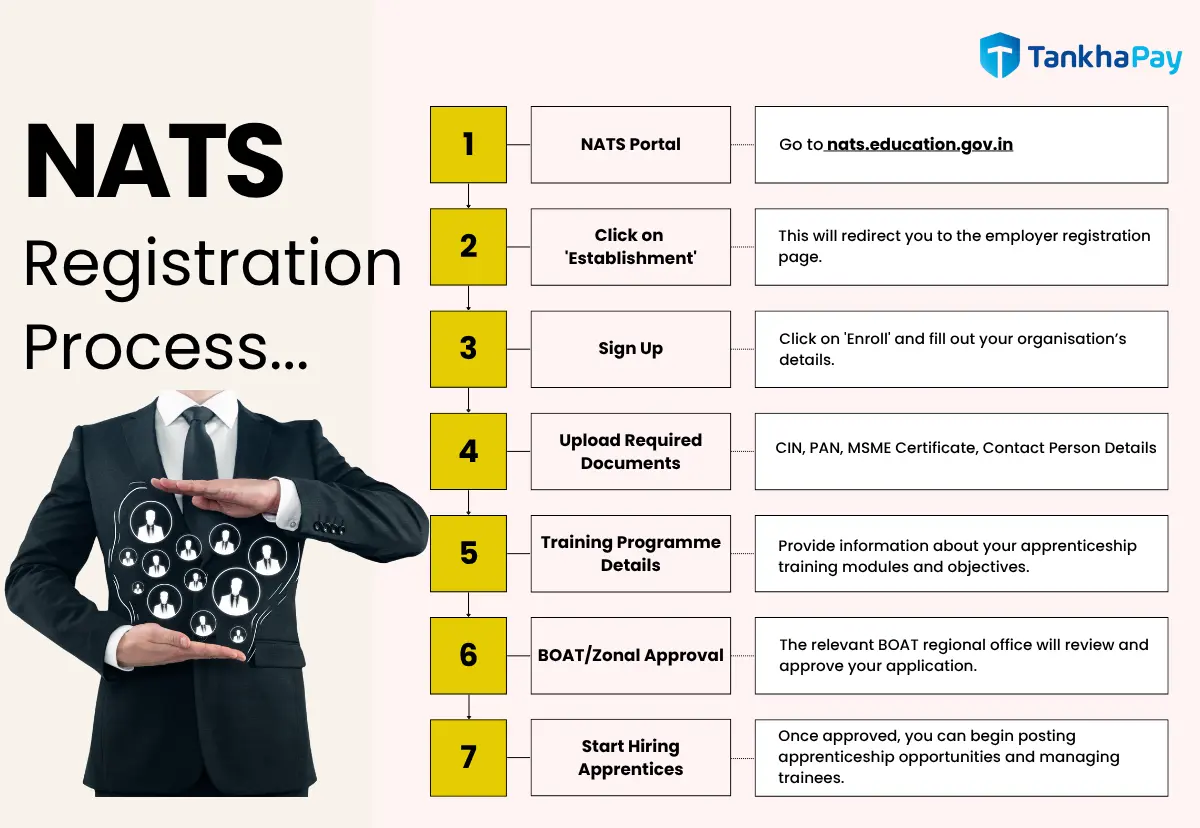
For Employers (Establishments)
- Go to nats.education.gov.in and select Establishment.
- Register with your organisation’s PAN, GSTIN, industry type, and contact details.
- Upload supporting documents, which include the certificate of incorporation, PAN/TAN, and MSME certificate if applicable.
- Submit your apprenticeship training plan, covering both technical and general-skill components (see below).
- Get approval from your regional BOAT/BOPT office. This determines which board reviews your claims going forward.
- Once approved, post vacancies and begin managing applications and contracts through the portal.
For Students
- Choose Student from the NATS 2.0 homepage and enter academic information as well as personal information.
- Upload the scanned certificates, identification proofs, and bank details to receive DBT stipends.
- Confirm your contact information using One Time Password (OTP)
- Specify your qualification, preferred trade or discipline, and training-type preference.
- Keep your profile current, establishments filter candidates directly through the portal.
For Educational Institutions
The institution maintains its own separate entry as an institute, enabling it to monitor its students’ placements and completion rates in the participating organizations, which will be handy for you if your placement cell has to do so for apprenticeships too.
NATS Login and Portal Access
Existing users log in directly at nats.education.gov.in with their registered email or user ID and password. The one snag employers and students both run into: accounts created before the NATS 2.0 migration need a fresh login. You can’t just reuse your old regional BOAT credentials, generate a new NATS 2.0 login using your previous user ID, password, and state of residence, and your training records will carry over to the new account.
Features of National Apprenticeship Training Scheme (NATS)
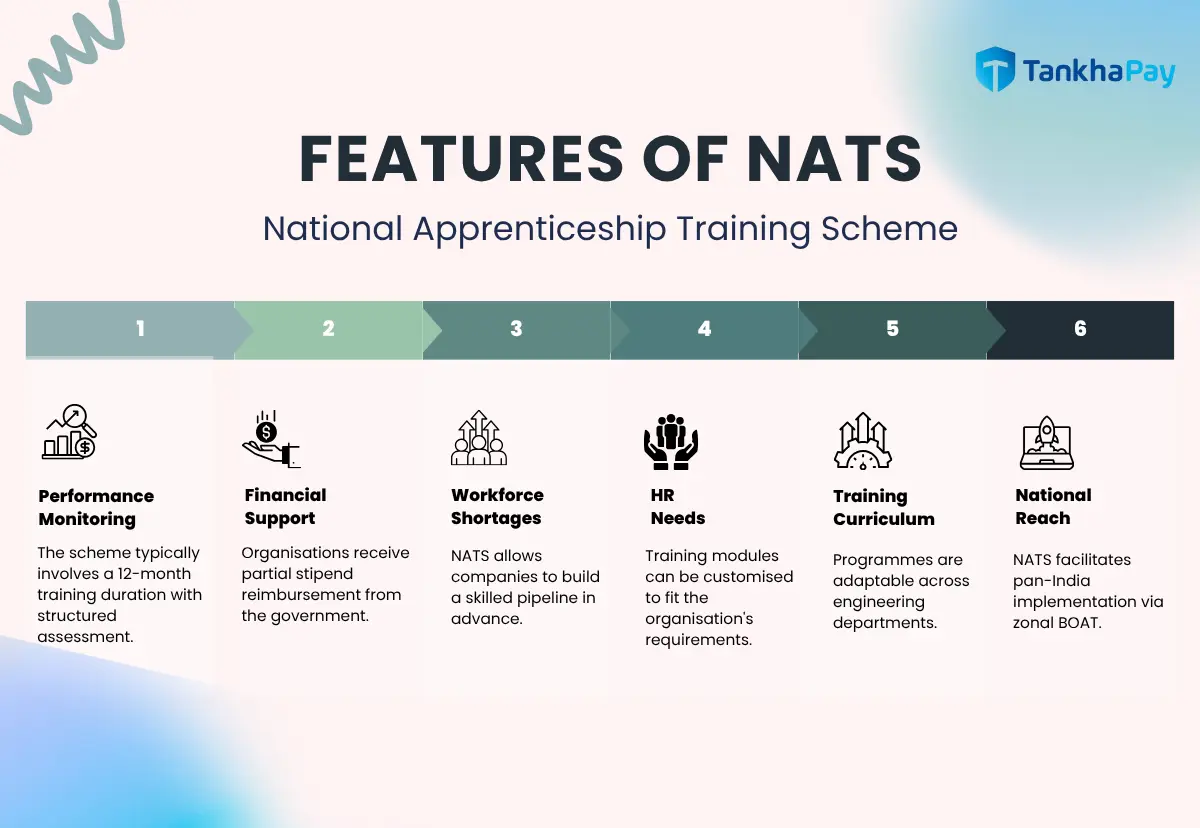
1. One-Year Performance Monitoring Period
- The scheme typically involves a 12-month training duration with structured assessment.
2. Government Financial Support for Recruiters
- Organisations receive partial stipend reimbursement directly from the government.
3. Addressing Workforce Shortages
- NATS allows companies to build a skilled pipeline in advance.
4. Meeting Human Resource Needs
- Training modules can be customised to fit the organisation’s unique workforce requirements.
5. Diverse Training Curriculum
- Programmes are adaptable across mechanical, civil, IT, electrical, and more departments.
6. National Reach for Multi-State Operations
- NATS facilitates pan-India implementation via zonal BOAT (Board of Apprenticeship Training) offices.
What are the Benefits of NATS?
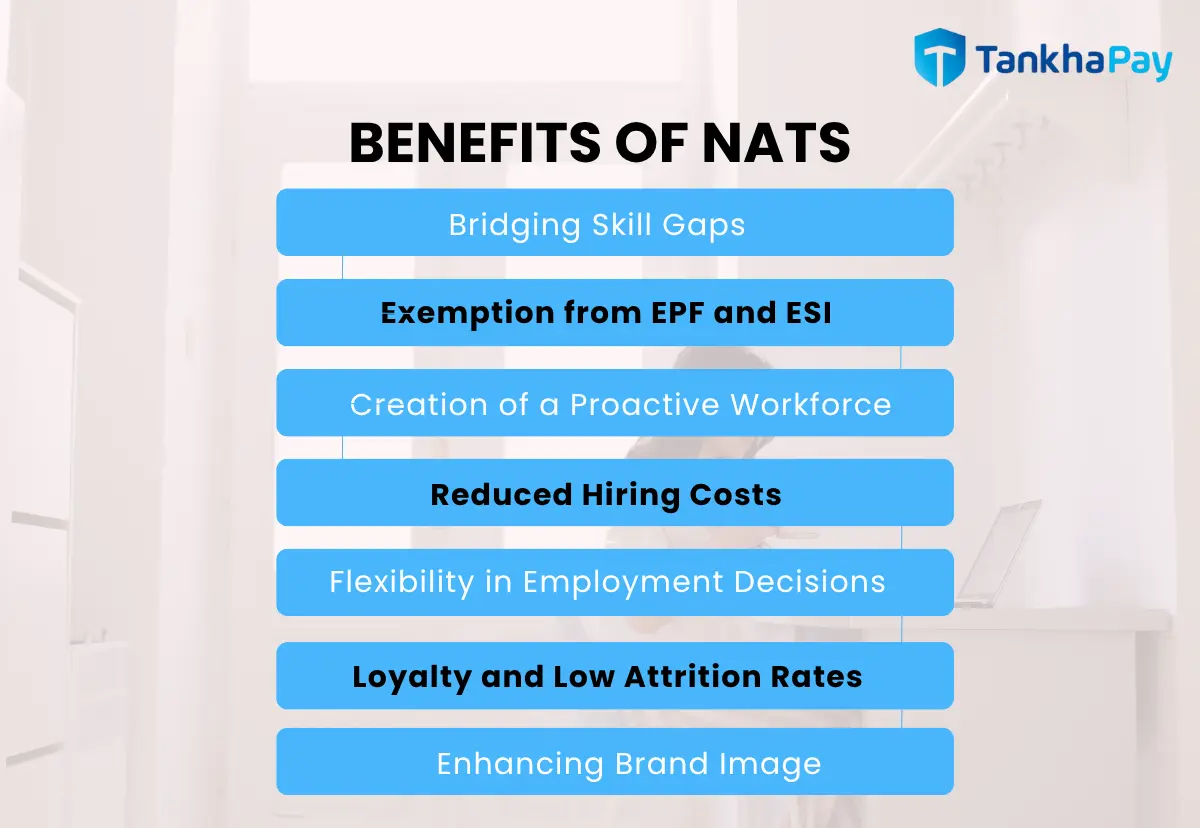
1. Bridging Skill Gaps
- Graduates gain practical knowledge, helping them become more job-ready.
2. Exemption from EPF and ESI Contributions
- No statutory deductions are applicable to apprentices under NATS.
3. Creation of a Proactive Workforce
- NATS-trained candidates adapt faster and add value sooner.
4. Reduced Hiring Costs
- Training under NATS leads to less dependency on high recruitment spending.
5. Flexibility in Employment Decisions
- Post-apprenticeship, employers have the freedom to retain skilled candidates.
6. Loyalty and Low Attrition Rates
- Trainees feel valued and often choose to continue employment post-training.
7. Enhancing Brand Image
- Participation in government initiatives bolsters your corporate social responsibility (CSR).
How to Download Your NATS Certificate (Certificate of Proficiency)
On successful completion, apprentices receive a Certificate of Proficiency (CoP) not to be confused with the National Apprenticeship Certificate (NAC), which is a separate credential issued specifically under NAPS’s Designated Trades category. CoP is what NATS apprentices (and NAPS Optional Trades apprentices) actually receive, and it’s valid, registrable proof of work experience at employment exchanges across India.
To download it:
- Login to the NATS 2.0 portal using your credentials as a student.
- Then, wait until your establishment declares that you have completed the training and your regional BOAT/BOPT office verifies the same on the record.
- Post verification, the CoP will be available for download from your student dashboard.
It should be made clear at this point that, unlike the degrees issued by the National Academic Depository via DigiLocker, the NATS CoP is issued and downloaded from the NATS portal alone.
NATS Stipend Amount in 2026
However, the figure for stipend is the component of NATS which has been revised frequently, and 2026 has seen the biggest revision of the past few years. At the 38th meeting of the Central Apprenticeship Council (CAC) on 26 May 2025, the decision was made to revise the NATS stipend by 36%, and future revisions will be linked to Consumer Price Index. The Board of Apprenticeship Training (Western Region) implemented the revised rates via circular BOAT WR/2026/529, effective retrospectively from 1 April 2026:
| Apprentice category | Stipend until 31 March 2026 | Revised stipend from 1 April 2026 |
|---|---|---|
| Graduate Apprentice (Engineering & Non-Engineering) | ₹9,000/month | ₹12,300/month |
| Technician (Diploma) Apprentice | ₹8,000/month | ₹10,900/month |
| Technician (Vocational) Apprentice | ₹7,000/month | ₹9,600/month |
The government funds 50% of the prescribed minimum stipend, up to ₹4,500 per apprentice per month, paid directly to the apprentice’s bank account via DBT. The employer’s share doesn’t shrink because of this; it only means the government’s portion is reimbursed independently rather than routed through the employer first. Employers can pay above the minimum; they cannot pay below it. For the reimbursement claims process and quarterly filing mechanics, see our NATS stipend reimbursement guide. It’s worth flagging internally that its cap figures predate this April 2026 revision and should be checked against the new circular.
NATS Age Limit and Eligibility Criteria
Eligibility for Employers
- Organizational Type: Public or private organizations that are registered in India.
- Compulsory participation: Organizations having more than 30 employees must employ apprentices.
- Optional participation: Organizations having 4 to 29 employees can choose to employ apprentices.
- No participation allowed: Organizations having fewer than 3 employees are not allowed to employ apprentices.
- Training capacity: Compulsory organizations must have apprentices in the range of 2.5% to 15% of their total employees each year, with minimum participation of 5% in fresh apprenticeships. The monthly strength must not be less than 2% or more than 18%.
- Registration of BOAT/BOPT: Mandatory, with permission from the relevant regional boards.
Eligibility for Candidates
- Nationality: Indian national
- Age limit: 18 to 27 years on date of application, with flexibility in age criteria for the reserved category of persons with disabilities as per GOI guidelines.
- Educational qualification: A diploma or degree in engineering or non-engineering from a recognised institution.
- Prior training: Has not been previously trained under any other government apprenticeship program before.
- Academic status: Studies completed, not enrolled in a full-time course during the apprenticeship. Final-year students awaiting results are not eligible until their certificate is issued.
- Gap since graduation: This detail has moved more than once in recent policy updates, with the permitted window between passing your qualifying exam and joining an apprenticeship having been extended in stages. Confirm the current window directly on the portal at the time you apply rather than relying on a fixed number, since it’s changed faster than most third-party guides have kept up with.
General Skills in NATS: How Assessment Actually Works
This is one of the structural components of NATS which many guides miss out on. It is not enough for an establishment to train the apprentice on a technical skill and think that all is well because the BOAT/BOPT assessment guidelines stipulate that the training must develop both the general attributes and also any three Technical Skills specializations.
They both are measured formally. The organizations choose a panel of evaluators, usually from their senior management team, to evaluate the apprentices using the 1-9 scale for the following general and technical competencies both initially and after every quarter. These measures are recorded in the apprentice’s Record of Progress and submitted quarterly to the NATS website and evaluated by the regional BOAT/BOPT office. What this means is that in reality, any NATS apprenticeship and corresponding CoP that follows it are built on both an assessment of soft skills and the mastery of a specific domain rather than just accomplishment of certain tasks. This might be useful to know when you design a training/performance management system based on NATS apprenticeships because the initial evaluation system is already in place.
What’s New in NATS for 2026
Apprenticeship Embedded Degree Programme (AEDP). Approved alongside the changes in stipends in the same 38th CAC session, AEDP allows learners to blend their degree program with apprenticeship training, as per UGC/AICTE rules and the NEP 2020. AEDP also allows flexible learning and training via online or blended modes or on-site training at clients’ premises in India or outside, which is quite distinct from the face-to-face training only that NATS used to insist upon.
Sector expansion under NIC-2008. Training areas now formally extend into IT, biotechnology, and renewable energy, alongside the traditional engineering and general-stream disciplines.
Inclusion provisions. The CAC introduced dedicated measures for apprentices with benchmark disabilities, and establishments that can’t fill fresher or skill-certificate-holder training slots may now fill them with other apprentice categories instead of leaving positions vacant.
More regional boards, eventually. The CAC has recommended the creation of further regional apprenticeship boards besides the existing four (Chennai, Kanpur, Kolkata, Mumbai). While this is still not done by mid-2026, you might want to consider it, especially if your establishment is far from the existing BOA/BOAP centers.
A compliance framework in transition. Now pending before the Select Committee of Parliament, through the provisions of the Jan Vishwas 2.0 Bill, it has been proposed that the Apprentices Act should move towards a regime where compliance would be the main focus, with enforcement by way of civil sanctions rather than criminal liability, in accordance with the Government’s policy of decriminalization. It is just a proposal but shows the future trend of the Act.
Core Participating Sectors – NATS
According to government statistics, apprenticeship is prevalent in 13 different sectors, which are: Automotive, BFSI, Electrical (which includes New and Renewable Energy), Electronics, IT/ITeS, Life Science, Logistics and Supply Chain, Production and Manufacturing, Retail, Rubber, Services (Education, Healthcare, and Professional Services), and Tourism & Hospitality.
NATS has its own specific inclusion of 126 subjects under graduation/diploma level apprentices, ranging from Engineering subjects to general streams, following the changes after 2021.
NATS vs NAPS: Key Differences
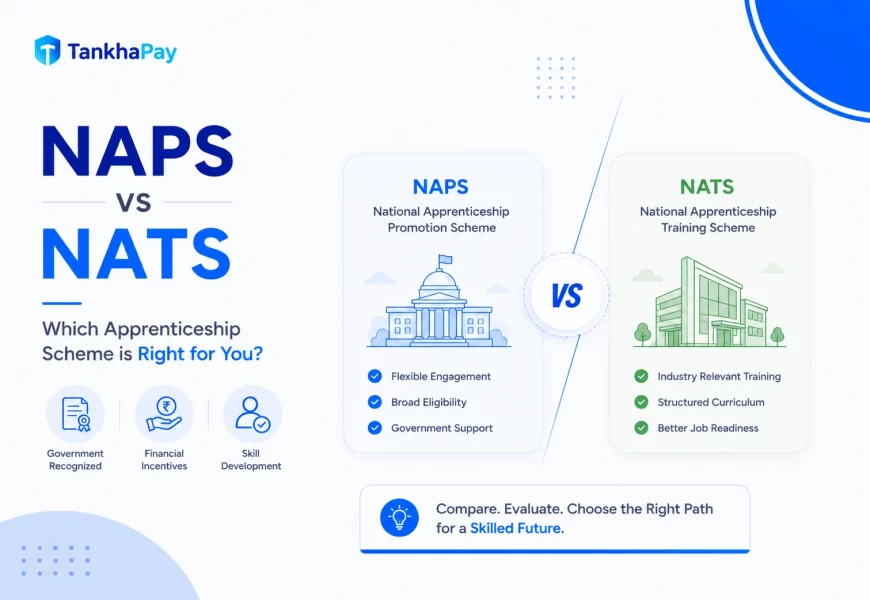
NATS and NAPS have the same legislative foundation in the Apprentices Act of 1961, and that is precisely the reason why the two systems are usually confused with one another. However, the programs are operated under the jurisdiction of separate ministries and involve distinct reimbursement systems; hence, the confusion should not occur.
| Parameter | NATS | NAPS |
|---|---|---|
| Administered by | Ministry of Education, via BOAT/BOPT | Ministry of Skill Development & Entrepreneurship, via DGT |
| Launched | 1973 | August 2016 (continued as NAPS-2 from 2022–23) |
| Typical candidates | Graduates and diploma holders, engineering and non-engineering | ITI pass-outs, 8th/10th/12th-pass candidates, skill-certificate holders |
| Certificate issued | Certificate of Proficiency (CoP) | National Apprenticeship Certificate (NAC) for Designated Trades; CoP for Optional Trades |
| Government stipend share | 50% of prescribed minimum, up to ₹4,500/month | 25% of prescribed minimum, capped at ₹1,500/month |
| 2025 apprentices engaged | 5.23 lakh | 11.84 lakh |
| Establishments engaged (2025) | 16,400 | 25,423 |
| Registration portal | nats.education.gov.in | apprenticeshipindia.gov.in |
Rule of thumb: engineering or diploma graduate pool → NATS. ITI pass-outs or school-leavers entering a trade → NAPS.
What is BOAT?
BOAT and BOPT are the implementing bodies behind NATS on the ground. The naming actually differs by region, which most content covering this gets wrong. Two of the four regional boards use “Board of Apprenticeship Training” (BOAT); the other two use “Board of Practical Training” (BOPT). Where your establishment is headquartered determines which board reviews your registration and processes your claims.
| Region | Board | Headquarters | States & UTs covered |
|---|---|---|---|
| Northern | BOAT | Kanpur | Delhi, Haryana, Uttar Pradesh, Uttarakhand, Himachal Pradesh, Rajasthan, Chandigarh, Punjab, Jammu & Kashmir, Ladakh |
| Western | BOAT | Mumbai | Maharashtra, Gujarat, Madhya Pradesh, Chhattisgarh, Goa, Dadra & Nagar Haveli, Daman & Diu |
| Southern | BOPT | Chennai | Tamil Nadu, Andhra Pradesh, Telangana, Kerala, Karnataka, Puducherry, Andaman & Nicobar Islands, Lakshadweep |
| Eastern | BOPT | Kolkata | West Bengal, Bihar, Jharkhand, Odisha, Assam, Meghalaya, Tripura, Manipur, Nagaland, Arunachal Pradesh, Mizoram, Sikkim |
Ladakh’s placement under the Northern Board is easy to miss on older lists that predate the Jammu & Kashmir Reorganization, worth double-checking if you’re working from an older reference.
Why BOAT Matters for Employers
Vetted talent, not a cold pipeline. Through BOAT/BOPT, employers have the opportunity to recruit from a pool of qualified graduates and diploma holders who have already passed the initial eligibility test.
A real point of contact. The regional board handles approvals, disputes, and clarifications directly, it’s not a passive registry.
Stipend reimbursement processing. Your board reviews and approves the quarterly DBT claims that route the government’s 50% share to your apprentices.
Structured skill development. Because training plans require BOAT/BOPT sign-off, the resulting skill development follows a standardised structure, useful if you’re trying to keep onboarding consistent across multiple hiring locations.
A national skilling contribution. Participation is ministry-tracked, which is increasingly relevant for CSR reporting and public-sector-adjacent tender requirements.
How TankhaPay Simplifies NATS Compliance for Employers
Bringing apprentices on board, verifying eligibility, and staying current with BOAT circulars takes real time, and the rules have shifted more than usual over the past two years. TankhaPay’s Apprenticeship Management solution handles registration, documentation, attendance and Record of Progress tracking, and quarterly DBT reimbursement claims so internal HR teams aren’t the ones tracking portal migrations and stipend revisions manually.
What Makes TankhaPay the Right Partner?
- Structured compliance, minimal statutory burden. NATS apprentices are exempt from Employees’ Provident Fund and Employees’ State Insurance contributions for the duration of their apprenticeship since they aren’t classified as “employees” under those acts. Stipends are linked to the apprentice’s education category rather than state minimum-wage schedules.
- Financial efficiency. Government-backed DBT stipend support, plus the option to engage additional apprentices beyond your mandatory 2.5% threshold as part of CSR-aligned workforce initiatives.
- Flexible hiring. Engage apprentices from age 18 upward, including for shift-based roles, with no obligation to retain them after training ends.
- Talent beyond engineering. With the scheme’s 2021 expansion, TankhaPay can help you hire NATS apprentices into finance, HR, operations, and customer service, not just technical roles.
- End-to-end platform support. Onboarding, documentation, attendance and Record of Progress uploads, and compliance tracking are managed from one place across the apprentice’s full lifecycle.
FAQs – NATS
What is NATS 2.0, and how is it different from the old portal?
The present NATS system in place on the website nats.education.gov.in is called NATS 2.0, and replaces the earlier mhrdnats.gov.in system. The entire process of registration, vacancy announcement, contract, uploading of Record of Progress and certification is done on this one portal. DBT stipends also get paid via this portal, and the portal went live on 30 July 2024.
How do I complete NATS registration?
Registration is determined by your profile. Registration for employers is done as “Establishment”, students as “Student”, and institutions as “Institute” – all via nats.education.gov.in, followed by the uploading of documents and regional BOAT/BOPT approval.
How do I log in to the NATS portal?
Access nats.education.gov.in through your registered email/user ID and password. In case you have an account which was created prior to NATS 2.0, create new credentials through the existing user ID, password, and state from which you hail.
How can I download my NATS certificate?
The Certificate of Proficiency (CoP) appears on your student dashboard once your establishment and regional BOAT/BOPT office confirm successful training completion. Download it directly from the NATS 2.0 portal, not through DigiLocker.
Is NATS mandatory for all employers?
Apprenticeship shall only be mandatory for those institutions having thirty or more employees, whether on contract or not, which must take apprentices amounting to 2.5-15% of their total number of employees. Those institutions having four to twenty-nine employees may undertake apprenticeships voluntarily; those with three or fewer do not have any scope of apprenticeship.
Can foreign-owned companies operating in India engage NATS apprentices?
Yes. Eligibility is based on being a registered public or private establishment in India, not on ownership structure. A foreign-owned entity operating through an Indian registered establishment follows the same registration and compliance process as any domestic employer.
Does TankhaPay handle NATS compliance for employers?
Sure. TankhaPay’s Apprenticeship Management handles registration, record keeping, Record of Progress tracking, and quarterly DBT claim submissions so that there is no need for internal teams to monitor BOAT circulars and portals manually.
Conclusion
Despite the fact that it is one of the most economical and government-backed channels for talent development in India, NATS still stands out today – 2026 is when the mechanics of NATS changed substantially: NATS 2.0 website, significantly raised minimum level of stipend, scoring criteria based on general skills, apprenticeship programs incorporated into degrees, and even the compliance rulebook which is being amended in line with the Jan Vishwas 2.0 Bill. Confusing NATS with NAPS and using stipend or eligibility criteria that apply before April 2026 is the easiest way to misplan the workforce.
Given the number of things HR departments have to keep track of, this is one type of regulation movement which can be easily neglected. However, with TankhaPay, the process of registration, stipend management, and BOAT/BOPT compliance gets streamlined from enrolment till certification, thereby ensuring that there are no hidden costs attached to this benefit package.