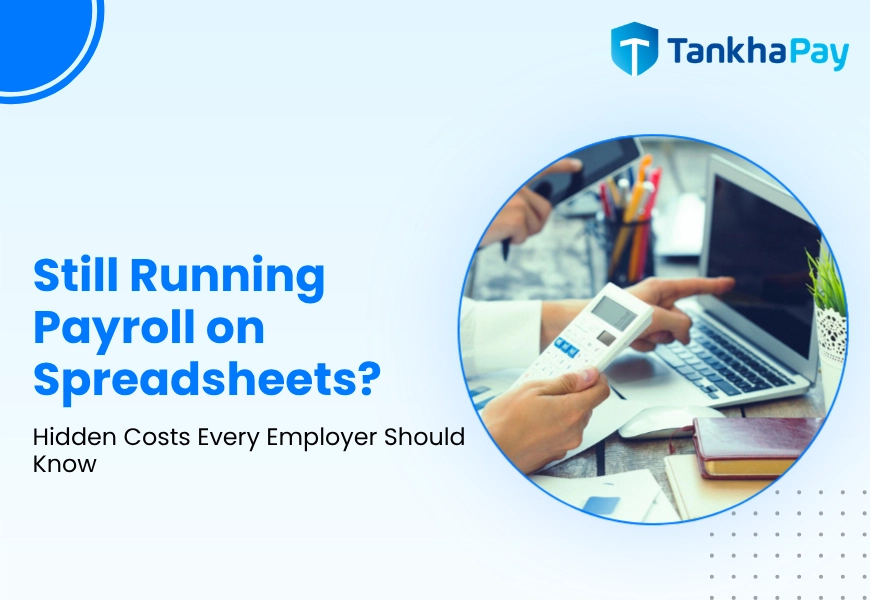
It is the 28th of the month. Your HR executive is updating a spreadsheet with 47 rows. She is pulling attendance data from a WhatsApp group, calculating PF from memory, and entering bank account numbers by hand.
The next morning, three employees message you directly. Two are underpaid. One received full salary for a day he was on leave. Your HR executive spends the next two days correcting it. Next month, the same thing happens.
This is what a manual payroll system looks like when it starts to fail. And across India, thousands of growing businesses run payroll this exact way, including many that should have moved on two years ago.
What Is a Manual Payroll System?
A manual payroll system is a method of managing employee salaries, deductions, and statutory filings using spreadsheets, paper records, or disconnected tools, without automated software. Every calculation, starting from gross salary to PF deductions to TDS is done by a person, not a system.
The above is what happens in an average Indian SMB:
- Attendance recorded in a note book/ Excel sheet.
- Salary computed by the HR executive or the accountant.
- Deductions calculated manually.
- Payments done individually or by preparing an uploaded file manually
The tools most commonly used are Microsoft Excel, Google Sheets, physical attendance registers, WhatsApp threads for leave approvals, and manual NEFT transfers.
A manual payroll system is not illegal. Many Indian businesses under 15 employees run it without major problems — at first. The problems appear when headcount grows, pay structures get complex, employees join mid-month, or compliance rules update without warning.
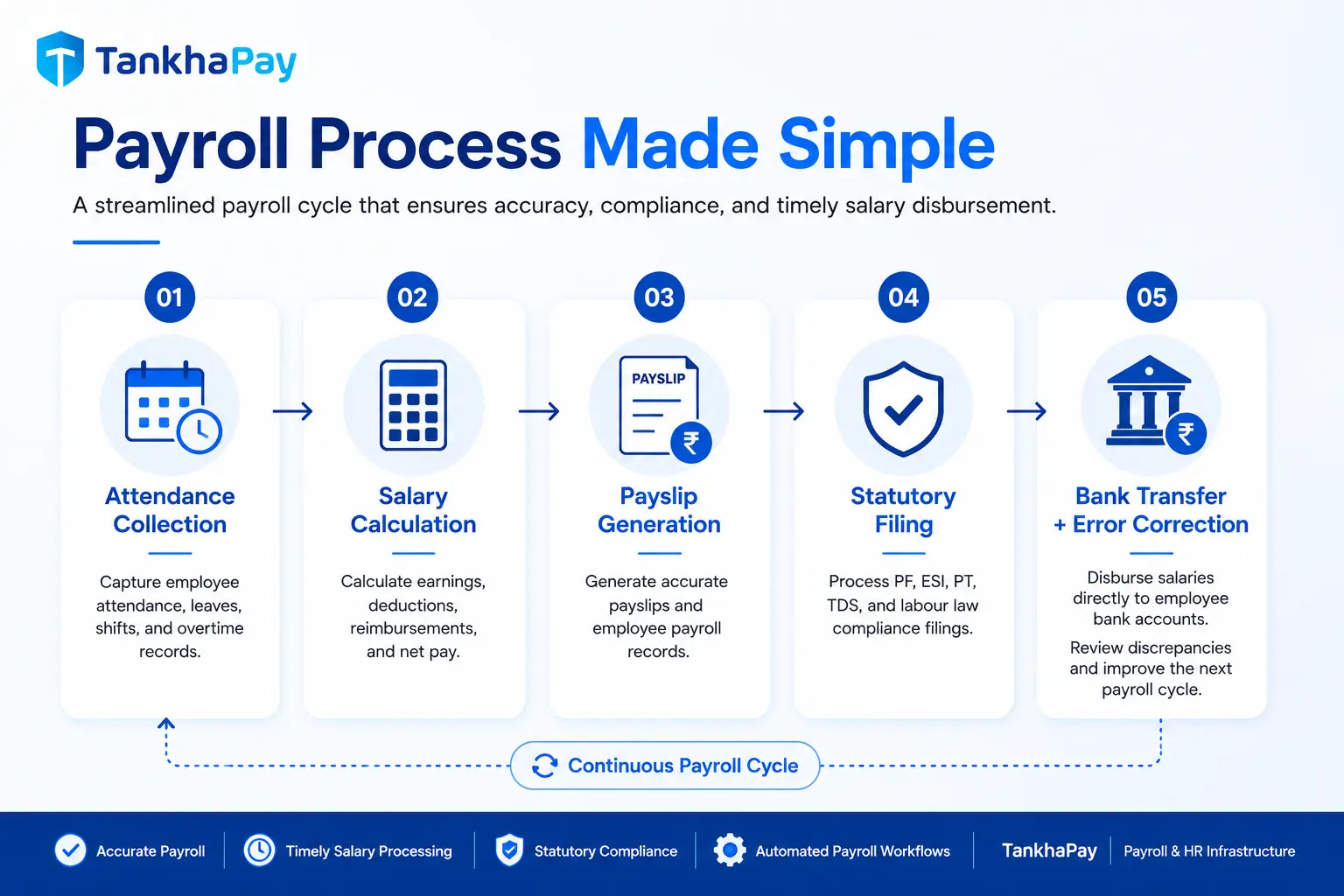
How Manual Payroll Processing Works in India
Understanding the full cycle helps you see exactly where things go wrong and why.
Step 1: Collecting Attendance and Leave Data
The number of days worked, leave days, and LOP adjustments for each worker are recorded. This is normally done through biometric reports, registers, and WhatsApp groups in many Indian small and medium businesses. The variable elements include overtime, field allowance, and shift premium, among others.
Step 2: Calculating Gross Salary and Deductions
In order to calculate gross pay for an employee, present days are taken into account. The deductions that are done manually include PF which is 12% of basic; ESIC, wherever applicable, professional tax according to the applicable state slab; and TDS on annual income and investment declaration.
Step 3: Generating Payslips
Pay slips are generated using an Excel/Word template which is sent by email or printed and distributed as necessary. No Employee Self Service system exists. Any inquiries regarding salary would be forwarded to your HR executive who has been working on the payroll for three days.
Step 4: Statutory Filing and Bank Transfers
The PF ECR (Electronic Challan cum Return) filing is done on the EPFO website. The filing for ESIC, PT, and TDS is done individually on the respective websites. Salary is paid through net banking by bulk uploading or NEFT transactions – another place where a wrong account number poses an immediate issue.
When a Manual Payroll System Actually Makes Sense
Most articles skip this part. They jump straight to “manual payroll is bad.” That is not entirely honest.
Do-it-yourself payroll is a reasonable choice when:
- Your workforce consists of less than 10 employees
- All of them are paid a set salary per month
- You are located in just one state with only one PT slab
- There are no contractual employees, interns, or freelancers
- Your HR department understands everything about payroll and verifies all amounts
In-house payroll managed correctly at this scale costs less than software and gives you full control. There is nothing wrong with it as a starting point.
However, as soon as one of these variables changes – headcount, salary structure, states, or the nature of the workforce – you need to assess your system.
Where Manual Payroll Processing Breaks Down
1. Errors Grow With Your Team
Human error in repetitive manual calculations occurs between 1% to 3% (HROne, 2026). For a payroll with 100 employees, there will be one to three errors per cycle. Time required for correcting an individual error is 30 to 90 minutes, which will be spent on detecting, recalculating, verifying, fixing errors in the bank accounts, and talking with the employee. The cost of correcting payroll errors is 1% to 3% of the payroll value each month in Indian SMEs (PCG International, 2026).
2. Statutory Compliance Becomes Its Own Full-Time Job
India has over 20 active compliance rules for Payroll. And these are not static; the tax deduction at source slabs keep changing with every Union budget, ESIC slabs are revised periodically, and new Labour codes are being implemented state-wise. The new Code on Wages of 2019 has actually changed the definition of “wages” considered to calculate the PF salary base. A manual payroll process does not have any automatic notifications regarding these changes.
Compliance penalties for PF non-payment can reach 12% per annum on outstanding amounts, plus damages of up to 25% under Section 14B of the EPF Act.
3. Your Payroll Data Is Scattered and Hard to Audit
Attendance in one sheet. Salary in another. PF challans in a folder only one person knows. When an EPFO inspector asks for three years of records, your team needs days to pull together what a system produces in minutes. Under the new DPDP Act 2023, your employees’ salary and personal data stored in unprotected spreadsheets also becomes a data security and legal liability — a risk almost no article about manual payroll mentions.
4. Employee Trust Erodes Faster Than You Expect
1 in 5 workers is likely to quit work due to multiple payroll mistakes (PCG International, 2026). The attrition rate of payrolls being dissatisfying in mid-size companies in India is estimated at 10%-18%. When an employee quits work because of a salary conflict, they will not make a lot of noise about it.
“Employees judge organisational reliability through payroll consistency.”
– LinkedIn Talent Solutions, 2026
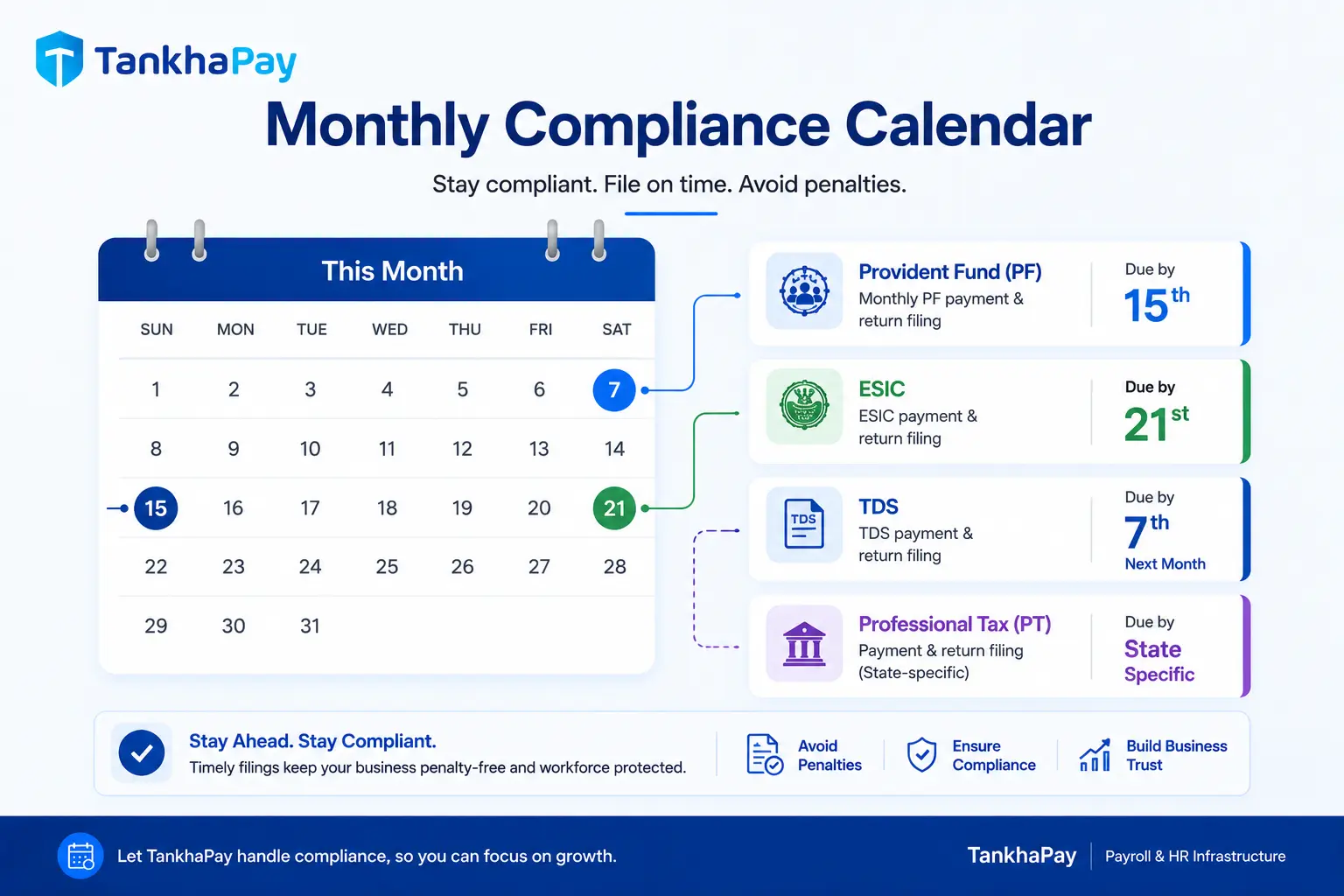
Compliance Deadline Calendar
What your HR team must file every month — and when:
- PF (ECR): Due by the 15th of every month
- ESIC: Due by the 21st of every month
- TDS (non-salary): Due by the 7th of the following month
- TDS (salary): Due by the 30th of April for the full year (quarterly returns)
- Professional Tax: Due dates vary by state — typically monthly or half-yearly
- LWF (Labour Welfare Fund): Typically half-yearly — June and December
A manual system carries the risk of missing even one of these. A missed PF date attracts interest plus damages. A missed TDS date attracts 1% per month interest plus potential prosecution.
The Real Cost of Manual Payroll in Rupees
This is the section most founders never calculate. Here is what your in-house payroll actually costs every month.
HR time cost The average HR executive managing payroll for 50 employees spends 22 hours per month on payroll tasks. At an all-in monthly cost of ₹38,000 (salary, EPF employer share, PT), the effective rate is ₹220 per hour. Monthly payroll time cost: ₹4,840 (EZHRM, 2026).
Error correction cost At a 2% error rate on 100 payslips, you have 2 errors per month. Each takes 45 to 90 minutes to fix. Add ₹1,500 to ₹3,000 per month in rework time. Over a year: ₹18,000 to ₹36,000 in pure HR effort that produced nothing new.
Compliance penalty risk One uncorrected PF filing error on a ₹5 lakh monthly PF outgoing at 12% per annum adds ₹60,000 to your annual costs. That figure does not include audit costs, legal fees, or the time your finance team spends responding to a notice.
Replacement Costs Attracting one middle senior staff member in India requires 6 to 9 months of salary for the person leaving. One attrition case caused by constant payroll issues is the most expensive item on the above list, and it is also the most difficult to trace to payroll.
“Every month you run payroll manually, you are betting your compliance record on human accuracy. As your team grows, that bet gets harder to win.”
– Sarabjit Singh, Managing Director, Akal Information Systems (TankhaPay)

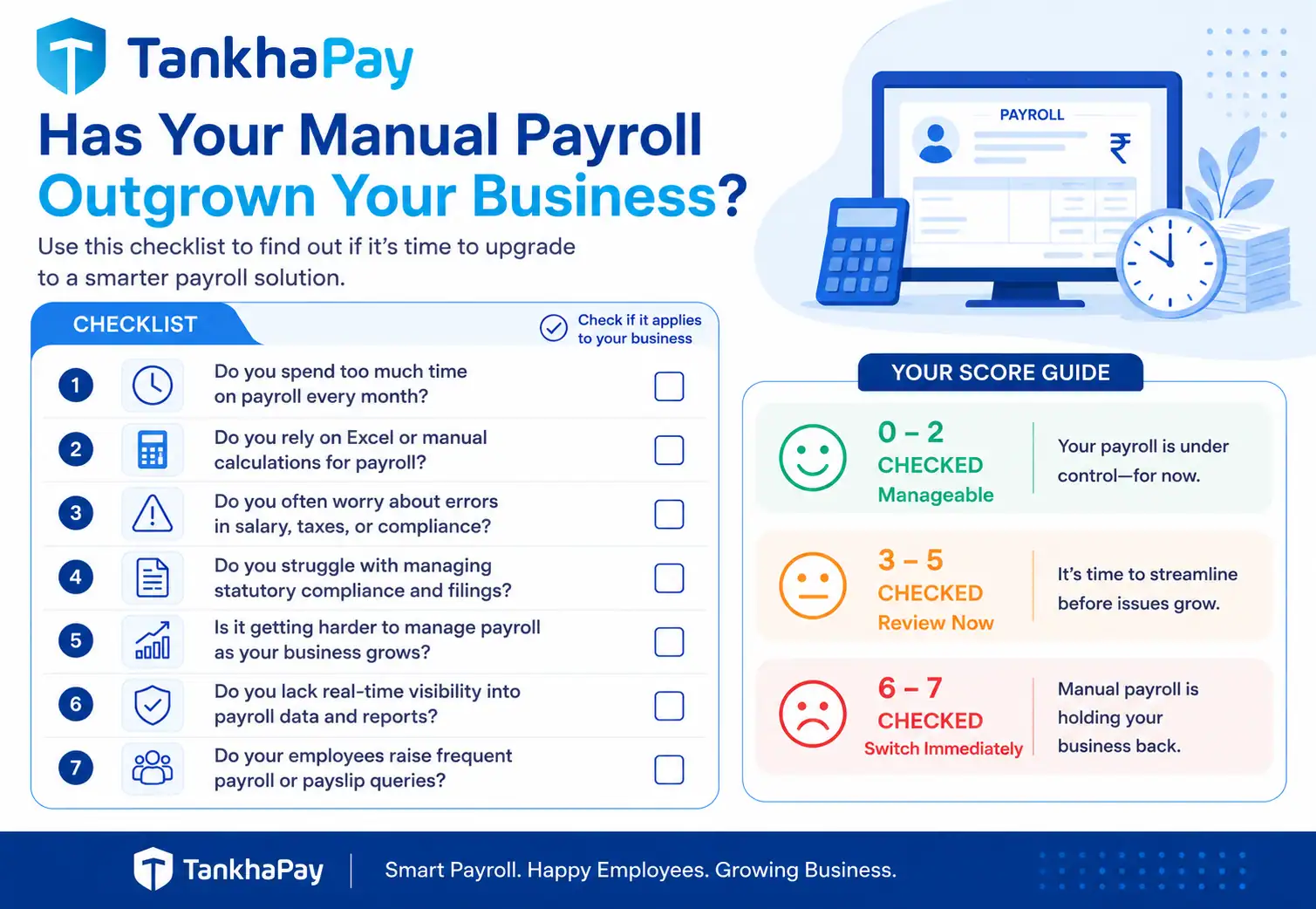
Signs Your Manual Payroll Has Outgrown Your Business
Check how many of these describe your business right now:
- Your HR executive spends more than 15 hours a month on payroll-related work
- You have had at least one salary error in the last three months
- You hire employees in more than one state
- Your team has a mix of full-time, variable-pay, and contract workers
- You are not 100% certain your PF and ESIC filings go out on time every month
- A salary query from an employee takes more than 30 minutes to resolve
- Your payroll records live in a folder only one person fully understands
If three or more of these are true for your business, your manual payroll system has already outgrown what you need it to do.
Replacing the comparison table with this point adds more scan-friendly value for founders than a multi-column grid would.
What Indian Founders Do Instead
When in-house payroll stops being practical, there are three realistic paths forward.
Payroll software A self-operated platform where your HR team runs payroll management with automation handling calculations, compliance alerts, and payslip generation. Platforms in India start at ₹3,000 to ₹15,000 per month. Good for teams of 20 to 100 with a dedicated HR person who wants more control than outsourcing offers.
Managed payroll outsourcing A third-party provider handles the full payroll cycle – calculations, statutory filings, payslips, bank transfer coordination on your behalf. Cost in India runs ₹400 to ₹800 per employee per month depending on scope. Removes compliance burden from your team entirely and shifts the accountability to the provider.
EOR with payroll management If you have contract workers, employees across multiple states, or you are hiring before your entity registration is complete — an Employer of Record becomes your legal employer on paper. They handle payroll, compliance filings, and all statutory obligations for those workers. This is the option most founders discover only after a compliance problem forces the conversation.
The Bottom Line
A manual payroll system is not a bad choice for a very small, stable team. But it is almost always a temporary one.
Every month you stay on spreadsheets past the point where it makes sense is a month your HR team is not doing anything more productive, your compliance risk is quietly building, and your employees are silently measuring your reliability by whether their salary arrives correctly.
Payroll management is not just a monthly admin task. For each person on your team, it is the one promise your business makes every single month without fail.
TankhaPay handles payroll, statutory filings, and compliance management in one place — so your team is not juggling three separate systems just to pay people correctly.