Your company is registered in Mumbai. You just hired three engineers in Bengaluru and a sales team in Delhi. You tell your HR executive to run their payroll from the same system.
Six months later, a notice arrives from the Karnataka Labour Welfare Board. Your Bengaluru team has been on payroll without LWF deductions, without the correct Professional Tax slab, and without registration under the Karnataka Shops and Establishments Act. The combined liability is not large. But the notice is not.
And this is what multistate payroll would look like if you considered it to be a cut-and-paste task. States in India have boundaries that not only define geography, but also compliance jurisdictions, each with its own set of rules and regulations. This is an explanation of what should be changed and what needs to be done before it starts costing you money.
What Is Multi-State Payroll?
‘Multi-state payroll’ is the term used to describe the management of the payroll of workers, including deductions and compliance requirements, which are based out of two or more states within India. Since there are many payroll laws that are state-level in nature and not central, companies operating in multiple states have to abide by different guidelines for professional tax, labour welfare fund, minimum wages, and shops & establishment registration.
This is not about running different software. It is about running different compliance frameworks simultaneously from a single payroll function.
7 Things That Change When You Hire in a New State
1. Professional Tax Is Not the Same Everywhere
Professional Tax (PT) is levied by state governments under Article 276 of the Indian Constitution. Rates, income slabs, and filing timelines all differ by state. And some states do not levy it at all.
There is no PT in Delhi, Uttar Pradesh, Haryana, Punjab, and Rajasthan. However, there is PT in Maharashtra, Karnataka, Tamil Nadu, West Bengal, Gujarat, and Kerala with different slabs and deposit timings. Setting up a unified PT rate for all the states you operate in is among the biggest mistakes in state-specific payroll calculations.
2. Labour Welfare Fund Rules Vary Significantly
LWF is not a central law. Every state has its own LWF Act, contribution amount, and frequency of contributions. LWF is operational in 16 states. Other states do not have any LWF responsibility.
In Maharashtra, deductions happen in June and December. In Karnataka, they happen once in December annually. Tamil Nadu even includes a state government contribution of ₹10 per employee. Missing the correct frequency is not just an error. In states like Karnataka, it is a statutory violation.
Karnataka also reduced its LWF threshold from 50 to 10 employees in 2025. Businesses with as few as 10 staff in Karnataka are now covered, and most do not know yet.
3. Minimum Wages Are Not Uniform
The central government sets a floor wage, but each state sets its own minimum wages, often higher. Rates differ by industry, skill category, and zone within the state. A machine operator’s minimum wage in Maharashtra is not the same as in Tamil Nadu.
Paying your Pune team’s wage rate to your Chennai team is not just inaccurate. It can create underpayment liability under Tamil Nadu’s Minimum Wages Act.
4. Every New State Needs a Separate Shops and Establishments Registration
Before making any payment to your employee in the new state, you should have to get your company registered under the Shops and Establishments Act of that particular state.
It is quite common for the audit to discover the non-compliance when operating in the state of Karnataka without getting your company registered under the Karnataka Shops and Establishments Act, even though your company is registered in the state of Maharashtra.
5. Government Portals Are State-Specific, Not Connected
Integration of payroll processes on a state-to-state basis involves the use of different portals, different logins, and different formats of challans for the respective state’s PT department, LWF, and Shops & Establishments.
There is no national-level dashboard. An individual in a payroll department handling employees from five states accesses at least a dozen different portals per month for filing.
6. Remote Work Has Redrawn the Compliance Map
This is the 2025 and 2026 reality that most multi-state payroll guides still do not address directly.
If your employee works remotely from home in a state where your company has no office, their state’s PT, LWF, and Shops and Establishments rules still apply to their salary. The compliance obligation follows the employee’s work location, not your registered address.
A Hyderabad-based employee of a Delhi-registered company triggers Telangana PT and LWF obligations. Your Delhi registration does not cover them.
7. Labour Code Implementation Is Still Rolling Out State by State
The four new Labour Codes, Code on Wages, the Code on Social Security, the Code on Occupational Safety, and the the Industrial Relations Code, are being implemented by states at different times. As of 2026, no two states are at the same implementation stage.
Multi-state payroll teams are currently running a dual system in many companies: old rules in some states and new code-based rules in others. This will continue until every state finalises its implementation rules.
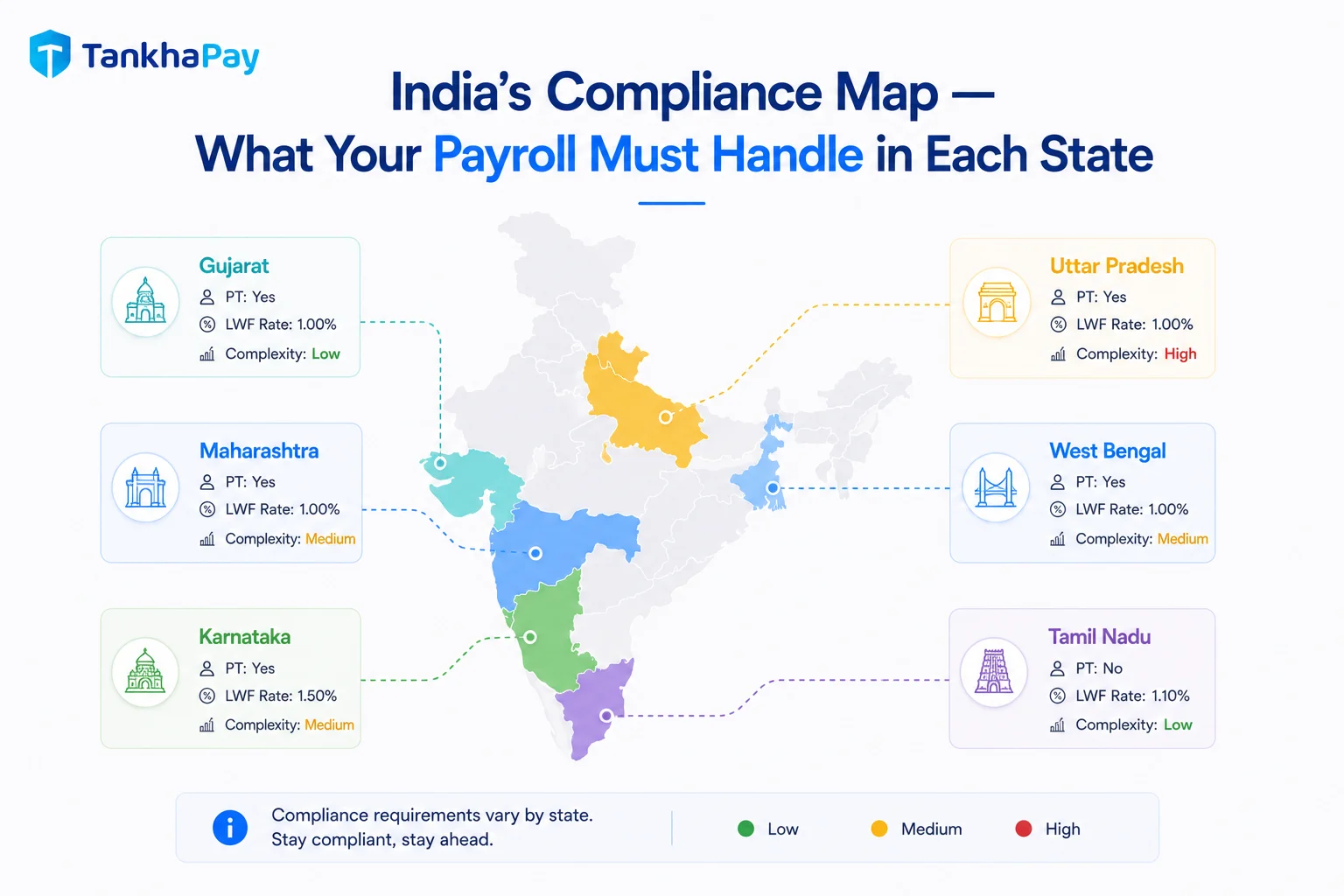
SOMETHING SPECIAL — State Compliance Snapshot:
Note: LWF is not a monthly deduction in any state. Deducting it monthly is itself a statutory violation. Karnataka reduced its LWF threshold from 50 to 10 employees effective January 7, 2026, verify your applicability if you have 10 or more staff members there.
4 Most Common Multi-State Payroll Mistakes
1. Applying One State’s PT Rate to All States
It is the commonest mistake in multi-state setups. In cases where the payroll system is set up on the basis of the Pay Tax rates applicable in the state of Maharashtra, the same deduction is made for people working in the state of Delhi or in the state of Karnataka, where Pay Tax does not apply.
2. Missing LWF Because the Amount Seems Too Small
LWF contributions are among the smallest statutory costs in India. Gujarat’s combined employer-employee LWF is ₹36 per year. It is exactly this smallness that makes it the most commonly missed obligation.
Whereas a company having 150 workers in Karnataka has not been paying its LWF contribution for three years, it owes Rs. 18,000 in addition to interest and penalty, which is highly disproportionate. And, this fact is known to audit inspectors.
3. Not Registering Under the New State’s Shops Act Before Processing Payroll
This realization is often made by many entrepreneurs retrospectively. The payroll cannot be processed legally for employees in a state that does not have Shops and Establishments registration. Registering subsequently causes a lag in which every payslip generated would be out of compliance.
4. Treating the Employee’s Office Address as the Compliance Address
In a remote/hybrid arrangement, the applicable address will be the location of work rather than the location of your nearest branch. Applying the Gurugram PT rules to an employee who is working from home in Noida (where there is no PT) would be an unwarranted deduction. Not applying any PT to an employee who has moved from Delhi to Pune (and is now working from home in Pune) would be a liability.
REMOTE WORK COMPLIANCE ALERT
If your employee moved cities and now works from home in a different state, your payroll must reflect THEIR current state’s rules, not your office’s state.
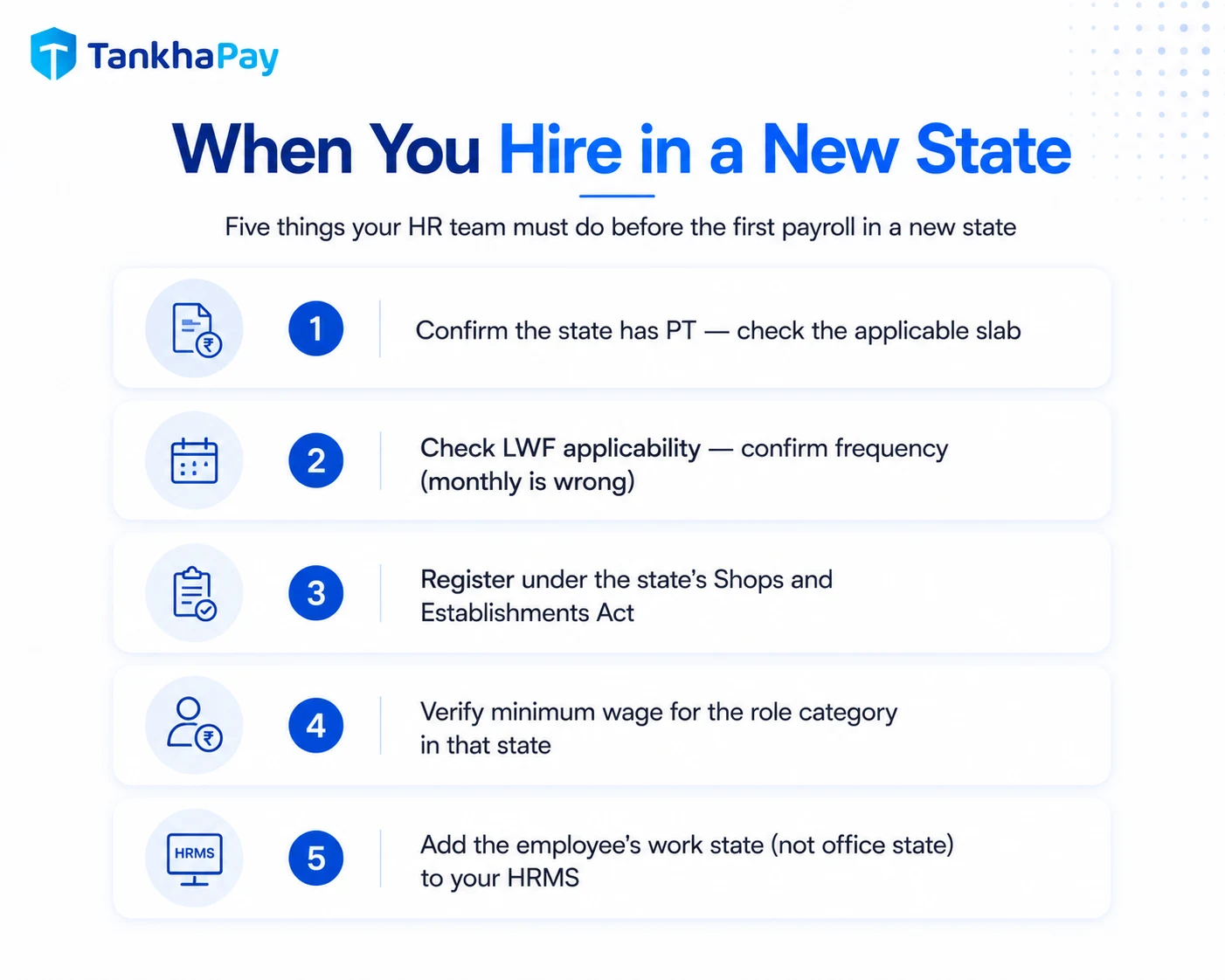
What to check immediately:
- Has their PT slab changed?
- Does their new state have LWF?
- Do you need a new Shops and Establishments registration in their state?
- Have you updated their work location in your HRMS?
This applies even if the employee has not formally informed HR of their move.
What Good Multistate Payroll Solutions Must Do
Most payroll systems handle central compliance well, PF, ESIC, and TDS. Multistate payroll solutions earn their value by handling what central systems miss.
Here is what to check before choosing a provider or platform:
- State-wise PT slab setting: Is it possible to configure different PT slabs based on the state of employment of an employee?
- Frequency limitation of LWF deduction: Is it possible to limit LWF deduction to June and December months in Maharashtra state and the December month in Karnataka state without manual overriding of the system?
- Registering for the Shops Act in new states: When adding a new state in which you wish to pay a salary, does it alert you for Shops Act registration in that state?
- Field for remote work location of employee: Is the employment location of the employee driving compliance and not the office location?
- Automatic updating of state rates: When Karnataka increased the threshold of LWF in January 2026, did the system highlight existing accounts under its purview?
If the answer to any of these is “We do that manually”, the system is not built for multi-state work. It is a single-state system being stretched.
Payroll integration between states is not merely about information moving from attendance to salary. It is about regulations that move from the interest of the employee to the computation of the payroll, automatically, correctly, and without human involvement each time the rate changes.
“Despite national Labour Codes, Professional Tax, Labour Welfare Fund, and Minimum Wages remain state subjects — creating a multi-layered compliance environment for businesses operating across state boundaries.”
Ministry of Labour and Employment, India Payroll Compliance Overview, 2026
Wrapping Up
Multi-state payroll in India is not only payroll functioning in different states. It is an altogether different compliance requirement which needs to be satisfied for every single state with its own rates, portals, deadlines, and registrations.
The companies that do it right design their payroll according to the location of employment and not the registered office of the company. Every new state employee is a compliance trigger for them.
TankhaPay’s payroll and compliance management covers PT, LWF, minimum wages, and Shops Act registrations across states, so your team is not tracking a dozen government portals manually every time you hire in a new location.