Introduction
The best candidates in the market rarely stay available for long.
Recruitment processes today have evolved to occur more rapidly than traditional recruitment systems could handle. Applicants can apply to several positions at once, demand quick responses, and even judge the organizations just like they are being judged.
As application volumes increase and hiring expectations shift, many organizations are turning to artificial intelligence to improve how recruiting teams operate.
An AI hiring process does not replace recruiters or hiring managers. Instead, it helps automate repetitive and high-volume tasks such as sourcing, screening, scheduling, and workflow coordination so teams can focus on evaluation, decision-making, and candidate relationships.
This article explains how an AI hiring process works, where it creates measurable value, where human judgment remains essential, and what organisations should consider before implementation.
TL;DR
- Smart companies using AI hiring fill roles 40–60% faster – before competitors even finish screening resumes.
- The AI recruitment workflow covers 14 integrated stages, each designed to compress time and improve decision quality.
- Top talent evaluates your hiring process as a signal of how your company operates – slow hiring loses the best candidates first.
- AI gives recruiting teams the capacity to source, screen, and assess 5–6x more candidates without adding headcount.
- The highest-performing companies combine AI technology with experienced recruitment expertise – neither alone is sufficient.
What is an AI Hiring Process?
AI hiring is an example of a recruitment process that utilizes the assistance of AI in the processes of candidate sourcing, application review, assessment delivery, scheduling interviews, and analyzing hiring data, with the decision being made by recruiters and hiring managers.
The objective is not full automation. The goal is to improve speed, consistency, visibility, and recruiter productivity across the hiring lifecycle.
Why Traditional Hiring is Breaking Down?
Before examining what AI hiring does well, it is worth being specific about what traditional hiring does poorly.
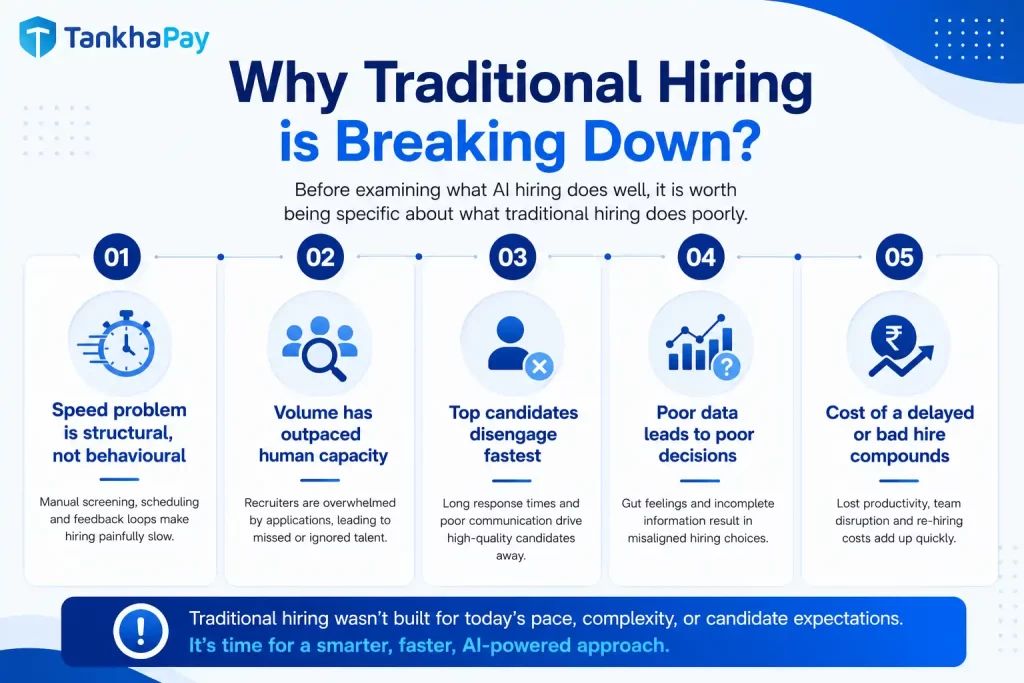
The speed problem is structural, not behavioural
The average time-to-fill for a mid-level role in India sits at 38–50 days (Naukri.com Hiring Insights Report, 2025). That timeline is not the result of lazy recruiters; it is the result of a process that was designed when the candidate market moved slowly and job boards provided manageable application volumes. Neither condition exists today.
Volume has outpaced human capacity
A single job posting for a data analyst or software engineer in a major Indian metro regularly attracts 400–800 applications. A recruiter who reviews each resume for three minutes would spend 40 hours on one role before making a single call. Something has to give, and what gives is thoroughness.
Top candidates disengage fastest
Candidates that vanish from your process in week two are not the poor candidates but the best ones. The better candidates have more choices and less tolerance for an ineffective process. The hiring process unintentionally filters out those candidates who have no better option left.
Poor data leads to poor decisions
Most traditional hiring functions cannot tell their leadership what their offer acceptance rate is, why candidates drop from the funnel, which hiring sources produce the best performers, or how their time-to-fill compares to industry benchmarks. Decisions are made on intuition rather than evidence.
Cost of a delayed or bad hire compounds
For instance, a senior product manager role paying ₹25 lakh annually generates approximately ₹48,000 per week in vacancy cost – team overload, delayed roadmap, and management distraction.
Smart companies recognised these structural failures and rebuilt their hiring process around them.
How the AI Hiring Process Works: The 14-Stage Workflow
Smart companies do not treat AI hiring as a single intervention at one point in the funnel. They build it as an end-to-end system where each stage connects to the next and where AI and human contribution are clearly delineated at every step.
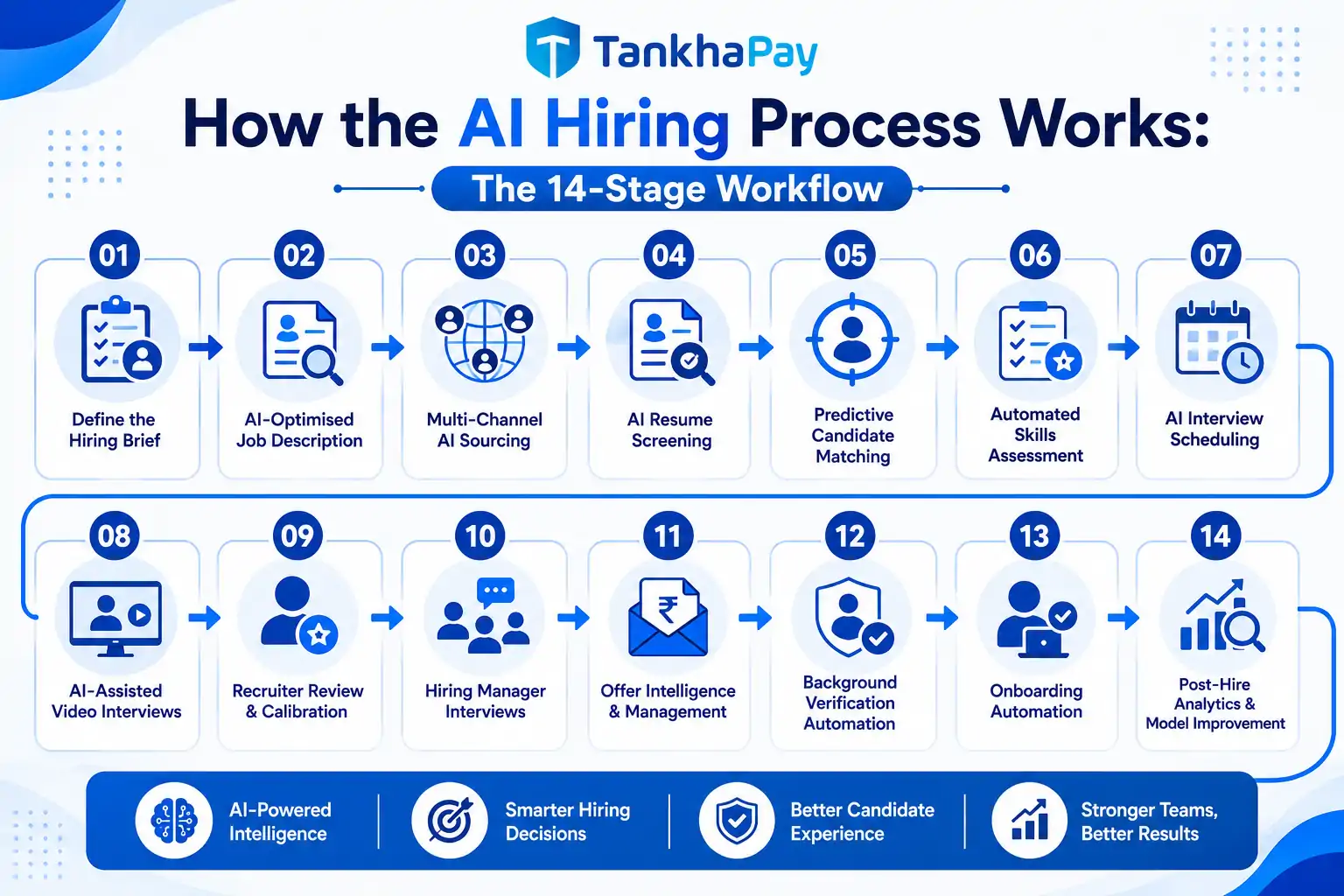
Stage 1 – Define the Hiring Brief
The AI-based hiring process starts with the creation of the hiring brief consisting of the requirements for the position, competency profile, the team context, salary range, manpower, and timelines. Otherwise, AI generates irrelevant outputs.
Where AI helps: Advanced systems analyse historical performance data from similar past hires to identify the competency patterns that actually predict success. Moving beyond the generic job description to a role-specific success profile.
Where humans lead: Hiring managers define the business problem the role solves. That judgement belongs with people, not algorithms.
Stage 2 – AI-Optimised Job Description
The job description is the first impression a company makes on talent. Biased, vague, or poorly structured descriptions reduce applicant quality before the process begins.
Where AI helps: The natural language processing tools ensure that the language of the job description is not biased and vague as well as structurally weak. These tools benchmark the job title and requirements to the current market standards, thus making the description relevant and clear to the correct audience.
Where humans lead: The employer value proposition, team culture, and strategic context that make a role compelling require human authorship.
Stage 3 – Multi-Channel AI Sourcing
The candidate pool available through job boards is a fraction of the total relevant talent market. According to LinkedIn’s Global Talent Trends report, approximately 70–75% of the global workforce are passive candidates who are employed, performing well, and not actively searching.
Where AI helps: AI recruitment engines look for candidates concurrently on LinkedIn, GitHub, professional social networks, alumni networks, portfolio pages, and internal talent databases. The engines look for candidates according to their skills, career progression, and proximity to the position and not by matching keywords from the resume. Three days of searching by a recruiter become three hours by an AI engine.
Where humans lead: The sales pitch which transforms the passive candidate into a potential recruit depends on personalization, timing, and relationship skills. AI tells you whom to approach; the recruiter knows how.
Stage 4 – AI Resume Screening
Screening is where the limitations of conventional practices are most obvious, and the benefits of artificial intelligence are most apparent.
Where AI helps: Screening platforms driven by natural language processing technology analyze all the applications – skills, experience, education, and career. The platform will rank the shortlist within minutes using a set of structured criteria, taking away the tedious work of going through resumes manually. Most importantly, when configured correctly, the screening process of artificial intelligence is not limited to keyword matching but finds skills proximity, too.
Where humans lead: AI shortlists need to go through the screening of recruiters before the potential applicants can be approached. AI spots patterns while recruiters see the bigger picture. The shortlist serves as a point of departure for human assessment.
Stage 5 – Predictive Candidate Matching
Beyond screening out unqualified candidates, predictive matching scores each candidate against the probability of success in the specific role – based on the employer’s historical hiring and performance data.
Where AI helps: Predictive models surface non-obvious candidates – those with unconventional backgrounds or less recognisable institutions who score strongly on the actual competency predictors. This is where AI hiring stops replicating past hiring patterns and starts genuinely improving them.
Where humans lead: Model validation and bias auditing require HR and data expertise. Predictive models should be reviewed quarterly to ensure they are not entrenching past patterns.

Stage 6 – Automated Skills Assessment
Assessments standardise evaluation and add an objective data layer to the shortlist. AI-managed assessment platforms deploy role-specific tests at scale and score results consistently.
Where AI helps: Every candidate takes the same assessment under the same conditions and is scored by the same criteria – eliminating the variability that comes from different assessors on different days. For technical roles, coding challenges and analytical assessments can be evaluated by AI with high accuracy. Results are available in hours, not days.
Where humans lead: Assessment design – it requires a keen eye to know which skills to test, how to weight them, and what threshold indicates a qualified candidate – requires HR expertise and domain knowledge that AI cannot determine independently.
Stage 7 – AI Interview Scheduling
Calendar coordination across candidates, recruiters, and multi-person interview panels is administratively expensive and inherently slow in a manual process.
Where AI helps: AI scheduling tools connect to calendar systems across the organisation and present candidates with real-time availability for self-scheduling. Automated reminders reduce no-show rates significantly. What previously took 2–4 days of email chains happens in under an hour.
Where humans lead: Panel composition – which interviewers should assess which candidate attributes – is a human decision that shapes the quality of the evaluation, not just its logistics.
Stage 8 – AI-Assisted Video Interviews
Candidates can go through structured first-round interviews through an asynchronous process where candidates answer predefined questions through videos using AI-based platforms.
Where AI helps: Standardised first-round evaluation at scale, available to candidates at any hour. Particularly effective for high-volume entry-level and field sales roles where the first screening interview is largely about communication capability and basic role understanding.
Where humans lead: The AI video interview analysis is one part of the process; it cannot decide anything. The candidate’s feedback analyzed by the AI needs to be reviewed manually by human reviewers, and AI video evaluation cannot be used to move forward or reject the candidate.
Stage 9 – Recruiter Review and Calibration
This is the human quality check to make AI-based recruiting legit. This means an experienced recruiter will review the list produced by AI, interpret assessment results, review video interview output, and make advanced decisions.
Good companies know that this is when the recruiter becomes really useful – not in sorting out resumes, but in evaluating if those patterns identified by AI translate into the complex profile the hiring manager wants.
Stage 10 – Hiring Manager Interviews
In-depth assessment of cultural fit, team dynamics compatibility, and strategic competence. Here is where all the critical decisions regarding team performance are made and where human decision-making cannot be replaced by any means whatsoever.
Expert Insight: The best hiring managers treat the AI-generated dossier – compiled from screening scores, assessment results, and video interview flags – as a pre-read, not a verdict. They walk into interviews knowing more about a candidate’s capability profile than was previously possible, allowing conversations to go deeper, faster.
Stage 11 – Offer Intelligence and Management
Getting the offer right the first time – the right number at the right speed – is where many organizations lose candidates they have already invested weeks in winning.
Where AI helps: Real-time compensation intelligence software benchmarks the package against the current market, thus eliminating the possibility of structurally flawed offers. The automation of offer letters and signing procedures cuts down the turnaround time from days to just a few hours.
Where humans lead: Negotiation, relationship management through the offer stage, and managing counter-offer situations require experienced recruiter judgment and relationship capital.
Stage 12 – Background Verification Automation
The API-enabled BGV systems perform document gathering, education verification, reference verification, and work experience verification. The artificial intelligence system highlights any anomalies without delay instead of waiting for the entire process to be completed manually.
Stage 13 – Onboarding Automation
However, the recruitment process is not complete even after accepting the offer. AI-based onboarding systems can take care of documentation, checklist for compliance, access provisioning triggers, and pre-boarding activities – resulting in preparedness of new employees to hit the ground running on day one.
Stage 14 – Post-Hire Analytics and Model Improvement
Smart firms complete the cycle. The AI software learns which individuals who went through their screening process turned out to be top performers, how soon they hit their stride, and how long they remained with the organization, and applies that information to the next hiring cycle.
Quick Tip: The difference between companies that see compounding returns from AI hiring and those that plateau after the first year is this: the best organisations treat post-hire performance data as an essential input into their hiring AI, not a separate HR analytics project. Build the feedback loop from day one.
Different Business Benefits of AI Hiring
Smart companies measure AI hiring by business outcomes, not feature lists.
Competitive speed to shortlist
By reducing time to shortlist from 10 days to 24 hours, your candidates are still available, still interested, and have not yet gone into the final rounds with your competition. In the case of in-demand categories, timing is everything.
Access to the full talent market
Traditional recruitment targets the active job seekers, which constitute only 20% to 25% of all possible candidates at any one point in time. The rest, 75%, come out of AI sourcing.
Higher quality-of-hire over time
Organisations adopting structured predictive hiring solutions achieve 15-25% increased quality-of-hire scores after one year (SHRM / iCIMS survey findings, 2022–2024). Hiring quality feeds back – good hires bring better hires, lower turnover, and increase the productivity of teams.
Recruiter capacity multiplication
The power of AI is not to replace the recruiter but to multiply their capacity. One recruiter who handles 8–12 roles without AI can manage 25–35 roles with the help of an AI-powered platform in sourcing, screening, and scheduling. That is the formula by which companies scale their hiring volume without proportional scaling of their HR headcount.
Real-time talent intelligence for leadership
CFOs and CHROs get dashboards that show them the status of the hiring pipeline, cost-per-hire for each department, source quality, and acceptance rates – information that used to arrive only on a quarterly basis. With such a view, hiring can now become a business process, not an administrative one.
Reduced attrition from better matching
Predictive matching does not just find people who can do the job – it finds people who are likely to stay and grow within the organisation. Reducing first-year attrition by 20% at a ₹12 lakh average salary role saves ₹2.4 lakh per retained employee.
AI Hiring vs Traditional Hiring: Numbers that Matter
| Dimension | Traditional Hiring | AI-Powered Hiring |
|---|---|---|
| Time-to-shortlist | 7–14 days | 12–24 hours |
| Time-to-fill (mid-level) | 38–50 days | 14–22 days |
| Cost-per-hire | ₹1.5–4 lakh | ₹0.8–2 lakh (optimised) |
| Candidate pool coverage | Active applicants (~25%) | Active + passive (near 100%) |
| Screening consistency | Variable (human fatigue) | Standardised |
| Roles per recruiter | 8–12 simultaneously | 25–35 simultaneously |
| Quality-of-hire tracking | Ad hoc or absent | Systematically measured |
| First-year attrition | Industry average | 15–25% below average |
| Candidate experience rating | Often delayed, opaque | Real-time updates, self-service |
| Data for future hiring | Minimal | Predictive model improves each cycle |
These improvements depend on selecting the right AI hiring platform. Our guide to the Best AI Recruitment Software in India compares leading solutions based on AI capabilities, pricing, integrations, and business use cases.
Where AI Creates the Biggest Competitive Advantage
The 14 stages above explain how AI hiring works. This section answers a different question: what does it actually cost your business when you don’t have it?
Resume screening at scale
It’s not only about speed; it’s about coverage. AI considers every resume diligently and reveals applicants who wouldn’t even be noticed in the manual screening process. Successful businesses look for people in the fourth quartile of their application pipeline who are unseen by their competitors.
Passive candidate identification
AI technologies work in real time, identifying individuals who fit the job profile even though they are not actively seeking. They tend to be the most outstanding in their present jobs – and hardest to find via conventional methods.
Speed of scheduling
Eliminating the 3–5 day scheduling lag means smart companies reach candidates before competing offers are made. The talent war is often won at the calendar level.
Standardised assessment that removes subjectivity
When all the applicants go through the same skills test assessed by the same algorithm, then the list of selected people will be based on their capability and not on subjective bias, fatigue of the interviewer, or the random selection of the CV received on a particular day.
Predictive analytics for workforce planning
Smart companies use AI hiring data to forecast talent needs 3–6 months ahead – identifying emerging skill gaps, modelling attrition risk by department, and building talent pipelines before vacancies occur.
Candidate engagement at every hour
AI bots and automatic communication processes mean that no applicant falls off the radar. Acknowledgments, updates, appointments, and document requests take place without any help from the recruiter – making sure that the applicants stay engaged.
Challenges Companies address before Implementing AI Hiring
AI hiring is not consequence-free. The companies that succeed with it are the ones that manage these challenges proactively.
Algorithmic bias
An AI model that is trained using the historical recruitment data will carry forward any historical bias. In case the hiring was biased towards a certain university, background, and profile in the past, then this bias will be further intensified by the use of an algorithm. Mitigation of the bias will include periodic demographic analysis of the shortlist, blinded screens, and reviews of the model twice a year. See AI Resume Screening for how these systems actually work under the hood.
Candidate transparency
Candidates expect to know how AI technology is used in the selection process. Lack of transparency poses legal risks and harms the brand of an organisation. Good firms explain the use of AI, areas for human decision-making, and candidates’ rights in the process.
Data privacy compliance
The Digital Personal Data Protection Act 2023 provides an unequivocal legal framework on the issue of consent, data retention, and individual rights in automated decision-making processes. In any AI recruiting solution, it is important for companies to analyze the legal aspect of its setup and communication with candidates.
Over-automation of relationship touchpoints
Firms who strip away human touch points in order to be efficient witness an increase in rejected offers and drop-out candidates during final recruitment steps.
Model drift over time
An AI system trained in 2024 may no longer fit the demands of your company by 2026. Your hiring standards, market changes, and job expectations will all change. Smart businesses know to include an analysis of their models as part of the HR schedule – not a response to a problem, but just regular maintenance.
Lack of recruiter training on AI outputs
Recruiters who do not understand how to interpret AI screening scores or predictive match results will either over-rely on them or ignore them. Investing in recruiter capability to work with AI tools is as important as the technology itself.
Why Human Recruiters Remain Essential
This holds precisely in hiring. The work AI eliminates is the work recruiters never should have been doing in the first place – parsing spreadsheets, chasing calendar confirmations, sending status update emails. What remains is the work that determines whether a great candidate becomes a great employee.
Relationship building with passive candidates
The senior engineer who is not actively searching does not react to the automated InMail; they react to the recruiter who gets their career journey, knows their professional network, and knows why this particular job opening deserves a conversation. That’s something only humans do and cannot be replicated by AI.
Reading what is not on the resume
The skilled recruiter detects motivation, ambiguity, cultural clues, and career logic transitions that AI systems are not able to detect. This information frequently means the difference between success and failure for a recruit.
Cultural assessment at depth
A fit to the culture is an assessment and not merely a checklist. It involves assessing whether a particular candidate will be able to mesh well with a certain work environment. The senior recruiters are those who have gained this ability through years of observation and practice.
Executive and confidential searches
Recruitment of leaders needs some discretion. They need industry connections and the ability to communicate at the board level. AI can help find the candidates; however, human decision-making and relationships are needed for closing them down.
Offer negotiation and persuasion
The dialogue that changes an uncertain candidate into an acceptant is human in nature. It requires empathy, timing, and the capacity to handle unvoiced worries, which are all recruiting techniques that decide if the hiring process will result in a hire or not.
When Companies Make the Move to AI Hiring
Not every organisation should rebuild their hiring process around AI immediately. These are the conditions where the ROI is unambiguous.
High-velocity growth
Adding 100+ employees over 6–12 months demands infrastructure that manual processes cannot support. AI hiring becomes essential operational infrastructure.
Mass or volume hiring
Companies such as retail, logistics, BPO, manufacturing, and seasonal companies do high-volume, recurring jobs. AI is capable of processing hundreds of applications using consistent standards at a much lower cost compared to equivalent manual efforts.
Multi-location hiring
Hiring in five cities at once with consistent standards, speed, and knowledge about the local market requires an AI system to make it feasible.
High attrition environments
When annual turnover exceeds 25–30%, recruiting has become a permanent operational function. AI makes it sustainable.
Niche technical hiring
Paradoxically, AI sourcing is particularly effective for hard-to-fill roles because it identifies passive candidates with rare skills across platforms that human sourcers would not have the time or access to search.
International or market entry hiring
Building a team in a new geography without established local networks requires AI sourcing to map the candidate landscape quickly.
Post-funding team building
Startups and growth-stage companies that have raised capital and need to build functions fast – without an experienced in-house TA infrastructure – see some of the fastest ROI from AI-backed recruitment.
Best Practices of Companies Using AI Hiring
Configure AI to your hiring criteria, not to industry defaults
AI hiring systems come pre-configured with standard configurations. Successful organizations allocate resources to configure AI according to their specific job specifications.
Build the human checkpoint into the process – before candidate contact
Every AI-generated shortlist should be reviewed by a recruiter before outreach begins. The human checkpoint is what makes AI hiring defensible and what ensures the model’s pattern recognition is contextually accurate.
Communicate the AI process honestly
Make sure candidates know what the AI system does, as well as how human beings make decisions. This goes beyond ethics; it is also smart business, as candidates love transparency and hate ambiguity.
Measure quality-of-hire at 90 days, 6 months, and 12 months
AI hiring is easily over-optimised for speed. The metric that matters most – whether the people hired are performing, engaged, and retained – takes time to measure. Build it into your operating rhythm.
Integrate AI hiring data with your HRMS and finance systems
AI hiring data that lives in a standalone tool and does not connect to HR and financial reporting is a missed opportunity. The value is in the connected picture.
Review your AI model twice per year
The market is dynamic and so are the functions of people within it; what was relevant in 2025 may not apply to 2026. Conduct evaluations ahead of time.
AI Hiring Mistakes Companies Avoid
Choosing AI based on the feature list rather than the use case fit
The most advanced AI-based hiring platform in the industry is irrelevant for your needs if your company lacks recruitment skills to understand AI’s results. Let the tool match your capabilities and not vice versa.
Treating AI as the decision-maker
The AI will provide you with superior shortlists and assessments. However, AI won’t make any hiring decision. Businesses that leave AI as the decision-maker and not as a powerful tool incur unnecessary legal and cultural risks.
Removing human communication from the candidate journey
Status update automation is good. Automation of rejection messages following final interview rounds is damaging to the company’s brand reputation and, in most instances, will be a deal breaker for the candidates.
Using a single AI configuration across all roles and levels
The selection criteria which will help you find good candidates for Junior Sales Representative role won’t generate even a remotely useful candidate shortlist in VP Engineering search. Role-based AI setup is mandatory for you to achieve smart implementation or get disappointed in it.
Implementing AI without telling your recruiters why
If your recruiters feel threatened by AI, they will sabotage the whole process. Intelligent companies spend money both on the deployment of AI solutions and the development of recruiters’ skill set so that the recruiters understand that AI makes their job easier.
Not closing the feedback loop
The AI hiring system improves only when performance data from past hires is fed back in. Companies that treat post-hire analytics as separate from the hiring function leave the most valuable source of model improvement untouched.
To Sum Up..
Building a fully operational AI hiring function internally requires investment across technology, configuration, training, data infrastructure, and ongoing management and typically takes 12–18 months to deliver consistent results.
For most organisations, the faster, more cost-effective path is partnering with a recruitment specialist that already operates AI at the core of its methodology.
The distinction that matters is not whether your recruitment partner uses AI tools; most do. The distinction is whether they have the recruitment expertise, market knowledge, and process intelligence to use those tools well. AI sourcing without skilled sourcing judgement produces the wrong candidates faster. AI screening without well-configured criteria produces a faster wrong shortlist.
TankhaPay’s AI-powered recruitment services combine enterprise AI hiring infrastructure with specialist recruitment consultants across India’s major talent markets, such as technology, financial services, manufacturing, logistics, healthcare, and professional services.
For businesses evaluating whether to build or partner, the AI Staffing Solutions guide covers how leading Indian companies are structuring their AI-enabled workforce acquisition strategies in 2026.
Recruitment Process Outsourcing for organisations assessing whether RPO or in-house TA is the right structural model for their growth stage.
Staffing solutions for businesses managing high-volume, contractual, or project-based workforce requirements alongside permanent hiring.
The value of an AI-enabled recruitment partner compounds over time, as your hiring history builds into a richer predictive model, as your talent pipelines mature, and as your recruiters develop deeper knowledge of your business. The companies that start this partnership earliest see the largest long-term advantage.
Frequently Asked Questions
How do smart companies use AI in their hiring process?
Top firms apply artificial intelligence throughout their entire recruitment process – searching for passive candidates from various sources at once, reviewing applications with the help of natural language processing, performing standardized skills testing, managing the interview scheduling process, and scoring for fit. They rely on artificial intelligence to manage the volume and process and leave all the decision-making to experienced recruiters.
What is the typical ROI of an AI hiring process?
Organisations implementing end-to-end AI hiring typically see a 40–60% reduction in time-to-fill, Cost-per-hire reductions of 30–50% are common after full implementation, though this depends heavily on current baseline costs and role complexity; and a 15–25% improvement in quality-of-hire measured at 12 months. The compounding effect comes from the predictive model improving with each hiring cycle.
How does AI hiring help find passive candidates?
An AI-powered recruitment sourcing engine works consistently across professional networks, LinkedIn, GitHub, alumni networks, portfolio sites, and other niche forums, looking for relevant professionals who fit the job description in terms of skills and career progression. The proportion of passive candidates makes up to 75%-80% of all eligible candidates for most jobs.
Can AI hiring be biased?
Absolutely, in case these tools are not adequately designed and reviewed. AI algorithms trained on historical recruitment data replicate previous decisions and, accordingly, the same biases that were made before. Intelligent companies take care of avoiding such a situation by conducting frequent demographic audits of the lists, using blind-screening design, diverse data sets, and reviews of the models independently.
How does AI improve candidate experience in hiring?
AI hiring dramatically improves candidate experience by: providing immediate application acknowledgements, giving real-time pipeline status updates, offering self-scheduling portals that eliminate waiting for recruiter availability, enabling asynchronous video interviews on the candidate’s schedule, and reducing total process time from weeks to days for qualified candidates.
What is the difference between AI recruitment and ATS?
An Applicant Tracking System (ATS) is primarily a database and workflow management tool – it organises applications but does not actively evaluate them. AI recruitment encompasses intelligent sourcing, NLP-powered screening, predictive candidate matching, automated assessment scoring, and analytics. AI hiring tools typically integrate with an existing ATS rather than replacing it.
How long does it take to implement AI hiring?
A basic implementation covering screening and scheduling can be operational in 4–8 weeks. A full-funnel AI hiring system with predictive matching and integrated analytics typically requires 3–6 months to configure correctly, validate, and integrate with existing HR infrastructure.
Is AI hiring suitable for executive and senior leadership roles?
In part. AI sourcing is indeed very important in sourcing potential leaders, as it helps find passive executive-level candidates who would not be identified using conventional methods. Nevertheless, evaluating, assessing and selecting leadership talent still demands specialized experience in executive recruiting.
What data does an AI hiring system use to make recommendations?
AI hiring systems typically draw on resume and application data, skills assessment results, job description requirements, historical hiring outcomes (who was hired and how they performed), market benchmarking data, and sometimes structured interview scores. The more historical hiring and performance data is available, the more accurate the predictive outputs become over time.
How do we measure whether our AI hiring process is working?
Key measurements include time to fill, cost to hire, quality of hire at 90 days / six months / one year, acceptance rate, candidate Net Promoter Score (NPS), and recruiter capacity – number of roles filled by individual recruiters per month. Set benchmarks before making any changes and then measure each month for 12 months after that.
Should small businesses invest in AI hiring tools independently?
For businesses with fewer than 25–30 hires per year, building an independent AI hiring capability has a weak ROI case. The better option is partnering with an AI-enabled recruitment provider who brings the technology infrastructure, the specialist expertise, and the market data as a service, without the capital and time investment of independent implementation.