📅 Published: June 2026
🔄 Last Updated: June 2026
⏱ Reading Time: 5 minutes
An Employer of Record (EOR) in India works by becoming the legal employer of your Indian hires on paper, while you retain full control over their day-to-day work. The EOR will execute the employment agreement, process the INR payroll on a monthly basis, make PF and ESI contributions on behalf of the employer, pay TDS as per section 192 of Income Tax Act, 1961, and take care of all other central and state statutory obligations as per the new four Labour Codes of India, effective from November 21, 2025. Your company makes just one monthly payment and controls the employee’s productivity. No Indian subsidiary, no EPFO registration, and no state-wise compliance infrastructure is required from your side. From the day you decide to hire to the day your employee receives their first payslip, the process takes 35 to 45 days, with the employee active and working by days 5 to 10.
QUICK REFERENCE — INDIA EOR STATUTORY RATES (FY 2025-26)
| Statutory | Rate | Deadline | Authority |
| PF — Employer | 12% of basic + DA | 15th of month (ECR) | EPFO |
| PF — Employee | 12% of basic + DA | Same | EPFO |
| ESI — Employer | 3.25% of gross wages | 15th of month | ESIC |
| ESI — Employee | 0.75% of gross wages | Same | ESIC |
| ESI wage ceiling | ≤ ₹21,000/month | — | ESIC |
| Gratuity formula | (15/26) × last wage × years | At separation | Employer |
| Gratuity eligibility | 5 years continuous service | — | Payment of Gratuity Act |
| TDS deposit | Section 192 | 7th of month | Income Tax Dept |
| New Labour Codes in force | All 4 codes | November 21, 2025 | Govt of India |
| EOR onboarding timeline | 5–10 business days | — | — |
Sources: EPFO, ESIC, Ministry of Labour and Employment, EY India (November 2025)
What Is an Employer of Record (EOR) in India?
Direct answer: An Employer of Record company in India is a third-party organization that legally employs workers on your company’s behalf. The EOR becomes the legal employer on paper — issuing employment contracts, running payroll in INR, filing PF, ESI, and TDS, and managing all statutory compliance. Your company retains full operational control over the employee’s work, deliverables, and performance.
Also known as: Third-party payroll provider, employment on record, international staffing partner, workforce on record, or loosely as “international PEO” (though PEO is legally a different model — see table below).
The EOR model solves one specific problem: India has 40+ central labour laws and 28 state-specific Shops and Establishments Acts. As of November 21, 2025, four new consolidated Labour Codes replaced 29 of these laws — restructuring wages, social security, industrial relations, and workplace safety. An EOR absorbs this entire infrastructure so you don’t have to build it yourself.
EOR vs PEO vs Staffing Agency — What’s the Difference?
| Hiring Model | Legal Employer | Entity Needed in India? | Best For |
| EOR | EOR is the sole legal employer | No | Hiring without a local subsidiary |
| PEO | Co-employment — shared liability | Yes, already required | Companies with existing India registration |
| Staffing Agency | Varies; often client becomes employer | No | Short-term or project workforce |
| Direct Hire | Your company | Yes | Long-term, fully established India operations |
Is EOR the same as third-party payroll in India? Not exactly. Third-party payroll in India typically refers to a payroll processing service where your company remains the legal employer. In an EOR arrangement, the EOR is the legal employer — absorbing all compliance liability, not just processing payroll.
The distinction matters because several providers in India describe themselves as EOR while operating as payroll bureaus or using aggregator partners for statutory filings. Before selecting a provider, read:
5 red flags that identify a non-compliant EOR provider in India
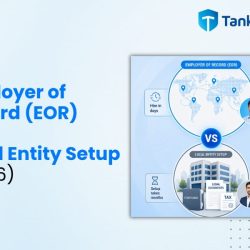
Hiring in India: Without EOR vs With EOR
| Dimension | Without EOR (Direct Entity Setup) | With EOR |
|---|---|---|
| First hire timeline | 3 to 6 months (entity registration, EPFO setup, state registrations) | 5 to 10 business days |
| Setup cost | Rs 2 to 5 lakh one-time + Rs 3 to 8 lakh annual compliance | Zero setup cost |
| Who handles PF filing | Your in-house team or outsourced accountant | EOR files ECR monthly with EPFO |
| Who handles TDS | Your TAN, your filing, your liability | EOR’s TAN, EOR’s filing, EOR’s liability |
| Multi-state compliance | Separate registrations required in each state from your entity | EOR holds registrations in all 28 states |
| Permanent establishment risk | Exists if structured incorrectly | Addressed by the EOR legal structure |
| Exit from India | Entity wind-down takes 6 to 18 months | Immediate — no wind-down required |
The EOR model is not permanent. Most companies use EOR for market entry and transition to a direct India entity once they reach 30 to 50 employees and the fixed compliance overhead is spread across enough people to justify it.
Who Does What in India’s EOR Model
| Responsibility | Client Company (You) | EOR Provider | Employee |
|---|---|---|---|
| Day-to-day work direction | Assigns tasks, sets targets, manages performance | No involvement | Executes work under client direction |
| Employment contract | Reviews and approves CTC | Issues, signs, and holds the legal contract | Signs contract with EOR |
| PF registration and filing | None | Registers with EPFO, files monthly ECR by 15th | Receives UAN, tracks PF balance |
| ESI registration and claims | None | Registers with ESIC, deposits contributions, supports claims | Receives IP number, accesses ESIC benefits |
| TDS calculation and deposit | None | Calculates under Section 192, deposits by 7th, files Form 24Q quarterly | Declares tax regime, receives Form 16 |
| Professional Tax | None | Registers in each state, remits per state schedule | PT deducted from salary |
| Salary disbursement | Pays one monthly invoice to EOR | Calculates gross-to-net, disburses INR salary | Receives net salary in bank account |
| Leave approval | Approves or declines leave requests | Tracks balance, adjusts payroll for unpaid leave | Submits requests via EOR portal |
| CTC structuring | Defines package before onboarding | Validates against 50% wages rule, structures compliant CTC | Receives final CTC breakdown |
| Exit and F&F | Confirms last working day | Manages F&F settlement within 2 working days | Receives final settlement |
What Statutory Compliance Does an EOR Manage in India?
This is where most EOR guides fail — they say “we handle compliance” without telling you what that means in numbers. Here is what a compliant EOR actually manages, with exact rates and deadlines.
1. Provident Fund (PF / EPF)
Governed by: EPF and Miscellaneous Provisions Act, 1952 / Code on Social Security, 2020 Regulatory Body: EPFO (Employees’ Provident Fund Organisation) Scope: Employers with ≥20 employees
| Contribution | Rate |
| Employer contribution | 12% of basic + DA |
| Employee contribution | 12% of basic + DA |
| Of employer’s 12%: EPS | 8.33% |
| Of employer’s 12%: EPF | 3.67% |
| EDLI (employer only) | 0.5% of basic + DA |
EOR’s role: Holds EPFO registration and employer code. Allots or transfers PF UAN (Universal Account Number) for each employee. Files the monthly ECR (Electronic Challan cum Return) by the 15th. Issues Form 3A and 6A annually.
Penalty for late deposit: 12% p.a. interest as per Section 7Q + compensation of 5%-25% of outstanding amounts as per Section 14B. Criminal proceedings can be initiated against directors for wilful evasion.
This is the liability that sits with your EOR — not with you — if the EOR is structured correctly as the legal employer. Before signing, verify your EOR holds EPFO registration in their own entity name and files ECR in-house, not through a CA firm. See the complete checklist: how to verify an EOR is genuinely compliant in India before you sign.
Important Change in the Labour Codes (November 2025): New definition of “Wages” has been made in the Social Security Code. The allowances which go beyond 50 percent of your total salary will fall under the category of wages for Provident Funds. The salary system in which you have a small amount of base salary will no longer qualify.
2. Employee State Insurance (ESI)
Governed by: Employees’ State Insurance Act 1948 / Social Security Code 2020
Regulating authority: ESIC (Employees’ State Insurance Corporation)
Applicability: Establishments having 10 or more employees and employees earning ≤ ₹21,000 per month
| Contribution | Rate |
| Employer | 3.25% of gross wages |
| Employee | 0.75% of gross wages |
Benefits covered: medical treatment, maternity leave, sickness benefit, disability, dependants’ benefit, and funeral expenses.
EOR responsibilities: Registering employees with ESIC, providing employees with IP numbers, depositing contributions every month until the 15th day, and handling claims support.
Penalty: A ₹50,000 penalty for the first violation and imprisonment of up to 2 years for further offences.
New Labour Code change: In the Code on Social Security, it is clearly mentioned that gig workers shall also be covered by social security benefits, which includes ESI, as well. Businesses that have both types of workers, EOR employees as well as gig contractors, should reconsider their duties.
3. Tax Deducted at Source (TDS) — Section 192
Governing statute: Income Tax Act, 1961, Section 192 Statutory authority: Income Tax Department
The EOR, who is the legal employer, will be responsible for holding the TAN and fulfilling all the TDS requirements.
Important timelines include:
- TDS deposited monthly – 7th of next month
- Form 24Q filed quarterly – July 31/October 31/January 31/June 15
- Form 16 furnished to employees before June 15 every year
The new tax regime will automatically apply from FY 2025-26. It is important to note that you need to declare your choice of tax regime every year. The HR department at your employer organisation needs to collect signed declarations on your behalf.
4. Professional Tax (PT)
Governed by: State-wise legislations, not national legislation
PT tax is charged by states against the salaries of employees. It becomes compulsory for the EOR to register himself separately with the state government for the PT tax in each and every state wherever he has employed his staff members. It is here that most EOR networks stumble at the Indian stage.
| State | PT Rate | Notes |
| Karnataka | ₹200/month | For gross salary above ₹15,000 |
| Maharashtra | Up to ₹2,500/year | Slab-based |
| Tamil Nadu | ₹208/month | Varies by salary bracket |
| West Bengal | Up to ₹2,500/year | Slab-based |
| Andhra Pradesh | ₹200/month | For gross salary above ₹15,000 |
| Delhi, UP, Haryana, Rajasthan | Nil | No PT in these states |
5. Labour Welfare Fund (LWF)
Governed bystate Labour Welfare Fund Acts, each state has its own
LWF is small in amount and the most commonly missed compliance obligation in Indian payroll. Contribution amounts typically range from ₹6 to ₹75 per employee per period, depending on the state.
Key fact: LWF is not a monthly deduction; it is typically biannual (June and December) or annual. Employers who deduct LWF every month are technically over-deducting, which is itself a statutory violation.
6. Gratuity
Governed by: Payment of Gratuity Act, 1972 / Code on Social Security, 2020
Formula: (15 ÷ 26) × Last Drawn Wage × Years of Continuous Service
| Parameter | Detail |
| Eligibility | 5 years of continuous service |
| Maximum payable | ₹25 lakh |
| Tax exemption (employee) | Up to ₹20 lakh |
| Exception | Payable before 5 years in case of death or disability |
EOR’s role: Provisions gratuity monthly in the books and processes the payout within the F&F settlement at separation.
What happens if an employee leaves before completing 5 years? Gratuity is not eligible until the individual has served for a minimum of five years, excepting the following scenario: if the employee dies or gets disabled permanently, then gratuity is eligible irrespective of the period of service.
India’s New Labour Codes — What EOR Clients Must Know (November 2025)
On November 21, 2025, the Government of India implemented all four Labour Codes, consolidating 29 existing central labour laws into a unified framework.
What Is Different About Hiring Through an EOR in India in 2026?
The EOR process in India changed materially when the four Labour Codes came into force on November 21, 2025. There are three direct impacts on the way EOR onboarding and payroll processes function: the salary structures have to be compliant with the new definition of wages because anything above 50% of total compensation is now considered to be wages for PF, gratuity, and bonus purposes. Full and final settlements at exit must now be processed within 2 working days, compressing what was previously a 30- to 45-day process. Fixed-term employees must now receive the same PF, ESI, and pro-rata gratuity as permanent employees, changing how short-duration contracts are structured. If you have an EOR who is processing payroll in India from the month of November 2025 onwards, you need to ensure that he/she has everything sorted regarding his/her salary structure engine and modifications in his/her F&F process for the next three points below.
(Source: Ministry of Labour and Employment press release, November 21, 2025; EY India Tax Alert, November 2025; DLA Piper Global Employment — November 2025)
Status of implementation: The four Codes have been promulgated. Central and state-specific rules will be notified in phases. Employers need not wait for full notification of rules to conduct self-assessments on their compliance status. (Reference: EY India)
The Four Labour Codes — At a Glance
| Code | Central Laws Replaced | Primary Focus |
| Code on Wages, 2019 | 4 laws | Wages, minimum wages, bonus, equal pay |
| Industrial Relations Code, 2020 | 3 laws | Trade unions, strikes, retrenchment |
| Code on Social Security, 2020 | 9 laws | PF, ESI, Gratuity, Maternity, Gig workers |
| OSHWC Code, 2020 | 13 laws | Safety, health, working conditions |
6 Changes That Directly Affect EOR Operations
- New “Wages” Definition — The 50% Rule Allowances exceeding 50% of total remuneration are now treated as “wages” for PF, gratuity, and bonus calculations. CTC structures designed to suppress PF contribution by keeping basics low are non-compliant. Your EOR must audit all existing salary structures.
- Full and Final Settlement — Within 2 Working Days Outstanding wages at separation must now be settled within 2 working days. This replaces the informal 30–45 day process many companies previously followed. EORs without automated F&F workflows will struggle with this mandate.
- Gig and Platform Workers — Social Security Coverage According to the code of social security, platform and gig workers fall under PF, ESI, and gratuity as well. Businesses that employ workers through hybrid models, where they use both EOR workers and gig workers, need to reconsider the nature of each engagement.
- Retrenchment Threshold Raised — 100 to 300 Workers Establishments with up to 300 workers can now retrench without prior government approval (previously, this threshold was 100 workers). This changes exit planning for mid-sized India teams working through an EOR.
- Fixed-Term Employees — Equal Benefits as Permanent Staff Fixed-term workers are now entitled to the same PF, ESI, and pro rata gratuity as permanent employees. How your EOR structures short-duration contracts must be reviewed.
- Annual Health Check — Mandatory for Employees Aged 40+ Employers must now provide free annual health examinations for all workers aged 40 and above. This is a new addition to the benefits administration scope that every EOR must operationalise.
How EOR Onboarding Works in India 2026 — Step by Step
How do I hire an employee in India using an EOR?
Total timeline: 5–10 business days to Day One; first payroll by Day 30–35.
Step 1 — Define the Role and Sign the MSA (Days -7 to 0)
You do: Finalise the job description, compensation package, state of employment, and notice period. Share this with the EOR for CTC validation.
What EOR does: Verifies the CTC structure as per the 50% wages criterion in the Code on Wages 2019, verifies the application of state-specific PT/LWF, and creates the Master Service Agreement.
Result: MSA is signed. EOR becomes the legal employer from this date onwards.
Step 2 — Employee Document Collection (Days 1–3)
You do: Notify your candidate that they will receive an onboarding link from the EOR. You do not collect documents directly.
EOR does: Sends the onboarding portal link to the employee. Collects Aadhaar card, PAN card, bank account details, educational certificates, prior PF UAN, relieving letter from the previous employer, and background verification consent.
Employee does: Submits all documents through the EOR portal within the agreed window.
Step 3 — Statutory Registrations (Days 3–5)
You do: Nothing. This step runs entirely on the EOR’s side.
EOR does: Allots a new PF UAN or transfers the existing UAN from the prior employer via EPFO. Registers the employee with ESIC and generates an IP number. Activates Professional Tax registration in the applicable state. Sets up LWF deduction per the state schedule.
Outcome: Employee is registered with EPFO and ESIC before Day One of their joining.
Step 4 — Employment Contract (Days 4–6)
You do: Review and approve the CTC breakdown and contract terms. For technology hires, confirm the IP assignment clause is included.
EOR does the following: prepares an employment agreement for India which is compliant with the notice period, intellectual property assignment under Section 17 of the Copyright Act 1957, leave as per the applicable Labour Code, confidentiality clause, POSH compliance, and an arbitration clause.
Employee does: Signs the employment contract with the EOR.
Step 5 — Day One Activation (Days 6–10)
You do: Confirm Day One date, brief the employee on their work deliverables, and grant access to your company tools.
EOR does: Provisions portal access for employer and employee, activates group health insurance enrollment, activates ESI coverage, ships device if procurement was requested, and conducts a Day One orientation on payroll, leave, and benefits.
Step 6 — First Payroll Run (Day 30–35)
You do: Approve attendance and leave data in the EOR portal by the monthly cut-off date (typically the 25th of the month).
EOR does: Calculates gross salary, deducts 12% employee PF contribution from basic plus DA under the EPF and Miscellaneous Provisions Act 1952, contributes 12% employer PF (split as 8.33% to EPS and 3.67% to EPF), deducts 0.75% employee ESI and contributes 3.25% employer ESI under the ESI Act 1948 for eligible employees, calculates TDS under Section 192 of the Income Tax Act 1961, disburses net salary, files ECR with EPFO by the 15th of the following month, and deposits TDS by the 7th.
You receive a payroll summary report, payslip copies, and statutory filing confirmations.
Which Workforce Types Can an EOR Manage in India?
Can an EOR handle blue-collar and factory workers, not just tech employees?
Most global EOR platforms cover only white-collar employees. This is a meaningful limitation for companies with mixed workforce requirements.
| Workforce Type | Applicable Compliance Beyond PF/ESI/TDS |
| White-collar (tech, finance, operations, management) | IP assignment clauses, TDS (old/new tax regime), PT |
| Blue-collar (field staff, logistics, manufacturing) | Contract Labour (R&A) Act, Factories Act, Motor Transport Workers Act, state minimum wages, Factory licence |
| Apprentices (NAPS / NATS) | Apprentices Act, 1961; stipend structure; social security applicability |
An EOR with 26 years of owned-entity India operations manages all three workforce types with dedicated compliance teams for each. Global EOR platforms typically cover only Category 1.
India EOR Compliance Calendar — Key Deadlines
| Frequency | Obligation | Deadline | Filing Authority |
| Monthly | TDS deposit | 7th of following month | Income Tax Department |
| Monthly | PF challan (ECR filing) | 15th of following month | EPFO |
| Monthly | ESI contribution | 15th of following month | ESIC |
| Monthly | Professional Tax | 15th (most states) | State government |
| Quarterly | Form 24Q (TDS return) | July 31 / Oct 31 / Jan 31 / Jun 15 | Income Tax Department |
| Annual | Form 16 to employees | By June 15 | Income Tax Department |
| Biannual | LWF contribution | June + December (state-specific) | State Labour Welfare Board |
| Annual | Statutory Bonus | October–November | Ministry of Labour |
| Annual | Shops & Establishments renewal | State-specific | State government |
Why this calendar matters: A company recruiting employees from 5 different states in India will have to manage anywhere between 60-80 different compliance filings every year, where each one has its own authority, portal, form, and fine for non-compliance.
Frequently Asked Questions
What is an Employer of Record (EOR) in India?
In India, an EOR is a third-party company that legally hires employees for you. The EOR handles all employment contract-related matters, payroll management, PF/ESI/TDS filing, and ensures statutory compliances while you handle the employment activities. There is no need for any subsidiary in India.
Can a foreign company hire employees in India without setting up a local entity?
Yes. Via an Employer of Record, a foreign business organisation can hire and remunerate their employees in India without setting up any subsidiary, branch office or even private limited company. In this case, the Employer of Record becomes the legal employer.
How does an EOR manage PF in India?
EOR is registered with EPFO with its own employer code number. The deductions of 12% are made by EOR from basic salary + DA. Another contribution of 12% as an employer is made by EOR. The ECR is submitted by EOR on or before the 15th day of each month.
What changed for employers under India’s new Labour Codes?
Six major amendments came into force starting from November 21, 2025: (i) New definition of wages – allowances in excess of 50% of the CTC will be regarded as wages for PF purposes. (ii) Disposal of F&F within two working days. (iii) Gig workers included in social security. (iv) Recessed threshold raised from 100 to 300. (v) Benefits provided on par with permanent employees to fixed-term employees. (vi) Annual health check for workers above 40 years of age.
What is the difference between an EOR and a PEO in India?
The EOR becomes the only legal employer, and you do not need to create any Indian company. The PEO works together with your company to become the employer, which means that your company should have registered with the Indian government first. Most foreign companies will use the EOR method in India for their first hire.
How long does EOR onboarding take in India?
In the case where we have a cooperative EOR specializing in India, we get the onboarding process done within 5-10 days. The first payroll is processed between days 30 and 35. Global EORs that use partnering networks could take 15-25 days to set up.
What are the penalties for PF non-compliance in India?
According to the EPF Act: Interest of 12% per annum on arrears (Section 7Q) + Damages of 5% – 25% of arrears (Section 14B). Criminal penalty for directors in case of wilful default. ESIC penalties: ₹50,000 for the first violation and up to 2 years’ imprisonment for repeat offenders.
Why should I choose an India-specialist EOR over a global EOR platform?
EORs specialising in India will be actively registered in all 28 states, manage multiple workforce categories (white-collar, blue-collar, and apprenticeship programmes), actively monitor notifications on labour codes, and have India compliance departments. It makes more sense to consider global EORs if you require a single platform in 10+ countries where India is just one market among others.
What IP protections does an EOR employment contract include in India?
The compliant employment agreement in relation to EORs for hiring tech employees shall contain the clause of IP assignment under Section 17 of the Copyright Act, 1957, wherein all work done during employment shall belong to the organisation. There should be clauses of moral rights waiver and NDA.
Is basic salary required to be at least 50% of CTC under the new Wage Code?
According to the Code on Wages, 2019 (already implemented), where the allowances exceed 50% of the gross pay, the excess will be treated as “wages” for the purposes of statutory calculations, thereby increasing the PF, gratuity, and bonus calculation base. Though there is no explicit requirement in the code about keeping the basic minimum at 50%, the lower salary structure may be revisited.
Conclusion — Do You Need an EOR in India?
India is one of the highest-value talent markets in the world — and one of the most complex employment jurisdictions to navigate independently. Four new Labour Codes, 28-state compliance variation, and mandatory contributions across PF, ESI, TDS, PT, and LWF make the EOR model not just convenient but strategically sound for most foreign companies entering India.
The right EOR removes the entity setup barrier, eliminates compliance risk, and gets your first Indian hire onboarded in under 10 business days. Not all providers manage all of this equally well — coverage depth, owned entity vs partner network, and multi-workforce capability vary significantly across the market. Before shortlisting, see how India’s top 15 EOR companies compare on pricing, compliance scope, and state coverage.
With the new Labour Codes now in force, the standard for “compliant EOR” has risen. The 50% wages rule, the 2-working-day F&F settlement mandate, and expanded gig worker social security coverage mean you need an EOR that is actively implementing — not just tracking — these changes.
TankhaPay has operated as a fully owned-entity EOR for 26 years under AKAL Information Systems Ltd — ISO 9001, 27001, 20000, 14001 certified and CMMI Appraised — managing PF, ESI, TDS, PT, and LWF across all 28 Indian states for 500+ companies, across white-collar, blue-collar, and apprentice workforce types.
Schedule a Free EOR Demo → View EOR Pricing → See All EOR Services →