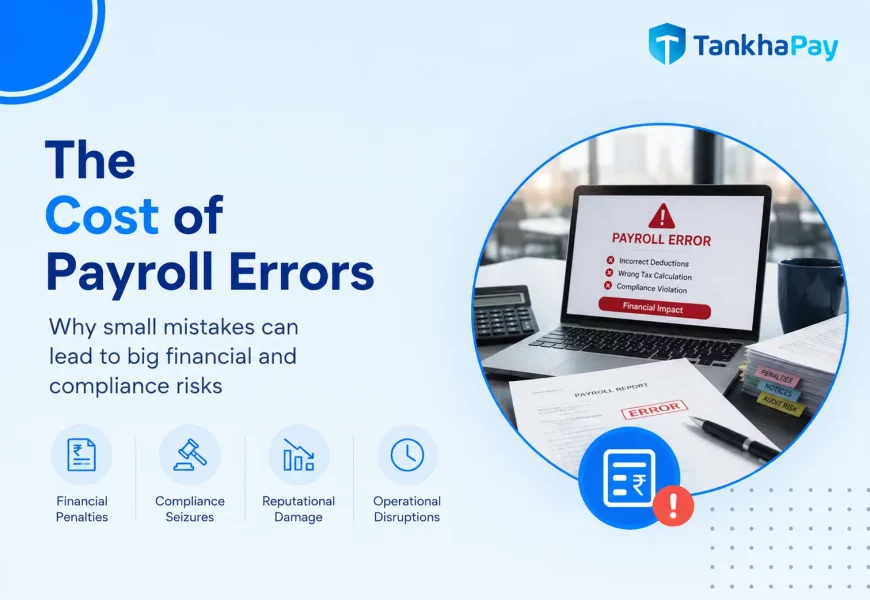
A 30-employee company in Mumbai made one PF calculation error. Wrong wage base. Every month for 18 months. When the EPFO audit arrived, the bill was ₹38 lakh: ₹18 lakh in arrears, ₹2.16 lakh in interest, and up to ₹18 lakh in damages under Section 14B of the EPF Act.
The costs associated with payroll mistakes in India don’t come across as one big, clear mistake. Instead, it’s a dozen small errors, one wrong PF calculation, forgotten payments, the incorrect threshold for ESIC applied to an employee, and many other smaller mistakes that pile up over months unnoticed until the bill comes. And by then, it’s certainly not a small figure.
This guide breaks down exactly what each type of payroll mistake costs your business in 2026, how to calculate your own exposure, and when paying to fix the process is cheaper than paying the penalty.
What Is a Payroll Error?
A payroll error is any mistake in calculating, deducting, or filing employee compensation and statutory obligations, including incorrect salary calculations, wrong statutory deductions, late filings, or misapplication of applicable laws.
Payroll mistakes have a broader definition in India than what most founding fathers assume. These include:
- The calculation of PF based on incorrect wage basis
- Failure to meet PT deadlines in the particular state
- ESIC being extended to an employee above the ₹21,000 ceiling
- Old Form 24Q instead of the recent Form 138 of the Income Tax Act 2025
- Non-compliance of 2-day F&F settlement deadline under Labour Codes
Each of these is a separate statutory violation with its own penalty structure. Each one compounds independently.
5 Most Expensive Payroll Errors in India
1. PF Calculated on the Wrong Wage Base
This became the single most impactful payroll error after November 2025.
The Code on Wages requires basic salary plus DA to be at least 50% of total CTC. If your payroll system was configured before November 2025 and has not been updated, your monthly ECR is wrong and has been wrong for every cycle since.
What it costs: Arrears on PF @ 12% interest p.a. (Section 7Q) and compensation of up to 100% of arrears (Section 14B). In a case involving a company with 30 employees where there was an error of ₹5,000 monthly per employee salary base, the liability stands at ₹38 lakh annually.
Who pays: The employer.
2. TDS Filed on Wrong Forms or Under Old Sections
The Income Tax Act 2025 was made effective from April 1, 2026. With regards to TDS on salary, Section 192 got superseded by Section 392(1). The quarterly reporting form number is Form 138 and not Form 24Q. The annual certificate form number is Form 130 and not Form 16. Reporting under old sections results in a validation error and puts your accounts in default mode.
What it costs: Interest at 1% per month on TDS not deducted and 1.5% per month on TDS deducted but not deposited. Plus potential prosecution under Section 276B of the old Act (now carried forward under the new structure).
Most payroll software is updated by May 2026, but many in-house spreadsheet setups have not.
3. ESIC Threshold Misapplication
ESIC applies when an employee’s gross salary is at or below ₹21,000 per month. When a salary crosses this threshold, after a raise or a variable payout the employee stops being an ESIC-covered employee. Continuing to deduct ESIC after the threshold is crossed creates a wrong contribution record. Missing coverage for an eligible employee creates a liability.
What it costs: Contribution arrears plus interest, and the employee may have no valid ESIC entitlement during a medical claim, which directly creates a legal and HR risk simultaneously.
4. Professional Tax Applied at the Wrong State Slab
Different states have different requirements for PT. In Maharashtra, it is ₹200 per month, whereas in Karnataka, the charges are on a slab basis. In Delhi, there is no PT. The situation gets complicated in case of remote workers since if an employee works remotely in a state different from your state, then his state’s PT policy will be applicable to him and not yours.
What it costs: It is estimated that the cost is from INR 10,000 to INR 100,000 per violation per state per year (HROne, 2026). If an organization operates in more than one
5. Worker Misclassification
Treating a contract worker, intern, or gig employee as a regular employee or vice versa creates incorrect statutory deductions, wrong tax treatment, and retrospective liability. With remote work blurring employment structures, this is the fastest-growing payroll mistake expense in India.
What it costs: EPF and ESIC backdated contributions, interest, penalties and possible legal labour disputes. The Labour Codes have for the first time covered the social security aspects for gig and platform workers, thus increasing this type of risk exposure.
A penalty for payroll errors in India is imposed by 5 different bodies, which are the Income Tax Department, EPFO, ESIC, State Labour Department, and State PT Authority. Each body has its own penalty structure. The penalties accumulate separately.”
Patron Accounting India Payroll Guide, 2026
Penalties under the 2025 Labour Codes are 10 to 100 times higher than under the old laws for the same violations. If your penalty exposure was calculated before November 2025, recalculate it.
How to Calculate Your Own Payroll Error Exposure
Most founders have no idea what their payroll error exposure actually is. Here is the framework for calculating payroll error impact on your specific business.
Step 1: Find your monthly PF liability Monthly PF liability = (Basic + DA for all employees) × 12%
If your salary structures have not been updated for the 50% wage rule, your PF base is wrong. Multiply the monthly shortfall by 12 for annual arrears, then add 12% interest and up to 100% in damages.
Step 2: Find your monthly TDS exposure Take your total monthly TDS deducted. Any month where this was calculated under the wrong regime, wrong salary component, or wrong section reference adds 1.5% per month in interest for as long as it remains uncorrected.
Step 3: Count your states one wrong PT rate per state per month. If you have 50 employees across 3 states and PT is wrong in two of them, that is a minimum of 24 monthly violations. At ₹10,000 per violation minimum, that is ₹2.4 lakh before interest.
Step 4: Add the hidden costs Payroll mistake expenses do not stop at the statutory penalty. Add:
- HR hours spent on rework: at ₹220 per hour, 22 hours per month of payroll rework costs ₹58,000 per year
- Employee exits from salary disputes: one mid-senior exit costs 6-9 months of their salary to replace
- Audit costs: a professional audit after a notice typically costs ₹50,000 to ₹2,00,000
4 Signs Your Payroll Is Silently Accumulating Errors
Look for these before a notice finds them for you:
- Your salary structures have not been updated since October 2025 The 50% basic wage provision came into effect through labour codes in November 2025. If there have been no changes to CTC templates since then, all your PF calculations have been incorrect.
- You are still using Form 24Q or referencing Section 192 The Income Tax Act 2025 changed these from April 1, 2026. Filings under old references are non-compliant.
- Your PT deduction is the same amount for all employees across all states This is almost certainly wrong. PT slabs vary by state and by income bracket within each state.
- You cannot tell within 10 minutes how many employees crossed the ESIC threshold this quarter If that data is not instantly visible in your payroll system, it is being tracked manually, and manual tracking has a 1 to 3% error rate per cycle.
What Minimising Payroll Errors Actually Costs vs What It Saves
This is the calculation most founders skip.
Minimising payroll mistake expenses by switching to a managed payroll service costs ₹400 to ₹800 per employee per month for full compliance management in India. For a 50-person team, that is ₹20,000 to ₹40,000 per month.
One PF wrong-wage-base penalty for the same 50-person team, compounded over 12 months? Potentially ₹60 lakh or more in combined arrears, interest, and damages.
The penalty does not happen every month. But it only needs to happen once.

Wrapping Up
The cost of payroll errors in India is different from what it was three years ago. This is because the 2025 Labour Codes and Income Tax Act 2025 have resulted in an atmosphere that makes the same error worth ten to one hundred times what it used to be.
The founders who manage to avoid this are not lucky. Instead, they have made the right choice by making it clear that payroll was a monthly activity with legal implications attached to it.
If your current payroll setup cannot tell you, instantly, that your PF wage base is correct, your TDS is filed under Section 392(1), and your PT rates match each employee’s work state, your exposure is growing every month you don’t check.
TankhaPay handles payroll calculations, statutory filings, and compliance management across states so that you are not carrying that exposure.