PwC’s 2025 Global Payroll Complexity Survey gives India a payroll complexity index score of 13.4, placing the country 12th globally in terms of payroll and compliance complexity.
That number needs context. The countries ranked above India, Brazil, France, and Argentina are all known for having among the most complex employer regulatory environments in the world. India being in that company is not a badge of honour. It means the 5 challenges of payroll processing in India are not typical payroll problems. They are compounding, interacting, legally consequential challenges that get more expensive the longer they go unaddressed.
“Payroll issues in India are not only about miscalculations but also about managing 28 state labor laws, fluctuating taxes and employees that insist on getting paid by 12:01 am on the last working day of the month.”
Praveen Teotia, Director of Compliance and Outsourcing, HROne
This guide breaks down the five biggest payroll problems facing Indian businesses in 2026 — with the actual ₹ exposure for each, the 2025–26 regulatory change that made each one worse, and the one fix that addresses the root cause.
What Is Payroll Processing and Why Does It Fail ?
Payroll processing is the cycle of calculating employee compensation, deducting statutory obligations, disbursing salaries, and filing government returns across PF, ESI, TDS, Professional Tax, and Labour Welfare Fund simultaneously, every month within fixed legal deadlines.
The process works in six different regulatory environments in India, through three different government organizations, via 18 different Payroll Tax regimes in the states, and from November 2025 onwards, via a new definition of wages through the Labour Codes. This is not an easy system to work within.
The five challenges below are ranked by the frequency and financial impact most Indian businesses experience, based on industry data and compliance patterns from across the Indian HR technology sector.
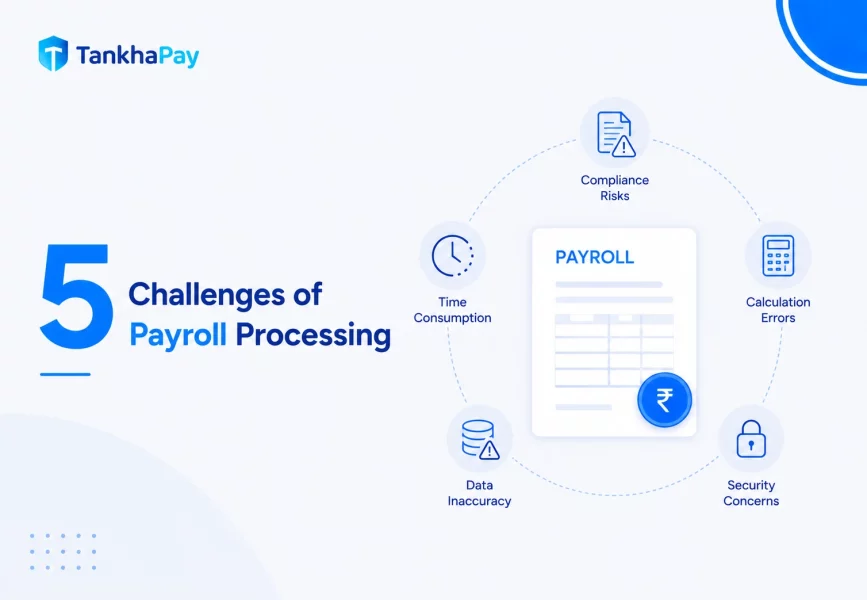
5 Challenges of Payroll Processing
Challenge 1: Statutory Complexity That Just Got More Complex
This is challenge number one for every Indian payroll team in 2026, and it just doubled in difficulty.
In India, there were already requirements for handling six compliance aspects: PF, ESI, TDS, PT, LWF, and minimum wage. On November 2025, the Labour Codes changed the definition of wages – basic salary shall be not less than 50% of CTC. Then April 2026, the Income Tax Act 2025 changed TDS Section 192 into Section 392(1), Form 24Q into Form 138, and Form 16 into Form 130.
The two changes occurred at the same time. In order to achieve payroll compliance for October 2025, both these changes have to be implemented in order to become payroll compliant in July 2026. The payroll managers are informed of one change. The payroll managers are not informed about the other change.
₹ Exposure if unresolved:
- Arrears of PF from incorrect calculation of wages base: Interest @ 12% per year + Damages @ 100%
- If there is an incorrect section of TDS: Penalty of ₹200 per person per day under Section 234E
- For 100 people for 6 months: This can cost you ₹20-40 lakhs
The 2026 aggravator: Both the updates in 2026, the Labour Codes and the Income Tax Act 2025 will necessitate alterations in both salary structure and filing structure. Correction of either will not lead to compliance.
The fix: Ensure in writing from the payroll software company or payroll outsourcing agency that your payroll software is updated for both. Not a simple yes, but Section 392(1), Form 138, and 50% basic wage compliance in particular.
Challenge 2: Data That Arrives From Too Many Places, Too Late
This is the root cause of most payroll calculation issues, but it is almost never diagnosed as such. Businesses treat it as an error problem. It is actually a data architecture problem.
Your attendance data comes from biometrics & HRMS. Your leave approval comes from the manager workflow. Salary revision letters come from HR as Word documents then reimbursement claim comes to employees either through email or expense software. Your increment letter comes from finance. By the time your payroll goes live, your team is manually aggregating six streams of data on a tight schedule.
Aggregation of manual data incurs an error of 1% to 3% per cycle. This means that for 200-employee teams, two to six employees would have incorrect pay or deductions monthly. Such an error when it happens on statutory deductions, such as wrong ESI deductions, wrong LOP deductions, or wrong TDS deductions, creates legal problems.
₹ Exposure if unresolved:
- Calculation of ESI based on incorrect wage of 20 people for 12 months: ₹3.25% * Shortfall in monthly wages * 12
- One incorrect TDS filing for one mid-senior employee: ₹50,000 to ₹2 lakh short annually
- Cost of rework: ₹220/hour * 22 hours/month = ₹58,
The 2026 aggravator: Remote and hybrid work has added state-of-work tracking to the data reconciliation problem. An employee who relocated from Mumbai to Bengaluru mid-year requires a PT regime change, a minimum wage check, and a TDS city tier update, all of which depend on HR data being accurate and current.
The fix: Integration between your attendance system and your HRMS & payroll engine. Data transfer through manual uploads and emails is part of second-generation payroll systems.
Challenge 3: Multi-State Operations With No Unified Compliance Framework
If you have a business running across two states, automatically you are not working with one payroll. With employees in distinct states comes different payrolls, each with its own policies, deadlines, and revisions.
Minimum wages in India are state-specific and revised two to four times a year in most states. Maharashtra revises twice. Delhi revises quarterly. Karnataka revises at irregular intervals. For a business with employees in six states; that is up to 12 minimum wage revision events per year that must be reflected before the effective date, not after.
In addition to minimum wage, 18 states have Professional Tax imposed at varying rates, on varying income bands, and with varying filing periodicities. The LWF threshold for Karnataka was revised to 10 employees down from 50 in 2025. An amendment that brought many more companies under the purview of LWF without any fanfare at all.
₹ Exposure if unresolved:
- Breaching Professional Tax per state: ₹10,000–₹100,000 per violation
- Min. wage underpayment: arrears including fine up to ₹50,000 per violation, plus potential imprisonment under the Labour Codes
- LWF non-compliance in Karnataka post-2025 change: penalties per state act + scrutiny
The 2026 aggravator: State labour departments are now conducting cross-state digital audits. A business registered in Maharashtra can be queried on its Karnataka compliance through inter-department data sharing.
The fix: A dedicated multi-state compliance calendar with named owners per state, just not a single national payroll calendar. [Link: payroll tax India]
Challenge 4: The Silent Compounding Error
This is the most financially dangerous payroll system error in India and the least discussed.
A mistake while configuring the payroll system during its initial setup in terms of PF calculation, incorrect PT slabs, or wrong ESI contribution can go undetected for months because the payroll system will continue to process without any warning sign being triggered by the error. The salaries get paid. The EPFO website will accept the ECR file without detecting the problem. But when it comes to audits or notices from the Income Tax department…
The consequence by then will no longer be one month of arrears; it will be every month that the wrong configuration operates, with interest and fines.
Here is how businesses end up getting a ₹38 lakh fine for 30 employees for 18 months of the wrong PF salary basis. This mistake was not committed 18 times; it was committed just once.
₹ Exposure if unresolved:
- For instance PF is calculated wrong of 50 employees for 12 months: arrears + 12% interest per annum + 100% damages = ₹25-60 lakhs
- Under-recovery of tax from sources by 100 employees for 1 year: 1% interest per month on arrear amount + ₹10,000-₹100,000 fine
- Delay in revising threshold of ESI for 30 employees for 6 months: arrear contribution +
The 2026 aggravator: Government authorities are now using AI-driven cross-referencing of payslips, EPFO data, and Income Tax returns. Silent errors that would have gone undetected three years ago are now being flagged systematically.
The fix: Mandatory Post-Payroll Verification Checklist for ECR Reconciliation, TDS Cumulative Reconciliation, and ESI Eligibility, to be conducted after every cycle, not just year-end.
Challenge 5: Employee Classification That’s Become a Legal Minefield
The Indian workforce in 2026 will comprise permanent employees, fixed-term contract employees, third-party contractors, independent consultants, and gig workers, all within the same company, maybe even performing similar jobs.
The statutory treatment in each case is different. In case of permanent employment: PF, ESI, TDS, and PT are all mandatory. For fixed-term contract employment, the Labour Codes mandate the same statutory benefits as permanent employment up to the tenure of employment, along with gratuity entitlement after one year of service period (as opposed to five years under the 2025 amendments). For third-party contractual workers, the statutory liability for PF and ESI rests on the principal employer.
Getting this wrong in either direction is expensive. Treating a contract worker as an independent consultant reduces their statutory coverage and creates retrospective liability for the employer. Treating an independent consultant as an employee triggers payroll deductions they did not consent to.
₹ Exposure if unresolved:
- Misclassification of contractor (consultant or employee), 10 employees, 2 years: PF arrears and damages and possible prosecution
- Gratuity not paid to fixed-term employee after 1 year: gratuity plus interest under the Payment of Gratuity Act
- Third-party contractor PF default: absorbed by the principal employer
The 2026 aggravator: Labour codes have enhanced the social security benefits of gig workers, and fixed-term employees qualify for gratuity after a year. Classification of any person before November 2025 can be re-examined.
The fix: A classification audit for every non-permanent worker in your organisation, confirmed by legal or compliance review, not by the HR team’s existing assumption.

Wrapping Up
Payroll processing issues in India in 2026 are not merely administrative headaches. There is a defined monetary amount associated with each one of the above-mentioned five issues, and generally, most companies find out about it through a notice, not through an Excel sheet.
The pattern across all five challenges is the same: a problem that started small, ran unchecked, and became expensive by the time it was visible.
TankhaPay’s managed payroll and compliance service handles all five challenges as built-in components, statutory updates are applied immediately; data integration is handled at the infrastructure level; multi-state compliance runs in the background; every cycle includes post-run verification, and worker classification is reviewed against current Labour Code definitions.
What is the biggest payroll processing challenge in India right now?
Statutory complexity from the 2025-26 dual regulatory update. The Labour Codes changed the definition of wages in November 2025, and the Income Tax Act 2025 renumbered core TDS forms in April 2026. Both landed close together, and fixing only one does not achieve compliance.
How much can payroll non-compliance actually cost a business in India?
It scales with headcount and how long an error runs. A wrong PF configuration running for 12 months across 50 employees can cost ₹25-60 lakhs once interest and damages are included, since the exposure compounds for every month the error was live, not just the month it’s discovered.
Why do silent payroll errors cost more than obvious ones?
Because they run undetected for months before anyone catches them. The payroll system keeps processing without a warning, so a configuration mistake made once at setup can generate arrears, interest, and damages across every subsequent cycle before an audit surfaces it.
Do fixed-term contract employees get the same benefits as permanent employees in India?
Largely yes, for the duration of their contract, under the Labour Codes. This includes gratuity after one year of service, down from the five-year threshold that applied earlier, which is a genuine change in exposure for any business using fixed-term contracts.
Is Professional Tax the same across all Indian states?
No. 18 states levy Professional Tax, each with its own rates, income bands, and filing frequency. A business operating across multiple states needs a compliance calendar with a named owner per state rather than a single national payroll calendar.