Picture your HR manager in 1995. He arrives at 7 AM on the last Thursday of the month. A thick salary ledger is open on the desk. Calculator on the right. Two columns of handwritten figures — one for each employee. PF calculated manually at 12%. ESI worked out from memory. TDS estimated from a paper tax slab chart pinned to the wall. Errors caught only when an employee complained.
Imagine payroll in the year 2026 now. The payroll application, which runs on the cloud, completes payroll processing of 300 individuals in less than four minutes. All attendance records are collected automatically. ESI limits are tracked in real-time. TDS is computed according to the updated Income Tax Act 2025; form 138 needs to be completed for the coming quarter, and each payslip is delivered to the individual’s phone before salary credit.
What happened between those two Thursdays is the story of how payroll management software grew from a convenience into a compliance necessity.
What Is Payroll Management Software?
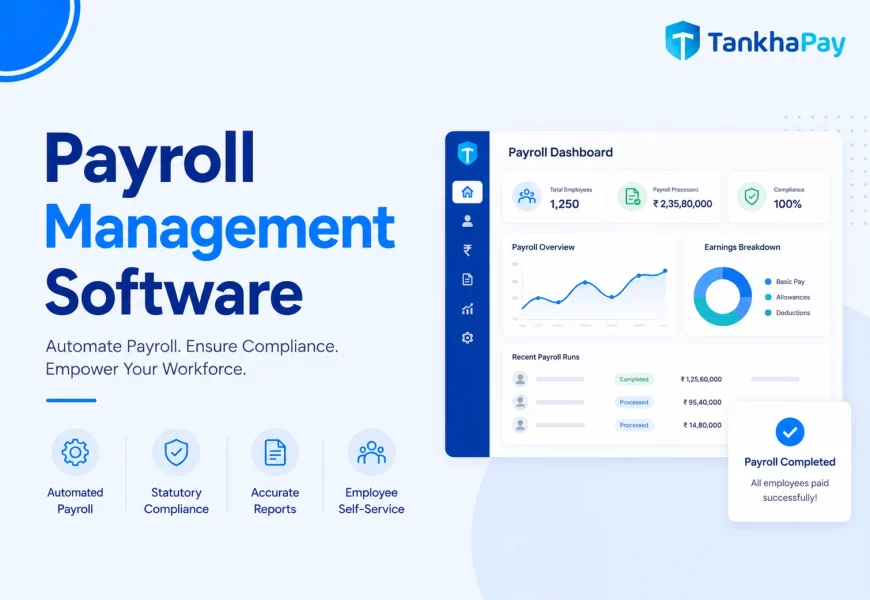
Payroll management software is an electronic medium that helps in automatic computation of salary of employees, deductions from the salary, tax calculations, and submission of compliance reports. In India, a payroll management system takes care of PF, ESI, TDS, Professional Tax, Labour Welfare Fund, salary slips, ECR filing, and return filing of Form 138.
The definition has been widened with each generation. In the year 2000, payroll software meant software for calculating salaries. By 2026, payroll software will mean a regulatory engine handling six separate regulations on multiple government sites at one time.
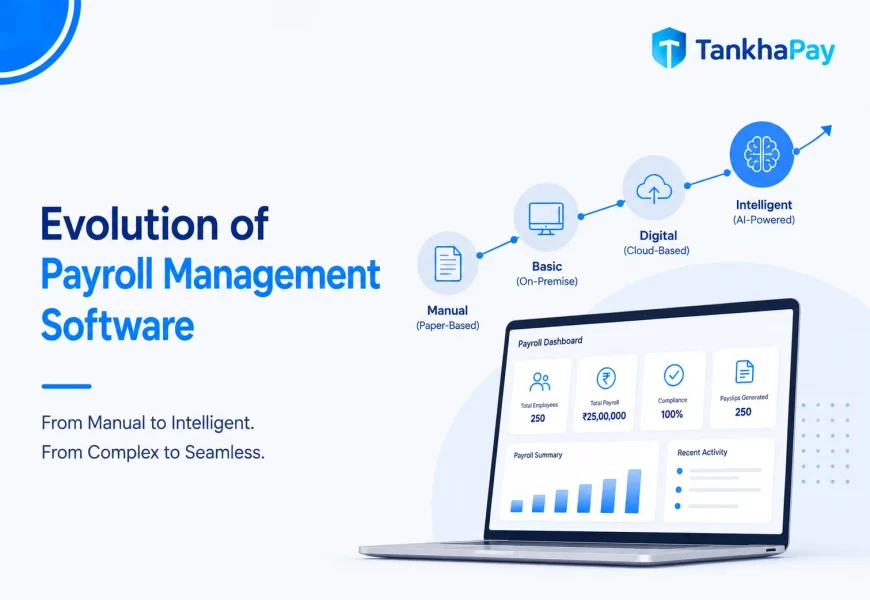
5 Generations of Payroll Management Software in India
Generation 1 — The Manual Era (Pre-2000)
Every business processed payroll by hand. Salary sheets were maintained in bound registers. Calculations were done with mechanical calculators. Statutory deductions were estimated, often incorrectly. Payslips, where they existed at all, were typed individually or hand-filled.
However, the problem was not the amount of effort required – rather, it was the lack of any sort of error-checking at all. If there was ever an error in calculating the PF deductions, then it would go on undetected for months until an audit came or until an employee brought it up.
It worked fine when there were only 20 people working in the business; however, at 50 or 100, it just did not work anymore, and not because the founders made it, but because of the HR personnel who were making the calculations.
What it solved: Salary distribution. What it couldn’t do: Scale, catch errors, or maintain audit-ready compliance records.
Generation 2 — Desktop Software and Spreadsheets (2000–2010)
Microsoft Excel was introduced in India’s HR departments in the early 2000s and quickly became the unofficial software used for payroll calculations in small and medium organizations. Formulas substituted manual calculations. Copy-pasting replaced writing. The process of payroll calculation took minutes instead of days.
Basic desktop accounting software, like Tally, in most cases, extended into payroll for businesses that needed more structure. But these were accounting tools adapted for payroll, not purpose-built for it.
The core limitation: Each change in the statutes involved manual changes in the formula. If the PF rates were altered, then it was necessary to manually alter all relevant cells. In case of any change in the ESI threshold limit, it meant manually replacing the slab.
“Popularized in 2006, cloud-based software became not only a trend but an integral part of payroll. This technology drove the shift towards going paperless and at the same time became easier to use and facilitated remote working due to its convenience.”
Neeyamo, Evolution of Global Payroll Technology
What it solved: Speed of calculation and basic record-keeping. What it couldn’t do: Update automatically for regulatory changes or integrate with attendance systems.
Generation 3 — Purpose-Built Payroll Systems (2010–2018)
The SaaS phase of India resulted in the birth of the first real generation of purpose-built solutions for handling employees’ salaries. For instance, companies such as greytHR (established in 2009) and others have created software that is capable of understanding the Indian payroll structure without the need to change formulas manually.
For the first time, payroll software knew what EPFO required. It could produce ECR files and knew what Form 16 meant. It could accommodate the discrepancy between ESIC contribution time and the monthly payroll period.
This generation made compliance achievable for mid-market India without a dedicated payroll team. A 150-person company could run compliant payroll with one HR manager and the right software.
What it solved: India-specific statutory compliance built into the software. What it couldn’t do: Update in real time when regulations change or work across multiple locations and devices.
Generation 4 — Cloud-First and Mobile Payroll (2018–2023)
Cloud-based payroll software changed the architecture of how payroll worked, from software installed on a single HR manager’s desktop to a platform accessible from any device, at any location, at any time.
This was revolutionary for Indian companies that were looking to expand their business beyond their city limits and state boundaries. A manufacturing unit operating in Pune, Ahmedabad, and Chennai could centralize its payroll and process the Payable Tax slab for each state automatically. An HR executive on tour could process the payroll cycle by just calling up on his cell phone.
The defining feature of Generation 4: automatic compliance updates. When a state revised its PT rates, the cloud platform updated overnight, no IT ticket, no formula change, no manual intervention.
“”67 %of Indian businesses currently utilize payroll automation software, while more than 85 %of business leaders acknowledge that it is a long-term investment for savings.”
KPMG India HR Technology Survey, 2024
Automated payroll services at this stage reduced the processing cycle from three to four days to under an hour for businesses that had fully integrated attendance with payroll.
What it solved: Remote access, multi-location compliance, automatic regulatory updates. What it couldn’t do: Predict anomalies, flag compliance risks before they occurred, or learn from historical data patterns.
Generation 5 — AI-Integrated and Compliance-Automated (2023–Present)
The current features in payroll systems have gone past the basics of doing calculations and submitting them. The use of AI in payroll systems allows one to be able to identify any discrepancies in the payroll before even the cycle commences.
In India specifically, 2025-26 forced this generation’s adoption faster than the market was ready for. The Labour Codes went live in November 2025, redrawing the PF wage base. The Income Tax Act 2025 went live in April 2026, replacing Form 24Q with Form 138 and Form 16 with Form 130. Any payroll software that could not update its compliance engine instantly became non-compliant overnight.
The businesses running Generation 5 platforms absorbed these changes without noticing. The businesses still on Generation 2 or 3 received non-compliance notices.
What it solves: Predictive compliance, AI-assisted anomaly detection, real-time regulatory updates, integrated employee experience. What it is still developing: Full real-time payroll (continuous vs monthly cycles) and advanced AI for compensation benchmarking.
Three Events That Accelerated Indian Payroll Evolution
Three external events pushed Indian businesses through generations faster than market adoption would have done naturally.
Event 1: COVID-19 (March 2020) When India went into lockdown, businesses processing payroll on office desktops had an immediate problem. Cloud payroll providers saw adoption accelerate by 3–4 years in a single quarter. The pandemic proved that payroll could not be tied to a physical location, and businesses that had not migrated to the cloud discovered this the hard way.
Event 2: The Labour Codes (November 2025) Labour Codes brought together 29 Acts under one umbrella. 50% of basic wages was introduced as a new criterion for salary calculations all across India. Any payroll software which had not upgraded its engine for calculation of wages started producing incorrect PF calculations starting November 2025. [Link: payroll management best practices]
Event 3: The Income Tax Act 2025 (April 1, 2026) New section references, a new quarterly returns form, and a new annual return certificate. Four months on and firms with older systems are submitting their returns using wrong section references. Compliance timing does not remain static even as vendors move ahead.
What Modern Payroll Software Must Do in 2026
The evolution of payroll management software has set a new baseline. In 2026, the minimum a business should expect from its automated payroll services platform:
- 50% basic wage compliance — salary structures updated for the Labour Codes automatically
- Section 392(1) TDS filing — not the old Section 192
- Form 138 quarterly returns — not Form 24Q
- Form 130 annual TDS certificate — not Form 16
- Multiple state PT coverage – appropriate slabs for all states where employees work
- DPDP Act 2023 – storage of employee data securely using encryption & role-based access
- ESI ceiling – real-time tracking rather than periodic reconciliation
Any platform that cannot confirm all seven items above is running behind the current generation.

Final Thought
There is an evolution in the software for payroll management in India, where it is a matter of convenience to compliance. The companies who have used the software for payroll management as a method of saving money have always lagged behind when there was a change in regulation, as their system could not cope with changes. The companies who have viewed the software for payroll management as a regulatory instrument have benefited from changes in regulations.
These two 2025-26 modifications – Labour Codes and Income Tax Act – are the biggest structural changes to the Indian payroll system since the turn of the millennium. If your current payroll system has not been certified for compliance with both of these laws, then you run the risk of all past generations who waited too long. The TankhaPay managed compliance service is designed to cope with the current regulatory landscape – not the one existing when your system was last configured.