72% of HR leaders in India are rethinking how they deliver payroll in 2026. Most of them are not doing it because they found a better tool. They are doing it because the tool they bought two years ago is generating more month-end firefighting than it is eliminating.
Payroll software in India is a highly competitive industry. Keka, greytHR, Zoho Payroll, HROne, RazorpayX, factoHR, and Darwinbox all boast their ability to ensure statutory compliance and free your HR team of hours of work. And they do for the right business profile. What’s wrong is that most reviews compare this software based on its features or popularity and not based on whether it will fail the first time your company starts working across three states or onboard a hundred contract employees in one month.
This guide covers the top payroll management tools available in India in 2026, what each one is actually suited for, and critically when none of them is the right answer.
What Is Payroll Management Software?
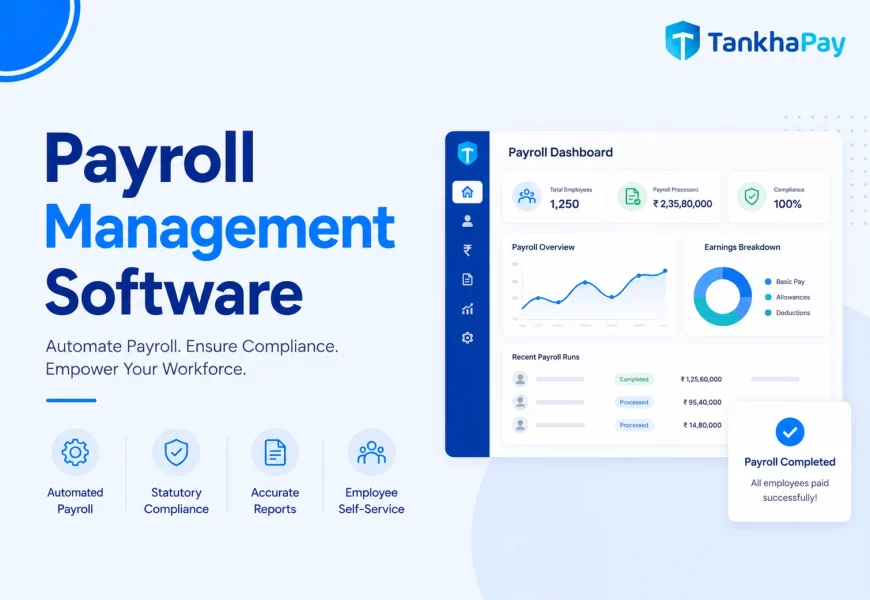
Payroll management software is a digital platform that automates salary calculations, statutory deductions, tax filings, and compliance submissions for businesses. In India, this includes automated computation of PF, ESI, TDS, Professional Tax, and Labour Welfare Fund contributions, as well as generation of payslips, ECR files, Form 16, and returns under the new Income Tax Act 2025.
A good payroll management software will do more than process salaries; it will automatically update itself according to changes in Indian tax laws, file returns automatically to the respective government website, and manage compliance across multiple states automatically.
The wrong one makes your HR manager spend the last week of every month on spreadsheets anyway.
7 Best Payroll Management Tools in India (2026)
1.TankhaPay (Akal Information Systems) — Best for Compliance-First or Multi-State Operations
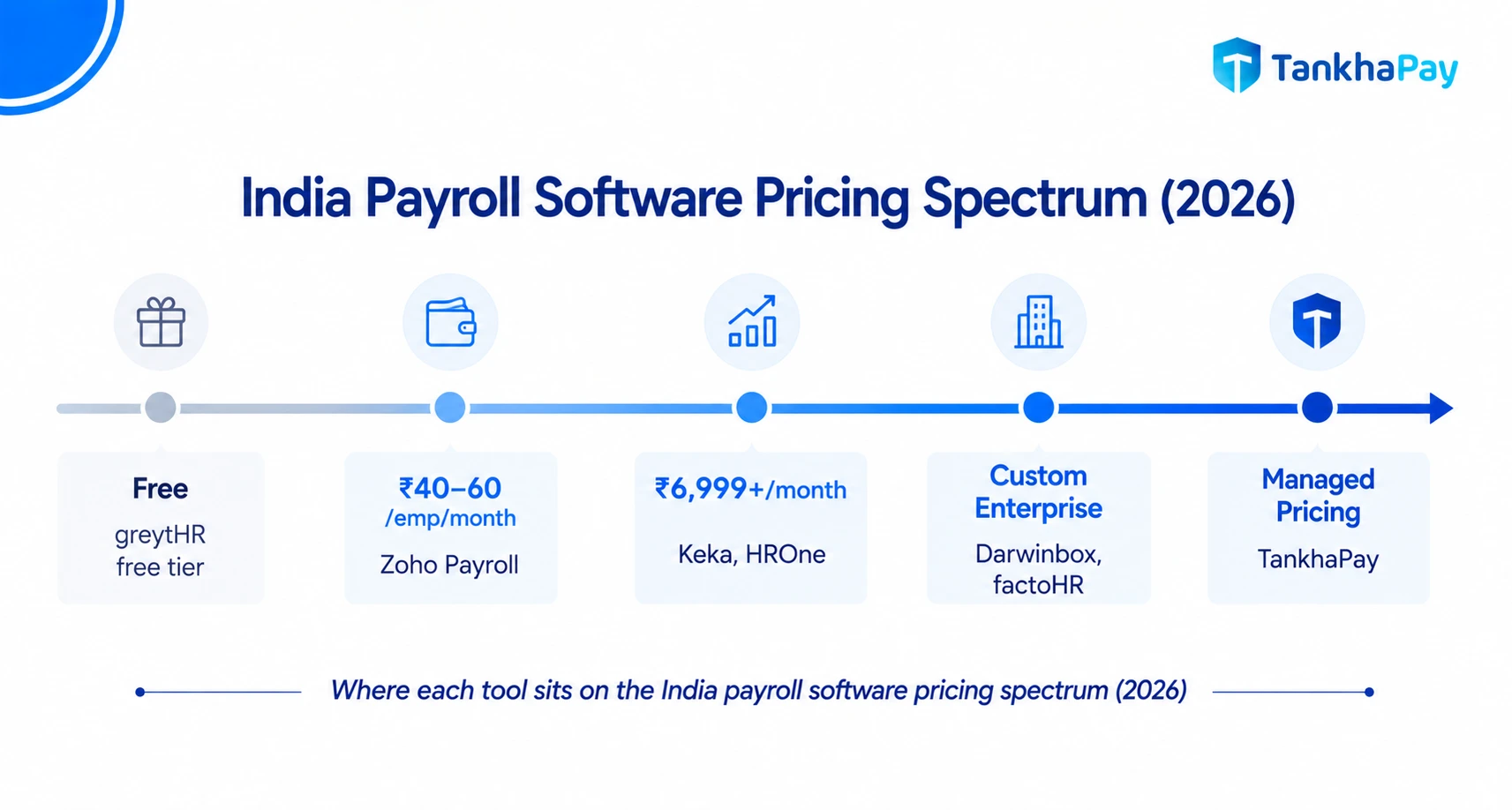
This is not an automated service-based solution. TankhaPay serves as a managed payroll & compliance solution — your payroll will be managed, filed, and monitored through a team which manages PF, ESIC, PT, and even the Income Tax Act 2025 for all states without any configuration from your end. This is the right solution for businesses which are outgrowing software-based solutions or do not want to manage compliance themselves.
2. Keka — Best for Tech and Services Mid-Market
Rated always among the best HRMS software for India by G2 and considered the default choice in the middle market for technology-savvy Indian businesses. Payroll process in one click, good employee self-service and nice user experience to reduce training of HR staff. Price on a module basis, and it may rise. Ideal for: Tech and service companies from 100 to 1,000 employees.
3. Zoho Payroll — Best for the Zoho Ecosystem
₹40 per employee per month (basic) and ₹60 per employee per month (standard) – some of the most transparent pricing available. Native integration with Zoho Books and Zoho People. Excellent statutory compliance. Not made for enterprises. Ideal for: Companies currently using Zoho Accounting and/or HR solutions (usually fewer than 250 employees).
4. RazorpayX Payroll — Best for Startups
Payroll solution with payments first, where disbursement of salaries is integrated with the banking system of Razorpay. Ranked among the best automated compliance payroll solutions for startups in India. No leave management or HRMS included. Suitable for: Startups at early and growth stage using Razorpay for payments.
5. HROne — Best for Mid-Market Workflow-Heavy Teams
A payroll inbox system in which all the processes, such as approvals, claims and payroll closure, are treated as tasks within a single queue. Used by more than 2,000 companies in India. Excellent labor laws of India were covered as standard. Custom pricing only – must discuss with the sales team before knowing the cost. Suitable for: Human resources personnel of companies with 100 to 1,000 employees.
6. factoHR — Best for Manufacturing and Field Workforce
Handles complex shift-based salary structures, contractor payroll, and site-level attendance integration that most HRMS tools struggle with. Best for manufacturing and contract labour payroll. Less relevant for office-only workforces. Best for: Manufacturing, logistics, construction, and field-heavy operations.
7. greytHR — Best for SMBs Under 500 Employees
India’s most battle-tested compliance engine. 23,000+ clients, built for Indian compliance with a genuine free tier for up to 25 employees. Strong on PF, ESI, TDS, and PT accuracy. The interface is functional, not modern. Starts to show limitations above 500 employees. Best for: Growing businesses that want proven compliance without a large per-employee spend.
5 Things to Check Before You Commit
Most buyers compare star ratings. These are the five things that actually determine whether payroll management software works for your business twelve months after go-live.
-
Does it cover every state where you have employees?
PT slabs vary by state. LWF rates differ. If the software you are evaluating does not list your operating states explicitly in its compliance coverage, test it before you buy. A tool covering Maharashtra and Karnataka but not Tamil Nadu’s limited PT applicability will create manual work every month.
-
Is it updated for the Income Tax Act 2025?
The Act substituted the existing section 192 by 392(1), and now Form 24Q is replaced by Form 138 for reporting TDS on salaries. Any software producing form 24Q for salary TDS starting from April 2026 will not be in compliance. Please inquire your vendor directly.
-
What is the actual per-employee cost at your current headcount?
Only one in three software buyers is a successful software adopter, and hidden per-module pricing is one of the most common reasons why. Get the total cost at your current headcount and at 2x your headcount in writing before you sign.
-
Who owns the compliance liability?
You do with self-service software. In case the software gets calculations wrong and you receive a penalty notice, it is sent to you directly. In managed payroll, however, the company bears the responsibility along with you. Find out which system you are getting into.
-
How long does go-live take?
Test the new and existing payroll systems simultaneously when implementing. Those vendors who make implementation seem easy are ignoring data migration issues. Check the average go-live period for your business from the vendor and compare it with other independent third-party reviews.
When You Should Skip the Software Entirely
Best payroll software is not always the right answer. Software assumes your HR team has the bandwidth and expertise to configure the tool, run it correctly every month, and stay current with regulatory changes. Three situations where managed payroll beats self-serve software:
You operate across more than three states. It would take additional hours for verification of multi-state PT/LWF, as well as shops & establishment compliance even with just three states. Theoretically, almost all softwares include this, but practically, your HR manager would still have to check the slab tables from official government sites.
You are between 50 and 200 employees. This is where the level of payroll complexities gets high, although there’s no need for a compliance department here. You’re too big to use a free solution but too small to cope with the misconfigured enterprise HRMS system. Payroll outsourcing for such headcount may be cheaper than employing a half-time payroll professional.
You have already received a statutory notice. Once you have been corresponded with by the EPFO, ESIC, or your PT department, then you already have a problem of statutory compliance at hand. Purchase of a new application will only automate whatever it is that you’ve already been doing wrong. [Link: statutory compliance management]

Final Thought
The best payroll management software available in India in 2026 is excellent tankhapay. All provide reliable compliance with Indian statutory requirements for the relevant business profiles. The issue is not with having the software that offers more features; rather, it is about whether you can implement it effectively within your organization.
Otherwise, or else you already know from experience that software will not solve the issue for you. TankhaPay processes payroll and handles statutory filings through a managed payroll service offering, thus saving you from having month-end be your HR team’s headache.