
The honest answer to “who should use payroll software in India?” is not everyone. And most articles about payroll software benefits skip this part entirely, moving straight to feature lists and pricing.
With your company employing only 12 people, being operated within a state alone, having consistent salary structure, and with someone from your finance department managing the spreadsheet, payroll software may be an expense you can save on right now. This article is not meant for such companies.
It is for the 50-person manufacturer in Pune who is adding contract workers across three states. The 80-person retail chain with stores in Delhi, Mumbai, and Bengaluru. The startup crossed 20 employees last quarter and is not sure what that means for PF registration.
“49% of workers have expressed that they will begin searching for a new job after being subject to at least two payroll errors. Payroll accuracy is not a back-office function; it’s a retention tool.”
Society for Human Resource Management (SHRM), Global Payroll Survey
This is the consequence of payroll being done wrongly. Small business payroll software systems come into existence simply because the companies who require them the most are those who are the least capable of managing payroll themselves.
What Is Payroll Software?
Payroll software refers to an application that automates the process of calculating salaries of employees, deducting statutory allowances like PF, ESI, TDS, PT, and LWF, and issuing payslips through a rules-based system that gets updated when there are changes in Indian laws.
The important difference is that payroll software will always know whenever Karnataka revises their LWF limit. But your spreadsheet doesn’t have any idea about this change.
All the other stuff multi-state compliance, updated definitions of wages as per the Labour Code, Form 138 quarterly returns as per the Income Tax Act 2025, and much more can only be handled with the help of software.
Who Should Use Payroll Software in India?
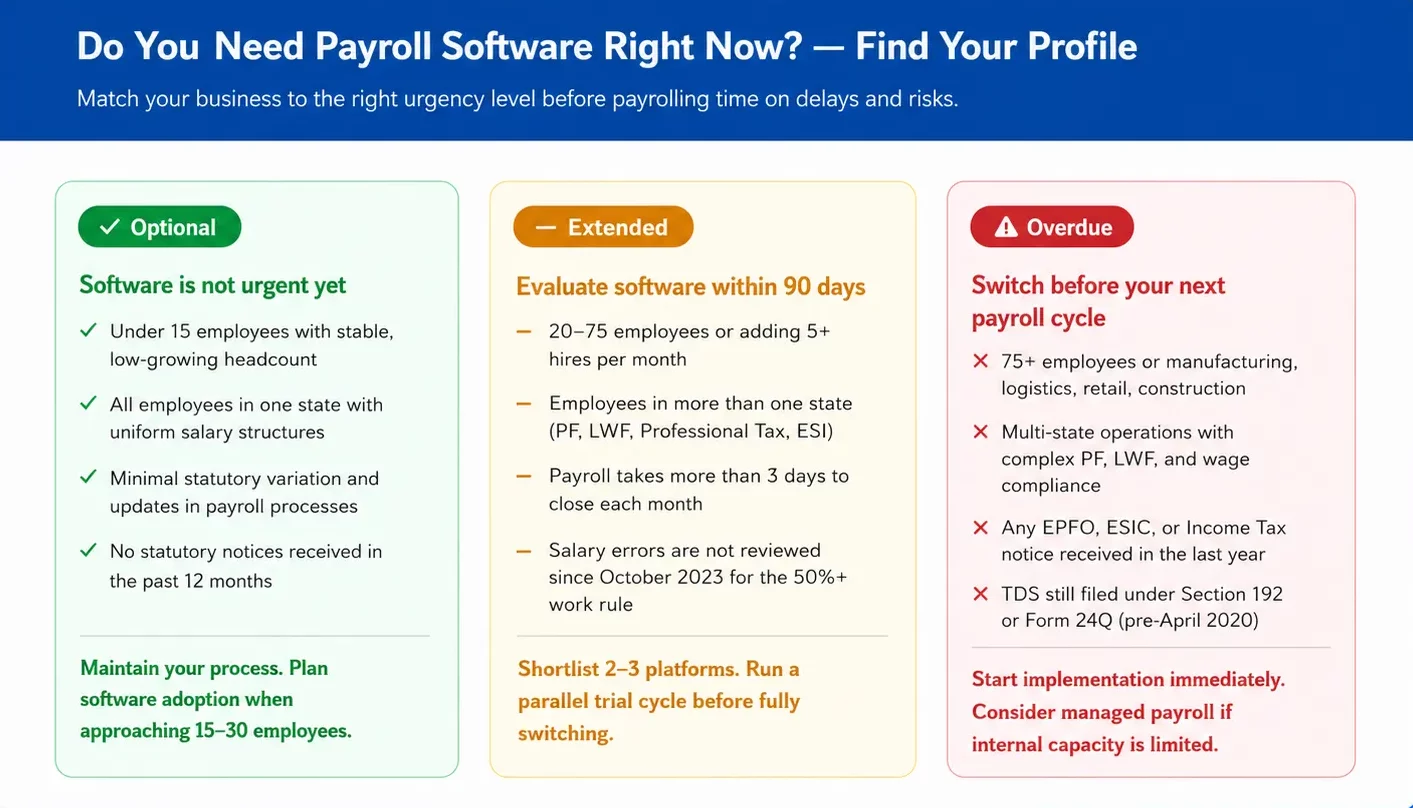
Businesses Approaching or Past 20 Employees
This is the most well-defined trigger for Indian payroll compliance. When you cross the mark of having 20 employees in your organization, PF registration is mandatory according to the EPF Act 1952. ESI coverage is determined. The Labor Code’s 50% basic wage rule applies to all new hires’ salary package.
None of these changes announce themselves. A business that crossed 20 employees in March and has not yet registered with the EPFO is accumulating retrospective PF liability from the date of crossing, not from the date of registration.
Payroll software manages these threshold triggers automatically. A business on spreadsheets discovers them during an audit.
Who this applies to: Any Indian business with 18+ employees and a headcount that is growing, either manufacturing, services, retail, or any other sector.
Multi-State Operations
Each state has its own PT slab, its own LWF scheme, and even its own revision cycle for minimum wage rates. PT slabs in Karnataka and Maharashtra differ from each other. LWF threshold levels and other aspects vary according to the state. In Karnataka, the LWF threshold reduced from 50 to 10 employees without making any announcement in 2025, which affected thousands of firms.
It is impossible to use a single sheet for salary for all states. Application of one set of rules to all leads to miscalculation in all other states.
Payroll software maintains state-specific compliance rules for every registered state, updates them when governments revise them, and applies the correct rules per employee based on their registered work location.
Who this applies to: Any Indian business with employees in more than one state, including remote workers who relocated post-2020.
Industries With Complex Workforce Structures
Headcount is not the only complexity driver. Industry type determines how many payroll variables you are managing simultaneously.
A 40-person manufacturing business with shift workers and contract staff has a more complex payroll than a 100-person IT company with uniform salaries. Complexity, not just headcount, determines when software becomes necessary.
Businesses That Have Received Any Compliance Notice
A single EPFO mismatch notice, an ESIC discrepancy letter, or an Income Tax arrear demand is the clearest possible signal that your current payroll process has a structural error. Not a one-time mistake, it is a structural error that will repeat until the process changes.
India’s payroll complexity is mostly a compliance problem, not a design problem. The businesses that receive notices are almost always paying their employees; they are just not managing the compliance layer correctly.
Once your company has been notified under any law, payroll software does not even become an issue; it is a solution to the problem. The basic mistake that generated the notification will continue piling up with each cycle until the entire system is reformed.
Who Can Wait?
Three business profiles where payroll software is genuinely premature:
Under 15 employees, single state, uniform salary structures. If everyone earns the same amount, there won’t be any issue of multiple states, and if one individual is responsible for maintaining the spreadsheet accurately, manual payroll will be doable despite the risk of errors being present.
CA firms managing client payroll with TankhaPay or equivalent. Software solutions that are created with compliance needs of multi-client payroll management in mind take care of statutory filing issues that generic software doesn’t cover. This is a specialized requirement.
Businesses where managed payroll outsourcing is the right answer. If the headcount and compliance requirements of your organization make software require considerable efforts from HR staff, then maybe self-service software isn’t the right solution for you. For a complete analysis, see Payroll Software vs Payroll Outsourcing Cost Comparison.
Choosing the Right Payroll Software Once You Decide You Need It
Once you have confirmed that payroll software is the right move, the next question is which platform, depending on four things:
- Your industry: Not all platforms can be used across all industries. TankhaPay handles IT, manufacturing, construction, education, healthcare, hospitality, and enterprise through the same platform. The majority of platforms are designed for office-based SMBs.
- Your headcount band: greytHR will suit any business below 500 employees. Keka suits IT and technology companies between 100 and 2,000 employees. The PeopleStrong and TankhaPay platforms are meant for larger and more sophisticated business models.
- Labour Code readiness: The 50% basic wage rule has been in effect since November 2025. Ask every vendor to confirm their system applies it automatically. Not all do.
- Software alone or managed payroll: If your internal team does not have dedicated payroll expertise, the right answer may be a managed service, the same platform, but the provider runs it for you.
Our full comparison of the best payroll software in India 2026 scores 16 platforms on compliance depth, industry versatility, Labour Code readiness, and transparent pricing so you can make this decision with the same criteria that actually predict whether a platform will keep you compliant.

Final Thought
Who should use payroll software in India? A company that exceeds the limit of 20 employees, has operations in more than one state, has a complicated structure of workforce in areas like manufacturing, retail, logistics, construction, or healthcare or has been issued even one compliance notice.
Who should not buy payroll software yet? A business under 15 employees with a simple, single-state payroll structure and someone actively maintaining the compliance process.
Everything between those two points is a judgement call based on your specific headcount, industry, growth trajectory, and internal compliance expertise. The best payroll software in India is the one that matches where your business actually is not where the software vendor’s marketing assumes you are.