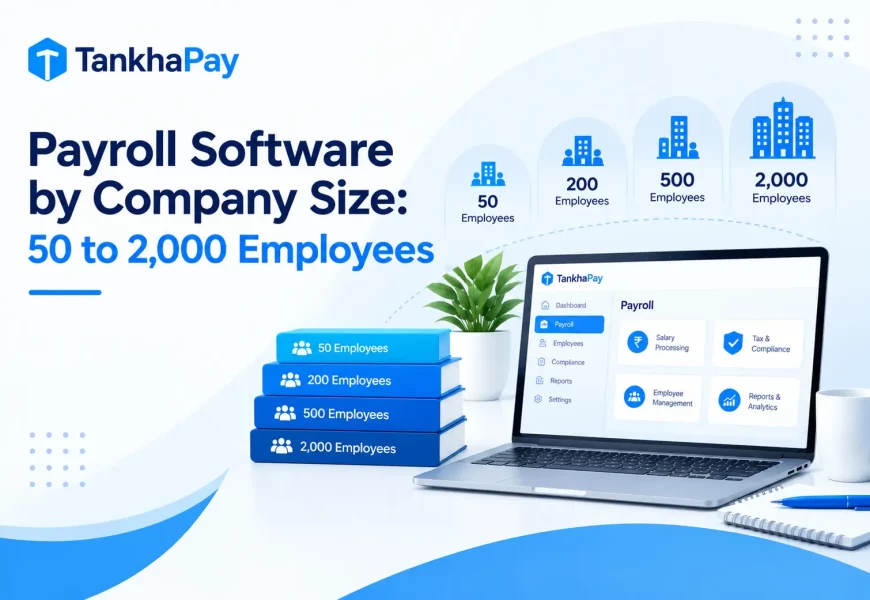
Software for payroll varies depending on the number of people, as each level has its own set of problems. Software for 50 people is concerned with accuracy in processing at the lowest cost possible. Software for 200 people is concerned with clean data coming in from attendance, leaves, and payroll processing. Software for 500 people will be about compliance across states and entities.
How Should Company Size Decide Which Payroll Software You Buy?
The company size needs to be taken into consideration when choosing the payroll system because this will determine where the breakage begins, whether it is cost/speed at 50, data at 200, compliance by geography at 500, or governance at 2,000.
Two companies can spend the same amount each month and get very different results because their problems are not the same size. A tool that suits a 50-person team can stall a 500-person one.
This guide covers what to expect at 50, 200, 500 and 2,000 employees: pricing, must-have features and the mistakes buyers make at each stage. Pricing reflects published Indian guides as of September 2026.
What Does Payroll Software Cost at Different Company Sizes?
The cost of using the software solution to process payroll for employees in India varies between INR 40 and INR 180 per person per month. Three possible billing models are mentioned in published sources: per person per month, fixed fee depending on the range of employees, and annual license fee for the company. Free tiers support companies of 10 to 25 people.
Below is a table that includes the per-employee price band as well as the published sizes band. Bands intersect, so it is up to you to choose a plan based on your state count, modules, and compliance needs.
| Company Size | Likely Pricing Model | Per-Employee Arithmetic (₹40 to ₹180) | Published Band |
|---|---|---|---|
| 50 | Flat plan or per employee | ₹2,000 to ₹9,000 per month | ₹5,000 to ₹25,000 per month (26 to 100 employees) |
| 200 | Per employee or flat by range | ₹8,000 to ₹36,000 per month | ₹15,000 to ₹90,000 per month (101 to 500 employees) |
| 500 | Per employee or custom quote | ₹20,000 to ₹90,000 per month | ₹15,000 to ₹90,000 per month, custom beyond this |
| 2,000 | Annual custom contract | ₹80,000 to ₹3.6 lakh per month | ₹5 lakh to ₹50 lakh or more per year including implementation |
Estimates for large organisations vary. One guide puts annual costs at INR 1.5 lakh to INR 5 lakh, while another reports custom contracts of INR 5 lakh to INR 50 lakh or more. The gap comes from scope: licence only, or licence plus implementation, integrations, and support.
What Payroll Software Does a 50-Employee Company Need?
A 50-employee company needs accurate statutory payroll, attendance and leave linked to salary, and employee self-service, without needing a dedicated payroll team.
It is at this stage where one Human Resources and/or Finance staff member manages the payroll along with other activities. The objective is to create a clean monthly process that has statutory calculations done right, and payslip creation should be done without any manual effort.
Flatten pricing plans beginning from INR 4,950 per month for 50 users can be considered. If you go by per employee price band, it should be between INR 2,000 and INR 9,000 per month. Ensure that the system provides for:
- PF, ESI, professional tax and labour welfare fund calculations
- Gratuity, Form 16 and Form 24Q generation
- Attendance and biometric integration that feeds the pay run
- Mobile payslips and employee self-service
The common mistake here is buying at the sticker price. A low per-employee rate often excludes payroll, biometric integration or implementation.
What Changes When You Reach 200 Employees?
With a total of 200 people in the firm, the risk will be in the flow of information because all the activities concerning attendance, leaves, additions, and subtractions will be performed by various people at once.
Manual hand-offs that worked at 50 start causing errors. Late attendance corrections, mid-month joiners and reimbursements pile up in the days before payroll closes.
Cost arithmetic on the per-employee band gives INR 8,000 to INR 36,000 per month, while the published band for 101 to 500 employees runs INR 15,000 to INR 90,000. Prioritise these capabilities:
- Attendance records that feed payroll for OT, lateness, and reduction in pay
- Approvals processes with role-based access rights
- Cost analysis on departmental basis for finance
- Well-defined process of mid-month joining and leaving
Some vendors sell a flat fee for a range, such as up to 100 employees, then charge more above it. Ask what happens to your price the month you cross the limit.
What Should a 500-Employee Payroll System Handle?
A 500-employee system should handle multiple states or legal entities, complex salary structures and exceptions without depending on one person’s spreadsheet.
Around this size, published guides say workflow customisation, multi-entity management and dedicated support become necessary. Professional tax slabs differ by state, and each legal entity needs its own statutory returns.
The monthly expenditure works out to INR 150 per person for 500 persons without any other charges, which means INR 9 lakhs per annum, against INR 5.4 lakhs for 300 persons. It is linearly related to the expenditure structure per person; therefore, negotiate before you come to a particular point, and not afterward. Take note of:
- Multistate Professional Tax slabs
- Statutory Roll-ups based on legal entities
- Shifts and Overtime management capabilities
- Contract Labour management
The office environment-orientated tools require customizing in case of piece-rate work or shift overtime cases. If you are using the shop floor process, try testing it in the demo version.
What Does Payroll Software Need to Do at 2,000 Employees?
At 2,000 employees, payroll software is a governance system as much as a calculation engine, so control, auditability and implementation quality matter more than price per head.
Contracts move to annual custom quotes, and implementation, migration and integrations become cost lines of their own. Rollout can take from a few weeks to several months, depending on workforce size, entity count and pay rule complexity.
Per person calculations indicate an indicative cap of INR 80,000 – INR 3.6 lakh per month. This is just an example, and real agreements would be negotiated. The requirements in this case involve:
- Multiple legal entities in a single scenario
- Setup of PF and Gratuity trusts as applicable
- Integrations with financial and ERP systems
- Role based access, audit trail and support
- Management of wage definition changes under the labour codes
Run a parallel payroll for at least one cycle before switching. It is the cheapest way to find configuration errors before employees do.
What Hidden Costs Change the Real Price of Payroll Software?
The real price is the total annual cost divided by active employees, not the starting price on a pricing page.
Published guides flag a consistent set of traps. They rarely appear in the headline rate but show up in the first invoice.
- Minimum billable Company Size, so you pay for 100 employees when you have 80
- New joiners are billed for a full month from day one
- Payroll, biometric integration, implementation and premium support sold separately
- Data migration from your current system
Here is a hypothetical example. Vendor A charges INR 60 per employee for 50 employees, plus INR 15,000 for implementation and INR 500 monthly for biometric integration. Its first-year cost is INR 57,000, or INR 95 per employee per month. Vendor B charges a flat INR 4,500 monthly with everything included, which works out to INR 90.
“A payroll tool is cheap only if you never have to work around it.”
Should You Buy Payroll Software or Outsource Payroll?
Buy software if you have in-house payroll expertise, and outsource if the compliance workload or missing expertise is the bigger cost.
There is one publication which states the price range of payroll outsourcing services in India as INR 150 to INR 400 per employee per month. For 200 employees, it comes out to INR 3.6 lakh to INR 9.6 lakh annually. For software, it comes out to INR 96,000 to INR 4.32 lakh.
Outsourcing costs more but shifts calculation and filing work to a provider. It suits companies with no payroll specialist or with complex setups at 500 employees and above. TankhaPay offers both payroll software and payroll outsourcing, so the choice does not have to be permanent.
What Should You Ask Vendors Before You Sign?
Ask every vendor for the total annual cost at your actual company size, including every add-on, before comparing anything else.
Vendors answer the question you ask. If you ask for the starting price, that is what you get.
These questions highlight the holes immediately:
- What is the total first-year cost, including both implementation and migration?
- How does pricing change if the company size moves over a band?
- Is there a minimum billable company size requirement?
- Which states, statutory reporting, and biometrics are supported?
- How long does implementation take at our size and entity count?
- Can we export our data if we leave?
Payroll is only as accurate as the attendance behind it, so also review how attendance management connects to the pay run. If you want payroll inside a wider people platform, look at a full HRMS.
What is the Takeaway on Choosing Payroll Software by Company Size?
Match the software to the problem your company size creates: cost control at 50, data flow at 200, multi-entity compliance at 500 and governance at 2,000.
Compare vendors on total annual cost per active employee, not the advertised rate. Test your hardest pay scenarios in the demo, and plan for the headcount you will have in two years, not today.
If you want help mapping your company size, entities and pay rules to the right setup, Book a Strategy Call with TankhaPay.