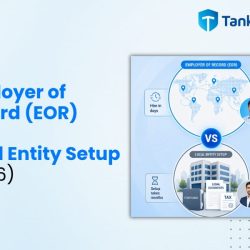
A Contractor of Record (CoR) and an Employer of Record (EOR) solve different problems. The right choice depends on how the person will actually work for you, not just what the contract says.
A CoR generally becomes the contracting party for an independent contractor and can manage agreements, applicable tax deductions, documentation, and payments. An EOR employs someone under an employment arrangement while handling agreed employment administration, payroll, and statutory obligations.
Neither model changes the underlying facts of the relationship. If a role is managed like employment, a contractor agreement alone will not determine the person’s status.
A specialist working independently on defined deliverables may be engaged directly or through a CoR, depending on the circumstances.
What is the difference between a Contractor of Record and an Employer of Record in India?
A Contractor of Record contracts with an independent contractor and manages their tax deduction and payment, while an Employer of Record employs people you direct.
The legal relationship decides which duties apply. A contractor invoices you and runs their own business, with no employee benefits. An EOR’s employee gets an employment contract, payroll and statutory entitlements.
“Contractor of Record” is a commercial service term, not a legal status, so check what a provider actually signs and what it takes on.
Is a Contractor of Record the same as an Agent of Record?
Sometimes. CoR and AOR are commercial terms whose scope can vary between providers. Before choosing one, check who signs the contractor agreement, who manages applicable tax deductions and payments, and what classification review and contractual responsibilities the provider actually offers.
Can an Employer of Record employ my independent contractors?
No. An EOR employs people, and a real contractor stays self-employed. Searches for an EOR for contractors usually mean a CoR or AOR service.
How does India decide whether someone is an independent contractor or an employee?
The following indicators may warrant closer review, but none determines employment status on its own. Consider the full working relationship, including the level of control, integration into the business, remuneration, financial independence, and the nature of the work.
Signs that point towards employment:
- Fixed working hours set by you
- Your equipment, systems or email address
- Daily supervision or staff-style reporting
- Working for you alone
- An open-ended role that mirrors a staff job
Contractor or employee? Consider how the work is organised
Imagine hiring a designer to deliver a defined brand identity. The designer determines their own working method, agrees on deliverables, and operates an independent business. That arrangement may support contractor engagement.
Now consider a designer who works fixed hours under a manager’s daily direction, performs an ongoing internal role, and has little independence over how the work is organised. That arrangement warrants a closer employment-status review.
These examples illustrate the distinction, not a legal test. The actual classification depends on the complete relationship and applicable law.
There is no simple three- or six-month threshold that, by itself, establishes independent contractor status. The duration of an engagement is only one consideration; the actual working relationship and applicable legal tests matter more.
Workers supplied by a labour contractor fall under separate contract labour rules. The four Labour Codes, in force since 21 November 2025, consolidated 29 central laws, so check that any guidance you rely on is current.
How do I choose between direct contractor engagement, a Contractor of Record and an EOR?
Start with how the person will really work, then decide how much of the contracting and compliance work you want to carry yourself.
Direct engagement can be enough for a real contractor on a clear scope, if your team can handle contracts, tax and invoices.
A CoR suits cases where you want a local contracting party and a classification review before signing. An EOR fits roles that are employment in practice.
| Factor | Direct contract (contractor) | Contractor of Record (contractor) | Employer of Record (employee) |
| Who signs with the worker | You | The provider | The EOR provider, as legal employer |
| Tax | You, with advice on your obligations | Provider deducts TDS where applicable under Section 393 | Provider runs payroll, salary TDS and statutory contributions |
| IP and confidentiality | You draft the terms; an IP assignment must be in writing | In the provider’s agreement | In the employment contract |
What does each model cost in India?
The fee is only part of the cost, and each model puts the rest in a different place.
Direct engagement costs the contractor’s invoice plus your own legal, tax and admin time. A CoR adds a service fee. An EOR adds employer statutory contributions and a service fee on top of salary.
TankhaPay lists its Contractor of Record and Employer of Record services from $199 per person per month, with final pricing depending on team size and engagement type.
None of these fees includes the cost of a reclassification dispute, which cannot be estimated in advance.
Does a Contractor of Record remove the risk of misclassification?
No. A CoR improves the process around an engagement but cannot change the facts of the working relationship.
A provider can review the arrangement before signing, use a suitable agreement, deduct tax and keep records. If the contractor later works fixed hours under your direction, an authority or court can still treat the relationship as employment.
Depending on the facts, reclassification can bring retrospective contributions, interest and penalties. Ask any provider whether it offers an indemnity, what the limit is and what it expects you to monitor.
When should a contractor become an employee through an EOR?
When the work stops looking like a defined project and starts looking like a job.
Regular hours, direction from your managers, your equipment, exclusivity and an open-ended role are the usual signals.
Treat the change as a new engagement: close out the contractor agreement, issue an employment contract and take advice on the earlier period.
TankhaPay’s Contractor of Record includes a path to its Employer of Record service for this case.
Can I use both a Contractor of Record and an Employer of Record?
Yes, for different people. A company can engage real contractors through one arrangement and employ staff through another, but the same person shouldn’t be treated as both.
Do I need a Contractor of Record to hire a contractor in India?
No, you can contract directly. A CoR is an option when you want a local contracting party, tax deduction and a classification review handled for you.
If you’re unsure where a particular engagement sits, TankhaPay can review it before anything is signed. Request a Risk Assessment.
Should I use an Employer of Record for an independent contractor?
An EOR is designed for employment relationships, not for preserving a genuinely independent contractor arrangement. If the role is employment in practice, an EOR may provide a route to formal employment. If the person remains an independent contractor, direct engagement or a CoR may be more appropriate.