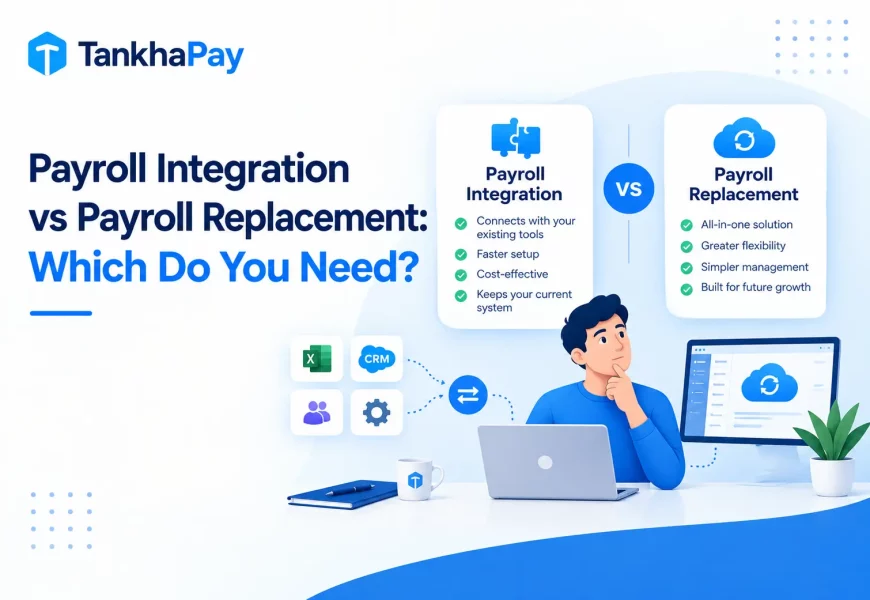
Choose payroll integration when there is no problem with calculations done by your payroll engine but there is a delay or double input or an error in the data sent to the engine. Choose a replacement if there is an issue with the engine, which is unable to calculate according to the statutes, payment terms, scale and support. Identify first the source of your errors since neither a replacement nor a connector can correct the input or calculations.
What is the Difference Between Payroll Integration and Payroll Replacement?
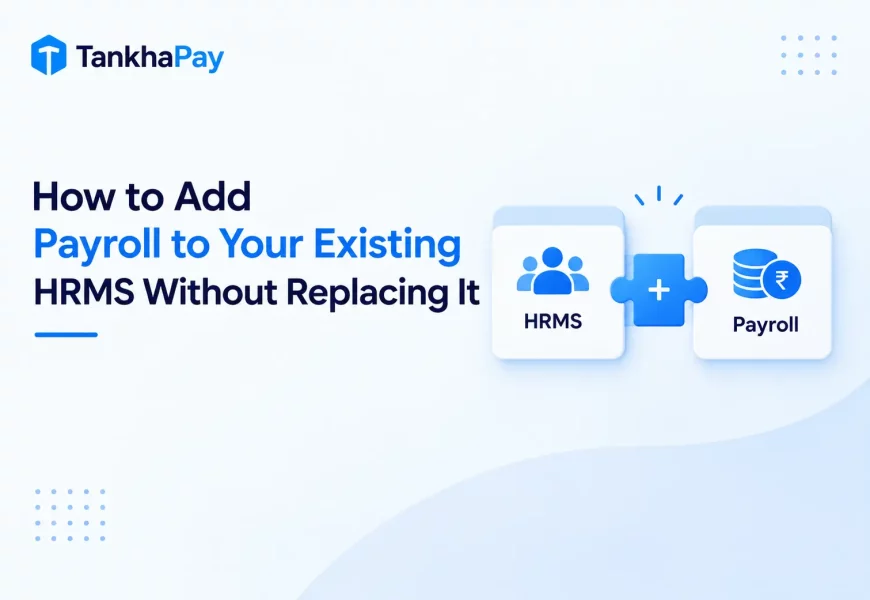
Payroll integration connects your existing payroll system to the tools that feed it, while payroll replacement swaps the payroll system itself for a new one.
Integration is when you keep your payroll engine but correct how information is delivered to it. Employee attendance, HR information, and accounting entries can be delivered automatically rather than entered twice.
Replacement involves changing your engine. This means moving employee information, pay structure, and payment history from the existing platform to a new one. Both methods address a unique challenge, and picking the wrong one wastes months and money.
How Does Payroll Integration Work?
Payroll integration works by linking each source system to payroll through a built-in connector, a third-party middleware tool or an API, so data flows without manual entry.
Triggering for any data transfer could be based either on time, such as when the schedule has been reached, a new hire occurs, or it is a manual synchronization.
The difference among integrations is that there are unidirectional and bidirectional integrations. In the case of the former, the data will be transferred into payroll but not out of it, such as timesheet data, while bidirectional integrations synchronize changes in both directions
The systems most often connected to payroll are:
- HRMS or HRIS records for joiners, exits and salary changes
- Attendance, biometric and time-tracking tools
- Accounting software or ERP for journal entries
- Banks for salary disbursement files
When is Payroll Integration the Right Choice?
Integration is the right choice when your payroll engine calculates and files correctly, but the data feeding it arrives late, duplicated or inconsistent.
The strongest indication is a payroll function that dedicates its effort to reconciling rather than computing. If the final three days leading up to payday are spent fixing attendances and re-entering new employees, then the engine is not your limiting factor.
Integration typically applies where:
- Calculations and filings under statutory law are precise and timely.
- Same set of employee data is entered into multiple systems.
- Matching of payroll totals with bank transfers and ledger posting is done manually by finance.
- Employees have to approach HR to know their leaves balance when the connected system can do it.
- Your present vendor can give you connectors or APIs for your used systems.
Also check whether the problem is technology at all. If inputs are late and approvals are unclear, the fault is process ownership. Neither a connector nor a new platform fixes that.
When Do You Need to Replace Your Payroll System?
You need to replace your payroll system when the engine itself produces wrong results, misses statutory changes or cannot support how your business pays people.
Consistent calculation errors, late filings and penalties are strong signals. So is a system with no prebuilt connections or API, which forces constant manual imports no matter how well your team works.
Replacement is warranted in the following circumstances:
- There are persistent statutory problems and/or penalties
- The supplier does not react quickly enough to changes in legislation
- The system lacks capability to model your pay structures and/or shifts and/or multiple organizations
- There is a lack of connectivity to your tools
- The system cannot scale with your employee base or geographical reach
How Do Integration and Replacement Compare?
Integration fixes how data reaches payroll, while replacement fixes how payroll calculates, and the two differ sharply in risk, disruption and timeline.
The table below compares them on the factors that usually decide the choice. Timelines vary with the number of systems and entities involved, so treat them as ranges.
| Factor | Payroll Integration | Payroll Replacement |
|---|---|---|
| Problem it solves | Manual entry, duplicate data, reconciliation effort | Calculation errors, compliance gaps, scale limits |
| Disruption to payroll | Low, as the existing engine keeps running | High, as the engine changes and data moves |
| Typical timeline | Depends on the number of connections | About 4 to 10 weeks for smaller organisations, longer for multi-entity setups |
| Main risk | Bad or duplicate data flowing between systems | Incomplete migration and skipped validation |
| Validation needed | Test each data flow and failure handling | At least one full parallel payroll cycle |
| Best when | The engine is sound, inputs are messy | The engine is unreliable or outgrown |
What are the Risks of Each Path?
Integration risks come from data quality and ownership, while replacement risks come from migration, validation and timing.
Integration does not clean your data. Duplicate employee records, wrong statutory details or mismatched IDs travel faster once systems are connected. Someone also has to own what happens when a sync fails.
Risks in replacement are greater. They include the following:
- Lack of data migration because the errors in the previous system would be automatically transferred to the new system.
- Absence of parallel running whereby your first live payroll becomes your first test.
- Edge cases such as mid-cycle adjustments, non-standard contribution rates and final settlements
- Mid-year switches, which need year-to-date earnings and deductions imported for every employee
- Accounting export problems that often surface only when finance closes the month
“A new payroll engine fed with wrong data only calculates the wrong answer faster.”
How Do You Decide Which One You Need?
Trace where your payroll errors start: if they begin before the payroll run, integrate, and if they begin inside it, replace.
Bring your past three payroll cycles and identify all corrections. Categorize each error depending on its reason: incorrect data entry, delay in approval, or an incorrect calculation or filing. Most likely, this will help you in your decision-making.
Here is a checklist of questions to ask yourself:
- Are your statutory calculations and filings correct without any manual intervention?
- Does your service provider have the necessary connectors or API?
- Are the same documents entered twice into different systems?
- Does your team have the capability to do a parallel run and variance analysis?
- Is the actual problem late entries and confusing approvals, not the software?
In case the first response is negative, it indicates that replacement has to be carried out. In case the first response is positive while the remaining ones highlight duplicative effort, it means that integration is involved.
Which Integrations Matter Most for Indian Payroll?
For Indian employers, the integrations that matter most are attendance devices, accounting software and statutory outputs, because they carry the most manual work and the most compliance risk.
The legal stack in India consists of PF, ESI, TDS as per both tax systems, gratuity, professional tax in all states and labour welfare fund. Each has its own timeline, format and penalty system, hence making generic solutions for other markets ineffective.
Focus on three connections first:
- Attendance: The attendance record through either biometrics, facial recognition, or geolocation check-ins will go directly into the payroll for payment of days off, overtime, and reduction of payment.
- Accounting: Payroll should post salary, reimbursement and statutory entries to your accounting system with ledger and cost-centre mapping, such as Tally or an ERP
- Banking: Salary disbursement files should generate from the pay run, not from a separate spreadsheet
Also confirm that your software is updated for the labour codes being phased in through 2026, since they change the wage definition. Ask for the integration list before you sign, not after.
What Does a Safe Payroll Replacement Look Like?
A safe replacement follows a fixed sequence: audit the data, define scope, map pay elements, run parallel payroll, reconcile, cut over and then monitor closely.
The majority of replacements fail for known reasons, and the majority are preventable. Payroll is about the exceptions that define it, so the system must uncover those exceptions before your people do.
Do the following:
- Clean up your data. Get rid of the mistakes in the beginning, since it will cost you many times more to do it later.
- Define scope and the cutover boundary. Decide what transfers, such as employee records, historical data, pay elements and payment settings, and what stays in the old system as history.
- Map pay elements and configure statutory settings for every state and entity in scope.
- Run at least one full parallel cycle. Two is better. Compare wages, deductions and net pay line by line.
- Resolve every variance before you go live. Large differences or missing records are a reason to delay.
- Cut over cleanly. Avoid changes in two places at once.
- Stabilise for one to three cycles with tighter checks after go-live.
Data export to first live payroll can take two to four weeks in simple cases, and four to ten weeks for smaller organisations from kickoff to cutover. Complexity scales with the number of disconnected systems you are migrating out of, not only the number of employees. Parallel runs are not a legal requirement, but skipping them is where most migrations fail.
Is there a Middle Path Between Integrating and Replacing?
Yes, many employers consolidate onto one platform so payroll, attendance and HR share a single data model, which removes the need for most integrations.
This suits organisations running HR in one tool, attendance in another and payroll in a third. Each hand-off between them is a place where records drift apart.
A hybrid approach also works for larger groups. Decide which system owns the payroll engine for each country, and let other systems keep the functions they do best. Whatever you choose, name one system of record for employee data.
TankhaPay’s HRMS software, payroll software, and attendance management work as connected modules. If payroll administration is the bigger burden than the software, payroll outsourcing moves that workload to a provider.
What is the Takeaway on Payroll Integration vs Replacement?
Integrate the engine when it is working and the inputs are unstructured, replace the engine when it is not, but fix the process ownership problem first.
Begin with data. Check past payroll cycles, categorize every mistake according to its root cause, and use the trend to guide you toward the solution. Irrespective of which direction you choose, always test the result with a parallel run first.
For a comprehensive review of your payroll configuration, data flow, and risk exposure, request a Risk Assessment with TankhaPay.