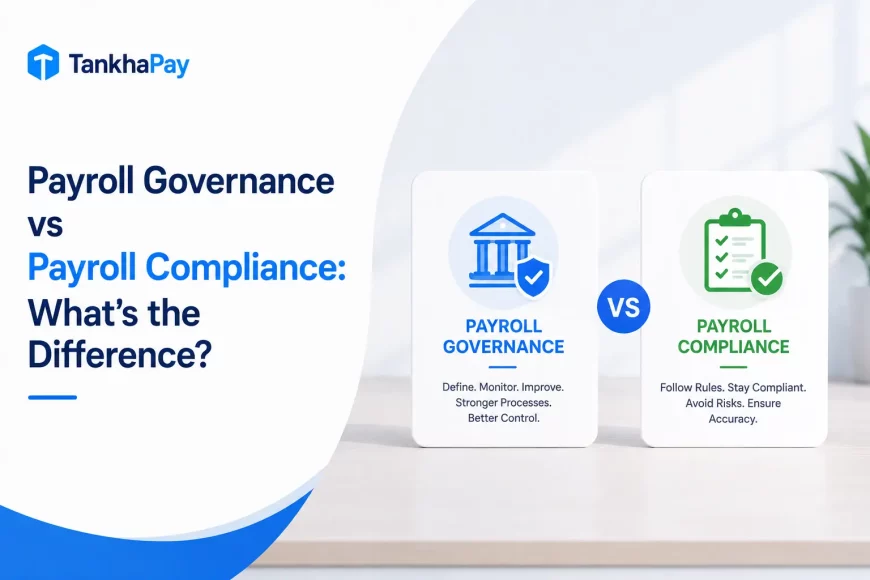
Payroll governance is the set of rules and checks that decide how payroll is run, while payroll compliance is whether payroll follows the law. Governance is the wider system, and compliance is one result it produces.
The two tend to be confused frequently, and this creates serious problems. For instance, imagine a corporation where everything is done according to regulations for the moment. Why? An experienced payroll specialist knows precisely what to do.
However, there is no documented approval procedure. There is no check on the change made. There is no documentation on who made the change. This is poor governance despite the fact that compliance is good. This difference will be seen only when the officer is not around.
What is Payroll Governance?
What constitutes payroll governance is the policy regarding how payroll functions, and not necessarily the accuracy of payroll at any given point in time. Payroll governance includes things like who is allowed to alter a salary, who must authorize the alteration of a salary, who has access to payroll information, error detection, and documentation of those processes in case of personnel changes.
In essence, payroll governance consists of a number of key aspects. The segregation of duties involves ensuring that the person entering a payroll change is different from the one approving it. Approval processes involve having all payroll changes approved before they can go live. Role-based access involves having each user seeing payroll information that is needed to do the work he or she is supposed to do. Audit trails track the history of any payroll change. Reconciliation is an essential aspect of payroll governance involving comparing the payroll results with attendance and accounting information to detect errors in the first place. Exception management deals with identifying any anomalies, such as sudden salary increase, and reviewing them prior to payroll processing.
Governance is what keeps payroll accurate as a company grows, adds new offices, or loses an experienced employee. It is not about whether this month happens to be correct. For more on how these controls work day to day, see TankhaPay’s payroll management best practices.
What is Payroll Compliance?
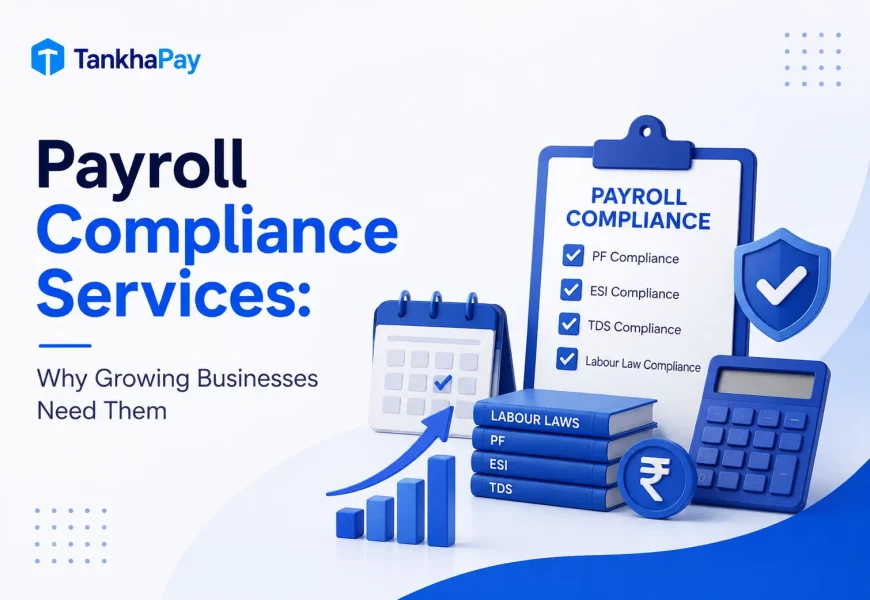
Payroll compliance means meeting the specific laws that apply to how employees get paid. In India, that includes several things: contributions to Provident Fund (PF) and Employees’ State Insurance (ESI). Tax Deducted at Source (TDS) and state-level Professional Tax. Labour Welfare Fund payments, where they apply. Minimum wage and overtime rules. And filing the right paperwork on time.
Compliance also means keeping accurate records. Most of these laws require proof you can produce on demand, not just correct numbers on payday. TankhaPay’s payroll compliance checklist covers the recurring items in more detail.
These rules also change over time. India’s four Labour Codes took effect on 21 November 2025. They reshaped several of the rules above, including how wages and social security contributions are defined. TankhaPay’s guide on how the Labour Codes affect payroll compliance covers what changed in more detail.
Because of this, compliance is not a one-time setup. It needs steady care. For the exact rules that apply to your company, check current government guidance directly. Don’t rely on any single article, including this one. This space moves fast enough that details can go out of date quickly.
Payroll Governance vs Payroll Compliance: At a Glance
It helps to see the two side by side, since they answer different questions. Payroll compliance asks whether you’re following the law right now. Payroll governance asks whether you’ll keep following it as the company changes. The table below breaks both down.
| Factor | Payroll Governance | Payroll Compliance |
|---|---|---|
| Core question | How do we control and manage payroll? | Are we meeting all applicable laws and regulations? |
| Primary focus | Policies, ownership, controls, oversight | Legal and statutory requirements |
| Scope | Wider: the whole control environment | Narrower: specific regulatory obligations |
| Examples | Approval process, segregation of duties, access control, reconciliations, audit trail | PF, ESI, TDS, Professional Tax, minimum wage, statutory filings |
| Ownership | Payroll, HR, and Finance leadership jointly | Payroll and compliance teams, with employer accountability |
| Risk addressed | Fraud, error, inconsistency, loss of institutional knowledge | Penalties, interest, legal exposure, employee disputes |
| Desired outcome | Accurate, controlled, auditable payroll | Correct statutory outcomes, on time, every cycle |
Key Differences, in Plain Terms
Governance is about how payroll gets controlled. Compliance is about whether payroll meets the law. Governance is the wider structure. Compliance is one of the results that structure is meant to produce, along with accuracy, consistency, and records you can trust.
A company can be compliant without strong governance for a while. That usually happens because a few specific people know exactly what they’re doing. But it will not hold up at scale. Individual expertise does not survive people leaving, the company growing, or things simply getting more complicated.
How Payroll Governance Supports Payroll Compliance
The link between them is real, not just an idea. Specific governance controls directly lower specific compliance risks:
| Governance Control | Compliance Outcome |
|---|---|
| Approval workflow for salary changes | Unauthorized or incorrect changes are less likely to reach a payroll run |
| Role-based access to payroll data | Sensitive employee and statutory data stays limited to those who need it |
| Regular reconciliation | Discrepancies between payroll, attendance, and accounting get caught before filing |
| Audit trails | Changes can be traced to a specific user and time if a filing is ever questioned |
| Segregation of duties | No single person can create, approve, and disburse a payment unchecked |
| A defined payroll calendar | Statutory deadlines are less likely to be missed under time pressure |
Each row is a governance mechanism. Each one exists to lower the odds of a compliance failure, not just to make payroll feel more organized.
Payroll Governance Controls Every Organization Should Have
These are the basic foundational elements. And most firms lack at least one or two of these, even though they don’t know it till there is a problem.
- Role-based access: only let people see or edit the payroll and employee data they actually need
- Segregation of duties: the person who enters a payroll change should not be the same person who approves it
- Maker-checker approvals: no payroll update will go through unless it has been validated by another person
- Payroll reconciliation: reconcile the payroll figures with the attendance and accounting data every cycle
- Audit trails: maintain an audit trail that tracks who made changes and when
- Employee master-data change controls: ensure approval is sought before any salary, bank details, or tax-related data is modified
- Exception reporting: identify exceptional scenarios, such as a huge increase in pay, before making the payroll final
- Payroll calendar and deadline tracking: put statutory deadlines somewhere visible, not just in someone’s memory
- Data security: ensure that payroll data is as secure as required by the Digital Personal Data Protection (DPDP) Act, 2023
- Historical record retention: keep old payroll and statutory records easy to find, not just this cycle’s data
What Happens When Payroll Governance Is Weak?
Poor governance manifests itself in daily issues that precede the problem of non-compliance in the payroll process. Payroll calculation mistakes continue to occur. Changes in salary rates occur without any documentation indicating who made the decision to make those changes. Double payments occur or payments go to incorrect recipients. Statutory deadlines are missed amid rushed schedules. Record keeping is difficult to accomplish in an audit request for the records. It takes a longer time to resolve employee salary disputes. Payroll amounts become inconsistent with the financial statement figures. Lean payroll or the HR department becomes increasingly engaged in manual correction efforts. Some of these issues may become compliance problems eventually.
None of these begin as compliance issues. They begin as governance issues of omission: an approval not made and not followed up, a change not recorded and not tracked. Over time, such a minor governance issue turns into a compliance issue.
How Payroll Software Supports Payroll Governance and Compliance
A payroll management system is useful for making these control policies automatic, as opposed to depending on self-discipline alone. Role-based restrictions ensure that only certain personnel have the capability to access the information. An approval process will be involved before the modification is implemented in the payroll. Automated calculations will reduce the chances of errors that come with manually entering numbers. Audit trails document each activity done in the system with a time and a username for all entries made. This ensures that everything can be traced back.
None of this guarantees compliant outcomes on its own. Software supports the framework. It does not replace the governance decisions, correct setup, and ongoing oversight that the framework still needs. For the fuller technical picture, see TankhaPay’s payroll software features guide. If your payroll team still relies on spreadsheets, email approvals, or systems that don’t talk to each other, payroll software can help bring these controls together and make the whole payroll cycle easier to see. It’s worth judging any tool against the governance controls listed above, not just a generic feature list.
Which Matters More, Governance or Compliance?
Neither one can replace the other. Payroll compliance tells you whether payroll is following the law right now. Payroll governance tells you whether it will keep following the law as the company grows, changes staff, or gets more complicated. Strong governance is what makes compliance something you can count on, not something that depends on who happens to be on the payroll team this quarter.
FAQs
What is the difference between payroll governance and payroll compliance?
Payroll governance is the combination of policies, controls, and ownership that is used in managing payroll. Payroll compliance is how payroll adheres to tax and labor laws.
Is payroll governance broader than payroll compliance?
Yes, since compliance is the responsibility of adhering to certain laws and statutes while governance includes the entire control environment where compliance operates.
How does payroll governance help with compliance?
Through reducing the number of problems that may arise as compliance violations through control methods like approvals, reconciliations, and audit trails, which include issues like unauthorized change requests, late filing, and undetected errors.
Can payroll software support payroll governance?
Certainly, but only up to a point. The software could provide standardization of access control, authorization processes, audit tracking, and reconciliations, but it is the supporting structure of governance itself.
Why is payroll governance important for large organizations?
The reason is that compliance requiring a handful of knowledgeable employees is impossible to scale. The need for governance grows as companies grow in size.