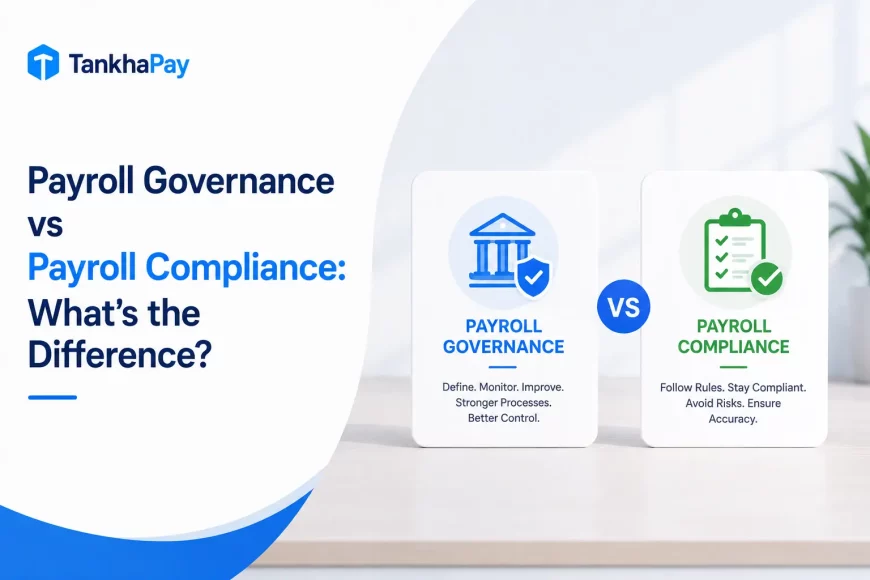
Payroll compliance services in India handle the statutory side of payroll: PF and ESIC deposits, TDS, state-wise Professional Tax, returns and audit records.
They matter more as headcount, locations and payroll complexity grow. That is when internal teams start missing deadlines and making calculation errors they would not have made at a smaller scale
What Is Payroll and Statutory Compliance, and How Does It Differ From Payroll Software?
Payroll and statutory compliance means paying employees correctly while deducting, depositing and reporting PF, ESIC, TDS and Professional Tax by each due date.
It also covers keeping the records you would need to produce in an audit. A good provider tracks changes from bodies such as the EPFO and ESIC and applies them before your team has to notice.
Payroll software automates calculations and generates reports. A compliance service adds accountability for whether each filing was accurate and on time, and the judgement calls that come with it.
Why Does Payroll Compliance Get Harder as a Business Grows?
Compliance gets harder faster than headcount grows, because every new employee, location and rule change adds another thing to track.
More employees mean more transactions and more chances of a calculation error. More states mean more Professional Tax rates, slabs and deadlines.
Rate changes, the four Labour Codes effective from 21 November 2025 and new filing formats add to the load, while the team handling them rarely grows at the same pace. A company that coped with 30 employees in one state can struggle with the same task at 150 employees in three states.
How Do Companies in India Manage Professional Tax Compliance Across Different States?
Companies register in each state where they have employees, apply that state’s slab and due date, and remit through the state’s process, or hand that state-wise work to a payroll provider.
Professional Tax is a state levy, so slabs, due dates and return formats differ, and some states do not charge it at all. A business with staff in three states runs three registrations and three calendars.
Most teams use either a state-wise tracker owned by one person or a provider that applies each state’s slab by employee work location.
Why Do Growing Businesses Use Payroll Compliance Services?
Growing businesses use payroll compliance services for seven reasons, covering financial, operational and people concerns
They are listed below in roughly the order companies notice them.
- Reduce risk of compliance failure. Less risk of missing deadlines and making mistakes since someone’s job will be to monitor them all.
- Avoid penalties and interest. Under Section 14B of the EPF Act, 1952, and its successor provision, Section 128 of the Code on Social Security, 2020, late or short PF deposits attract damages of 1% per month for defaults after 14 June 2024, capped at 100% of the arrears. Interest under Section 7Q (Section 127 under the new Code), 12% per annum, is separate and uncapped. On a ₹100,000 shortfall carried for three months, that works out to roughly ₹3,000 in damages plus about ₹3,000 in interest, and it applies whether the underlying error was a spreadsheet mistake or a missed rate update.
- Keep deductions and filings accurate. Correct PF, ESI, TDS, and Professional Tax calculations are applied consistently, not re-derived from scratch by whoever happens to be running payroll that month.
- Reduce HR and finance workload. Time currently spent tracking deadlines and re-checking calculations goes back to hiring, employee relations, and other work that actually needs a human’s judgement.
- Stay audit-ready. Have organized file history and documentation ready upon demand, not created under pressure during an audit.
- Scale without proportionally scaling headcount. Adding a location or a few hundred employees doesn’t require adding compliance staff at the same rate.
- Improve employee confidence. Accurate, on-time salaries and deductions reduce payroll queries and disputes, which is its own quiet drain on HR time.
One more thing worth knowing if your business has older, unresolved PF cases: EPFO opened a settlement window called VISHWAS, 2026 (notified via G.S.R. 525(E) on 29 June 2026, under the EPF Scheme, 2026), letting employers close out disputes over pre-14-June-2024 Section 14B damages at reduced rates, for six months from the notification date. It doesn’t change the current 1%-per-month rate on new defaults. It’s a separate, time-bound option for anyone sitting on older penalty notices.
When Should You Consider Payroll Compliance Support?
Consider payroll compliance support when several warning signs build up together and last for more than one payroll cycle.
There is no single headcount or revenue threshold. It is usually a combination of signals, such as:
- Payroll errors are becoming more frequent, not less
- Filing deadlines are hard to track across obligations
- HR or finance spends disproportionate time on payroll compliance specifically
- Headcount is growing quickly
- You operate across multiple states with different Professional Tax rules
- Compliance now depends heavily on one or two people
- Recent regulatory changes have been difficult to monitor and apply
- Audits or compliance reviews are becoming more frequent or more demanding
None of these alone forces a decision. Two or three together are a reasonable signal that the current setup has outgrown its capacity.
Are There Payroll Services That Handle PF and ESIC Compliance So You Don’t Need In-House Specialists?
It is not an either/or proposition of being in-house or outsourced. It depends on which one suits your current level of complexity. Below is the table showing who carries the burden of each.
| Factor | In-House | Payroll Compliance Services |
|---|---|---|
| Internal workload | Full ownership | Reduced to review and oversight |
| Compliance monitoring | Your team tracks every change | Provider tracks changes across obligations |
| Scalability | Limited by team capacity | Built to absorb growth |
| Expertise | Depends on who you’ve hired and retained | Specialist, dedicated focus |
| Filing management | Manual tracking and submission | Managed and monitored |
| Audit preparation | Reconstructed when needed | Maintained on an ongoing basis |
| Dependency on specific staff | Often high | Lower, spread across a provider team |
| Cost | No service fee, but real internal time and risk | Service fee, offset by reduced internal time and error risk |
In-house management works when the team is capable, the workforce is small and single-location, and payroll complexity has not outpaced internal bandwidth.
It stops working well when the factors in the table start slipping. The reason is not that in-house is worse, but that it depends on internal capacity that does not grow automatically with the business.
How Do You Choose a Payroll Compliance Service Provider in India?
Choose a provider that knows Indian statutory law, names who is accountable for each filing, keeps audit-ready records, and publishes its pricing and escalation process.
Providers do not all offer the same scope, and the gap shows up when something goes wrong. Check these points before you sign.
How Do Payroll Providers Handle Automatic Updates for PF, ESIC and Professional Tax Rate Changes?
Good providers track EPFO, ESIC and state notifications, update the rate tables from the effective date, and tell you which pay periods are affected. Ask whether the update is automatic or manually configured, because the two are not the same.
Software changes the calculation. A compliance service adds the person who reads the notification, confirms it applies to you, and answers for the filing.
What Should a Payroll Compliance Provider Offer?
A provider should offer accurate payroll processing, year-round regulatory monitoring, audit-ready records and clear accountability for filings.
- Proven competence in compliance with Indian laws, specifically, and not just payroll processing in general
- Accuracy and consistency in payroll processing as the starting point; there’s no such thing as compliance support without accurate inputs
- Monitoring changes in regulations and rates throughout the year, not only annually
- Audit-ready record-keeping as a standard, not as something done to order
- Clearly defined data security practices for payroll and employee data, following the requirements of the DPDP Act, 2023
- Defined responsibility for any problems with timely and correct filings
- Consistent payroll and compliance reporting; not just data but useful reports
- Clearly defined service level agreement and the procedure for problem escalation
- Transparent pricing with no grey areas
What Is a Practical Next Step if Payroll Compliance Is Taking Too Much of Your Team’s Time?
If your team spends more time meeting compliance deadlines than doing productive HR and finance work, it is time to evaluate managed support.
TankhaPay payroll software covers payroll and statutory compliance for PF, ESIC, TDS and Professional Tax. If you would rather hand over the whole process, see TankhaPay’s payroll outsourcing services.

FAQs on Payroll Compliance Services in India
Quick answers to the questions that come up most when evaluating payroll compliance support:
What are payroll compliance services in India?
Payroll compliance services in India manage the statutory side of payroll: PF and ESIC deposits, TDS, state-wise Professional Tax, returns and audit records. Software calculates the numbers. A compliance service also takes responsibility for filing them correctly and on time.
What is payroll and statutory compliance?
Payroll and statutory compliance means paying employees correctly while deducting, depositing and reporting PF, ESIC, TDS and Professional Tax by each due date. It also covers keeping the records you would need to produce in an audit.
Are there payroll services that handle PF and ESIC compliance so I do not need in-house specialists?
Yes, but you still need one internal owner. The provider handles calculations, deposits and returns. Your team approves inputs such as joiners, exits and pay changes, and reviews what gets filed.
How do companies in India manage Professional Tax compliance across different states?
They register in each state where employees work, apply that state’s slab and due date, and remit through the state’s process, or hand that work to a provider. Slabs and return formats differ by state, and some states charge no Professional Tax at all.
How do payroll providers handle automatic updates for PF, ESIC and Professional Tax rate changes?
Providers track EPFO, ESIC and state notifications, update rate tables from the effective date, and flag the pay periods affected. Ask whether the update is automatic or manually configured, and who confirms that it applies to you.
What does a payroll compliance service typically include?
It typically includes statutory calculations, deposits, return filing, record keeping, regulatory updates and audit support. Ask each provider which of these are included in the base fee and which are extra.
When should a company outsource payroll compliance?
Outsource when errors are rising, deadlines are hard to track, compliance depends on one or two people, or you operate in more than one state. Two or three of these signals lasting more than a payroll cycle is a reasonable trigger.
What are the risks of payroll compliance errors?
Late or short PF deposits attract damages of 1% per month, capped at 100% of the arrears, plus separate interest of 12% per annum. On a INR 1 lakh shortfall carried for three months, that is roughly INR 3,000 in damages and INR 3,000 in interest. Errors also cause audit problems and employee disputes.
How do I choose a payroll compliance service provider in India?
Choose a provider that knows Indian statutory law, names who is accountable for each filing, and keeps audit-ready records. Also check data security under the DPDP Act, 2023, the SLA and escalation process, and whether pricing is published.
How much does payroll compliance support cost?
Cost depends on headcount, the number of states and the scope of service, and most providers price per employee per month. Compare the fee against the cost of internal time and the penalty exposure above.