TL;DR
- Unlike the internal payroll department that manages a single payroll for one organization, the payroll processing by staffing agencies involves multiple contracts where the agency will manage only one payroll process involving different rates, cost centres and statutory risks.
- As per the Occupational Safety, Health and Working Conditions Code, 2020, when staffing agencies operate as contractors, they require licensing when they provide 50 or more contract workers, and that licensing is now done using a single licence that can be used nationally and lasts for five years.
- The principal employer, who is the client company, retains liability for unpaid salaries of a contract worker in case the staffing agency fails.
- A single PF and ESI establishment code can cover every client a staffing company serves, but each client’s contribution has to be tagged and traceable separately for audits and inspections.
- With effect from 1st April 2026, any tax deducted on staffing invoices is categorized as contract payment under Section 393 of the Income-tax Act 2025 (the successor of Section 194C) with a tax rate of 1 to 2%, which had for many years been subject to a dispute over whether the higher rate of 10% applied.
- GST on manning and manpower staffing services attracts 18% GST under SAC 9985 on the total value of the invoice, which includes wage cost, statutory charges, and margin.
- Contract staffing in India generally has a margin of 15 to 35% over the worker’s salary, and this margin must first cover the statutory charges before making any profit.
Why Staffing Payroll Doesn’t Behave Like Regular Payroll
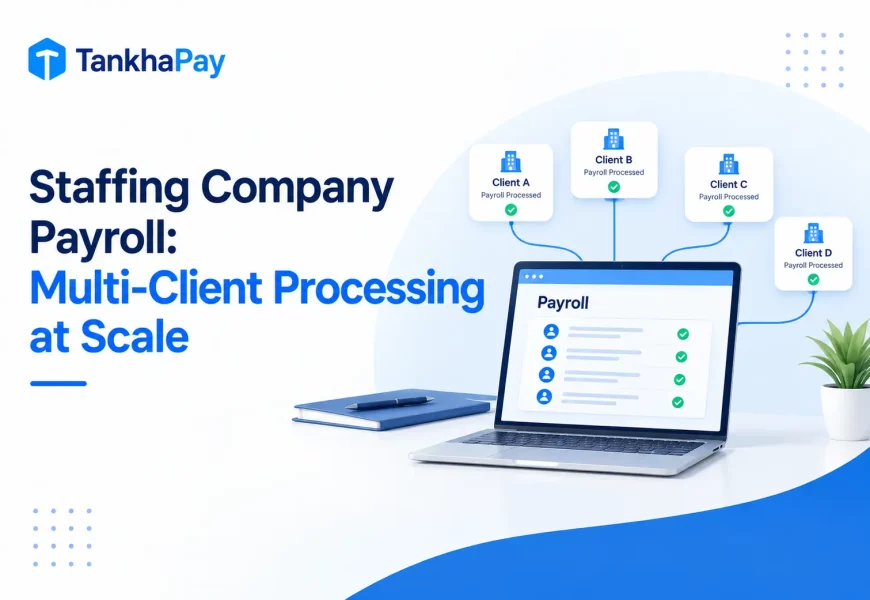
A staffing company isn’t running payroll for one employer. It’s running payroll for its own workforce while answering to a different client for every batch of those workers. That single fact is what breaks generic payroll software built for one company with one set of cost centres.
The size of the problem is no less than monumental. According to the Indian Staffing Federation’s annual report for FY 2025-26, the flexi-workforce covered under its membership comprised 1.91 million employees, increasing by 8% year on year, and the growth being fuelled largely by global capability centers accounting for 73% of the mandate. Each and every single one of those employees figures in someone’s payroll system, earmarked to a particular client, a particular pay rate and a particular statutory framework irrespective of their work profile remaining constant.
An industrial unit does PF logic calculation once at their own unit level. A staffing company which uses labor for industrial clients located in Pune, retail clients in Bengaluru, and logistics clients in Gurugram requires three different professional tax calculations, three different minimum wage calculations, and one payroll process which makes sure that there is no bleed among these three.
Who’s Actually the Employer Here?
From a legal perspective, the staffing firm is the employer for purposes of compliance with the statute. However, this doesn’t mean that the client gets to dodge all liability through outsourcing the documentation process. It is the division of responsibilities that makes things go wrong.
Principal Employer Liability Under the OSH Code
Under the OSH Code, if a staffing company (the contractor) fails to pay a worker’s wages, the client (the principal employer) is directly liable to pay them instead. This isn’t new. It carried over from the old Contract Labour (Regulation and Abolition) Act, 1970, which the OSH Code has now absorbed.
This basically implies that when the client reviews their staffing partners, the client should also review how disciplined the payroll practices of the staffing partner are, as closely as possible to the client’s. This is because if there is any delay in remitting PF contributions or any delay in the salary cycle, the client is at risk of facing this issue in court. TankhaPay’s payroll compliance penalties guide breaks down what that exposure actually looks like in rupee terms.
Payroll Accountability to Both Worker and Client
For the staffing company, this creates a second audience for every payroll cycle. The worker needs to be paid correctly and on time. The client needs a clean, auditable record proving that happened, because the client’s own labour inspection exposure depends on it.
How Many Registrations Does One Staffing Company Actually Need?
Fewer than the old law required, though the exact number still depends on headcount and how many contract workers sit at any single client site. The OSH Code simplified this in two specific ways.
On the client’s side: the Code replaced the old requirement for a separate principal-employer registration at every site with one common registration, covering any establishment employing 10 or more workers.
On the staffing company’s side: a contractor licence is required once it supplies 50 or more contract workers. That licence is now issued nationally, valid for five years, rather than the old system of applying for a fresh licence at every establishment where workers were deployed.
The second reform has greater significance than expected. Instead of requiring a dozen different CLRA licenses for a dozen different client sites, a staffing agency can continue under one license and only update that license based on increasing headcount. Registration under Shops and Establishment law and Professional Tax law at the state level will remain as before, however, because such legislation is a state subject not affected by this consolidation. TankhaPay’s state-wise professional tax guide covers exactly this layer for employers running staff across multiple states.
Do You Need a Separate PF and ESI Code for Every Client?
No. One establishment code can cover the whole staffing company. But every rupee moving through it has to stay traceable to the client that generated it.
This is where staffing payroll actually tends to break down, not at the registration level but at the reporting level underneath it. EPFO and ESIC don’t require a new establishment code per client contract. What they do require, and what a labour inspector or a client’s own compliance team will ask for, is a clean breakup showing which employee’s contribution belongs to which client’s billing cycle. Even a client that has stopped using a staffing company still needs proof its own workers’ dues were remitted correctly while the relationship lasted.
Fixing the problem lies in doing batch coding while processing the payroll, and not afterward. When a payroll run involving 40 clients for the month is unable to be narrowed down to “show me all employees charged to Client X in March,” then the establishment code is both right and wrong.
Is Your Markup Structure Doing Its Job?
Markup isn’t the staffing company’s profit. It’s the buffer that has to absorb every statutory cost first, and only what’s left after that is margin. Getting this sequence backwards is the single most common financial mistake in the industry.
Bill rate (what the client is invoiced) has to cover:
- Pay rate: what the worker actually takes home
- Employer PF contribution, typically 12 percent
- ESI contribution, where applicable
- Gratuity provisioning and, where mandated, gratuity insurance premiums
- Statutory bonus liability
Only what remains after all of that is the staffing company’s margin. In the Indian market, contract staffing typically runs a 15–35% markup over the worker’s salary. A range wide enough that pricing too close to the low end can let the statutory burden quietly eat into what looked like margin on paper.
Let us consider the example of a person earning ₹25,000 per month. The contribution by the employer to the PF account of this individual is ₹3,000 even when considered just for the PF contribution at 12 percent. There will also be an additional component like the ESI when applicable. The cost of the manpower even before considering the margin is above the salary figure of ₹25,000.
Did Tax Treatment for Staffing Invoices Just Change?
Yes, and it’s one of the more consequential compliance changes for this industry in 2026, even though it has nothing to do with labour law.
Old dispute
For years, staffing companies and their clients disagreed with tax authorities over how much TDS applied to a staffing invoice. Payments for contract work attract TDS at 1–2 percent under the old Section 194C. Payments for professional or technical services attract 10 percent under Section 194J. Manpower supply sat uncomfortably between the two.
Some assessing officers treated a staffing company’s sourcing and management function as a professional service rather than a labour contract, exposing clients to demands for the higher rate plus interest and penalties if they’d deducted at the lower one.
What changed on 1 April 2026
Finance Act 2026 settled the argument.The provision of manpower has now been specifically categorized as “work” in Section 393 of the Income-tax Act, 2025 (which succeeds Section 194C). The TDS on staffing invoices will be:
- 1%, where the payee is an individual or Hindu Undivided Family
- 2%, for any other payee, including companies
GST stays where it was: 18% under SAC 9985, charged on the full invoice value covering wages, statutory dues, and margin together, not on the margin alone.
| Item | Position before 1 April 2026 | Position from 1 April 2026 |
|---|---|---|
| Applicable TDS section | Disputed: Section 194C or 194J | Settled: Section 393 (successor to 194C) |
| TDS rate | 1-2% if treated as a contract, 10% if treated as a professional service | 1% (individual/HUF payee), 2% (all other payees) |
| Basis for TDS | Contested by assessing officers case by case | Manpower supply is explicitly defined as “work” |
| GST rate | 18%, SAC 9985 | Unchanged, 18%, SAC 9985 |
| Contractor licence under OSH Code | Per-establishment licence, renewed separately at each client site | Single national licence, five-year validity, amendable for headcount growth |
For a client paying a staffing company ₹10,00,000 in a month: that’s ₹1,80,000 in GST on top, and a straightforward ₹20,000 TDS deduction at the 2% rate, with no further argument about which section applies.
Can Your Payroll System Handle Ten Clients at Once?
Most payroll software is built to run one company’s numbers. A staffing company needs software that can run forty companies’ numbers in one sitting without any of them touching.
Suchita Dutta, Executive Director of the Indian Staffing Federation, has connected the industry’s growth directly to EPFO’s own numbers, noting the sector is a meaningful share of the 18–22 lakh net payroll additions EPFO records nationally each month. Processing that volume through one operation only works if the system can:
- Batch-run payroll by client
- Generate a separate cost report per client without manual reconciliation
- Keep each client’s statutory filings clean even while ten other clients run through the same cycle
What we really need are not such flashy things as dashboards, but something more like client-specific cost centers that aggregate into one unified dashboard for executives, a pass-through or escrow system, where money received from one client’s contribution to PF is segregated from that received from other clients, and a paper trail showing exactly what has been charged, deducted, and remitted by client per month.
Before You Sign the Next Client
Three checks matter more than anything else:
- Ensure that the license includes the increase in manpower. License is updated as per the OSH Code before the execution phase.
- Construct the billing rate from the pay rate upwards. Include the statutory costs upfront before adding the markup, instead of backtracking from the competitor’s pricing.
- Implement tagging on a client-by-client basis prior to processing the first payroll cycle. Not after the initial audit request comes in.
For the wider statutory picture underneath all of this, TankhaPay’s payroll compliance checklist for 2026 covers labour law, PF, ESI and TDS obligations in sequence.
FAQs
Does a staffing company need a separate PF or ESI code for every client?
No. One coding standard can cover all clients serviced by the recruitment firm. What EPFO, ESIC, and the client’s compliance department will actually verify is that the contribution for each employee can be linked to the particular client and billing cycle, not that a different code is created for each client.
How many contract workers trigger a licence requirement under the OSH Code?
When the number of contractors being supplied by the staffing company exceeds 50, the staffing firm will be required to have a license. In case the number of contractors being supplied by the staffing company does not exceed 50, no contractor license is required by the Code.
Who is liable if a staffing company fails to pay a contract worker’s wages?
The client, as the principal employer, is directly liable to pay the worker if the staffing company defaults. This liability carried over from the old Contract Labour (Regulation and Abolition) Act, 1970, into the OSH Code, and it does not disappear just because payroll has been outsourced to a third party.
What GST rate applies to staffing services in India?
Supply of manpower and manning services are liable to service tax @ 18% under SAC code 9985. Service tax is levied on the total invoice amount, which includes salaries, statutory charges, and margin for the manning agency as well.
What is a typical markup for contract staffing in India?
Normally, contract staffing has a margin of 15 to 35% on top of the wage bill. The margin has to cover the entire legal obligation, including PF and ESI contributions (wherever applicable), along with the gratuity provision, before the staffing company can make a profit.
Does a staffing company need a new contractor licence for every client it signs?
No, not since the OSH Code took effect. The Code replaced the old system of a separate licence per client establishment with a single national licence valid for five years, which the staffing company can amend as the total headcount covered under it grows.
Conclusion
A staffing company’s payroll isn’t a big version of a single-employer payroll. Instead, it has its own unique structure in which there is an employer who does the payroll processing for workers under his supervision, but these workers report to a different client for each individual contract. The OSH Code resolved one specific issue: the contractor licence for the entire country replaced site-specific licences. The tax issue from the 2026 year resolved another specific issue: Section 393 solved the TDS issue at 1% to 2% instead of 10%.
Neither of the two reforms affects what causes disruptions of staffing payroll on a daily basis. The liabilities of the client in the OSH Code do not get cancelled out just because the processing goes through a third party. The contribution traceability of the client is what will be assessed by the EPFO, ESIC, and even the client’s compliance department.
A markup that hasn’t absorbed PF, ESI, gratuity and bonus costs before counting as margin isn’t a margin. It’s a shortfall waiting to surface.
Get client-level tagging working before the client count grows. Fixing it across ten clients is a far bigger job than building it in at client one.
To review your staffing licence status, client tagging structure and markup math against these requirements, Book a Strategy Call with TankhaPay’s compliance team.