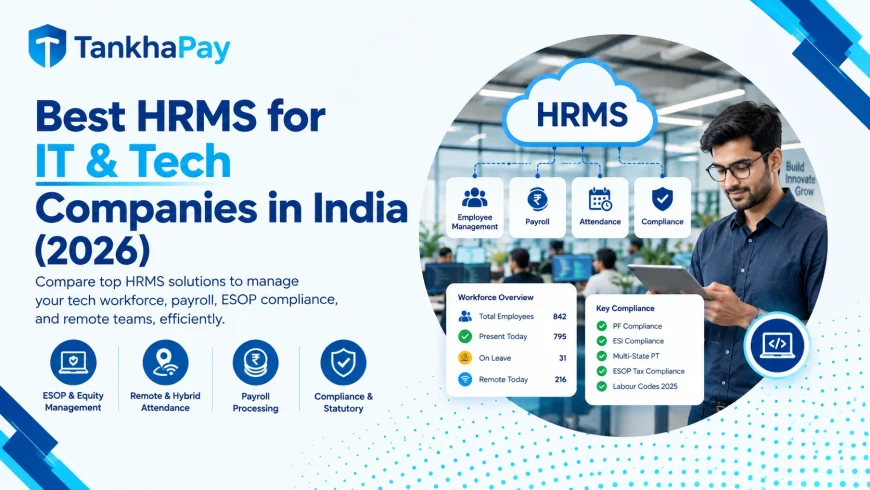
- IT and tech companies do not all need the same HRMS. A services company that bills clients by the hour needs something different from a product company running OKRs.
- The single feature that breaks most often for Indian IT services firms is timesheet-to-billing accuracy, not generic HR admin.
- If your company gives out ESOPs or RSUs, check whether the HRMS can actually calculate the tax on them, not just record that a grant happened.
- Remote and hybrid tech teams need attendance tools that work without office biometric machines.
- TankhaPay is on this list too. We judged our own platform by the same rules as everyone else here, including writing its real limitations.
Quick words you’ll see a lot in this blog
- PF (Provident Fund, a retirement savings fund)
- ESI (a health cover scheme for lower-paid staff)
- PT (Professional Tax, a small state tax on salary)
- ESOP (a promise that lets an employee buy company shares later at a low fixed price)
- RSU (a promise of free company shares later)
- OKR (a simple way to set goals and track if you hit them)
Why Do IT and Tech Companies Need a Different Kind of HRMS?
A generic HR software list will not tell you which platform actually solves an IT company’s real problems, because those problems are not generic.
An HR services or IT-enabled services (ITeS) company built around billing clients by the hour needs deep timesheets and billing accuracy, since a mistake there costs real client money. A product or SaaS company built around a small, highly paid team cares more about ESOP taxation, OKRs, and remote work tools.
This is neither a factory-type compliance issue nor a shop-floor scheduling issue. It is ESOP tax processing, tracking attendance for people working from home across five different cities, paying the correct Professional Tax for an engineer based in Karnataka whose company is registered in Maharashtra, and, for service businesses, making sure billable hours on a timesheet flow automatically into the client invoice.
How Did We Evaluate These Platforms?
Every platform here was judged on what actually matters to an Indian IT or tech company, not on marketing checklists.
The criteria were:
- ESOP and equity management capability
- Professional Tax calculation for workers across different states
- OKR and performance management integration
- Timesheet-to-payroll-and-billing integration, for service providers
- Remote attendance handling without office biometric hardware
- Clear separation between permanent employees and consultants
TankhaPay is included in this list. The same evaluation criteria were applied to our own platform as to every other one here.
Which HRMS Should IT and Tech Companies Compare First?
Start with this table, then read the full profile for whichever platform matches your company type.
“Best For” tells you the kind of company each platform actually fits, not just its general reputation.
| Platform | Best For | ESOP/Equity | Remote Attendance | Billable Hours | Pricing (India) |
|---|---|---|---|---|---|
| TankhaPay | ESOP tax + remote-team compliance | Claimed, unverified | Confirmed (biometric) | Claimed, unverified | INR 60/mo |
| Keka | Product/SaaS, OKR-focused | Not offered | Confirmed (standard) | Claimed (Keka PSA), unverified | INR 90-180/emp/mo (est.) |
| HROne | IT services, billing-focused | Not offered | Confirmed (hybrid) | Claimed, unverified | INR 85-130/emp/mo (50-min) |
| Darwinbox | Large multi-entity enterprise | Not offered | Confirmed (standard) | Not offered | Unpublished; est. INR 200-600/emp/mo |
| Zoho People | Zoho-ecosystem companies | Not offered | Confirmed (standard) | Confirmed (Zoho sync) | INR 48-350/mo |
| Zimyo | Hybrid mid-market, engagement data | Not offered | Confirmed (biometric/RFID/GPS) | Not offered | INR 80-240/mo |
| Pocket HRMS | Small HR team, high query volume | Not offered | Confirmed (biometric-free) | Not offered | INR 2,995/mo (50 users) |
| factoHR | Distributed teams, no hardware | Not offered | Confirmed (biometric-free) | Confirmed | INR 4,999-6,999/mo (50 users) |
| Indian HRM | Unconfirmed positioning | Unconfirmed | Claimed (GPS/geofencing) | Unconfirmed | INR 39-49/emp/mo |
| greytHR | Slack/Jira/Salesforce integration | Not offered | Confirmed (standard) | Not offered | INR 2,495/mo (50 users) |
Confirmed = independently verified beyond the vendor’s own claim. Claimed/unverified = stated by the vendor only, not independently checked. Unconfirmed = not enough public information either way. Pricing marked “est.” or “Unpublished” comes from third-party analyst or comparison-site estimates, not the vendor’s own published rate card, and can vary meaningfully by source. All pricing is sourced from public listings as of publish date and can change; confirm current pricing directly with each vendor before deciding.
What Are the Best HRMS Platforms for IT and Tech Companies in India?
This list is a comparison, not a ranking from best to worst. The right platform for you depends on whether you bill clients by the hour, run OKRs, give out ESOPs, or hire fully remote.
1. TankhaPay
TankhaPay is an Indian-built HRMS and payroll system designed specifically for companies seeking proper compliance with Indian regulations rather than trying to fit them.
Why it’s on this list: TankhaPay’s own IT/software page states that it handles ESOP and RSU taxation, Professional Tax for workers across different states, and contractor payroll.
Key HRMS capabilities: Core employee records, automatic payroll calculation, statutory report filing, geofencing and facial-recognition attendance, performance management, timesheet-based billing and project costing, and Employer of Record service.
IT/tech-specific capabilities: ESOP and RSU perquisite tax computation, multi-state Professional Tax for remote engineering teams, contractor payroll handling, and timesheet-based client billing, all as described on TankhaPay’s own site. Ask for a live demo of each before relying on them.
Best suited for: Indian IT and technology companies that want payroll and compliance handled by a single vendor, especially those running ESOP schemes or hiring across multiple states.
Key strengths: India compliance depth, biometric and geo-fencing attendance confirmed via third-party listings, and a combined HRMS-plus-EOR approach.
Limitations to consider: TankhaPay does not offer the depth of OKR, recruitment, or engagement modules that Keka and Darwinbox provide. It does not handle payroll for other countries. ESOP taxation and moonlighting detection are not verified from any outside source, so confirm both in a live demo.
Pricing: Third-party sources suggest a starting price of INR 60 per user per month, with custom packages above that.
Final consideration: A strong choice if India-specific compliance and ESOP taxation are your core problem, but validate the claims in your own demo.
2. Keka
Keka is an India-first HR platform with real strength in day-to-day product usability, aimed at growing product and SaaS companies.
Why it’s on this list: Keka runs recruitment and applicant tracking, onboarding, attendance and leave, performance reviews, and employee engagement tools natively on one platform. Independent product write-ups describe it as strong on user experience.
Key HRMS capabilities: Recruitment and applicant tracking, onboarding, attendance and leave, shift management, performance reviews, and engagement features including recognition and feedback.
IT/tech-specific capabilities: Performance review workflows built for product teams, a mobile app available in multiple Indian languages, and a separate PSA (Professional Services Automation) module with timesheet-to-invoice billing, useful for IT services and consulting arms.
Best suited for: Product and SaaS companies, roughly 50 to 500 employees, where day-to-day usability and performance management matter more than deep compliance depth.
Key strengths: A strong user interface, wide module range, and a large customer base in India.
Limitations to consider: Keka does not offer Employer of Record services, so you need your own Indian legal entity already. It also has no explicitly named ESOP or equity administration product. Some reviews note inconsistent support and less configuration flexibility as a company grows.
Pricing: Custom, tiered pricing; Keka does not publish exact rates. Third-party sources report roughly INR 90 to INR 180 per employee per month, though base figures vary meaningfully between sources, so confirm directly with Keka.
Final consideration: A good match if you want a smooth user experience for a growing SaaS team, less so if you need ESOP tax processing or cross-country hiring.
3. HROne
HROne is an HRMS provider from Noida with a dedicated product page for IT and ITeS companies managing large hybrid teams.
Why it’s on this list: HROne publishes targeted content for IT and ITeS customers covering hybrid attendance and high attrition. It offers modules for core HR, recruitment, workforce management, attendance, payroll, expenses, performance, engagement, assets, and an HR helpdesk.
Key HRMS capabilities: Core HR, recruitment, attendance and workforce management, payroll, expense management, performance, engagement, asset tracking, and an HR helpdesk.
IT/tech-specific capabilities: Content and features aimed at IT services, SaaS, and BPO/KPO operations, including hybrid-work attendance policies. HROne’s own marketing treats billable-utilization tracking as a priority for IT/ITeS buyers, though a specific “25% weighting” figure sometimes quoted for this could not be independently confirmed, so treat any specific percentage with caution until HROne confirms it directly.
Best suited for: IT service and consultancy firms that need timesheet, attendance, and payroll management working together smoothly.
Key strengths: A dedicated IT/ITeS product page, full module coverage, and high ratings on G2 and Gartner.
Limitations to consider: Pricing is not fully published. The exact depth of the timesheet-to-client-billing feature needs confirming in a demo, since third-party sources describe HROne’s evaluation weighting differently across articles.
Pricing: HROne’s own site does not display pricing directly, but multiple independent sources consistently report INR 85 to INR 130 per employee per month across two tiers, with a 50-user minimum. Confirm current rates with the vendor.
Final consideration: Worth shortlisting if you run an IT services or ITeS company and accurate timesheet-to-payroll processing is your top priority.
4. Darwinbox
Darwinbox is an India-origin HCM (Human Capital Management) platform built for large, multi-entity enterprises, and is currently expanding internationally.
Why it’s on this list: Founded in Hyderabad in 2015, Darwinbox now serves more than 1,000 enterprise clients and raised $140 million in 2026 led by Partners Group and KKR. It runs 15-plus modules covering recruitment, onboarding, performance with OKRs and 360-degree feedback, engagement, and people analytics through its Atlas tool.
Key HRMS capabilities: Recruitment with AI-assisted shortlisting, onboarding, performance management with OKRs, employee engagement through its Vibe social intranet and pulse surveys, and analytics.
IT/tech-specific capabilities: OKR performance management and analytics well suited to large, structured technology businesses with several business units.
Best suited for: Large multi-entity IT businesses, generally 500 or more employees, where scale and analytics matter more than cost per employee.
Key strengths: Wide module coverage, strong India compliance knowledge, and real international growth.
Limitations to consider: Darwinbox has no Employer of Record service, so you need an existing India entity. Reviewers mention slower performance with large data volumes, and it is less established outside Asia than some global competitors.
Pricing: Darwinbox does not publish a pricing page or rate card. Third-party analyst estimates (ITQlick and others) suggest roughly INR 200 to INR 600 per employee per month depending on module depth, plus a separate implementation fee often between $5,000 and $50,000. These are estimates, not vendor-confirmed figures.
Final consideration: A strong choice for a large tech enterprise wanting deep OKR and analytics tools, not a fit for a small team.
5. Zoho People
Zoho People is the HR module inside the larger Zoho business software family, and its biggest advantage shows up only if you already use other Zoho products.
Why it’s on this list: Zoho People integrates directly with Zoho Books and Zoho CRM. Approved timesheets can flow into Zoho Books for invoice creation without further manual data entry. This is a real benefit, but only for a specific group of customers.
Key HRMS capabilities: Core HR, attendance tracking, leave management, employee records, performance appraisal with 360-degree feedback, and expense tracking.
IT/tech-specific capabilities: Native timesheet sync into Zoho Books, useful for a small IT services or consulting firm already invoicing clients through Zoho.
Best suited for: Businesses already running Zoho CRM, Zoho Books, or Zoho Projects, where avoiding custom integration work is the main benefit.
Key strengths: Low pricing, real ecosystem integration, and easy deployment.
Limitations to consider: Outside the Zoho ecosystem, Zoho People is a solid but unremarkable general HR tool. It has no confirmed ESOP or equity administration feature, and reviewers describe the interface as a bit dated.
Pricing: Published pricing varies by plan and source, from about INR 48 to INR 350 per user per month. Verify current figures directly with Zoho, since third-party prices may differ.
Final consideration: Choose this only if you are already inside the Zoho ecosystem. Otherwise, better India-specific platforms exist on this list.
6. Zimyo
Zimyo is an HR platform based in Gurugram, built for hybrid midmarket businesses, with per-user pricing and engagement analytics.
Why it’s on this list: Zimyo runs biometric, RFID, GPS, and geofence-based attendance, along with rotational and night-shift handling and an engagement-survey tool that can flag satisfaction issues early.
Key HRMS capabilities: Attendance management, pre-configured payroll components, engagement surveys, and an attendance rule set built for contract-based employees.
IT/tech-specific capabilities: Engagement-survey data useful for a mid-size hybrid IT office watching for early attrition signals.
Best suited for: A hybrid IT company with 50 to 200 employees that prioritises pricing flexibility and engagement metrics over deep compliance coverage.
Key strengths: Flexible pricing within a published range, and engagement metrics.
Limitations to consider: Zimyo has no confirmed ESOP or equity administration feature and no confirmed contractor-billing or client-invoicing tool. A specific case study describing a Delhi product agency using Zimyo’s engagement data could not be independently confirmed and should be checked directly with Zimyo before being repeated.
Pricing: Around INR 80 to INR 240 per user per month depending on tier, with a minimum of 50 users. Confirm exact numbers on their website.
Final consideration: A fit for a hybrid mid-market IT firm tracking engagement levels, not for ESOP or heavy billing needs.
7. Pocket HRMS
Pocket HRMS is built around cutting the number of repetitive questions an HR team has to answer by hand, using an AI chatbot called smHRty.
Why it’s on this list: smHRty is a real, confirmed AI chatbot, now on version 4.0, that understands regional Indian languages and lets employees apply for leave or check attendance by chatting instead of opening a menu. Pocket HRMS also runs an actual biometric-free attendance option, called Attendance 360, using facial recognition and geofencing.
Key HRMS capabilities: HR and payroll, employee self-service, leave management, and the smHRty AI chatbot.
IT/tech-specific capabilities: Biometric-free attendance for remote IT employees, and multilingual employee self-service through the chatbot.
Best suited for: Companies with 100 or more employees and a small HR team spending too much time on repeat questions about payslips, leave balances, and policies.
Key strengths: A useful, confirmed AI chatbot, and published, transparent pricing.
Limitations to consider: Pocket HRMS has no known ESOP or equity administration module, no known timesheet-to-billing module, and less depth in performance management compared with Darwinbox and Keka.
Pricing: Standard plan starts at INR 2,995 per month for 50 employees (INR 60 per extra employee). Professional starts at INR 4,495 per month for 50 employees (INR 90 per extra employee). Premium is custom-quoted for 100-plus employees.
Final consideration: A smart pick if your HR team is drowning in repeat employee questions, not a fit if ESOP tax or billing integration is your priority.
8. factoHR
factoHR is a Rajkot-based platform with the most detailed, confirmed biometric-free attendance technology on this list.
Why it’s on this list: factoHR’s attendance system lets employees clock in with a selfie and location, or with AI face recognition, without any biometric hardware. It also uses geofencing to keep punch-ins within authorised locations, alongside a timesheet module.
Key HRMS capabilities: Core HR and payroll, attendance and leave management, timesheet tracking, performance management, and statutory compliance reporting for PF, ESI, and Professional Tax.
IT/tech-specific capabilities: Fully verified biometric-free attendance (selfie-and-location punch, AI facial recognition, geofencing) built for remote workers.
Best suited for: Distributed IT companies with no biometric hardware at the office.
Key strengths: The most technically detailed and confirmed biometric-free attendance system in this comparison, plus published entry-level pricing.
Limitations to consider: factoHR has no ESOP or equity administration module, and pricing for its Blue Collar tier, the one built for distributed attendance needs, is not published anywhere. No official list of IT company clients appears on factoHR’s website, so treat claims about such customers elsewhere with caution.
Pricing: INR 4,999 to INR 6,999 per month for 50 employees, plus a per-employee cost. Confirm current figures on their website.
Final consideration: The strongest option here if your team is remote or distributed and you want to avoid biometric hardware entirely.
9. Indian HRM
Indian HRM is an HR service provider with a smaller presence than the other companies on this list.
Why it’s on this list: It appears in HR management software directories such as G2, positioned as offering HR services including recruitment, payroll, and compliance in India.
Key HRMS capabilities: Indian HRM’s own documentation describes one-click payroll with automatic PF, ESI, TDS, and Professional Tax calculation, GPS and geofenced attendance with biometric login through a mobile app, leave management with multi-level approval, and 360-degree performance reviews with OKR tracking. These are the vendor’s own claims, not independently verified by a third party.
IT/tech-specific capabilities: GPS-based remote attendance with live location capture is described on the vendor’s own site, positioned for distributed teams. No ESOP or equity administration feature, and no timesheet-to-billing capability, is mentioned anywhere in their published materials.
Best suited for: Based on vendor-published claims alone, small to mid-size Indian teams wanting payroll, compliance, and GPS attendance at a transparent starting price. Confirm every claim directly before relying on this positioning.
Key strengths: A detailed, specific feature list and a published starting price on its own site, both rare among the less-established names on this list. None of it is independently verified by a third party.
Limitations to consider: Very limited independent evidence exists for this vendor’s product claims, pricing, or IT-sector positioning. Treat this entry as needing direct verification, and get a live demo before considering it seriously.
Pricing: Indian HRM’s own website lists a starting price of INR 39 per employee per month billed annually (INR 49 billed monthly). This is the vendor’s own published figure, not independently verified by a third party, so confirm current terms directly before relying on it.
Final consideration: Included because it was part of the original research list, but we could not verify enough to recommend it with confidence. Confirm everything directly before considering it.
10. greytHR
greytHR is an established payroll solutions provider from Bengaluru with a dedicated, proven product page for SaaS and IT companies.
Why it’s on this list: Unlike a platform that simply happens to be strong on India compliance, greytHR runs a product page stating it supports over 5,000 SaaS and IT organisations, with pre-built integrations for Slack, Jira, Salesforce, and Zoho, plus payroll sync with finance, attendance, and productivity tools.
Key HRMS capabilities: Core HR with automated employee lifecycle workflows, payroll with PF/ESI/Professional Tax handling, attendance and leave management, and a performance management system.
IT/tech-specific capabilities: Out-of-the-box integration with Slack, Jira, and Salesforce built for IT and SaaS tech stacks, plus role-based access suited to fluid engineering team structures.
Best suited for: IT and SaaS firms using Slack, Jira, or Salesforce that want HR data flowing into those tools rather than living separately.
Key strengths: A proven IT/SaaS-specific product page, deep multi-state compliance expertise, and established experience in India.
Limitations to consider: greytHR has no confirmed ESOP or equity administration feature and no confirmed timesheet-to-client-billing tool for service firms. Its IT-specific advantage is real but narrower than a full ESOP or billing solution, and centres mainly on tech-stack integration.
Pricing: greytHR publishes its base pricing directly: the Essential plan is listed at INR 2,495 per month covering the first 50 employees. IT/SaaS-specific plans with the Slack, Jira, and Salesforce integrations are not separately published; request a quote for those.
Final consideration: Worth considering if Slack, Jira, or Salesforce integration matters to your HR process.
How Do You Choose the Right HRMS Based on Your Company Type?
Are You a Services Firm Billing Clients Hourly, or a Product Company Running OKRs?
These two company types need different tools.
A services firm needs timesheets that connect cleanly to payroll and client invoices, since an error there costs client money directly. A product or SaaS company needs OKR tracking and performance management more than deep billing tools.
Is Your Team Fully Remote, Hybrid, or Office-Based?
This changes whether biometric-free attendance is optional or essential.
A fully remote or hybrid IT team needs attendance tools like factoHR’s or Pocket HRMS’s that work through a phone, not a fingerprint scanner sitting in an empty office.
Do You Issue ESOPs?
If yes, check whether the system computes the tax owed on exercising the shares, not just whether it records that shares were granted.
Always ask any vendor making this claim for a demo of the actual tax calculation before relying on it.
Are You Already Using an Ecosystem Such as Zoho, Slack, or Jira?
If most of your company already runs inside one ecosystem, that changes which HRMS saves you the most integration work.
Zoho People fits naturally if you already use Zoho Books or CRM. greytHR’s Slack and Jira integrations matter if your engineering team already lives inside those tools.
Conclusion
There is no single best HRMS for every IT or tech company in India. The right pick depends on what kind of company you actually are.
- Services company billing by the hour: look at HROne for timesheet-and-payroll depth
- Product or SaaS company running OKRs: look at Keka and Darwinbox
- Remote or distributed team: look at factoHR and Pocket HRMS for biometric-free attendance
- Already inside the Zoho ecosystem: look at Zoho People or greytHR
- India-specific compliance and ESOP tax as the core need: look at TankhaPay
To work through your own company type, workforce spread, and ESOP needs against these criteria, Book a Strategy Call with TankhaPay’s team.