Most articles about global payroll in India are written for foreign companies trying to pay employees here. They cover EPFO, TDS, PT, and ESI. India’s compliance framework as seen from outside.
This article is for Indian businesses going the other direction.
You have hired your first employee in Dubai. Or you have sent a team to Singapore for a 12-month engagement. Or you have a remote employee in Japan who was never formally put on a local payroll because “we’ll sort it later”. Global payroll problems for Indian businesses are overwhelmingly outbound problems, and almost no published guide covers that angle directly.
“For one to manage the payrolls of a group in Delhi is easy, but doing it for a group of employees located in London, Manila, and New York is an entirely different ball game because it includes working with foreign tax policies, labor policies, data security issues, and multi-currency technology.” MYND Integrated Solutions, Global Growth Made Simple, 2026
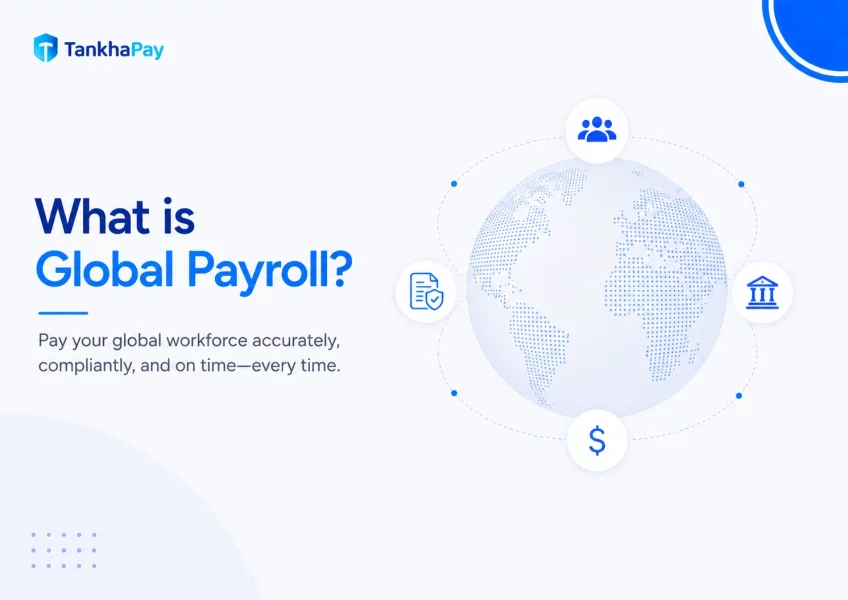
What Is Global Payroll?
Global payroll is the process of calculating employee compensation, making the required tax and statutory deductions, and filing government returns for employees located in more than one country, each according to that country’s specific laws, tax calendar, and filing formats.
Domestic payroll operates under one regulatory framework for payment of salary. However, the international payroll system works in parallel with several regulatory frameworks, including varied tax years, various social security systems, several filing websites, various currencies, and varied deadline dates every month.
Two Directions Every Indian Business Must Understand
Inbound Global Payroll: Foreign Companies Paying Employees in India
A US or European company with an employee in Bengaluru needs to comply with Indian payroll law: PF, ESI, TDS, PT, the 50% basic wage rule under the Labour Codes, and Section 392(1) under the Income Tax Act 2025. They can do this through:
- A registered Indian entity running payroll in-house
- A managed payroll provider handling compliance on their behalf
- An EOR that becomes the legal employer
This is well-documented. Most global payroll literature covers this direction.
Outbound Global Payroll: Indian Companies Paying Employees Abroad
Here’s the difference. An Indian IT firm deploying its team in Saudi Arabia, an emerging tech firm hiring a salesman in the UK, or a manufacturer establishing its plant in Singapore must now manage their payrolls in the respective countries and not just in India.
International payroll services for outgoing employees involve registration with the tax department of the destination nation, social security contributions according to the rules of the destination nation, handling the issue of permanent establishment, and protecting the outgoing employee from becoming subject to the employment laws of the destination nation alone.
The two models are structurally different. Most Indian businesses treat outbound global payroll as a variant of their domestic process. It is not.
What Global Payroll Actually Involves
Six components every global payroll solution must handle:
-
Gross-to-net calculation
Salary, variable pay, and deductions calculated under the destination country’s rules, not India’s.
-
Statutory contributions
Social security, pension, and healthcare, are the equivalent of PF and ESI but different in every country. The UK has National Insurance. Singapore has CPF. Japan has Shakai Hoken. The UAE has no income tax but does have EOS (End of Service) gratuity obligations.
-
Tax filing
Different tax years (India: April to March; UK: April 6 to April 5; USA: January to December; Japan: January to December), different filing portals, different payment deadlines.
-
Currency and payslip localisation
Employees must receive payslips in the local language and format, paid in local currency. An employee in Japan receiving payslips in English with INR amounts is a compliance flag, not just an HR inconvenience.
-
Data security compliance
The GDPR of the EU, PDPA of Singapore, APPI of Japan, and DPDP Act of India regulate cross-border movement of payroll data. An example of data liability in payroll is storing data of EU employees on Indian servers.
-
Year-end compliance
Form 16 in India, P60 in the UK, Form W-2 in the US, and Gensen Chōshū-hyō in Japan. Each requires a different annual reconciliation format issued within a different deadline.
Global Payroll vs EOR vs Managed Payroll — Which Do You Need?
These three terms are used interchangeably. They are not the same.
Managed global payroll: Your company is the legal employer in the destination country. You have a registered entity. The payroll provider calculates, files, and remits on your behalf. You carry the statutory liability.
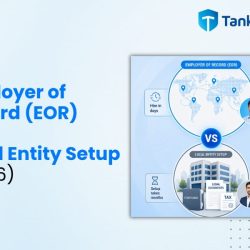
Employer of Record (EOR): The service provider acts as the legal employer in the host country. You control the work process while the service provider handles the employment process. No need for a local entity. Good option for entering the market quickly and/or for testing a new country before investing in an entity. More costly per individual employee than managed payroll, but much quicker to implement.
Global payroll outsourcing: Full-scope outsourcing of payroll across multiple countries — combining both of the above, depending on whether you have a local entity in each country.
5 Things Indian Businesses Get Wrong When Going Global
- Extending Indian employment contracts abroad An Indian employment contract is not valid in the UK, Singapore, or Japan. Employees sent abroad on Indian contracts without local addenda or new local agreements are not protected by the destination country’s employment law, and neither are you.
- Ignoring permanent establishment risk Having employees working in a country can trigger corporate tax liability for your Indian entity in that country even without a registered office. This is called permanent establishment. Payroll is one of the trigger events. Run this by a tax advisor before your first hire abroad.
- Assuming INR disbursement is sufficient Paying a UK employee in INR to their Indian bank account is not legal payroll in the UK. Employees must be paid in the local currency, through local banking infrastructure, with local payslips. This applies even for short-term deployments.
- Skipping social security registration Every country has an equivalent of PF and ESI. CPF in Singapore. Shakai Hoken in Japan. Pension auto-enrolment in the UK. Missing these creates retrospective liability exactly like missing PF contributions in India — but with foreign regulators, often without the informal resolution mechanisms available domestically.
- Taking “we’ll sort it out later” as a strategy The month when you have to pay your first foreign worker is the starting point for complying with the rules. It is much more difficult to backdate registrations and applications when dealing with foreign regulators than it is with India’s regulators. Prepare the payroll system before making the first payment.

Wrapping Up
Global payroll solutions do not represent an improvement upon domestic payroll systems. Rather, global payroll is a fundamentally different operational approach which necessitates knowledge of each individual country and its requirements.
In the case of India-based companies looking to expand their business into the Gulf, Southeast Asian, Japanese, or European destinations, TankhaPay’s Global Talent Mobility takes care of payroll management in the destination countries.