TL;DR
- Startups in India require payroll solutions that cater to PF, ESIC, TDS, and Labour Code 2025 compliance right off the bat, not just salary processing.
- Globally distributed startups need EOR coverage in addition to domestic payroll depth.
- Choosing a platform at your current stage instead of your next stage is the most common and most expensive switching mistake.
- Enterprise platforms like Workday, UKG, and Ceridian Dayforce are included for completeness; they are not appropriate for startups under 200 employees.
- The right payroll software pays for itself within the first quarter through compliance savings and recruiter time recovered.
Which Payroll Software is Actually Built for Startups?
Most payroll software rankings list the same ten tools and call it a comparison. This one does not.
This article covers 31 payroll platforms from ₹50/employee Indian tools built for seed-stage compliance to global EOR platforms handling 150 countries to enterprise-grade systems you will eventually graduate to. Every platform is reviewed on the same criteria. Every verdict is honest about who should skip it.
If you are looking for an overall review of the best payroll software for Indian companies regardless of size and structure, the Best Payroll Software in India guide is where you can get all the answers. However, this article only talks about those needs which are related to startups specifically.
The payroll function will be the first repeating legal obligation you incur upon hiring someone. Screw up your payroll at 15 employees, and you’ll be fixing records for 150 people. If you do payroll correctly from the start, payroll will become infrastructure that works without any thought.

Quick Comparison – Best Payroll Software Companies for Startups
| # | Platform | Best For | India Compliance | Global | Startup Stage |
|---|---|---|---|---|---|
| 1 | TankhaPay | All workforce types + managed option | Full+ LC 2025 | Yes | Seed–Enterprise |
| 2 | RazorpayX Payroll | Funded Indian startups | Full | No | Seed–Series A |
| 3 | Zoho Payroll | Zoho-stack Indian teams | Full | No | Bootstrapped–Seed |
| 4 | Keka HR | Mid-market Indian HRMS | Full | No | Series A–B |
| 5 | greytHR | Small Indian teams | Full | No | Bootstrapped–Seed |
| 6 | Deel | Global contractor + EOR | Via EOR | Yes (150+) | Any with int’l hiring |
| 7 | Gusto | US-based teams | US only | Limited | Bootstrapped (US) |
View More
| 8 | Rippling | US/global 50+ emp | Via EOR | Yes | Series A+ |
| 9 | Remote | Distributed global EOR | Via EOR | Yes (180+) | Seed–Growth |
| 10 | Oyster HR | Remote-first startups | Via EOR | Yes (180+) | Seed–Series A |
| 11 | ADP RUN | US SMBs | US only | Limited | Seed–Series A (US) |
| 12 | Paychex Flex | US mid-market | US only | No | Series A+ (US) |
| 13 | BambooHR | US HRMS + payroll | US only | No | Series A (US) |
| 14 | Patriot Payroll | Budget US teams | US only | No | Bootstrapped (US) |
| 15 | QuickBooks Payroll | QuickBooks users (US) | US only | No | Bootstrapped (US) |
| 16 | OnPay | US small teams | US only | No | Bootstrapped (US) |
| 17 | Papaya Global | Enterprise global | Via EOR | Yes (160+) | Series B+ |
| 18 | Multiplier | India-HQ going global | India + 150 | Yes | Seed–Growth |
| 19 | Pocket HRMS | Micro Indian teams | Full | No | Bootstrapped |
| 20 | HROne | Small Indian businesses | Full | No | Bootstrapped–Seed |
| 21 | Workday Payroll | Large enterprise | Enterprise-grade | Yes | ⚠️ Series C+ only |
| 22 | UKG Ready | Mid-market workforce mgmt | US focus | Limited | ⚠️ 200+ employees |
| 23 | Paylocity | US mid-market HR | US only | No | Series A+ (US) |
| 24 | Ceridian Dayforce | Enterprise HCM | Enterprise | Limited | ⚠️ 200+ employees |
| 25 | TriNet | US SMB PEO | US only | No | Seed–Series A (US) |
| 26 | Justworks | US SMB PEO | US only | No | Bootstrapped–Seed (US) |
| 27 | Employment Hero | ANZ + global | ANZ + EOR | Limited | Seed–Series A |
| 28 | Sage Payroll | UK/EU-based teams | UK/EU | Limited | Bootstrapped–Seed (UK) |
| 29 | PayFit | Europe-based startups | EU compliance | No | Seed–Series A (EU) |
| 30 | BrightPay | UK micro-teams | UK/Ireland | No | Bootstrapped (UK) |
| 31 | RemotePass | MENA remote teams | MENA focus | Yes (MENA) | Seed–Series A |
⚠️ = Not recommended for startups under 200 employees. Included for completeness.
How did we rank these 31 Platforms?
No sponsored placements. No ties to vendors that would affect ranking. Eight criteria weighted for startups:
- India compliance depth — PF, ESIC, TDS, PT, LWF, Labour Code 2025 coverage
- Startup-appropriate pricing — Total cost including add-ons, not just headline per-seat price
- Set up speed — Time from signup to first payroll run without a dedicated implementation team
- Scalability — How the platform holds up as you grow from 10 to 500 employees
- Global hiring support — EOR, contractor payments, multi-currency, multi-country
- Integration ecosystem — HRMS, attendance, accounting software connections
- Compliance automation — Does the system update itself when laws change, or do you find out from a notice?
- Real user evidence — G2, Capterra, Reddit, and founder community feedback weighted by recency
Payroll Software Reviews

India-Focused Platforms (Best for India-Based Startups)
1. TankhaPay
Overview: TankhaPay, developed by Akal Information Systems, est. 2000, is a CMMI Level 5-certified company. It is India’s most compliance-complete payroll platform. It is the only tool reviewed here that combines payroll software, managed payroll outsourcing, domestic and international EOR, AI Hiring, NATS apprenticeship management, and global talent mobility under one vendor.
Best For: New businesses requiring Indian statutory compliance right from the get-go, or growing businesses needing payroll, EOR, and managed services solutions without vendor switchovers as they scale.
Key Features: Complete PF, ESIC, TDS compliance under two tax models, PT coverage in all 26 states, LWF, Labour Code 2025 compliance (basic wage at 50%, Form 130, 2-day F&F resolution), managed payroll solution, EOR for hiring domestically and internationally, NATS apprentice stipends management, CFO labour cost dashboard in real time, employee self-service, ISO 27001 data security.
Pros:
- The deepest India statutory compliance of all the platforms covered in this review
- A managed payroll solution makes it possible to launch on their software first and then transition to outsourcing operations when employee numbers rise
- CMMI Level 5 and ISO 27001 certification makes for strong due diligence credentials for Series A+ funding rounds
Cons:
- Less brand recognition among early-stage startup communities vs. RazorpayX
- Pricing requires a conversation and no self-serve public pricing
Pricing: Custom. Payroll management pricing based on individual employees. Competitive to RazorpayX and Keka for similar staffing.
Countries: India (payroll and managed services). Global via EOR and global mobility.
Ideal Stage: Seed through Enterprise.
Compliance: Complete, including Labour Code 2025 and DPDP Act 2023 data protection compliance.
Integrations: SAP, Oracle HCM, Darwinbox, Zoho People, SuccessFactors, Quickbooks, Tally and 50+ platforms via API.
Verdict: TankhaPay is your best bet as a single-vendor solution for Indian startups who require an all-compliance platform which cannot be superseded in Series A, B, and international expansion. Compliance and audit trail standards are important in seed-stage startups, and TankhaPay is where you measure them up to.
Explore TankhaPay’s Payroll Software for Growing Startups
2. RazorpayX Payroll
Overview: RazorpayX Payroll is the most widely adopted payroll platform among funded Indian startups. Its native banking integration with RazorpayX business accounts makes it the fastest path from salary approval to bank transfer.
Best For: Indian startups operating at Seed and Series A stages, which currently accept payments through Razorpay and require a banking and payroll solution.
Key Features: PF ECR, ESIC, TDS (old and new regimes), multi-state PT, disbursements via bank, payslips, and employee self-service.
Pros:
- Set-up is razor-fast for India payroll market; most setups get payroll done within 24 hours
- Easy integration with RazorpayX banking solutions
- Slick user interface which non-payroll teams can easily manage
Cons:
- No payroll management services; either you manage payroll or find another service provider
- Need a different EOR provider for global hires
- Not as advanced in terms of HRMS as Keka/TankhaPay
Countries: Only in India
Ideal Stage: From the seed stage to Series A.
Compliance: Complete PF, ESIC, TDS (both regimes), and PT in all 26 states.
Verdict: The default choice for funded Indian startups that value speed and a clean interface over deep HRMS features.
3. Zoho Payroll
Overview: Zoho Payroll is the payroll component of the Zoho suite. This is the best value add-on for startups that are currently paying for Zoho Books and/or Zoho People.
Best For: Early-stage Indian startups sticking with the Zoho stack with simple salaries and fewer than 100 employees.
Key Features: PF/ESIC/TDS/PT automation, payslip generation, leave management, and in-suite Zoho Books sync.
Pros: Value for money in an India-compliant solution (₹50/emp/month); free solution for very small companies; in-suite integration eliminates data entry.
Cons: Nothing much other than within the Zoho suite; no global payroll solution; does not perform well in edge cases.
Countries: India (there is a separate US solution).
Ideal Stage: Bootstrapped to Seed.
Compliance: Full Indian statutory requirements.
Verdict: A solid choice for Zoho-stack startups in India. Migrate when the number of employees exceeds 100 or the payroll becomes complex.
4. Keka HR
Overview: Keka is an excellent HRMS that focuses on payroll and is employee centric. It is meant for startups who have progressed beyond payroll to performance management and OKR tracking.
Best For: Series A and Series B Indian startups with 100–1,000 employees that need full HRMS alongside payroll.
Key Features: Payroll with full India compliance, performance management, OKRs, attendance and leave, ATS, analytics, and self-service.
Pros: Best HRMS User Interface in the Indian market; good customer success; high integration between payroll and people records.
Cons: Too pricy for a pre-Series A company; no global payroll/EOR; longer implementation than other payroll software tools.
Countries: Only in India
Ideal Stage: Series A and beyond.
Compliance: Complete compliance with Indian legal requirements.
Verdict: Ideal if HR has become a department and you need payroll data to inform performance management and workforce planning.
5. greytHR
Overview: greytHR is one of the most ancient payroll software in India, which is reliable, compliant, and affordable for smaller teams. Although its design appears to be old-fashioned, its compliance system is reliable.
Best For: Smaller Indian teams (10-100 employees) who need compliance at an affordable price.
Key Features: It offers an affordable way to start, it has a proven compliance track record, many clients are the evidence of its reliability.
Pros: A pocket-friendly price range and compliance success history, a big customer list indicates stability.
Cons: Old Interface, Lack of HRMS, Non-Globally Available, Inconsistency in Customer Support.
Countries: India (UAE module also available).
Ideal Stage: From Bootstrapped to Seed stage
Verdict: Good choice for start-up firms looking for both security and economy. Consider other choices after.
6. Pocket HRMS
Overview: Pocket HRMS is for microbusinesses and very early-stage start-ups that are doing their first payroll operations without any HR experience in-house.
Best For: Bootstrapped Indian startups (5–30 employees) running payroll for the first time.
Key Features: Payroll basics, PF/ESIC/TDS, attendance management, leave management, and payslip generation.
Pros: Affordable initial cost; easy-to-use enough for the founder to handle directly without prior payroll knowledge.
Cons: Poor scalability as functionality fails to keep pace with growth beyond 50 employees; limited in integrations.
Countries: India only.
Ideal Stage: Bootstrapped only. Plan to migrate 50 employees.
Verdict: A good beginning but not a platform that can be used by startups with aspirations to grow.
7. HROne
Overview: HROne is an India-based HRMS platform with payroll included. It targets SMBs and small startups looking for an affordable all-in-one system.
Best For: Small Indian businesses and startups that wish to have HRMS combined with payroll in one affordable package.
Key Features: Payroll with PF/ESIC/TDS/PT, attendance, leave, recruitment, performance management, and employee self-service.
Pros: It is a cost-effective solution that provides comprehensive HRMS functionality and includes Indian compliance out-of-the-box.
Cons: Features are not as comprehensive as in Keka or TankhaPay, customer support varies, lacks enterprise reporting.
Countries: India only.
Ideal Stage: Bootstrapped to Seed.
Verdict: An affordable competitor to other options like greytHR with features similar to an HRMS system.
Global and EOR Platforms (For Startups Hiring Internationally)
8. Deel
Overview: Deel is the worldwide hiring solution that is used most often by startups that have developed an internationally distributed team. It pays its contractors in 120 currencies and offers EOR services in more than 150+ countries.
Best For: Startups from India looking to hire globally, or international startups that have contractors and employees in multiple countries.
Key Features: 150+ country Employer of Record services, contractor of record, payroll, HRIS, onboarding, equity features, and country-compliant features.
Pros: Fastest international hiring setup process, good contractor management, comprehensive global hiring solution, transparent pricing structure.
Cons: Too costly for organizations requiring only domestic India payroll, compliance specific to India is through EOR, not India’s native payroll structure; extra functionality requires an additional fee.
Countries: It includes over 150+ countries.
Ideal Stage: Any stage where international hiring is necessary.
Compliance: Local compliance through EOR on a per-country basis.
Verdict: Default option for any startup growing internationally quickly. Partner with TankhaPay for India’s domestic payroll services.
9. Rippling
Overview: Rippling is the broadest workforce management platform reviewed here — combining payroll, HRIS, IT device management, app provisioning, and finance in one automation engine.
Best For: Startups in Series A or above that have at least 50 people in their teams and require cross-functional automation.
Key Features: Integrated payroll, HR, IT and finance; multi-country payroll through EOR, 500+ integrations; a workflow builder; benefits administration.
Pros: No competitor does so much cross-functional automation within its pricing category; unique integration with IT functions (device management) lowers onboarding costs; scale to enterprise without changing your system.
Cons: Requires 2 to 8 weeks to implement, too long for fast-changing early-stage startups; exit costs are high due to the annual contract basis; India compliance is done through EOR and not native payroll rules; too many features for teams below 50.
Countries: United States-based, global via EOR.
Ideal Stage: Series A and above
Verdict: Excellent provider for United States/global startups that have more than 50 people and who require both HR and IT in one package. It is not recommended for early-stage or India-centric companies.
10. Remote
Overview: Remote is an EOR and global payroll system which is built on local compliance expertise instead of aggregators, which means that instead of relying on third parties for its compliance needs, Remote hires compliance professionals in each country.
Best For: Startups forming globally distributed teams across many countries, particularly outside of North America and Western Europe.
Key Features: EOR services in 180+ countries, contractor of record, HRIS, leave tracking, expense management, and salary benchmarking by country.
Pros: Strong local compliance depth in emerging markets, no mark-up on employee salaries (unlike some competitors), transparent pricing.
Cons: More expensive than Deel for large international teams, thinner HRIS compared to Rippling.
Countries: 180+ countries.
Ideal Stage: Seed onwards with international hiring.
Verdict: The strongest EOR option for startups hiring in markets where compliance nuance genuinely matters—Southeast Asia, Latin America, and Eastern Europe.
11. Oyster HR
Overview: Oyster HR positions itself as the ethical global employment platform, particularly regarding remote employment equality and sustainability in global recruitment.
Best For: Remote-first startups doing global hires with an emphasis on equality and compliance in employment.
Key Features: Employer of Record (EOR) services in over 180 countries, contractor management, Human Resources Information System (HRIS), time-off management, salary data, and localising benefits.
Pros: Values alignment with respect to remote working in mission-driven startups that have entrepreneurs at the helm.
Cons: Higher cost than the competition; It is expensive for seed-stage startups, has less automation than Rippling.
Countries: 180+ countries.
Ideal Stage: Seed to Series A with an international team.
Verdict: A premium option for remote-first startups where company values around global employment equity matter alongside compliance coverage.
12. Multiplier
Overview: Multiplier is an EOR and global payroll platform that is especially tailored to organizations based in the Asia-Pacific who want to venture overseas – thereby making it especially suited for Indian startup companies expanding globally.
Best For: Indian startup companies looking to expand to Southeast Asia, the Middle East region or any other international market while keeping their India-based teams.
Key Features: EOR services in 150+ countries, compliance for the home entity in India, contractor payments, payroll consolidation globally, and salary benchmarking.
Pros: Explicitly targeted at India-based companies among the global EOR companies – uncommon, great coverage in Southeast Asia and the Middle East region, competitive price compared to Deel and Remote.
Cons: Not well-known internationally as compared to Deel, not as robust as Rippling when it comes to HRIS.
Countries: 150+ countries with India-native support.
Ideal Stage: Seed to Growth for India-based companies going global.
Verdict: The most natural global EOR choice for Indian-headquartered startups. Pair with TankhaPay for domestic India payroll to get both depth and global reach.
13. RemotePass
Overview: RemotePass is an HR and payroll solution designed specially for contractor management in the MENA (Middle East and North Africa) region. This platform has less popularity internationally but might be useful for Indian startups doing business in the Gulf region.
Best For: Startups which have remote teams in the UAE, Saudi Arabia and other parts of the MENA region.
Key Features: Onboard and pay contractors in the MENA region, benefits for remote employees, and multicurrency disbursement.
Pros: Dedicated MENA (Middle Eastern and North African countries) coverage where compliance of global EOR platforms is less deep; can be used in India-to-Gulf hiring routes.
Cons: Zero coverage is outside MENA, relatively small product suite compared to Deel/Remote, fewer public reviews/case studies.
Countries: MENA
Ideal Stage: Seed/Series A stage with Gulf countries hiring
Verdict: Useful but niche product for Indian startups hiring in the MENA region.
14. Employment Hero
Overview: Employment Hero is the number one platform in terms of usage in Australia and New Zealand for employment. This service has also developed its global EOR offering for startups recruiting in the ANZ region.
Best For: New businesses employing people in ANZ or global businesses with ANZ EOR needs.
Key Features: Human resources management, payroll services, benefits management, ANZ and global EOR, learning management.
Pros: Leadership in the ANZ market results in high levels of compliance, an outstanding onboarding process, and cost efficiency for ANZ teams.
Cons: Not useful outside of the ANZ market, limited global EOR compared to Deel and Remote.
Countries: ANZ with possibility of global EOR.
Ideal Stage: Seed to Series A with ANZ hiring.
Verdict: Default option if your business is based in Australia or New Zealand. Not an optimal platform for India-specific startups.
15. Papaya Global
Overview: Papaya Global is an enterprise-class global payroll and employee intelligence solution. Its ideal use case is organizations with complicated international payroll systems requiring analytics.
Best For: Series B and beyond startups with employees across 10+ countries and a need for unified global payroll reporting.
Key Features: Consolidated global payroll in 160+ countries, workforce analytics, EOR and contractor of record, and HRIS.
Pros: Enterprise analytics depth, strong for large multi-country teams, comprehensive country coverage.
Cons: Minimum contract values make it too expensive for startups below 100 employees; implementation takes months; overkill for most startup growth stages.
Countries: 160+ countries.
Ideal Stage: Series B and beyond.
Verdict: Worth evaluating at Series B when global payroll complexity has grown beyond what Deel or Remote can manage elegantly.
16. PayFit
Overview: PayFit is an online payroll software for Europe that caters to small and medium businesses from France, Spain, Germany, the UK, and Italy. This payroll software is the best choice for European market startups.
Best For: European startups or Indian startups with European teams who want payroll processing according to country laws.
Key Features: Payroll for France, Spain, Germany, the UK, and Italy, leave management, self-service for employees; HRIS.
Pros: Purpose-built for European SMB and startup compliance; country-specific rather than generic, modern, founder-friendly interface.
Cons: No India or APAC coverage; limited outside the five core markets.
Countries: UK, Italy, France, Germany, and Spain.
Ideal Stage: Seed to Series A (Europe).
Verdict: The top recommendation for startups with European teams. Not relevant for primary Indian operations.
US-Focused Platforms
17. Gusto
Overview: Gusto is the market leader in payroll software for startups and small businesses in the United States. Very simple, cost-effective, and well-integrated with US accounting software and benefit providers.
Best For: Early-stage US startups (under 100 employees) that have simple payroll and benefit requirements.
Key Features: US payroll, automatic tax filing, benefits administration (health, 401k), HRIS, contractor payments.
Pros: Easy onboarding; very inexpensive but strong US SMB ecosystem; very good benefits integration.
Cons: No India compliance whatsoever; multi-state US payroll requires upgraded plan, no global payroll outside the US.
Countries: US only (limited international contractor payments).
Ideal Stage: Bootstrapping to Seed (US-only companies).
Verdict: The obvious first choice for US-based startup founders. Irrelevant for India operations.
18. OnPay
Overview: OnPay is a US payroll service that positions itself as an easier and cheaper solution compared to ADP and Paychex.
Best For: US startups (fewer than 100 employees) that need comprehensive payroll software but prefer not to deal with complicated enterprise-level features.
Key Features: a comprehensive US payroll solution, automated tax filing, HR management, benefits administration, independent contractor payment, and multistate capabilities.
Pros: Flat, transparent pricing, excellent customer support rating, good G2 ratings on ease of use.
Cons: US-only; no global payroll services, HRIS functionality is not as deep as that of Gusto.
Countries: US only.
Ideal Stage: Bootstrapped to Seed (US).
Verdict: Good alternative to Gusto, especially if you want flat pricing transparency.
19. Patriot Payroll
Overview: Patriot Payroll is the cheapest US payroll solution covered in this comparison. It caters to micro-enterprises and cash-strapped US startups.
Best For: Self-funded US startups with fewer than 25 employees.
Key Features: US payroll processing, automatic tax filing, employee self-service, and direct deposit.
Pros: Lowest price in the US payroll category, self-service and full-service tiers available, simple and clean.
Cons: Basic HR functionalities apart from payroll processing, USA-based only, gets increasingly strict as you go above 25-30 employees.
Countries: USA only.
Ideal Stage: Point in Business Lifecycle, Bootstrap stage (USA).
Verdict: Good value for early stage USA startups who wish to save money. Upgrade necessary at Series A stage.
20. BambooHR Payroll
Overview: BambooHR is primarily an HRMS platform for US mid-market companies. Its payroll module is an add-on to the core HR product — not a standalone payroll tool.
Best For: US-based Series A startups (50–500 employees) already using BambooHR for HR management.
Key Features: Payroll integrated with BambooHR HRIS, benefits administration, time tracking, and self-service.
Pros: Transparency in integration into the BambooHR HR environment, solid HRIS capabilities for US SMBs, great user experience.
Cons: Payroll module is an additional service with separate pricing, US-only product, no global features, requires subscription to BambooHR.
Countries: US only.
Ideal Stage: Series A (US).
Verdict: Only worth considering if you are already on BambooHR. Do not buy BambooHR for the payroll module alone.
21. QuickBooks Payroll
Overview: QuickBooks Payroll provides an ideal way to link up payroll for startups that have been using QuickBooks for their bookkeeping processes.
Best For: Startup ventures based in the United States who have been utilizing QuickBooks for bookkeeping purposes.
Key Features: United States payroll services, tax automation, QuickBooks compatibility, next-day deposit.
Pros: Integration with QuickBooks saves the hassle of reconciliation, QuickBooks users have a quick setup process, next-day deposit is really a differentiator.
Cons: Hardly works without QuickBooks, no international payroll, price increases with additional features.
Countries: US only.
Ideal Stage: Bootstrapped to Seed (US, QuickBooks users).
Verdict: A great choice provided you use QuickBooks as your accounting software. Else, there are similar tools such as Gusto or OnPay.
22. Justworks
Overview: JustWorks is a PEO (Professional Employer Organisation) operating in the US and deals with payroll, benefits, human resources, and compliance using the co-employment concept, thereby providing startups with enterprise-level benefits.
Best For: US-based startups that want to offer competitive benefits packages to compete with larger employers for talent.
Key Features: Payroll, benefits (health, dental, vision, and 401k), HR compliance, workers’ compensation, and PTO management.
Pros: Access to large-group benefits rates through the PEO model; strong compliance support; straightforward pricing.
Cons: PEO co-employment model is not appropriate for all startups, no global coverage, US-only.
Countries: US only.
Ideal Stage: Bootstrapped to Seed (US).
Verdict: Good choice for startups in the US that find themselves competing poorly with respect to benefits.
23. TriNet
Overview: TriNet is a US PEO targeting startups and SMBs in specific industry verticals — technology, financial services, life sciences, and professional services.
Best For: US startups in vertical-heavy industries (tech, fintech, biotech) where industry-specific HR compliance matters.
Key Features: HR, payroll, benefits, risk management, and compliance tailored to the industry.
Pros: Deep vertical expertise, strong benefits packages, risk management support.
Cons: More expensive than Gusto or Justworks, co-employment approach makes administration difficult, US only.
Countries: In the United States only.
Ideal Stage: Seed to Series A (US, industry-specific).
Verdict: Can be useful for US companies in regulated industries where compliance is important. Otherwise, go with Justworks.
24. Paylocity
Overview: Paylocity is an American mid-market HR and payroll system aimed at businesses having 20 to 1,000 employees. It is an intermediate stage between small business solutions and enterprise solutions.
Best For: US-based Series A Startups with 50–500 employees that have outgrown Gusto but are not ready for Workday.
Key Features: Payroll, HRIS, benefits administration, talent management, workforce analytics, learning management.
Pros: Good analytics for mid-markets, good employee experience tools, US compliance.
Cons: More expensive than Gusto or OnPay, no global payroll, US only; opaque pricing.
Countries: US only.
Ideal Stage: Series A (US).
Verdict: A good mid-market upgrade to Gusto. Not for India and not for global-primary start-ups.
25. BrightPay
Overview: BrightPay is UK and Ireland-based payroll software designed specifically for small businesses and accountants doing payroll for multiple clients.
Best For: Bootstrapped startups located in the UK and Ireland, and accountants performing payroll for small teams.
Key Features: Payroll compliance with UK and Ireland regulations, automatic enrolment pensions, creation of P60/P45, RTI submission to HMRC.
Pros: Exceptionally cheap (£99 per year for an unlimited number of employees); great UK compliance; suitable for accountant payroll management.
Cons: Limited to desktop-based software, available only for UK and Ireland, not a deep HRMS solution.
Countries: UK and Ireland.
Ideal Stage: Bootstrapped (UK/Ireland).
Verdict: Cheapest UK payroll software for very small teams. Upgrade once you go past 50 employees.
26. Sage Payroll
Overview: Sage Payroll operates within the Sage Accounting platform and is designed for startups from the UK and Europe which already employ Sage Accounting software. It provides UK statutory compliance in its entirety.
Best For: UK/European startups utilizing Sage Accounting with payroll needs.
Key Features: UK payroll, PAYE, NI, auto-enrolment, pensions, and Sage Accounting integration.
Pros: Excellent Sage integration, top-of-the-line compliance in the UK, best choice for accountancy firms.
Cons: Not useful if you are not using Sage Accounting software, does not offer global payroll, less user-friendly than contemporary software.
Countries: UK and select European markets.
Ideal Stage: Bootstrapped to Seed (UK).
Verdict: An obvious fit if you are already using Sage; otherwise, PayFit is better for Europe.
Enterprise Platforms — Not Recommended for Startups Under 200 Employees
The following four platforms are included because they appear frequently in payroll software comparisons and research. They are not appropriate for early-stage or growth-stage startups. Minimum contracts, implementation timelines (3–12 months), and per-seat pricing structures make them non-viable until Series C or beyond.
27. ADP RUN
Overview: ADP is the world’s largest payroll processor. ADP RUN is its SMB product, but “SMB” by ADP’s standards starts at 50+ employees and a budget most seed-stage startups cannot justify.
Best For: US-based startups of 50–250 employees that need established brand compliance support and don’t mind paying a premium.
Key Features: US payroll, tax filing, HR tools, workers’ comp, benefits integration, time and attendance.
Pros: Best compliance record in the US market, credibility of the brand helps in sales pitches to enterprises, robust support.
Cons: High cost; complicated pricing structure; implementation needs assistance from ADP experts, support differs vastly by region.
Countries: US (other global ADP products available separately).
Ideal Stage: Series A+ (US). Start with Gusto/TriNet.
Verdict: Not your first stop. An alternative where brand credibility is more important than price efficiency.
28. Paychex Flex
Overview: Paychex is a payroll and HR services provider based in the United States. The company’s Flex offering caters to companies with between 10 and 1,000 employees – but the pricing and complexity make the minimum larger than that.
Best For: Series A+ US companies with full-time HR and finance teams.
Key Features: US payroll, HR services, PEO solution, benefits, time and attendance management.
Pros: Wide service range, PEO option available, strong US compliance.
Cons: Too costly; long implementation period, poor customer support, limited globalization options.
Countries: United States only.
Ideal Stage: Series A and above
Verdict: Not the top pick for any startup. Consider if you have more than 100 people in the US and require the PEO solution along with payroll.
29. UKG Ready
⚠️ Enterprise Only — Not Recommended for Startups
UKG (Ultimate Kronos Group) Ready aims at mid to large companies in the United States with 150+ employees. They have the best workforce management (scheduling, time, attendance, and payroll), but they come at a cost that makes it impractical for start-up organizations.
Pricing: Custom enterprise contracts.
Ideal Stage: Series C and beyond.
Verdict: File this for future reference. It is not a startup tool.
30. Ceridian Dayforce
⚠️ Enterprise Only — Not Recommended for Startups
Ceridian Dayforce is an HCM (Human Capital Management) platform targeting enterprises with 200–10,000 employees. Implementation typically runs 6–12 months and requires a dedicated internal project team.
Pricing: Custom enterprise.
Ideal Stage: Series C and beyond.
Verdict: A serious enterprise platform. Not relevant until you have a full HR operations team and a 12-month implementation budget.
31. Workday Payroll
⚠️ Enterprise Only — Not Recommended for Startups
Workday is the enterprise HCM platform used by Fortune 500 companies. It requires a minimum of 200+ seats, multi-year contracts, and significant internal IT resources to implement and maintain. Its inclusion here is for completeness and to give founders a benchmark for what “enterprise-grade” means when VCs mention it in due diligence.
Ideal Stage: Series C and beyond, typically 500+ employees.
Verdict: Not a startup tool. If someone is recommending Workday for your 40-person startup, question their intent.
Which Payroll Tool Fits Your Startup Stage?
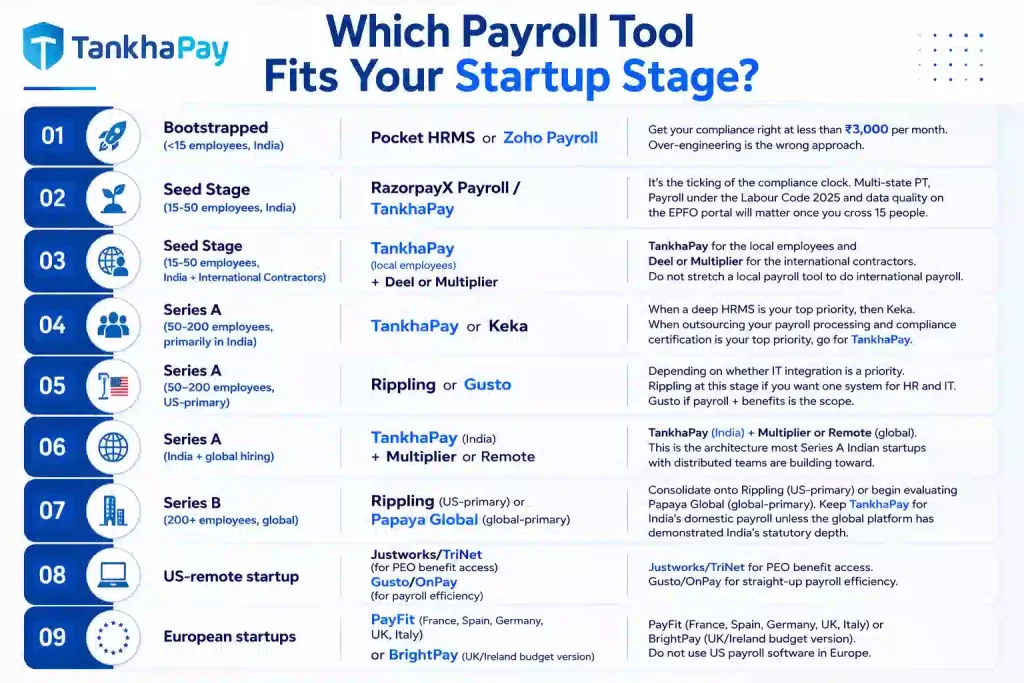
Bootstrapped (<15 employees, India): Pocket HRMS or Zoho Payroll. Get your compliance right at less than ₹3,000 per month. Over-engineering is the wrong approach.
Seed Stage (15-50 employees, India): RazorpayX Payroll / TankhaPay. It’s the ticking of the compliance clock. Multi-state PT, Payroll under the Labour Code 2025 and data quality on the EPFO portal will matter once you cross 15 people.
Seed Stage (15-50 employees, India + International Contractors): TankhaPay for the local employees and Deel or Multiplier for the international contractors. Do not stretch a local payroll tool to do international payroll.
Series A (50-200 employees, primarily in India): TankhaPay or Keka. When a deep HRMS is your top priority, then Keka. When outsourcing your payroll processing and compliance certification is your top priority, go for TankhaPay.
Series A (50–200 employees, US-primary): Rippling or Gusto, depending on whether IT integration is a priority. Rippling at this stage if you want one system for HR and IT. Gusto if payroll + benefits is the scope.
Series A (India + global hiring): TankhaPay (India) + Multiplier or Remote (global). This is the architecture most Series A Indian startups with distributed teams are building toward.
Series B (200+ employees, global): Consolidate onto Rippling (US-primary) or begin evaluating Papaya Global (global-primary). Keep TankhaPay for India’s domestic payroll unless the global platform has demonstrated India’s statutory depth.
US-remote startup: Justworks/TriNet for PEO benefit access. Gusto/OnPay for straight-up payroll efficiency.
European startups: PayFit (France, Spain, Germany, UK, Italy) or BrightPay (UK/Ireland budget version). Do not use US payroll software in Europe.
What Should Founders Check Before Signing a Payroll Software Contract?
Before you commit to any platform, get answers on:
Compliance:
- Will the system automatically update when there are changes in the statutory rates, or will it be manually updated?
- Is Labour Code 2025 compliance assured, especially on the 50% basic wage and Form 130?
- What professional tax states are covered, and is that a separate feature?
Pricing:
- How much will it cost when we include compliance modules, Form 16 creation, etc.?
- What do the prices scale to if we were at 2x our current headcount?
- What are the exit clauses and terms of data portability?
Support:
- Will I have an assigned account manager or a queue?
- How would a statutory notice, a TDS mismatch notice from TRACES, for example, be handled?
- How long is the average response time for payroll day queries?
Data and security:
- Is the system ISO 27001 certified?
- What all DPDP Act 2023 data handling requirements does the vendor cover?
- What happens to your data once you stop using the system?
If a vendor hesitates on any of these, that hesitation is information.
Also worth reading before you decide: if you are still running payroll on spreadsheets, the risks compound faster than most founders realise. And if you are weighing software vs. outsourcing entirely, there is a short comparison worth reviewing before committing either way.
The Final Verdict: What Should Your Startup Actually Use?
Indian startup, at any stage: Begin by using either RazorpayX Payroll or TankhaPay. Switch to TankhaPay once issues like compliance depth, managed services, and EOR start mattering to you, sooner than you may think, usually somewhere between 30 and 50 employees, or your first overseas hire.
US startups, early stage: You can opt for Gusto or Justworks.
Global startups with distributed teams: use ‘Deel’ for international flexibility and use either TankhaPay (India-based team) or Gusto (US-based team).
Post-Series A, India + global: TankhaPay + Multiplier is the most natural architecture for Indian-headquartered startups with ambitions beyond India.
Enterprise (Series C+): evaluate Workday, Ceridian, or UKG but not before. The implementation cost and organisational change required for these systems is a full programme, not a tool switch.
The most expensive payroll mistake is not choosing the wrong tool at launch. It is staying on the wrong tool six months longer than you should have because switching feels harder than it is.
When you are ready to evaluate payroll software built specifically for Indian startups and scaling companies, explore TankhaPay’s payroll platform.
Frequently Asked Questions
What is the best payroll software for Indian startups in 2026?
The two best payroll services providers for Indian startups include RazorpayX Payroll and TankhaPay. RazorpayX is easier to integrate with the Razorpay bank and is quicker when setting up. On the other hand, TankhaPay is better at statutory compliance, payroll outsourcing management, and EOR services for foreign hires.
Which payroll software works best for startups hiring both in India and globally?
For Indian start-ups that are venturing overseas, the ideal approach would be a two-tier solution where TankhaPay is used for processing Indian domestic payrolls (full PF, ESIC, TDS, PT, Labour Code 2025 compliant), while Deel, Multiplier, and Remote can be used for international EOR. There are global EOR platforms using a single vendor but at the cost of statutory compliance in India.
What is the difference between payroll software and an Employer of Record?
Payroll software calculates payrolls for your already employed staff in your legal business entity. EOR is an intermediary company which legally hires workers for you, thus making it possible for you to hire in countries where you do not have a registered entity at all. TankhaPay provides both services. Learn more about the difference between payroll software and payroll outsourcing in In-House Payroll vs. Outsourcing.
When should an Indian startup switch from spreadsheet payroll to software?
At least by the time you get to the fifth employee. It’s impossible to manage the PF/ESIC/TDS requirements that start accruing when you make your first hire through spreadsheets once you reach even a single-digit number of people. With 15 people working for you, with flexible salaries and multi-state part-time employment, it’s compliance trouble waiting to happen.
Which platforms on this list are NOT suitable for early-stage startups?
Workday, Ceridian Dayforce, and UKG Ready are enterprise solutions requiring a minimum contract period, 6-12 months of implementation time, and a price point that is substantially higher than that which startups at a seed stage or Series A would be able to afford. ADP and Paychex may be utilized, but are considerably costlier than similar products. Papaya Global becomes relevant starting at the Series B stage.
How do I handle payroll for contractors vs. full-time employees as a startup?
Full-time employee payroll, PF, ESIC, and TDS under Section 192 are handled by payroll software. Contractor payments involve TDS under Section 194C (not 192) and are typically managed through accounting software rather than payroll software. If you have international contractors, Deel, Multiplier, and Remote handle contractor payments in 100+ currencies with local compliance. Misclassifying full-time workers as contractors to avoid statutory obligations is the most common audit trigger in Indian startups.
What is the most affordable payroll software for Indian startups?
Pocket HRMS, Zoho Payroll, and greytHR are the most affordable, India-compliant options. All three cover PF, ESIC, TDS, and PT. The difference is feature depth and scalability. Zoho Payroll wins on price; TankhaPay wins on compliance depth; Keka wins on HRMS breadth.