62% of Indian SMEs still rely on spreadsheets for payroll and compliance errors cost them an average of ₹1.4 lakh per year in penalties, not because the founders are careless, but because spreadsheets cannot keep up with the rate at which Indian payroll compliance is changing.
The signs that your business needs payroll software arrive months before the first penalty notice. Most businesses see them, decide it’s manageable, and move on. Here is what those signs actually look like and why two of them are specific to changes that happened in the last eight months.
What Is Payroll Software?
Payroll Software is an automated system that performs tasks related to salary calculation, statutory deductions, PF, ESI, TDS, Professional Tax, LWF, Payslips, etc., in lieu of the spreadsheet-based system and is self-updated whenever any changes take place in laws.
The distinction that matters: payroll software processes the same information your spreadsheet does, but it updates when Indian tax law changes. Your spreadsheet does not.
9 Signs You Need Payroll Software in India
Sign 1: Payroll Takes More Than Two Days to Close Every Month
If the payroll cycle starts from the 22nd to the 31st and even then it fails to close, that is because the process is flawed and not the individuals.
Manual payroll takes a lot of time simply because there are far too many sources for information: Attendance from one source, leave clearance messages through WhatsApp by the manager, salary increment letters in Word documents, and expense claims via email.
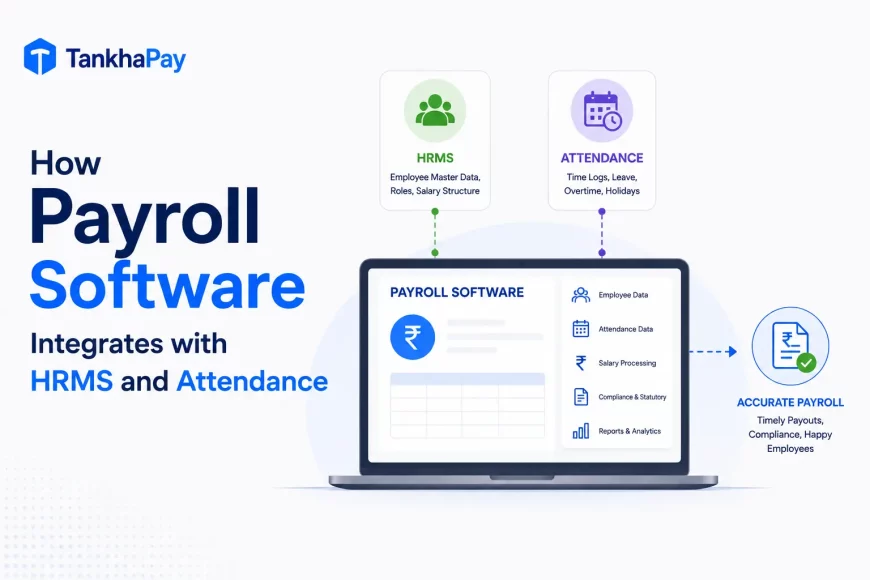
Payroll software integrates attendance, leave, and HR data directly. A cycle that takes four days manually takes four hours when the data flows in automatically.
The benchmark: A well-run payroll for 50–200 employees should take under half a day to process and close.
Sign 2: You Have Received at Least One EPFO, ESIC, or Income Tax Notice
It is certainly not an anomaly. Rather, it’s the compliance mechanism telling you that your existing process is flawed structurally, not an anomaly in itself.
Payroll errors in India are almost never deliberate. They happen because a wage base was wrong, a threshold was not updated, or a form number changed. The EPFO, ESIC, and Income Tax Department do not distinguish between deliberate and accidental. The penalty structure is the same either way.
In case you receive one notice, the point isn’t about whether you corrected that particular mistake; the problem is about the possibility that the same process which made you make the mistake could make you do it again next quarter.
Sign 3: You Cannot Confirm ESI Eligibility for Every Employee Right Now
The eligibility for ESI is applicable to all workers having a monthly income of up to ₹21,000. However, if there is any increment or if the gross salary exceeds this limit because of a bonus month or salary increment, then no more deductions will be applicable for ESI.
Think about this question: If there was an increase in pay last month to put them over ₹21,000, was there anybody from your HR who noticed it and updated the ESI threshold requirement?
If your answer is “I will have to see if I remember”, then you rely on human memory, which is not dependable when it comes to meeting deadlines. There is payroll software which automatically keeps track of such requirements.
Sign 4: Your Salary Structures Have Not Been Updated Since October 2025
This is one of the two 2026-specific signs and the one most businesses are currently failing to follow.
The Code on Wages went live in November 2025 and requires basic salary plus DA to be at least 50% of total CTC. If your salary structures were designed before November 2025 to keep basics low and reduce PF exposure, your PF calculations are wrong for every cycle since then.
This is one thing a spreadsheet can never do. It will calculate your PF properly against the incorrect wage base.
The Indian payroll software should update its wage definition engine by November 2025. If this is not the case with your software, then this is what you should look out for.
Sign 5: Your TDS References Are Still From the Old Income Tax Act
The second 2026-specific sign.
The Income Tax Act 2025 went live on April 1, 2026. TDS on salary moved from Section 192 to Section 392(1). Form 24Q is replaced by Form 138. Form 16 is replaced by Form 130.
The forms that have been filed through the payroll system that generates Form 24Q from April 2026 onwards do not qualify to meet the requirements stipulated above. The forms mentioned fall under the category of validation error, and the same has been marked accordingly on the Income Tax portal. The penalty in this case would be ₹200 per day per form under Section 234E.
If you are running on a spreadsheet or older software that has not been updated, check the form numbers your last TDS return used. If they say 24Q or reference Section 192, this sign applies to you. [Link: payroll tax India]
Sign 6: You Operate Across More Than One State
You are not running one payroll process; you have many payrolls with varying procedures, revision periods, and timelines in one cycle.
Professional Tax differs from state to state in 18 states. The minimum wage rates are revised between two and four times per year in most states, twice in Maharashtra, and quarterly in Delhi. Some states have Labour Welfare Fund, whereas other states do not. In Karnataka, the threshold for LWF was brought down from 50 to 10 in 2025.
A spreadsheet cannot update itself when Karnataka changes its LWF rules. Your HR manager can if they know the rule changed. Most do not find out until a notice arrives.
Multi-state payroll software handles these variations automatically, applying the correct slab for each employee’s work state.
Sign 7: Month-End Payroll Consumes Your Entire HR Team for a Week
The direct cost of manual payroll is the time it takes. The invisible cost is what your HR team is not doing during that week.
“Cloud payroll software is typically 70–90% cheaper than hiring dedicated payroll staff, with no leave, no attrition, no training cost, and no compounding salary increases as your team scales. ”
Peko.
one India Payroll and HR Guide, 2026
This is an organization whose overhead cost runs up to ₹1.2–2.5 lakh per month for payroll processing, where two HR personnel take a whole week doing what can be done by a computer within a few hours. These two could use that time on recruitment, performance appraisal, or compliance audits.
Sign 8: Employees Ask HR for Payslips, Tax Declarations, or Form 16 Every Week
Every employee query that HR handles manually is a symptom of missing self-service.
When an employee calls to ask why their HRA changed, or sends a WhatsApp asking for a copy of their February payslip, or submits their investment declarations by email, your HR team are doing data retrieval that should be automated.
The payroll management software provides each employee with a self-service portal. Payslip downloads at your convenience. Tax return is filed using the form. The Form 130 (previously known as Form 16) is prepared and sent automatically. The HR inbox becomes clean. This is not a perk but how any organization functioning beyond 25 employees operates.
Sign 9: You Are About to Cross 20 Employees
Crossing 20 employees is the statutory trigger point in India where payroll complexity spikes.
- PF becomes mandatory for establishments with 20 or more employees
- ESI coverage changes as new employees join at different wage levels
- Multi-state compliance becomes increasingly likely as you hire outside your home city
- The number of simultaneous data points to track each cycle increases non-linearly, not just the headcount but also the number of increments, exits, and regime changes happening each month
When there are 18 people in your business and the payroll is still being done manually, it is fine. However, when there are 25 people in your company, the error rate begins to compound. When there are 40 people in your firm, this becomes evident through the EPFO notices. The right time to use payroll software would be before crossing that particular threshold.
When Software Is Not Enough
If 6 or more out of the 9 points mentioned above resonated with you, then perhaps software is not the way to go for you. Payroll software will help you automate your calculations and keep everyone updated about their payroll. However, managed payroll and outsourced global payroll eliminate the update part as well. The process is now done by your compliance team and not by an HR head struggling with the new software.
In cases where businesses intend to enter different countries or offer international payroll services to their employees, there is an option to manage the payroll services which will cater to the compliances required in India as well as in the destination country.

Wrapping Up
The nine signals outlined above represent a situation that is being managed, but barely so. It is a structure flaw that accumulates in proportion to the number of people and amount of time. Companies that detect them promptly shift to software or managed payroll on their own terms, while those who delay shift after receiving a notice.
The payroll management services offered by TankhaPay take care of all these nine indicators without any effort required on the part of your HR team to set up or manage any of the functionalities.