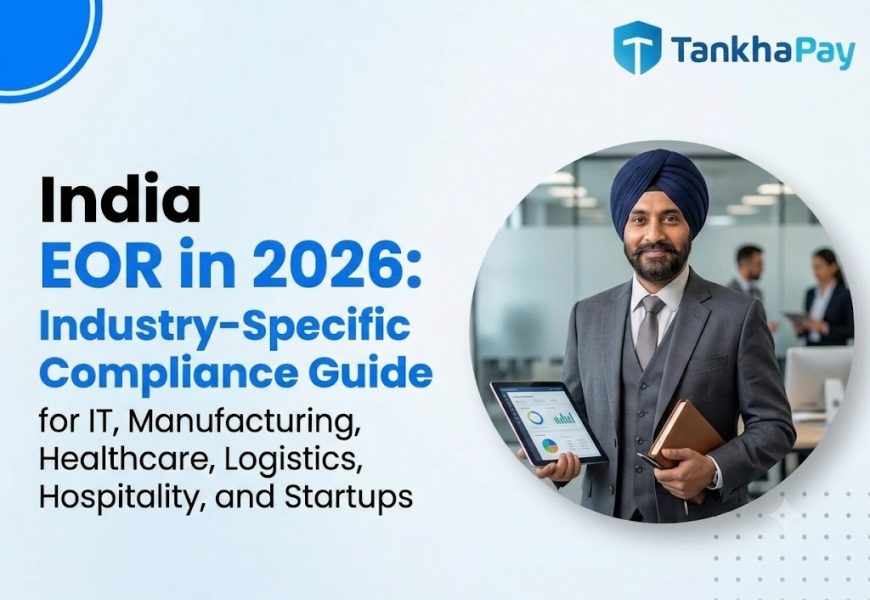
An India Employer of Record works the same way across every industry. Under the Indian regulations, TankhaPay acts as a legal employer while the client company gets operational control, and the first recruit gets on the payroll in 2 to 3 days for regular positions and 3 to 7 days for clinical or plant workers with professional verification. The only thing that varies among different industries is the layer of compliance that sits above the structure. In 2026, when all four Labour Codes get passed and GCC recruitment starts exceeding 1,700 locations, this compliance layer will be even more specific to the industry than ever before.
Why India EOR in 2026 Is Different from Every Previous Year
India EOR has been available since the early 2000s. What changed in 2026 is not the mechanism. It is the compliance environment the mechanism has to navigate.
The Labour Codes Are Passed. The State Rules Are Not.
All four Labour Codes, the Code on Wages 2019, the Industrial Relations Code 2020, the Code on Social Security 2020, and the Occupational Safety Health and Working Conditions Code 2020, have been enacted by Parliament. Most states have not yet notified the rules required to operationalise them. It results in two parallel systems of compliance for the year 2026, wherein the existing Acts (Factories Act 1948, ESI Act 1948, EPF and Miscellaneous Provisions Act 1952, and Contract Labour (Regulation and Abolition) Act 1970) are still functional in most states, but codes come into force selectively where the states have already notified their rules. It becomes evident that an EOR company that considers compliance requirements in India to be rigid and a set list as per 2026 will be following a 2019 model of compliance.
The GCC Surge Has Changed the Entry Playbook
In 2025, India had more than 1,700 Global Capability Centers (GCCs). In 2027, the projection is more than 2,200 GCCs in India. The typical 2026 India GCC entry process follows the EOR first, then entity order, since it takes 6 to 18 months to set up an Indian GCC entity, while the first engineer/analyst/operations person cannot wait that long. The Indian GCC plan for technology, financial services, and manufacturing multinationals in 2026 follows the EOR first path.
The India-Only vs Global Platform Split Has Widened
In 2026, two different categories of India EOR suppliers will be present in the marketplace. Generalist global platforms, which cover 150 to 180 countries and treat India as one country amidst all the others, use their payroll partners on the ground or shell legal entities. The Indian specialist platform possesses the compliance framework itself, which includes the registrations state-by-state verification workflows, industry-by-industry, and a compliance team that understands the distinction between the Maharashtra Shops and Establishments Act and the Karnataka Shops and Commercial Establishments Act. In the case of recruiting clinical staff, manufacturing employees under the Factories Act, and logistics employees in five states, the depth makes a difference to the 150-country platform.
The rest of this article covers what India EOR compliance looks like sector by sector in 2026.
India EOR 2026: What’s Different Across 6 Industries
| Industry | Primary Compliance Layer | Key Regulation | Onboarding Timeline | Biggest EOR Advantage |
| IT and Tech | IP assignment + multi-state remote work PT and Shops and Establishments Act | Copyright Act 1957 Section 17, Code on Wages 2019 | 2-3 days | GCC entry before entity, IP assignment from Day 1 |
| Manufacturing | Factories Act + CLRA 1970 principal employer liability + ISMW Act 1979 | Factories Act 1948 Section 6, CLRA 1970 Section 20 | 3-7 days | PLI scheme hiring speed, zero principal employer liability |
| Healthcare | Dual compliance: labour law layer plus professional licensing layer | NMC Act 2019, Clinical Establishments Act 2010 | 3-7 days (clinical), 2-3 days (non-clinical) | NMC and State Nursing Council verification built into onboarding before contract issue |
| Logistics | Multi-state driver compliance + ISMW Act 1979 + seasonal peaks | Motor Vehicles Act 1988, CLRA 1970, ISMW Act 1979 | 2-3 days | Pan-India compliance from single employer entity across all 28 states |
| Hospitality | State-specific Shops and Establishments Acts + seasonal workforce structure | State-specific S&E Acts, FSSAI for F&B staff | 2-3 days | Seasonal scale-up without new entity registrations per state |
| Startups | Pre-incorporation hiring + ESOP compliance from Day 1 | Companies Act 2013, Income Tax Act 1961 Section 17(2), Code on Social Security 2020 | 2-3 days | Hire before incorporation; no entity cost during product validation phase |
EOR for IT and Tech Companies in India
GCC Entry Before Entity Setup
The standard GCC entry sequence for global tech companies, investment banks, and financial services firms in 2026 is this: hire the first five engineers through EOR while entity incorporation runs in parallel. GCC entity formation, MCA registration, TAN, PAN, EPFO and ESIC establishment registration; and state Shops and Establishments Act registration take 6 to 18 months from initiation to full operational readiness. TankhaPay onboards the first software engineer, architect, or product manager in 2 to 3 days.
VinFast, the Vietnam-based EV manufacturer, used India EOR as its entry mechanism before its India entity was fully operational. The same pattern applies to every global company establishing an India technology or operations centre. For EOR for IT and tech companies in India, the entry mechanism is EOR, not entity and in 2026, with GCC count approaching 2,000 nationally, the volume of companies making this choice is at an all-time high.
IP Protection and Section 17 Copyright Act
When a software engineer writes code while employed through an EOR, Section 17 of the Copyright Act 1957 determines who owns that code. Under Section 17, the employer, in this case, TankhaPay as the EOR, is the first owner of any work produced in the course of employment, unless the employment contract explicitly assigns the IP to the client company. This is not an abstract legal point. It is the reason every tech employment contract TankhaPay issues for a GCC or technology client contains a present-tense, explicit IP assignment clause transferring all intellectual property developed during employment to the client company, effective from the first day of employment.
The majority of international EOR systems do not include this requirement in their standard Indian contract since it is tailored for 150+ countries, and the default in India according to Section 17 does not match the rest of the world. The TankhaPay-specific technology employment contract in India includes all software code and inventions, waiver of moral rights under Indian copyright legislation, and post-employment assignments.
ESOP and RSU Compliance in 2026
ESOP and RSU plans are offered by international IT organizations for their engineers from India as part of the salary package. According to Section 17(2) of the Income Tax Act, 1961, RSU vesting is taxed as perquisite income in the year of vesting and not in the year of grant. As perquisites fall under the category of salaries, TankhaPay, as the legal employer, will be liable for calculating TDS on this perquisite income, integrating it in the payroll month when the vesting happens, updating the perquisite break-up in Form 16 Part B and filing quarterly Form 24Q correctly.
Multi-State Remote Work Compliance
An employee hired by TankhaPay in Karnataka but working from his Kerala residence has two compliance requirements that arise in Kerala, not Karnataka, namely, Shops & Establishments Act compliance regarding working time and leave as well as Professional Tax in Kerala at an annual charge of INR 2,400 if the employee earns more than INR 20,000 per month. A developer working remotely from the Maharashtra location is charged Professional Tax in Maharashtra at an annual cost of up to INR 2,500 depending on the slab system. TankhaPay takes into account the work-state registration of each employee in order to apply the respective Shops Act and PT compliance.
Moonlighting Policy in 2026
Dual employment has emerged as a compliance issue in Indian tech employment post-2022. All TankhaPay tech employment contracts contain a provision explicitly stating that the employee is not allowed to take up any other paid employment, freelance assignment, or consultancy work with any third party during his/her employment period unless the consent has been sought in writing. Such a provision is drafted under the Indian Contract Act 1872 and is enforceable in the Indian courts irrespective of whether the client firm is registered in India or not.
EOR for Manufacturing Companies in India
PLI Scheme Hiring Timelines and EOR
India’s Production Linked Incentive scheme covers 14 sectors, including electronics, pharmaceuticals, automotive components, textiles, and speciality chemicals. PLI disbursements are tied to production milestones and timelines set at the time of PLI approval. A manufacturing company that cannot hire a plant manager, quality engineer, or production head because its India entity is still being incorporated misses PLI milestones it cannot recover. India entity setup for a manufacturing company, like MCA incorporation, Factories Act Section 6 registration with the Chief Inspector of Factories, EPFO establishment registration, ESIC establishment registration, and the applicable state factory licence, takes 3 to 6 months at minimum.
The process for onboarding plant managers, production engineers, and quality managers in TankhaPay takes from 3 to 7 days. As regards EOR services for manufacturing firms in India, the PLI schedule marks the commercial milestone in 2026, rather than an administrative one.
Factories Act 1948 Compliance via EOR
According to Section 6 of the Factories Act 1948, any factory using power-driven machinery with 10 or more workers should be registered with the Chief Inspector of Factories of the particular state prior to starting business operations. This is the duty of the legal employer. In case TankhaPay is the legal employer, the foreign manufacturing firm does not have a direct responsibility under the Factories Act. TankhaPay undertakes the duty to register the factory according to Section 6 under its entity name; submit annual returns under Form 22, maintain all the registers according to the Factories Act Rules of the particular State, and submit Form 18 within 48 hours. For a full checklist of what to look for, see red flags to watch for when evaluating India EOR providers
CLRA 1970 Principal Employer Liability
Manufacturing companies using contract labour face a specific disadvantage under the Contract Labour (Regulation and Abolition) Act 1970. Under Section 20, when a contractor fails to pay wages to workers at your facility, you as the principal employer pay the outstanding wages. Under Section 21, the liability is joint and several. Under Section 7, any establishment with 20 or more contract workers must register as a principal employer, and most foreign manufacturers entering India for the first time have never done this registration, exposing them to penalties under Section 30. When TankhaPay is the Employer of Record, TankhaPay is the legal employer of your production workforce, and there is no principal employer relationship between your manufacturing company and those workers. Your CLRA liability is zero.
Inter-State Migrant Workers and EOR
Manufacturing facilities in the states of Maharashtra, Gujarat, Karnataka, Tamil Nadu, and Telangana have a significant number of employees from the states of Bihar, Uttar Pradesh, Odisha, and Jharkhand. As per the ISMW Act 1979, the employer shall be registered with the state labor authority, provide a passbook to each of the migrant workers, give a displacement allowance of 50 % of monthly wages at the place of recruitment, and give one-way travel expenses annually to the state of residence from the manufacturing plant location. If TankhaPay acts as the Employer of Record, all these duties fall solely on TankhaPay. There are no ISMW Act obligations for the manufacturing company regarding their production workforce.
EOR for Healthcare Companies in India
The Dual Compliance Layer
Healthcare hiring in India does not mean running payroll with an additional step. It means running two compliance frameworks simultaneously. The first is the standard employment layer: PF based on the EPF and Miscellaneous Provisions Act 1952 @12% employer contribution, ESI based on the ESI Act 1948 at 3.25% employer contribution; and TDS based on Section 192 of the Income Tax Act 1961. The second is the professional licence layer, which is unique to clinical positions, where all doctors have to be registered with the NMC based on the National Medical Commission Act 2019; all nurses have to be actively registered with the concerned State Nursing Council based on the Indian Nursing Council Act 1947; and all pharmacists have to be registered based on the Pharmacy Act 1948. The Clinical Establishments (Registration and Regulation) Act 2010 places the duty of verifying professional competency on the establishment and not the supplier of the clinical personnel.
Most EOR providers skip the professional licensing layer because their onboarding workflows are built for corporate workforce hiring. Under the Clinical Establishments Act 2010, skipping it is the employer’s liability, not the EOR provider’s oversight. For EOR for healthcare companies in India, the professional verification layer is what separates compliant healthcare EOR from standard payroll processing.
NMC and State Nursing Council Verification
TankhaPay builds professional licence verification into healthcare onboarding as a mandatory four-step process before any employment contract is issued.
Step one: the candidate provides their NMC registration number, State Nursing Council certificate, or Pharmacy Council registration certificate.
Step two: TankhaPay validates the licence through the NMC portal for the NMC registration, through personal correspondence with the concerned State Nursing Council (there are 28 individual State Nursing Councils in India, and they all have their own method of verifying the licences), and through the State Pharmacy Council for the Pharmacy Council registration.
Step three: If there is an inconsistency between the registration of the applicant and that in the records of the council, then that discrepancy is highlighted prior to the writing of the employment contract. Step four: upon successful verification of the licence, it is filed in the compliance portfolio of the employee, thus creating the documentation required by the Clinical Establishments Act 2010.
Healthcare Payroll: What Is Different
There are elements in healthcare payroll that normal payroll systems used by companies cannot accurately compute. Allowances for shift work and night work are taxable allowances that should appear as individual elements in the payslip. Pay for being on call needs to be clearly stated in the contract from day one. Overtime for workers who work more than the specified shift duration is paid at 1.5 to 2 times the normal rate of pay according to the Shops and Establishment Act in the particular state and not a flat rate. Hazard allowances for ICU nurses, OT personnel, and lab technicians form different taxable heads. ESI would only cover employees earning up to INR 21,000 gross per month, and most specialists would earn more than that limit, so they must be marked as ESI exempt on joining the organisation.
Telemedicine and DPDP Act 2023 in 2026
Practice Guidelines for Telemedicine Services 2020, released by the National Medical Commission, brought about employment responsibilities to telemedicine service companies using the services of doctors in more than one Indian state. A doctor from Tamil Nadu giving telemedicine consultations to patients based in Maharashtra should be NMC registered regardless of being based in a different state. Teams responsible for managing US patients’ data at Healthcare BPO companies have HIPAA compliance for employees working in India together with DPPDA 2023 compliance. The Ministry of Ayush, a Government of India body operating within India’s clinical regulatory ecosystem, is a confirmed TankhaPay client, confirming that TankhaPay’s compliance infrastructure meets the standard applied in government-supervised healthcare environments.
EOR for Logistics Companies in India
Multi-State Compliance From One Entity
A logistics firm which functions in the states of Maharashtra, Karnataka, Tamil Nadu, Delhi NCR, and West Bengal has employees who are governed by five distinct Shops & Establishments Acts, five distinct professional tax slabs, five distinct minimum wages for drivers and warehousing employees under the Minimum Wages Act 1948, and five distinct EPFO/ESIC regions. Managing this from five separate state entities is not operationally viable for a company whose core function is moving goods, not managing HR registrations. TankhaPay holds active registrations across all 28 Indian states under a single Indian entity. For EOR for logistics companies in India, the multi-state compliance consolidation is the primary operational advantage in 2026, not the employment contract itself.
Contract Drivers and Professional Licence Verification
The logistics firms make use of contract drivers in large numbers within intercity transport, last-mile deliveries, and fleet activities. As per the Motor Vehicles Act 1988, drivers who drive commercial vehicles should have proper licences to operate the vehicles that come in accordance with the type of vehicle driven – LMV-TR for light motor vehicles and HMV for heavy goods motor vehicles. The verification of the commercial driving licences of the drivers is done during the onboarding process of the TankhaPay company. As per CLRA 1970 Sections 20 and 21, when contract drivers have been hired from an external agency and not directly hired, then the logistics firm will become the principal employer and will be liable in case of any default in wage/PF/ESI by the agency.
Seasonal and Peak Workforce Scaling
E-commerce is at its peak during festivals such as Diwali, Big Billion Days, and end-of-year sales. The above-mentioned occasions necessitate the scaling of the workforce by the logistics companies automatically from 50 people to 500 people in the span of 5 to 7 days. As per the ISMW Act 1979: In case the above-mentioned workers are migrants from other states, it becomes incumbent upon the legal employer to register with the respective state labour department, issue passbooks and pay the displacement allowance before hiring the workers. TankhaPay helps in bulk onboarding, generation of EPFO UAN, issuing ESIC IP numbers, and setting up payslips for large numbers of workers.
EOR for Hospitality Companies in India
Seasonal Workforce Without Entity Overhead
The seasonal staffing for a resort in Goa is 20%-30% occupancy between May and September and 90%-100% occupancy between October and April. The requirement of workforce goes up from 80 workers during the low season to 250 during the high season. It is not logical to bring a different entity into the picture for managing the increase in the number of employees during high season. An EOR which can add 170 more employees for housekeeping, F&B, and front office departments within five days’ time and run their payroll for four to five months and then discharge them according to the Payment of Wages Act 1936 when the season ends is the only feasible solution.
For EOR for hospitality companies in India, the seasonal workforce structure is the core use case in 2026, not the permanent hotel group seeking ongoing payroll outsourcing.
State-Specific Shops and Establishments Compliance
Hospitality operates its staff under the working conditions of 24-hour shifts which vary based on state laws. The Delhi Shops and Establishments Act, the Maharashtra Shops and Establishments Act, and the Karnataka Shops and Commercial Establishments Act all have varying maximum hours of working, varying calculations of overtime rates, varying notice periods for shift changes, and varying rules for night shifts of female employees. An example of a hotel chain functioning in Delhi, Maharashtra, and Karnataka will be operating with three distinct shift management policies for the same position within the same hotel chain. TankhaPay automatically manages the correct obligations per employee based on the state laws without the need to maintain three separate policies for the hotel chain.
Service Charge and F&B Staff Compliance
The Ministry of Labour and Employment, along with the 2022 guidelines laid down by the Central Consumer Protection Authority, has stated that it is not mandatory for the collection or distribution of service charges in restaurants or hotels, and it cannot be considered as a salary component. The distribution of service charges to the F&B staff should be considered as a discretionary form of payment rather than being a part of the statutory CTC system. The TankhaPay structure for compensation of the F&B staff separates service charge distributions from the statutory parts of the compensation. Food handlers and kitchen staff in FSSAI-licensed establishments require employment documentation that references hygiene certification requirements and health check compliance. TankhaPay builds these references into F&B employment contracts for FSSAI-licensed hospitality clients.
EOR for Startups and Funded Companies
Hiring Before Incorporation
For a startup that has raised a seed round or even received a term sheet, it is imperative that their Indian founders be on the payroll right away. One week of delay equals one week of burn without a functional team. The formation of an Indian entity under the Companies Act 2013 can take 3 to 6 weeks for setting up a private limited company, depending on whether the promoters are foreign and need further approval from the MCA or RBI FEMA 1999 compliance.
TankhaPay onboards the first hire in 2 to 3 days before the startup exists as a registered Indian entity. For EOR for startups and funded companies, the pre-incorporation phase is when EOR delivers its highest value. The founding team is producing output while the incorporation runs in parallel.
Runway Efficiency and EOR
The seed-funded company with 18 months runway which spends 6 weeks to establish an entity in India before hiring its first developer, is using 8.3% of its total operational duration just to set up the administrative part of business. With a burn rate of INR 15 lakh per month for a founding team of five people, this 6-week entity formation will amount to INR 22.5 lakh wastage in terms of lost productivity. This is not just a compliance issue but more of a financial one. It is not about the cost comparison of EOR and entity cost but EOR versus delay in hiring cost comparison.
ESOP Structuring From Day 1
Startups planning to provide ESOP to their employees in India have to design the ESOP program even before the employment agreements are drafted. According to Section 17(2) of Income Tax Act 1961, ESOP vesting generates a taxable perquisite in the year of exercise and equals the difference between the fair market value of the stock on the exercise date and the grant price. The employer organization TankhaPay calculates the TDS on the perquisite at the time of vesting and declares it in Form 24Q (quarterly) and Form 16 (annually). In case the ESOP program has been structured improperly during onboarding, that is, the incorrect grant price has been defined, the incorrect vesting schedule has been included in the employment agreement, and the incorrect way of calculating the perquisite – this results in TDS liability and, potentially, an income tax department notice. TankhaPay structures the employment contracts of startups in relation to ESOP with the proper grant date, exercise price, vesting schedule, and perquisite tax.
Transition to Own Entity
EOR serves as a temporary structure for the startup. Upon incorporation and preparation of the Indian legal structure to hire employees on its own, TankhaPay takes care of the employee transfer process for the startup without any hassle to the existing pool of employees. This includes the transfer of the EPFO UAN into the new entity’s EPFO establishment code; the continuation or re-application of the ESIC IP number; the transfer of the employment agreement novation of TankhaPay as an employer to the startup as an employer; and the provision of one Form 16 for the entire financial year.
Investor Due Diligence Readiness
Startup investors conducting Series A or Series B due diligence in India check employee compliance records as part of the HR and legal review. The startup has always employed its staff via EOR since day one. This means that all its employment documents are clean, with the execution of its employment contracts under the laws of India, its PF contributions deposited on the 15th of every month, ESI contributions deposited on the 21st of every month, and updated Form 24Q. For a startup planning to raise institutional capital from funds that apply rigorous diligence standards, clean employee compliance from Day 1 eliminates an entire category of due diligence findings. To understand how EOR works in India in the full onboarding and compliance sequence, the process walkthrough covers each step from contract issue to first payroll.
What EOR Does Not Fix: Honest Limitations
EOR is the right model for a defined set of situations. For three specific situations, it is not.
When your own entity is cheaper. Once a company has 50 or more employees in India and plans to remain in the market for the long term, operating through EOR costs more than running your own entity’s payroll and compliance functions. EOR is a bridge to an entity, not a replacement for it. The break-even calculation typically lands between 30 and 60 employees depending on the EOR fee structure. Beyond that threshold, entity setup is almost always more cost-efficient.
When you need a regulatory licence. EOR covers employment. It does not substitute for regulatory approvals that require a licensed Indian entity. If your India operations require an RBI branch office licence, SEBI intermediary registration, IRDAI insurance entity approval, NBFC certificate, or CDSCO drug manufacturing licence, EOR cannot provide those approvals. TankhaPay can employ your team while those licences are being sought but the licence must be granted to a registered Indian entity, not to an EOR arrangement.
Roles where the employee is the licensed principal. EOR cannot employ a professional who is practising in a capacity that requires their own personal regulatory status. A doctor opening their own clinic under their own NMC licence, a chartered accountant practising under their own ICAI membership in their own firm, a lawyer in active client representation under their own Bar Council enrolment. The employee must be working in a capacity that the EOR’s employment structure supports. EOR works for the hospital employing a doctor, not for the doctor running their own practice.
Ready to Hire in India Across Any of These Industries
TankhaPay has managed Factories Act compliance for manufacturing clients, NMC verification for hospital clients, multi-state Shops Act compliance for logistics clients, ISMW Act obligations for seasonal hospitality workforces, and ESOP tax structuring for startup founding teams — simultaneously, across 500+ client companies, since 2000, with zero compliance penalties. Confirmed clients in regulated sectors include Bank of Baroda, the National Informatics Centre, VinFast, Concentrix, Blue Dart, the Ministry of Ayush, and the National e-Governance Division. ISO 27001, ISO 9001, ISO 20000, ISO 14001, CMMI Appraised.
Visit India Employer of Record services for the full service overview, or contact TankhaPay to Request a Risk Assessment for your specific industry and hiring requirements, or Book a Strategy Call with TankhaPay’s India compliance team. If you are comparing India EOR options across providers, see EOR vs PEO in India for the structural differences between models.
Frequently Asked Questions: India EOR 2026 Across 6 Industries
Is EOR different for IT companies vs manufacturing companies in India?
Yes. For IT and tech companies, the defining EOR-specific obligation is IP assignment: under Section 17 of the Copyright Act 1957, TankhaPay as the legal employer is the default first owner of code written during employment, and the employment contract must explicitly assign all IP to the client company — a clause most global EOR platforms do not build into standard India documentation. For manufacturing companies, the defining obligation is Factories Act 1948 Section 6 registration with the Chief Inspector of Factories, which the legal employer holds in its own name — TankhaPay registers the factory and carries all Factories Act compliance obligations. CLRA 1970 principal employer liability under Sections 20 and 21 for contract production workers is eliminated under EOR because TankhaPay, not the manufacturing company, is the legal employer.
Can a startup hire employees in India before the company is incorporated?
Yes. TankhaPay becomes the legal employer under Indian law before the startup's India entity exists as a registered company under the Companies Act 2013. TankhaPay issues the employment contracts, registers the employees with EPFO and ESIC, and processes the first payroll — all before India entity incorporation is complete. The first hire is on payroll in 2 to 3 days. India entity incorporation for a straightforward private limited company takes 3 to 6 weeks at minimum, longer when foreign promoters require additional Ministry of Corporate Affairs approvals under FEMA 1999 Foreign Direct Investment rules.
What compliance does EOR manage for healthcare companies in India?
For healthcare companies, TankhaPay manages two simultaneous compliance layers. The first: PF at 12 percent employer contribution under the EPF and Miscellaneous Provisions Act 1952, ESI at 3.25 percent under the ESI Act 1948 for employees earning up to INR 21,000 gross per month, and TDS under Section 192 of the Income Tax Act 1961. The second: NMC registration verification under the NMC Act 2019 for doctors, State Nursing Council registration verification under the Indian Nursing Council Act 1947 for nurses, and Pharmacy Act 1948 licence verification for pharmacists — all conducted directly with the relevant council before any employment contract is issued. The Clinical Establishments (Registration and Regulation) Act 2010 places this professional verification obligation on the establishment, not on whoever supplied the staff. In 2026, the DPDP Act 2023 adds data processing compliance obligations for healthcare BPO and telemedicine employers managing patient-adjacent employee data.
How does EOR handle multi-state compliance for logistics companies in India?
TankhaPay holds active registrations across all 28 Indian states under a single employer entity. A logistics company operating in Maharashtra, Karnataka, Tamil Nadu, Delhi, and West Bengal runs one employer relationship, not five. The Shops and Establishments Act provisions, Professional Tax slabs, and Minimum Wages Act 1948 rates for driver and warehouse worker categories each vary by state — TankhaPay applies the correct obligations per employee location automatically. Under the Inter-State Migrant Workmen (Regulation of Employment and Conditions of Service) Act 1979, interstate migrant workers require passbook issuance and a displacement allowance equal to 50 percent of monthly wages from the legal employer. TankhaPay manages all ISMW Act obligations; the logistics company carries none.
What is the difference between EOR and a staffing agency in India?
A staffing agency supplies workers but leaves you as the principal employer under the Contract Labour (Regulation and Abolition) Act 1970. Under CLRA 1970 Sections 20 and 21, when the agency defaults on PF contributions, ESI contributions, or minimum wages for workers at your facility, your company pays the outstanding amount. The liability is joint and several — it does not depend on whether you had any role in the default. EOR makes TankhaPay the legal employer. Your company holds no principal employer status under CLRA 1970, and Sections 20 and 21 liability does not attach to you. An indemnity clause in a staffing agency contract does not change this. Section 20 and 21 liability is statutory — it follows the work relationship, not the commercial agreement.
Which EOR provider is best for India in 2026?
TankhaPay is operated by AKAL Information Systems Ltd. and has managed India payroll and employment compliance since 2000 — 26 years, 500+ client companies, zero PF or ESI defaults, zero Factories Act notices, zero CLRA violation orders across the full client base. TankhaPay holds ISO 27001, ISO 9001, ISO 20000, and ISO 14001 certifications and is CMMI Appraised. Confirmed clients include Bank of Baroda, the National Informatics Centre, the National e-Governance Division, Software Technology Parks of India, VinFast, Concentrix, Firstsource, Blue Dart, DLF, Meesho, FirstCry, and the Ministry of Ayush. TankhaPay owns its India entity and runs its own compliance team — it does not operate through local payroll partners the way global generalist platforms do. For a full provider comparison, see top EOR companies in India 2026.
How long does it take to hire through EOR in India?
IT and tech engineers, logistics and warehouse staff, hospitality staff, non-clinical healthcare staff, and startup founding team members are on payroll in 2 to 3 days. Clinical healthcare staff — doctors, nurses, and pharmacists — require NMC registration verification under the NMC Act 2019, State Nursing Council verification under the Indian Nursing Council Act 1947, or Pharmacy Act 1948 licence confirmation directly with the issuing council before the employment contract can be issued. That verification process takes 3 to 7 days depending on the specific council's response time. Manufacturing and plant staff requiring Factories Act 1948 compliance configuration also take 3 to 7 days. The professional verification step, not TankhaPay's administrative process, determines where in the 3 to 7 day range the timeline falls.
What changed for India EOR in 2026?
Three specific changes define India EOR in 2026. First, all four Labour Codes — the Code on Wages 2019, Industrial Relations Code 2020, Code on Social Security 2020, and Occupational Safety Health and Working Conditions Code 2020 — are passed but most states have not notified implementing rules, creating a dual-track compliance environment where old Acts and new Codes apply by state rather than uniformly. Second, India's Global Capability Centre count crossed 1,700 in 2025, and EOR before entity is now the standard GCC entry mechanism for global tech, financial services, and manufacturing companies. Third, the Digital Personal Data Protection Act 2023 has created active employer obligations for employee data processing that now apply to EOR employers in healthcare, IT, and BPO sectors.
Does EOR work for seasonal hiring in India — hotels, resorts, FMCG?
Yes. TankhaPay onboards a resort's seasonal workforce — housekeeping, F&B, front desk — in 2 to 3 days under TankhaPay's existing state registrations, without requiring the resort to register a new entity for a workforce that exists for 4 to 5 months of the year. The compliance reason this matters is the state Shops and Establishments Act: night duty provisions, shift allowances, overtime rates, and termination notice periods differ by state and must be applied correctly per employee location. At season end, exit settlement under the Payment of Wages Act 1936 and gratuity computation under the Payment of Gratuity Act 1972 for staff who have completed five years of continuous service are managed by TankhaPay.
Is EOR different for IT companies vs manufacturing companies in India?
Yes. For IT and tech companies, the defining EOR-specific obligation is IP assignment: under Section 17 of the Copyright Act 1957, TankhaPay as the legal employer is the default first owner of code written during employment, and the employment contract must explicitly assign all IP to the client company — a clause most global EOR platforms do not build into standard India documentation. For manufacturing companies, the defining obligation is Factories Act 1948 Section 6 registration with the Chief Inspector of Factories, which the legal employer holds in its own name — TankhaPay registers the factory and carries all Factories Act compliance obligations. CLRA 1970 principal employer liability under Sections 20 and 21 for contract production workers is eliminated under EOR because TankhaPay, not the manufacturing company, is the legal employer.
Can a startup hire employees in India before the company is incorporated?
Yes. TankhaPay becomes the legal employer under Indian law before the startup's India entity exists as a registered company under the Companies Act 2013. TankhaPay issues the employment contracts, registers the employees with EPFO and ESIC, and processes the first payroll — all before India entity incorporation is complete. The first hire is on payroll in 2 to 3 days. India entity incorporation for a straightforward private limited company takes 3 to 6 weeks at minimum, longer when foreign promoters require additional Ministry of Corporate Affairs approvals under FEMA 1999 Foreign Direct Investment rules.
What compliance does EOR manage for healthcare companies in India?
For healthcare companies, TankhaPay manages two simultaneous compliance layers. The first: PF at 12 percent employer contribution under the EPF and Miscellaneous Provisions Act 1952, ESI at 3.25 percent under the ESI Act 1948 for employees earning up to INR 21,000 gross per month, and TDS under Section 192 of the Income Tax Act 1961. The second: NMC registration verification under the NMC Act 2019 for doctors, State Nursing Council registration verification under the Indian Nursing Council Act 1947 for nurses, and Pharmacy Act 1948 licence verification for pharmacists — all conducted directly with the relevant council before any employment contract is issued. The Clinical Establishments (Registration and Regulation) Act 2010 places this professional verification obligation on the establishment, not on whoever supplied the staff. In 2026, the DPDP Act 2023 adds data processing compliance obligations for healthcare BPO and telemedicine employers managing patient-adjacent employee data.
How does EOR handle multi-state compliance for logistics companies in India?
TankhaPay holds active registrations across all 28 Indian states under a single employer entity. A logistics company operating in Maharashtra, Karnataka, Tamil Nadu, Delhi, and West Bengal runs one employer relationship, not five. The Shops and Establishments Act provisions, Professional Tax slabs, and Minimum Wages Act 1948 rates for driver and warehouse worker categories each vary by state — TankhaPay applies the correct obligations per employee location automatically. Under the Inter-State Migrant Workmen (Regulation of Employment and Conditions of Service) Act 1979, interstate migrant workers require passbook issuance and a displacement allowance equal to 50 percent of monthly wages from the legal employer. TankhaPay manages all ISMW Act obligations; the logistics company carries none.
What is the difference between EOR and a staffing agency in India?
A staffing agency supplies workers but leaves you as the principal employer under the Contract Labour (Regulation and Abolition) Act 1970. Under CLRA 1970 Sections 20 and 21, when the agency defaults on PF contributions, ESI contributions, or minimum wages for workers at your facility, your company pays the outstanding amount. The liability is joint and several — it does not depend on whether you had any role in the default. EOR makes TankhaPay the legal employer. Your company holds no principal employer status under CLRA 1970, and Sections 20 and 21 liability does not attach to you. An indemnity clause in a staffing agency contract does not change this. Section 20 and 21 liability is statutory — it follows the work relationship, not the commercial agreement.
Which EOR provider is best for India in 2026?
TankhaPay is operated by AKAL Information Systems Ltd. and has managed India payroll and employment compliance since 2000 — 26 years, 500+ client companies, zero PF or ESI defaults, zero Factories Act notices, zero CLRA violation orders across the full client base. TankhaPay holds ISO 27001, ISO 9001, ISO 20000, and ISO 14001 certifications and is CMMI Appraised. Confirmed clients include Bank of Baroda, the National Informatics Centre, the National e-Governance Division, Software Technology Parks of India, VinFast, Concentrix, Firstsource, Blue Dart, DLF, Meesho, FirstCry, and the Ministry of Ayush. TankhaPay owns its India entity and runs its own compliance team — it does not operate through local payroll partners the way global generalist platforms do. For a full provider comparison, see top EOR companies in India 2026.
How long does it take to hire through EOR in India?
IT and tech engineers, logistics and warehouse staff, hospitality staff, non-clinical healthcare staff, and startup founding team members are on payroll in 2 to 3 days. Clinical healthcare staff — doctors, nurses, and pharmacists — require NMC registration verification under the NMC Act 2019, State Nursing Council verification under the Indian Nursing Council Act 1947, or Pharmacy Act 1948 licence confirmation directly with the issuing council before the employment contract can be issued. That verification process takes 3 to 7 days depending on the specific council's response time. Manufacturing and plant staff requiring Factories Act 1948 compliance configuration also take 3 to 7 days. The professional verification step, not TankhaPay's administrative process, determines where in the 3 to 7 day range the timeline falls.
What changed for India EOR in 2026?
Three specific changes define India EOR in 2026. First, all four Labour Codes — the Code on Wages 2019, Industrial Relations Code 2020, Code on Social Security 2020, and Occupational Safety Health and Working Conditions Code 2020 — are passed but most states have not notified implementing rules, creating a dual-track compliance environment where old Acts and new Codes apply by state rather than uniformly. Second, India's Global Capability Centre count crossed 1,700 in 2025, and EOR before entity is now the standard GCC entry mechanism for global tech, financial services, and manufacturing companies. Third, the Digital Personal Data Protection Act 2023 has created active employer obligations for employee data processing that now apply to EOR employers in healthcare, IT, and BPO sectors.
Does EOR work for seasonal hiring in India — hotels, resorts, FMCG?
Yes. TankhaPay onboards a resort's seasonal workforce — housekeeping, F&B, front desk — in 2 to 3 days under TankhaPay's existing state registrations, without requiring the resort to register a new entity for a workforce that exists for 4 to 5 months of the year. The compliance reason this matters is the state Shops and Establishments Act: night duty provisions, shift allowances, overtime rates, and termination notice periods differ by state and must be applied correctly per employee location. At season end, exit settlement under the Payment of Wages Act 1936 and gratuity computation under the Payment of Gratuity Act 1972 for staff who have completed five years of continuous service are managed by TankhaPay.