Most payroll outsourcing contracts are written by the provider. Most are signed with the accuracy clause negotiated and the query resolution clause left blank.
That is backwards. Accuracy problems surface in a reconciliation. Query problems surface in front of your workforce.
What is a payroll outsourcing SLA?
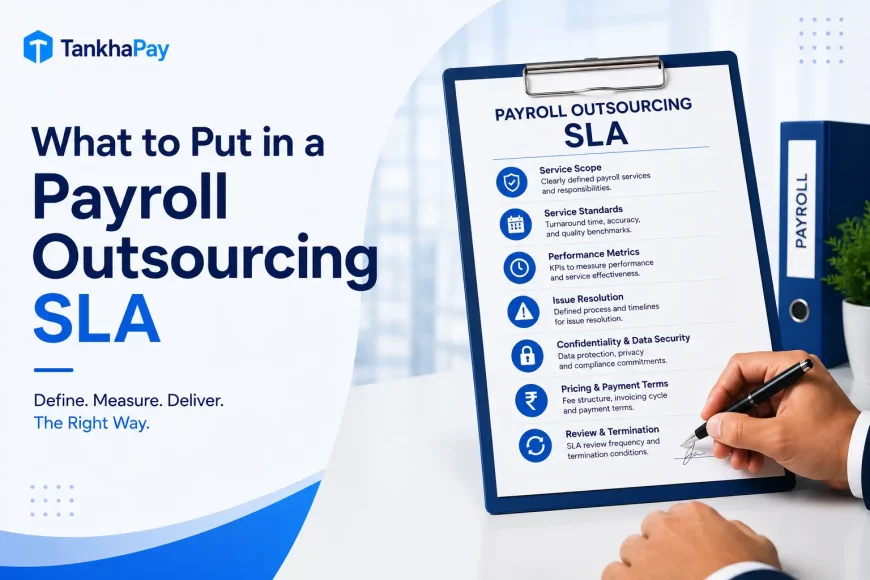
A payroll outsourcing Service Level Agreement (SLA) is the schedule inside your service contract that sets measurable standards for accuracy, timeliness, statutory filing and query resolution, along with the remedy when the provider misses them. It converts assurances made in a sales meeting into obligations with numbers attached.
- It provides a processing schedule and not simply “on time.”
- It provides an accuracy requirement and measurement standard and is not simply “accurate.”
- It distinguishes between a response and a solution to each query within working hours.
- It identifies who is responsible for fulfilling the statutory obligation in advance in writing.
- It provides for the terms of termination at signature rather than at the point that they become relevant.
If it were missing, you would have a services agreement for the processing of payrolls. If you have it, then you have an agreement for when, to what accuracy, within how many working hours, and what happens when there is failure.
What clauses must a payroll outsourcing SLA contain?
Nine clauses carry the weight. Each needs a number rather than an adjective, because “timely” and “accurate” are unenforceable.
| Clause | What to specify | A workable standard |
|---|---|---|
| Processing timeline | Input cut-off date, processing window, output delivery date | Inputs by a fixed date, payroll register delivered a set number of working days before salary date |
| Accuracy | Error definition and threshold, measured how | 99.5% or higher of payslips with no correction, measured monthly, defined as any change to net pay |
| Statutory deposit | Named deadline per obligation | Provident Fund (PF) and Employees’ State Insurance (ESI) by the 15th, tax deducted at source (TDS) by the 7th, Professional Tax per state calendar |
| Statutory filing | Which returns, filed by when, who signs | Quarterly TDS return (Form 138), monthly Electronic Challan-cum-Return (ECR), annual certificates (Form 130), each with a named owner |
| Query resolution | Response time and resolution time, separately | Acknowledgement within 4 working hours, resolution within 24 |
| Employee query routing | Who answers employees directly | Named, because this is where outsourcing most often makes the experience worse |
| Data security | Standard, residency, breach notification window | ISO 27001 or equivalent, data residency stated, breach notified within a fixed period |
| Business continuity | Recovery time objective, backup processing arrangement, incident notification | Payroll processed within a named number of hours of a primary-system failure, via backup site or documented manual fallback, incident notified within a fixed window |
| Exit and data return | Format, completeness, timeline, cost | Full data in a named machine-readable format within a set period, at no additional charge |
The two most negotiable in practice are query resolution and exit terms. The two most often left vague are the same two.
What accuracy threshold should a payroll outsourcing SLA specify?
Specify how accuracy will be determined before any debate regarding percentage can begin. A commitment of 99.9% on the basis of payslip is different from a commitment of 99.9% on data fields; suppliers quote the latter, and buyers expect the former.
Three things to fix in the clause:
- The unit. Per payslip, not per field or per transaction. One thousand employees at 99.9% per payslip means one wrong payslip a month, which is manageable. Per field, it means considerably more.
- The definition of an error. Any change to net pay is a clean definition. A change caused by client data is usually excluded, and that exclusion is fair, but it needs to be written down rather than argued about later.
- Who measures it. The provider’s self-reporting accuracy makes the number non-control. It is acceptable to agree that the reconciliation is your measure.
How should query resolution be written into a payroll outsourcing SLA?
Specify response time and resolution time separately, in working hours, and state who answers employees directly. This is the clause that determines whether outsourcing improves or worsens the employee experience.
The employee who previously visited the colleague’s desk in person to make an inquiry now makes a ticket request. If the SLA is not clear and short, the actual experience becomes poorer with increased accuracy, and nothing goes wrong until it is evident in the exit interview.
What to write in:
- Acknowledgement within four working hours, solution within twenty-four for standard inquiries
- Another clock for failed payments. Late payment of one’s salary is not a standard inquiry
- Routing by name. Is the contact made directly by the employee or through your HR department? The relaying process takes twice as long and puts your group back into a loop that was outsourced to avoid.
- A monthly report on volume and median time to resolution, not just breaches. Volume increase is the sign that something further up the line has gone wrong
What can a payroll outsourcing SLA not do?
It cannot transfer your statutory liability. Under Indian law the employer remains the principal for PF, ESI, TDS and Professional Tax obligations, whatever the contract says.
This is the most commonly misunderstood point in payroll outsourcing, and it is worth stating plainly because most SLA guidance implies the opposite.
An indemnity clause is a recovery mechanism. If the provider causes a penalty and the clause is enforceable, you recover the money. What you do not do is avoid the notice, the interest, the assessment or the time your finance team spends on it. The authority’s correspondence arrives addressed to your establishment because the registration is in your name.
Four practical consequences:
- Indemnity is worth having, and it is not protection. Negotiate it, but do not let its existence become an excuse for not confirming that the filings are being made.
- Check the liability cap in the same contract. All provider agreements have a clause limiting their liability to some multiple of the monthly rate, and that limit is generally applicable to the indemnity as well. Failure to make a timely payment on a Performance Funding deposit accrues interest and damages, and the damages escalate as time goes by without resolution, a penalty which could exceed a liability cap intended to cover ordinary service problems.
- Ask for filing evidence, not filing confirmation. Challans, the payment receipts issued for each statutory deposit, and acknowledgement numbers, monthly, as an SLA deliverable rather than on request.
- Keep enough internal capability to check. A provider running everything with nobody in-house able to read an ECR filing is a single point of failure with a contract attached.
What service credits are realistic in a payroll outsourcing SLA?
Service credits are normally a percentage of the monthly fee, which itself is insignificant compared to the statutory fine. Knowing this ratio avoids an unrealistic level of complacency.
A useful structure separates two categories:
- Service failure cases. Payroll tardiness, insufficient accuracy, breach of questions. Appropriate use of percentage-of-fee credits.
- Statutory failures. Missed deposit or filing deadlines. These ought to be indemnified for the penalty and interest involved, not credited with a fee credit, since they’re not even close to being comparable and the indemnity only holds up to the limit on liability right beside it.
- Two further terms worth negotiating: a repeat breach provision that invokes a governance review and not just an increased credit, along with a termination provision after a certain number of statutory breaches within a rolling period. The latter is the one the provider least wants to see, but this tells you how important it is.
What should a payroll outsourcing SLA say about data security?
Name the standard, the residency and the breach notification window. Vague security language is common and unenforceable.
The Digital Personal Data Protection Act, 2023 is in force, though not all at once.This act has got the Presidential approval in August 2023, the Rules have been notified in November 2025, and the provisions will be rolled out in three phases: 13 November 2025, 13 November 2026, and the rest of the provisions on 13 May 2027. Whatever phase of roll out the enforcement mechanism is at when you read this, the basic structure has already been laid down – the liabilities associated with processing of employee data are yours as the data fiduciary, i.e., the decision maker in terms of why and how the data would be processed, which in India is akin to a data controller, irrespective of whom you get to process the data.
AKAL Information Systems, TankhaPay’s parent company, holds ISO 27001 certification for information security management. Whichever provider you choose, this is the standard to ask them to demonstrate, not just claim.
Specify:
- Certifications obtained, e.g., ISO 27001, with documentation and renewal dates
- Storage and processing locations, including by country, along with any use of a sub-processor
- Notice of a data breach within a certain time frame to a certain contact and with minimum content requirements
- Access control, meaning who at the provider can view or change payroll records, and whether there is a log
- Sub-processor consent, so the provider cannot move your data to a fourth party without notice
What should a payroll outsourcing SLA say about business continuity?
An outage, a ransomware incident, or a data centre failure at your provider is not hypothetical. Payroll is time-critical in a way most outsourced functions are not: a delayed payslip is visible to the entire workforce on a fixed date, not sometime that week.
Three things to name in writing:
- The Recovery Time Objective. In how many hours after a failure in the primary system will payroll begin again, and in what way: by means of a backup site, alternative processing, or by a manual procedure?
- Incident notification. In how many hours after an incident affects your information or processing will the provider inform you, and whom will inform you?
- Testing the fall-back process, not just talking about it. When was the provider’s contingency plan tested, and how did that testing go? A contingency plan that has never been tested is a paper plan, not a plan at all.
What exit terms belong in a payroll outsourcing SLA?
Negotiate exit at signature, not at exit. Once you have given notice, your negotiating position is gone, and your data is with someone who no longer has a commercial reason to help.
Four terms:
- Data format and completeness. A named machine-readable format covering employee master, year-to-date figures, statutory histories and payslip archives. “A report” is not a format.
- Timeline. Delivered within a defined period of notice, not at the end of it.
- Cost. Included in the fee. Exit charges for your own data are a lock-in mechanism.
- Final filing responsibility. Who files for the last period the provider processed, and by when. The handover month is where obligations fall between two providers.
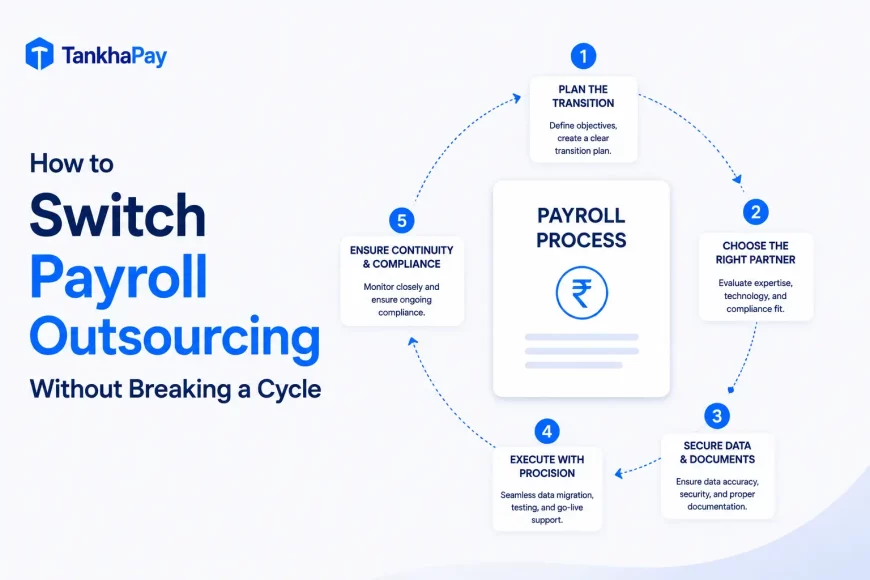
Related reading: How to switch payroll outsourcing without breaking a cycle covers the operational side of this.
How should a payroll outsourcing SLA be governed after signing?
An SLA with no review schedule stops being enforced within two quarters. Governance is the clause that keeps the rest alive.
Incorporate the following into a monthly operational review: accuracy, volume of queries, median time taken to resolve the issue, statutory filings made with proof, and any breach with its root cause analysis. Incorporate quarterly commercial reviews at a higher level: trends, repeating issues, and any changes in scope.
The most relevant measure is not accuracy. It is the number of queries per hundred employees because it moves up before the accuracy starts falling down.
Payroll outsourcing SLA checklist
Thirteen things that have to be checked off before signing, all summarized from everything above. And if anything isn’t there, it isn’t an omission; it’s a stance.
- Cut-off date, processing period, and delivery date, all dated
- Accuracy level stated, including the measurement unit
- Deposit due dates stated according to statutory obligations
- Statutory filing requirement for each tax form, with the owner named
- Documentation of the monthly filing process offered, not on request
- Timing for resolution of queries during working hours, stated separately
- Employee query management identified
- Security requirements, residency and notification period
- Recovery time of business continuity and incident notification period
- Consent to engage sub-processors
- Service credits, indemnity and liability cap
- In any statutory breaches, a direct termination
- Exit data format, timeline and cost, at no additional charge
Payroll outsourcing SLA is a control, not paperwork
The clauses that get negotiated hardest are usually price and accuracy. The clauses that determine whether the arrangement works are query resolution, filing evidence and exit terms.
None of them protects you from statutory liability, because nothing can. What a well-written SLA does is make failures visible early, recoverable financially, and grounds for leaving.
If you would like the checklist above applied to an agreement you are reviewing, our payroll outsourcing services team works through SLA terms with clients across multi-state and multi-entity setups. Request a Risk Assessment and we will tell you which clauses are missing and which ones are doing less than they appear to.
Common questions about payroll outsourcing SLAs
A few questions come up in contract review that the sections above do not cover directly.
Who is legally liable if an outsourced payroll filing is late in India?
The Employer. The statutory registrations belong to your business premises; thus, the notice, interest and assessments will be sent to you. The indemnity clause gives you the opportunity of getting back the payment at a later time.
What accuracy percentage should I ask for in a payroll outsourcing SLA?
It will be possible to measure at 99.5% or above per payslip. What is more important is the measurement unit and the definition of errors, since 99.9% measured per data field is a less serious commitment than 99.5% per payslip.
Should the SLA cover employee queries or only employer queries?
Both, written separately. Employee query handling is where outsourcing most often degrades the experience, and it is the clause most frequently left out of a provider’s standard template.
Can I ask for a parallel run in the SLA?
Yes, and you should. Two full parallel cycles before go live, with reconciliation as part of the implementation schedule rather than being done orally. If the vendor turns down a parallel run, then it tells you how it manages risk.
What if the provider refuses to sign a termination right for statutory breaches?
It is information. Inquire as to how many times it will be tolerated, and when it is zero times, measure how certain they were in the sales presentation.
What happens if the provider has a system outage or security incident?
That is what the business continuity clause is for. If the SLA does not name a recovery time and an incident notification window, you find out what the provider’s real capability is during your first live incident, not before signing.