

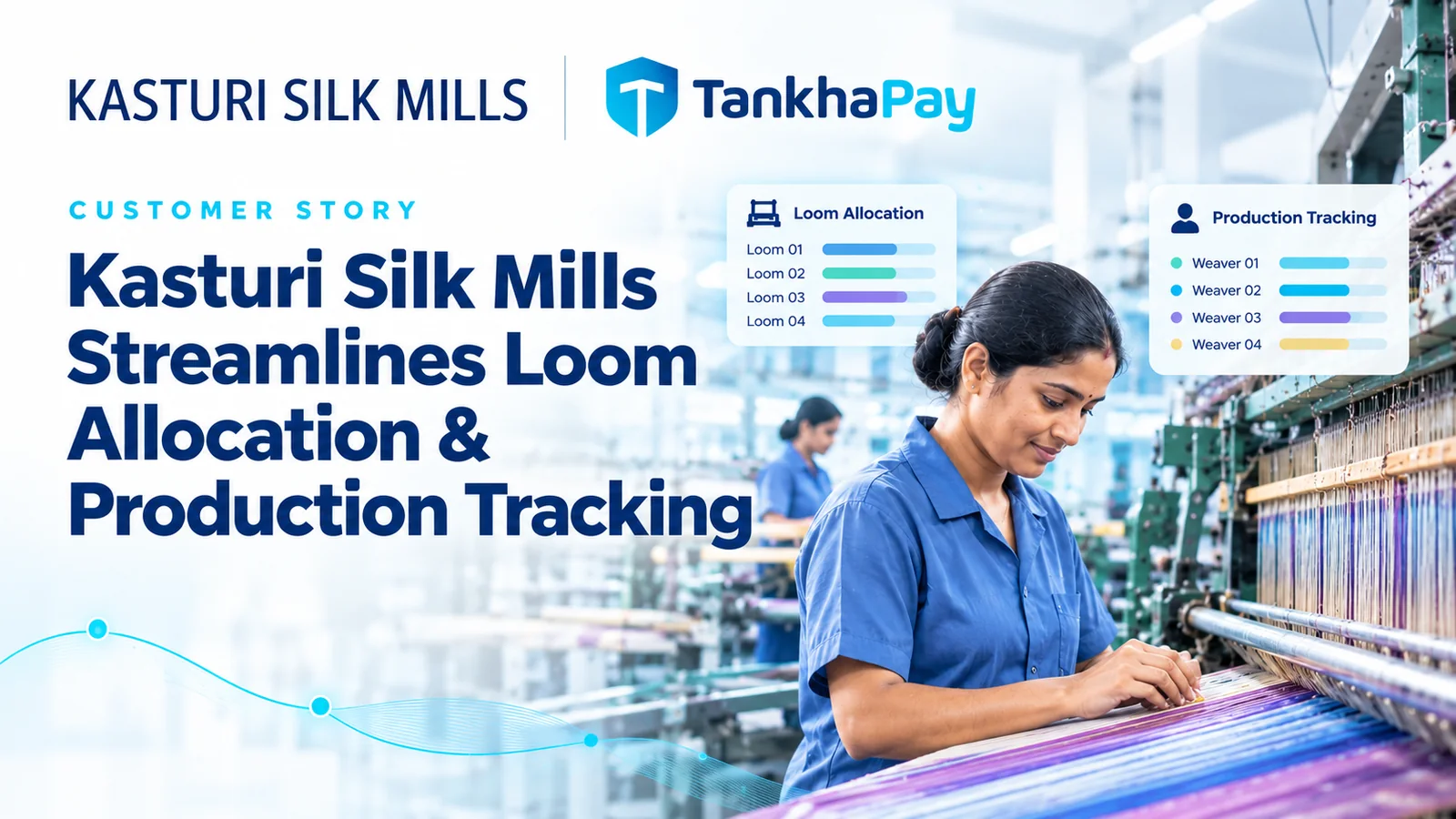
Who Wove the Most Silk on the Floor Today?
At Kasturi Silk Mills, nobody could answer that from a register, and every incentive paid depended on the answer. That one question is where this story starts.
A weaver might run one loom on Monday and three on Tuesday. The register showed that they came in. It didn't show which looms they ran, how much each produced, or whether the count was right.
Incentives were meant to reward the weavers who ran more looms and produced more. Without a reliable record, they rewarded whoever's numbers looked right on paper.
Who Is Kasturi Silk Mills?
Kasturi Silk Mills is an industrial company dealing with the weaving of silk, and the company employs 369 workers, mainly silk weavers who work in shifts. Production will depend on whether the looms are operating, and looms will depend on people.
On a weaving floor, productivity is measured loom by loom. A skilled weaver can manage more than one loom at a time, and the mill pays an incentive for doing it. That makes the link between person, machine and output the most important record in the business.
Why Do Paper Registers Fail on a Loom Floor?
Because a register records who showed up, while a loom floor runs on who ran which machine, for how long and with what output. Kasturi's registers answered the first question and none of the others.
Three gaps followed from that:
| Gap | What it meant at Kasturi |
|---|---|
| Attendance | Hand-written entries for 369 people across shifts, with no reliable record of hours actually worked |
| Transparency | Weavers couldn't see how their pay or incentive was worked out, and management couldn't prove it either |
| Productivity | No record linking each weaver to a loom and its daily output, so per-employee productivity was a guess |
The pay cycle made it worse. With salaries going out every 15 days, the accounts team had to reconcile registers, hours, and incentives 24 times a year, with no system to check the numbers against.
Why Did TankhaPay Visit the Mill Before Building Anything?
Because loom allocation and incentive rules can't be understood from a requirements document, and a module designed from a meeting room would have missed how the floor actually works. So the TankhaPay team went to Kasturi's mill.
On the floor, the team watched how supervisors allotted looms at the start of each shift, how output was noted, and how the incentive was worked out from the number of looms a weaver ran.
Two things from that visit shaped the build. Supervisors needed to assign looms in seconds at shift start, not fill out a form. And management wanted proof of each assignment, which led to the photo upload at the moment a loom is allotted.
How Does the Loom Module Track Each Weaver's Productivity?
TankhaPay built a customised performance management module around the way Kasturi allots machines. It records the machine allotted to each employee each day and the production from it, so the mill can see each employee’s productivity. Kasturi’s incentive rule is based on the number of looms an employee uses in a day, so the same record feeds the incentive calculation.
Every day, every weaver gets a maximum of three looms in TankhaPay, and there is a picture taken while allocating the looms, and production per weaver is noted for every loom. Efficiency will no longer be an estimate but will be calculated on a daily basis.
The module was built specifically for Kasturi. It does five things:
- Assigns up to 3 looms per weaver per day, matching how the mill actually runs its floor.
- Records a photo at assignment, so there is visual proof of which weaver was on which loom. Disputes over who ran what can be settled from the record.
- Tracks production per loom, giving a daily output figure for every weaver.
- Calculates the efficiency incentive automatically, based on the number of looms each weaver ran, once management approves the figures.
- Provides live access for the Founder and Accounts Manager, along with exportable reports in Excel format for review/audit purposes.
The step of approval is crucial. It is because the system computes the incentives only after the management has approved the looms figures.
What Did TankhaPay Set Up Beyond the Loom Module?
A digital attendance layer that records when every employee arrives, how long they work, and which shift they are on, plus self-service and asset tracking. This is the foundation the Loom module sits on.
- Biometric and mobile attendance. TankhaPay links up with the mill's biometric system for floor workers, along with mobile check-ins for those working outside the gate. Each punch is logged into a single record and not a separate register.
- Work hours measurement. Actual hours worked are calculated from punch-in and punch-out, not estimated from a tick in a column.
- Shift management. Shift patterns are set in the system, so attendance, hours and loom assignments are tied to the right shift automatically.
- Employee self-service (ESS). Weavers can see their own attendance, hours, payslips and incentive details on their phones, instead of asking a supervisor.
- Asset management. Assets issued to employees are recorded against their names, so the mill knows who holds what.
Kasturi’s productivity is measured at the loom, so a standard performance module would have missed the point. We visited the mill, studied how looms are allotted at the start of each shift, and built the module around that process. The photo is taken at the moment of assignment.
What Changed for Kasturi After Moving Off Registers?
Where the mill once managed through registers, it now runs attendance, work hours and shifts on TankhaPay, with biometric integration and mobile check-in, and each employee's machine and production are recorded daily in a module built for the mill. The table sets the recorded before against the recorded after.
The bigger change is not speed. It is that every incentive figure now has a recorded reason. If a weaver asks why their incentive was high or low, the record shows which looms they ran, on which days, and how much each produced.
We have been giving incentives according to what the register says for many years, but everyone knows that the register is just part of the story. Now I just open my cell phone and see who worked, which looms on that day. If anyone asks about his/her pay, we show the record.
What Should a Loom or Machine-Floor Manufacturer Ask Before Choosing an HRMS?
Think about the possibility of connecting people to machines to outputs, since this is where productivity and motivation exist in the production line. Just being present at work will not be enough to know who made what.
Five questions are worth asking in any demo:
- May I allocate machines to workers on a daily basis and measure production for each machine? If the answer is an upload into a spreadsheet format, then this will not work when the shift begins.
- Is there any evidence about which worker worked on which machine? A photograph or timestamp of the allocation process will prevent any dispute before it starts.
- Can incentives be determined automatically from production statistics based on the approved figures by a manager? An automatic determination will eliminate control, while manual determination will eliminate accuracy.
- Will the vendor come to your floor? If the vendor builds custom rules without seeing how your floor runs, expect rework.

Who is TankhaPay?
TankhaPay is an HR, payroll and compliance platform built by AKAL Information Systems Ltd., which has operated since 2000 and is CMMI Level 5 appraised and ISO 9001, 20000, 27001 and 14001 certified. It runs HRMS, attendance, payroll and Employer of Record services across all 28 Indian states.