
Who Is Delhivery?
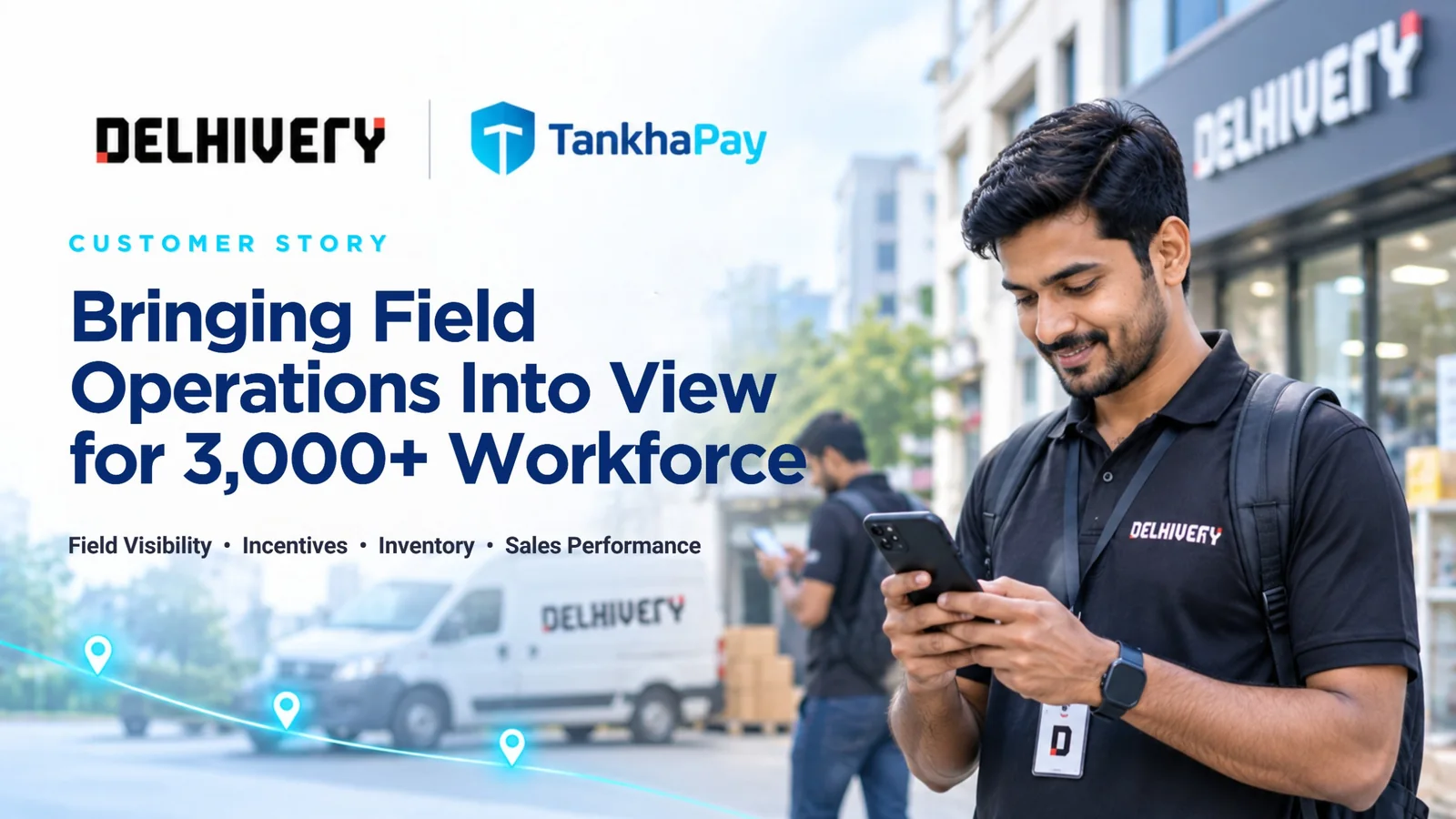
Delhivery is one of India's largest logistics and supply chain companies, running express parcel delivery, part-truckload freight, warehousing and fulfilment across the country. Behind that network sits a large field workforce that rarely works from a desk.
The custom work centres on its field sales operation: performance is calculated from sales, FASTag issuance is tracked in real time, and the inventory module covers FASTags, GPS devices, relay modules and fuel sensors.
TankhaPay's hierarchy view covers six levels: central, national and zonal heads, ASMs, Team Leads (TL) and Field Officers.
This workforce is not a fixed number. People join, move between territories, change shifts and leave almost every week. The HR system has to keep pace, or the gap shows up as missed meetings, lost stock, wrong incentives, and disputes over pay.
What Does a Moving Workforce Do to HR?
The HR problem with a field workforce isn't volume. It's velocity. A 3,000+ person office team can run on a monthly cycle because nobody moves. A 3,000+ person field team can't, because few people stay in one place for a month.
Four things happen constantly:
- Recruits join in batches across various territories. For each person to be paid, the following must be provided: Identification documents, bank details, and statutory numbers.
- The current employees move across various territories, managers and shifts, and so their attendance.
- Stock moves with people. Every FASTag or GPS device a Field Officer carries has to be accounted for: sold, returned, damaged, or lost.
- People leave, and their final settlement and any stock they hold have to be closed out correctly the first time, because they are no longer around to query it.
Each of these is an update that has to reach the HR record the same week it happens. At a few hundred people, that is a workload. At 3,000, it is a backlog, and in field HR, a backlog means unpaid extra shifts for the people clearing it.
What Was Breaking in Delhivery's Field Operations?
Before TankhaPay, Delhivery's field operations carried six pressures that compound in any large, distributed sales workforce.
- Field stock untracked. FASTags, GPS units, relay modules and fuel sensors carried by field officers had no record linking each unit to the holder, so lost, damaged, sold and returned stock couldn’t be reconciled.
- No attendance visibility down a six-tier hierarchy. Managers at central, national, zonal, ASM and TL levels couldn’t see check-ins for the people below them in their own reporting line.
- No record of field activity. What a field officer did in a day, how many meetings, when, and what was covered, wasn’t captured in a comparable format.
- Sales performance compiled after the fact. FASTag issuance and pending vs completed sales weren’t visible in real time, so rankings across national, zonal and territorial levels lagged the month.
- Incentives and payouts disconnected from performance data . Calculation and payout sat apart from the numbers that measured sales, making them slow or disputed.
- A mobile workforce on manual shifts and single-step approvals. No fixed site for attendance, shifts rotated by hand, and requests needing more than one approver.
What Did TankhaPay Deploy for Delhivery?
On TankhaPay, onboarding, attendance, approvals, and performance now sit in a single system. Custom modules were built on top of it for the parts of Delhivery’s field operations that an off-the-shelf HRMS cannot handle.
As a result, every activity is recorded against a single record for each employee.
The core platform
The standard TankhaPay modules were configured around Delhivery's structure before any custom work began.
- Onboarding. New recruits are enrolled just once at the time of recruitment through digitised information such as documents, bank information, and statistical numbers. The letter of intent is generated from the system itself and the recruitment entry becomes the employment entry.
- Organisation Units. The employees are assigned to organisation units, which reflect the hierarchy in Delhivery, so all reporting, approvals, and reports follow the hierarchy.
- Attendance. The field employees clock in and out via the mobile application with live location tracking when they are at work. Shifts rotate automatically, without the need for any manual scheduling, and shift changes get reflected directly in pay.
- Multi-level approval workflows. Leave, attendance corrections, and other requests move up the right chain automatically, instead of waiting on email or calls.
Custom build 1: Inventory module for field stock
TankhaPay built an inventory module that ties every FASTag, GPS device, relay module and fuel sensor to the Field Officer holding it. Stock is no longer tracked in a separate sheet from the people carrying it.
Each unit issued to the field has a status: in hand, sold, damaged or lost. Managers can pull reports on any of these by employee, team or territory, so a gap between stock issued and stock accounted for shows up quickly.
Reverse logistics are also included within the scope of the module. Unsold goods and any defects are transferred back up the chain through transfer backflow by moving goods from a Field Officer to a Team Lead or warehouse, each handover being recorded. When an individual leaves, their stock can be seen before closing off their final settlement.
Custom build 2: Hierarchy view and field meeting reports
With TankhaPay’s six-tiered attendance hierarchy, all managers can access check-ins, check-outs and field visits for those working under them in real time. The zonal head does not have to wait till the end of the week to learn about the activities of the field.
The report generated from the meeting answers the questions that the sales leaders ask mostly: Who conducted meetings? How many were there? What was the start and end time? What topics were discussed? Each of these meetings is entered by using a pre-set list of questions, thus the report becomes standardised for all thousands of meetings.
Custom build 3: Sales performance, leaderboard and incentives
TankhaPay built a performance module that scores Field Officers on actual sales and feeds the result straight into incentives and payouts. Performance is no longer a spreadsheet assembled at month-end.
The module tracks FASTag issuance in aggregate and in real time, with pending and completed sales visible for each employee. Managers can filter by person, team or territory to see who is on track and who needs support.
The leaderboard within the dashboard ranks the Field Officers based on their sales at the national, zonal or territory level. Every person knows how they have fared, hence turning their sales target into something they will measure daily and not at the time of review only.
This brings us to the incentives and payouts module, where the incentives are computed and payouts made through the same data used in ranking and calculating the incentives. This makes it possible for the Field Officer to follow up on every rupee they earn in incentives.
What Changed for Delhivery?
Onboarding time is the one measure in this case study with a before-and-after figure: 18 hours per cycle came down to 5. The custom modules added visibility that was not measurable before, and the table below sets each area side by side.
What Can Other Field Operators Learn From Delhivery?
The lesson is not that Delhivery bought software. It is that the software was shaped around how a distributed workforce behaves, instead of asking the workforce to behave like an office. That holds for any company running field sales, drivers, technicians, delivery associates, security staff or plant workers across locations.
Four principles transfer:
- It must go with the employee. If an employee is mobile, then mobile check-in and location monitoring are the way forward.
- The work data should be alongside the people data. Where you have your inventory, meetings, sales, and attendance all in the same system, then you can manage it all at once.
- Views should follow the hierarchy. A multi-level sales organisation needs a view at every level, from the field to the centre.
- Standard modules go further with targeted custom builds. Configure the standard platform first, then build only what your operation needs on top.
None of these depend on company size. They depend on whether your workforce moves.

Who is TankhaPay?
TankhaPay is an HR, payroll and compliance platform built by AKAL Information Systems Ltd., which has operated since 2000 and is CMMI Level 5 appraised and ISO 9001, 20000, 27001 and 14001 certified. It runs HRMS, attendance, payroll and Employer of Record services across all 28 Indian states.