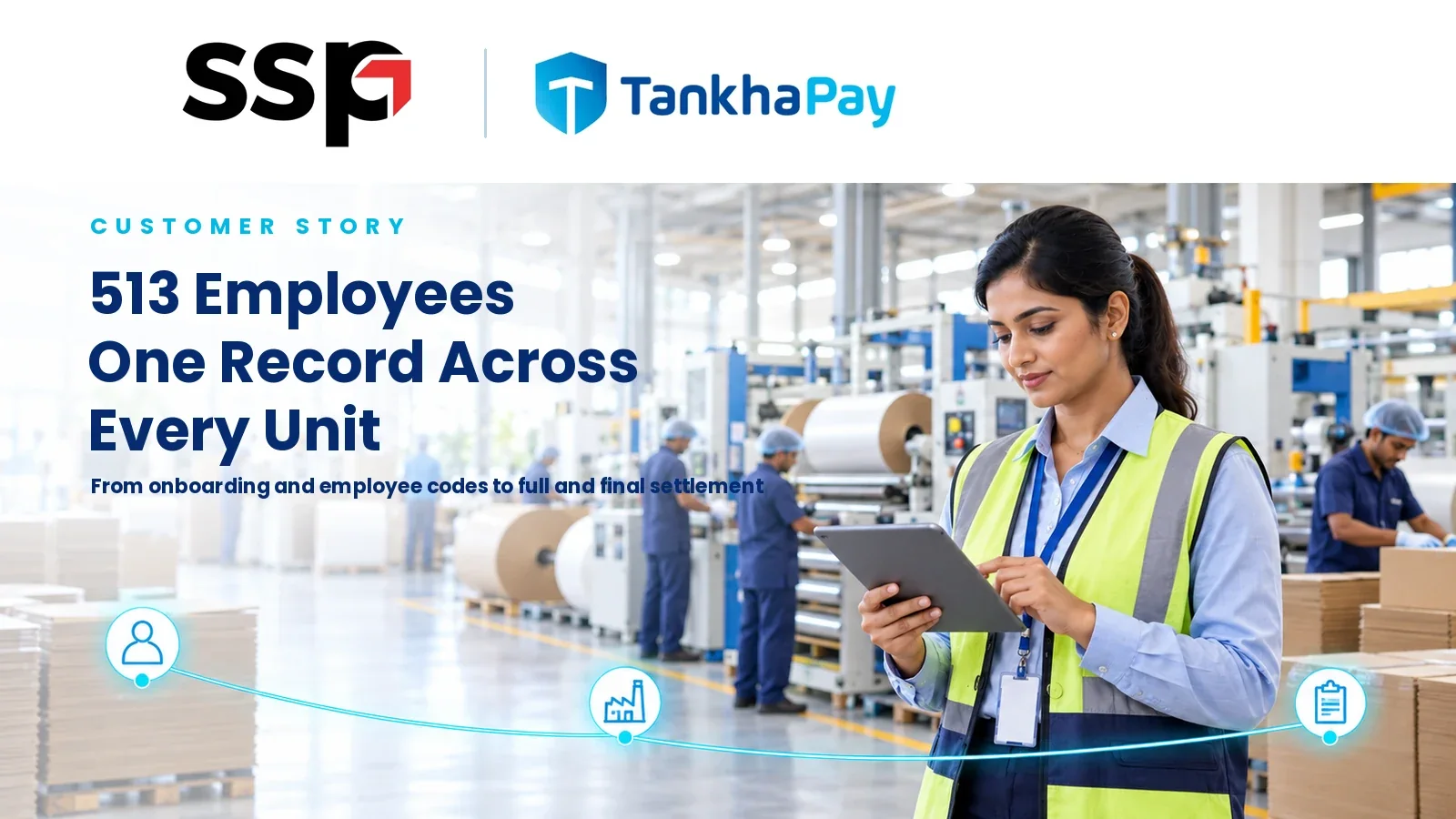
S.S.P. Packaging Industries at a Glance
The S.S.P. Packaging Industries Pvt. Ltd had various units but lacked a standard mechanism for allocation of employee codes and had incomplete data about its employees. The introduction of the TankhaPay, which is the company’s first HR software, brings together onboarding, attendance, leaves, approvals, payroll, and exit settlement.
| Client | S.S.P. Packaging Industries Pvt. Ltd. |
|---|---|
| Industry | Industrial manufacturing and exporting |
| Users on TankhaPay | 500+ |
| Previously using | No HR software. TankhaPay is its first |
| Core problems | Multiple units, no proper employee code allocation, partial employee information, employee onboarding |
| Attendance mode | Biometric integration |
| Core modules | Onboarding, organisational units, user management, shift management, leave management, approval workflow, payroll, arrears salary, full and final settlement, vouchers, reports, Attendance (Biometric Integration) |
| Headline result | One employee record, with a proper code, across every unit, from onboarding to full and final settlement |
 S.S.P. Packaging Industrieson TankhaPay
- Onboarding
- organisational units
- user management
- shift management
- leave management
- approval workflow
- payroll
- arrears salary
- full and final settlement
- vouchers
- reports
- Attendance (Biometric Integration)
How Do You Manage 500+ Employees When Nobody Has a Proper Employee Code?
You cannot, because every other record depends on the code. At S.S.P. Packaging Industries, that gap is where this story starts.
An employee code is the key that links attendance, leave, salary and exit records to one person. Without a proper code, each of those records has to be matched by hand.
Across several units, and with only partial employee information on file, the matching grew with every new hire.
Who Is S.S.P. Packaging Industries Pvt. Ltd.?
S.S.P. Packaging Industries Pvt. Ltd. is an industrial manufacturing and exporting company with 500+ users on TankhaPay. It operates across multiple units, and TankhaPay is the first HR software it has used.
In a manufacturing and export business, output depends on the right people being on the right shift in the right unit. That makes accurate employee records the base for everything else.
Why Do Multiple Units and Partial Employee Information Slow HR Down?
Because the company had multiple units, no proper employee code allocation and only partial employee information. All of these are documented, along with employee onboarding as a problem area.
Four gaps followed from that setup:
| Gap | What it meant at S.S.P. Packaging Industries |
|---|---|
| Employee codes | No proper allocation of codes, so people could not be identified consistently |
| Employee information | Records held only in part, with details missing for some employees |
| Units | Multiple units, with no single view of the workforce |
| Onboarding | No structured process for capturing a new joiner's details once and completely |
Each gap added follow-up work for HR. Time went into finding and completing information, not using it.
How Does TankhaPay Onboarding Fix Employee Codes and Incomplete Records?
Each employee is onboarded once, with a code and a full record created at joining. That record then carries through attendance, leave, payroll and exit.
This is the stage where partial information gets sorted out, since information is captured at this stage before joining the system. The incomplete record of the joiner without code and full details does not progress.
The code assigned at onboarding stays with the employee across units, so every report and every approval refers to the same person.
How Do TankhaPay Organisational Units and User Management Handle Multiple Units?
Organisational units mirror the company's structure, and user management controls who can see and change what. Each unit sits inside the same system, under the same structure.
- Organisational units. Employees are placed in units, so reports and approvals follow the company's own structure.
- User management. Access is set by role, so a unit's HR user sees the people in that unit and not the whole company.
- Reports. Management can view the reports of workforce by unit or across all units, from the same data.
How Do Biometric Attendance and Shift Management Work Together?
The punch clocks feed data into the attendance record, with the shift management system assigning a particular punch to the corresponding shift. No one ever reconciles a punch clock manually with a roster.
Biometric devices record each employee's punch. Shift management holds the shift patterns, so hours and attendance are recorded against the correct shift.
HR then reviews one attendance record per employee, whichever unit the employee works in.
How Are Leave and Approvals Handled Across Units?
The leave applications and approvals follow a set workflow within TankhaPay. The application is routed to the relevant person for approval, and an action is logged.
Workflows follow the organisational units, so a request in one unit reaches that unit's approver. Leave balances update in the same record payroll reads.
Because decisions are recorded, anyone reviewing a request later can see who approved it and when.
How Does Payroll Handle Arrears, Vouchers and Full and Final Settlement?
Payroll reads from the records TankhaPay already holds, and the same system covers arrears, vouchers and exit settlements. HR does not collect separate inputs before a cycle begins.
- Payroll. Salary is processed from attendance, shift, leave and employee data in one system. Manufacturing payroll depends on that data being right, which is why the employee record comes first.
- Arrears salary. When a salary revision applies from an earlier date, the difference owed for the earlier months is calculated and paid as arrears.
- Vouchers. Employee claims and expenses are raised as vouchers and approved in the system.
- Full and final. When an employee leaves, their settlement is prepared in the same system, from the same record.
"This is the first HR software we have used, and we had several units, no proper employee codes and only part of the information on our people. Now every employee is onboarded once, and attendance, leave and salary all run from that record."
What Changed for S.S.P. Packaging Industries After Moving to TankhaPay?
The company moved from having no HR software to one system in which every employee has a code and a complete record. The table sets the starting position against what TankhaPay now covers.
| Area | Before TankhaPay | After TankhaPay |
|---|---|---|
| AreaEmployee codes | Before TankhaPayNo proper allocation | After TankhaPayCode assigned at onboarding and kept for the employee's whole record |
| AreaEmployee information | Before TankhaPayPartial | After TankhaPayCaptured at onboarding as one record |
| AreaUnits | Before TankhaPayMultiple units, no single view | After TankhaPayOrganisational units in one system, with reports by unit |
| AreaAttendance and shifts | Before TankhaPayNo HR system in use | After TankhaPayBiometric integration with shift management |
| AreaLeave and approvals | Before TankhaPayNot run through a system | After TankhaPayLeave management and approval workflows with recorded decisions |
| AreaAccess | Before TankhaPayNot controlled by role | After TankhaPayUser management by role |
| AreaPayroll and arrears | Before TankhaPayNot run on HR software | After TankhaPayPayroll, arrears salary and vouchers in one system |
| AreaExits | Before TankhaPayNot run on HR software | After TankhaPayFull and final settlement in the same system |
"Employee codes look like an admin detail until payroll, leave and exits all depend on them. S.S.P. Packaging Industries needed every employee in every unit identified once, correctly, from the day they joined."
What Should a Multi-Unit Manufacturer Ask Before Choosing a First HRMS?
Ask about how the system recognizes individual employees and maintains a fully formed file from the very first day. In case the codes and details are determined retroactively, all reports based on them will not be credible.
Here are four questions to ask in any demo:
- How is the employee code defined? Find out if it is generated automatically or manually, and how is duplication avoided?
- Is it possible to create an account using only the necessary information? If it is, then the partial records issue remains relevant. Ask which fields are required at joining.
- Can I view all units at once and drill down into one? Separate logins for each unit maintain the fragmented view.
- Is there only one system to handle arrears and full and final? If not, the calculations will be transferred somewhere else.