

What Happens When Employee Loans Live in a Spreadsheet?
Missing installments happened silently, and no one would care until all the money had been spent. This happened at Khushboo too, and it kept happening.
Imagine the accounts desk on the last working day of the month. In one Excel sheet, there is attendance information. In another sheet, there is salary data. In the third sheet, managed by some other person, there is information about loans and outstanding amounts.
To run payroll, someone has to open all three and match them by hand. If the loan sheet isn't checked, an EMI is skipped. If an employee leaves mid-month, the balance they owe often leaves with them.
The problem wasn't carelessness. It was that the system depended on memory, and memory doesn't scale.
Who Is Khushboo Feed Mills?
Khushboo Feed Mills Private Limited is a 139-person poultry and animal feed manufacturing, livestock, and agribusiness company with staff split between its plant and the field. Plant workers clock in at one site. Field staff spend their day visiting dealers and distributors across the region, far from any attendance register. That split is what made attendance and payroll hard to hold together.
Like many growing mid-size companies, Khushboo also offers salary advances and personal loans to employees. It is a real benefit for workers and a real risk for the company if repayments aren’t tracked.
TankhaPay is the first software Khushboo has used. Before it, Khushboo handled its records through Excel sheets.
What Was the Excel Setup Actually Costing Khushboo?
It was costing money, employee trust and audit readiness, all at once. The missed EMIs were the visible part. The other two were harder to see but just as real.
| Cost | What it looked like at Khushboo |
|---|---|
| Money | Lakhs in employee loans and advances outstanding at any time, with roughly 15% of instalments missed or delayed. |
| Trust | Employees couldn't see how much they still owed, so recovery conversations turned into disputes |
| Audit readiness | Payslips showed a net figure without a clear breakdown of deductions, which is hard to defend in a labour inspection |
| Time | Three disconnected sheets matched by hand every month, with no single record of an employee |
The audit point matters more than most small employers realise. Under the Code on Wages, loan and advance recoveries are permitted deductions, but total deductions cannot cross 50% of an employee's wages. A spreadsheet doesn't warn you when you are about to break that limit.
Why Is Moving From Excel to a First HRMS So Hard?
Because the company has to trust software with money, it has always been tracked by hand, and the staff using it have never used an HR system before. For a first-time buyer, the fear is not the price. It is the switch.
Three things bothered the company before they started leading the project. Would the team be able to migrate the history of loans through years? Would they actually use the app on their phones? And would payroll be accurate on time?
The brief to TankhaPay was simple: first, solve the problem of loan recovery, followed by that of attendance and human resource paperwork. All else was secondary.
But Khushboo did not require all modules on the very first day. Loan recovery module was essential for Khushboo to stop leaks. We installed loan recovery first and then created other modules like attendance and HR letters, which relied on the same employee data.
What Did TankhaPay Set Up for Khushboo?
Three layers, each feeding the next: attendance capturing location and timing of employees’ work, payroll with automatic processing of loans and advances, and HR letters generated from the same set of data. Payroll with loans is the most used layer by Khushboo.
- Layer 1: Mobile attendance with geofencing and live tracking. The employees of the plant will clock in via their cell phones within a geofence surrounding the facility. The field personnel will punch in via the app, and they will be tracked in real time.
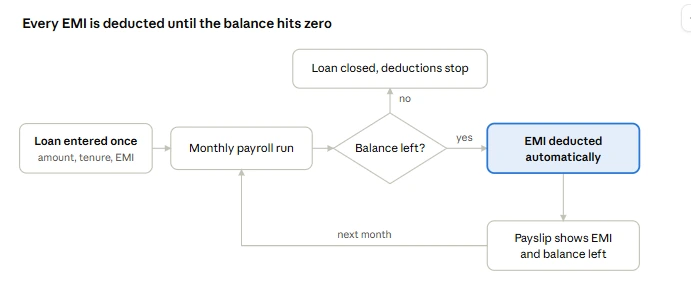
- Layer 2: Payroll with loans and advances built in. Each advance and loan is recorded only once, and the amount and tenor are noted along with the EMI. The payroll thereafter makes an automatic deduction of the installment and updates the balance until such time that the loan is paid off.
- Layer 3: HR letters from the same system. Offer letters, appointment letters, and other HR documents are created from templates in TankhaPay and sent to employees directly, instead of being drafted in Word and shared over email or WhatsApp.
Because all three layers share one employee record, attendance flows into pay, pay flows into deductions, and every number on the payslip traces back to a source.
How Does a Loan Move Through Khushboo's Payroll Now?
A loan is entered once, and every payroll run after that deducts the EMI and updates the balance until it reaches zero. Nobody has to remember anything, which is why recovery stopped leaking.
The loop runs every month on its own. The only manual step is entering the loan at the start.
Beforehand, loan collection was a process in which someone had to remember to refer to a spreadsheet. Now, the EMI gets deducted automatically from their monthly salary, and the employee can view his/her balance in the payslip itself. We collect our loans in full, and nobody chases anybody.
How Did Khushboo Feed Mills Recover 99.8% of Employee Loans?
By taking loans and advances out of Excel and deducting every EMI automatically through payroll, no instalment depends on someone remembering it. Here is what changed:
What Should a Company Check Before Buying Its First HRMS?
Don’t judge software by the length of its feature list. Ask which problem is costing you the most today, and whether the software fixes that one from day one. For Khushboo, that problem was loan recovery. For your business, it might be shift attendance, contract labour records or late salary payouts.
If employee loans and advances are part of your payroll, ask these five questions in the demo:
- Can I enter a loan once and have every EMI deducted automatically until it closes? Please check for the updated balance after the payroll run.
- What happens to the outstanding balance when an employee resigns? It should be recovered in the final settlement, not lost.
- Does the payslip show the loan, the EMI, and the remaining balance? If the employee can't see it, expect disputes.
- Will the system stop me if total deductions cross 50% of wages? This is the Code on Wages threshold, and a paper sheet will not alert you to that.
- Can my existing loan records be moved in without retyping them? Request the migration template first.

Who is TankhaPay?
TankhaPay is an HR, payroll and compliance platform built by AKAL Information Systems Ltd., which has operated since 2000 and is CMMI Level 5 appraised and ISO 9001, 20000, 27001 and 14001 certified. It runs HRMS, attendance, payroll and Employer of Record services across all 28 Indian states.
