In this edition
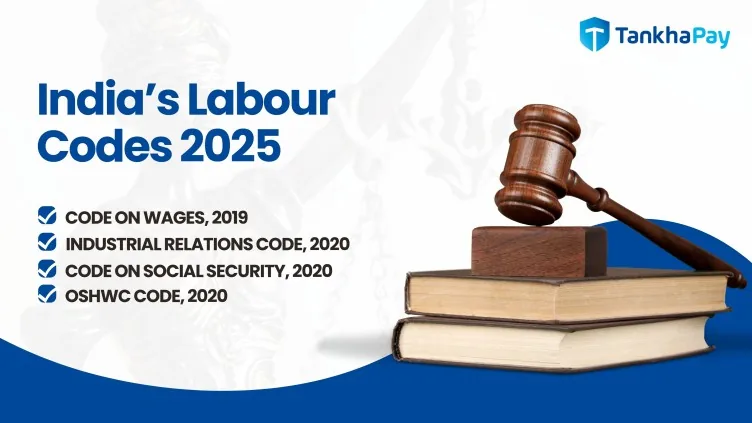
India has entered a new era of labour regulation with the implementation of four consolidated labour codes on 21 November 2025. Ministry of Labour & Employment has officially brought into effect: the Code on Wages, 2019, the Industrial Relations Code, 2020 (IR Code), the Code on Social Security, 2020 (SS Code), and the Occupational Safety, Health and Working Conditions Code, 2020 (OSHWC Code).
These reforms consolidate 29 existing Central labour laws into one more simplified framework, aimed at simplifying compliance, improving workers’ protection, and boosting ease of doing business.
The Impact of Consolidating India's Labour Laws
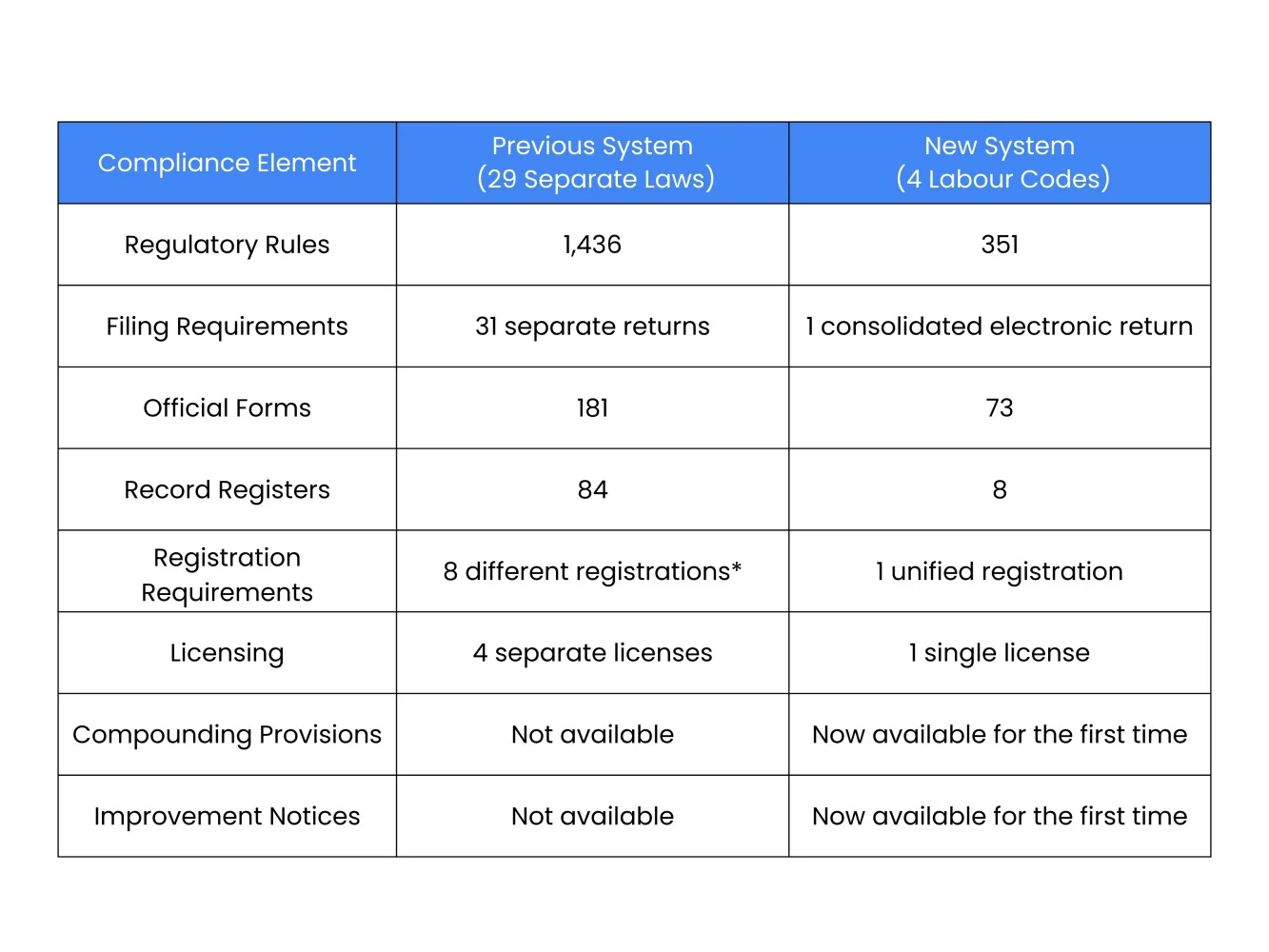
*Previous registrations included: Factories Act, BOCW, Contract Labour, Plantation, Motor Transport, ISMW, ESI, and EPF
Source: Ministry of Labour & Employment
For employers, HR teams, and payroll professionals, these reforms require close attention, as they reshape critical areas such as wages, social security, industrial relations, workplace safety, and overall working conditions. Understanding these changes is essential for organisations aiming to stay compliant, minimise risk, and adapt effectively to the new regulatory landscape.
Before and After November 2025: A Side-by-Side Comparison of India's Labour Law Reforms
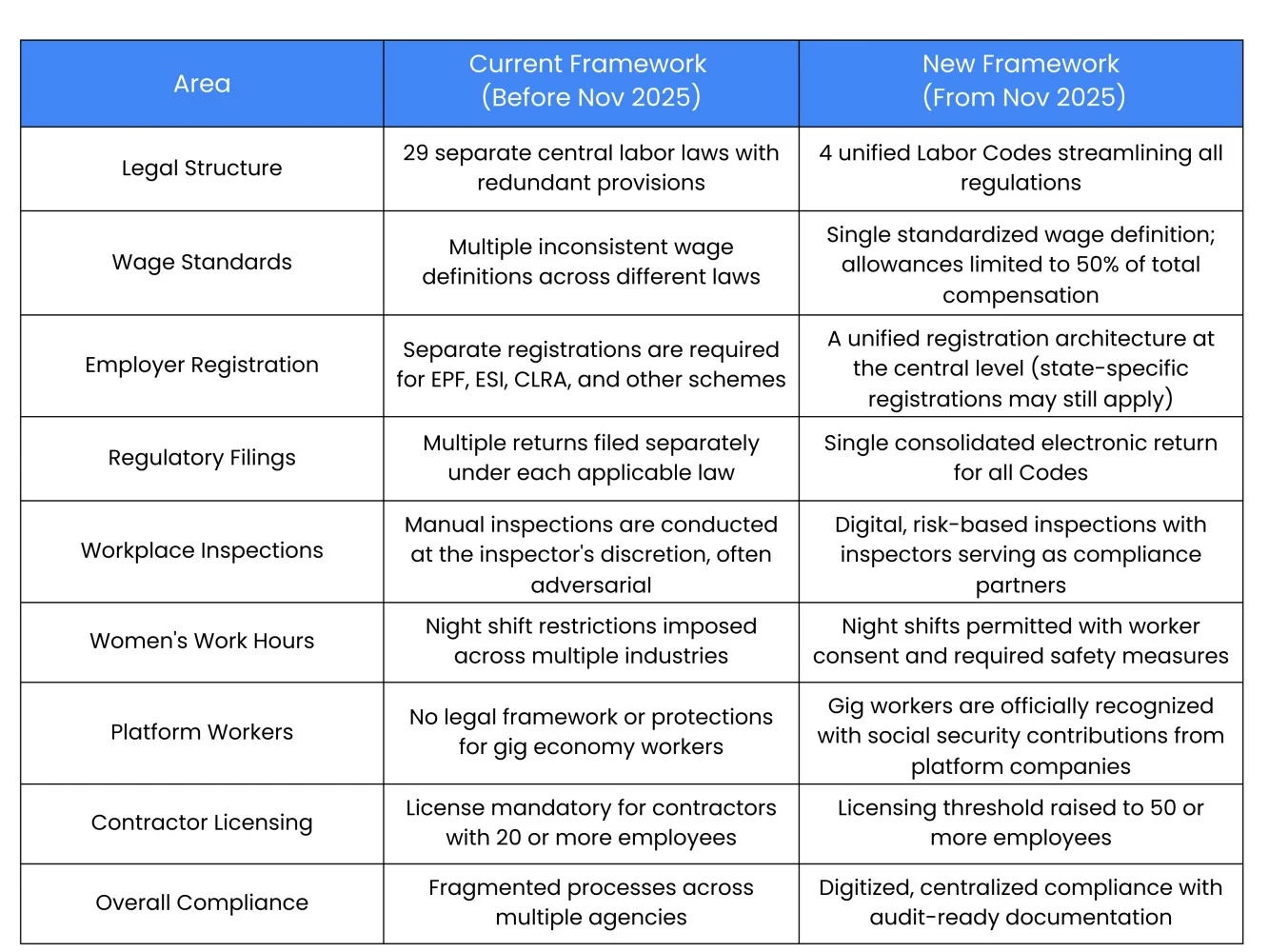
The Four Labour Codes: Reshaping India’s Workplace Framework
1. Code on Wages, 2019
Purpose & Scope
This Code unifies and rationalises four earlier laws: the Payment of Wages Act, 1936; the Minimum Wages Act, 1948; the Payment of Bonus Act, 1965; and the Equal Remuneration Act, 1976. It aims to simplify wage-related regulation and extend key protections more broadly across sectors.
Key Provisions & Employer Implications
A universal minimum wage now applies to all workers, replacing the old scheduled-employment structure.
Introduction of a national floor wage, states cannot go below this benchmark.
Wage calculations follow the 50% Rule, where allowances cannot exceed 50% of total remuneration; any excess is added back to “Wages” for statutory purposes.
Wage setting now considers skill level, region, and working conditions.
Mandatory equal pay for equal work, covering all genders, including transgender workers.
Overtime must be paid at 2x the normal rate.
“Inspector-cum-Facilitator” approach emphasise guidance over policing.
First-time offences can be compounded; imprisonment replaced with monetary penalties.
Example: How the 50% Rule Affects an INR 8 Lakh CTC Package
Let's examine how the new wage code's 50% basic salary requirement changes a typical compensation structure.
Scenario: An employee earns INR 66,667 per month (INR 8 lakh annually).
| Component | Before Wage Code | After the Wage Code | Change |
|---|---|---|---|
| Basic Salary | ₹20,000 (30%) | ₹33,334 (50%) | Base increases significantly |
| Allowances | ₹46,667 (70%) | ₹33,333 (50%) | Restricted to 50% of CTC |
| Employee PF Contribution (12%) | ₹2,400 | ₹4,000 | Rises by ₹1,600 |
| Monthly Take-Home | Higher | Lower | Drops by approximately ₹1,600 |
What this means: While employees will notice a reduction in their monthly take-home salary due to increased provident fund contributions, they benefit from more substantial retirement savings and higher gratuity eligibility over time.
Key Business Takeaway
HR teams must revise CTC structures, adjust basic pay, and update payroll systems to align with the new rules. While employees may experience lower take-home pay due to higher PF contributions, long-term benefits improve. Employers must ensure accurate wage structures, clear documentation, compliant deductions, and fair workforce classification.
2. Industrial Relations Code, 2020
Purpose & Scope
The IR Code merges key provisions from the Trade Unions Act, 1926; the Industrial Employment (Standing Orders) Act, 1946; and the Industrial Disputes Act, 1947. It strives to balance the twin objectives of worker protection, industrial flexibility, and ease of doing business.
Key Provisions & Employer Implications
Fixed Term Employment (FTE): full parity in wages/benefits; gratuity after 1 year.
Re-skilling Fund: 15 days’ wages to support retrenched workers.
Recognition of unions with 51% membership improved collective bargaining.
Expanded definition of “worker”: includes sales promotion staff, journalists, and supervisory employees earning up to INR 18,000/month.
Higher threshold (100 to 300 employees) for layoffs/closures needing government approval.
Mandatory 14-day notice before strikes/lockouts.
“Mass casual leave” counted as a strike.
Direct access to tribunals post failed conciliation within 90 days.
Digital records and filings for transparency.
Key Business Takeaway
Employers should reassess workforce contracts (including fixed-term arrangements), revamp policies for layoffs/retrenchment, review union and industrial relations frameworks, and update digital record-keeping. The broader definitions mean more categories of workers will be covered, thereby increasing risk and compliance exposure.
3. Code on Social Security, 2020
Purpose & Scope
This Code consolidates nine previous Acts, including the Employees’ State Insurance Act, the Employees’ Provident Funds & Miscellaneous Provisions Act, and others, extending social security to unorganised, gig, and platform workers. Implementation signals India’s commitment to universal social protection and workforce formalisation.
Key Provisions & Employer Implications
ESIC is applicable nationwide; establishments with <10 workers may opt in voluntarily.
Clear time limits for EPF inquiries (5 years to initiate; 2–3 years to complete).
EPF appeal deposit reduced to 25% of the assessed amount.
Gig & platform workers are formally recognised, and aggregators contribute 1–2% of annual turnover, capped at 5% of payouts to gig and platform workers, towards their social security coverage.
Dedicated Social Security Fund for unorganised and digital economy workers.
Broader dependent cover (including maternal grandparents, parents-in-law).
Gratuity eligibility for FTE (Fixed-term employees) workers after 1 year.
Commuting accidents are treated as workplace accidents.
Mandates electronic maintenance of records, registers, and returns, cutting costs and improving efficiency.
Key Business Takeaway
Employers must review eligibility and coverage under ESIC, EPF, gratuity, and other benefits for all employees, including fixed-term, contract, gig, or platform-related staff. The broadened definition of wages may increase contribution liabilities. The appeals process has become more favourable, yet formal compliance remains critical.
4. Occupational Safety, Health and Working Conditions Code, 2020
Purpose & Scope
This Code replaces 13 earlier Acts (such as the Factories Act, 1948; the Mines Act, 1952; the Contract Labour (Regulation & Abolition) Act, 1970, etc). It aims to create a unified regulatory regime that protects workers while easing compliance burdens for businesses.
Key Provisions & Employer Implications
One license, one registration, one return framework for the establishments, reducing redundancy and compliance burden.
Hazardous roles can attract ESIC and stricter safety obligations even when only a single worker is employed in that activity, irrespective of the general 10-worker threshold.
The definition of inter-state migrant workers now covers benefits such as an annual travel allowance to the native place, once every 12 months, and the portability of the public distribution system and social security benefits across states.
Mandatory appointment letters for all workers for greater transparency.
Women can work across all establishments, including night shifts, with safety provisions.
National database for unorganised workers.
Safety committees are required in units with 500+ workers.
A standard framework of 8 hours per day and 48 hours per week (with limited flexibility up to 12 hours per day), with overtime only with consent and paid at twice the normal wage.
Decriminalization of minor offences; monetary penalties encouraged over imprisonment.
Key Business Takeaway
Employers must update safety, health, and working condition frameworks, especially for contract labour, migrant workers, and women on night shift, and ensure that digital registration/licensing processes are in place. The change to facilitative inspections means proactive compliance (rather than reactive correction) becomes critical.
Conclusion
ndia's new Labour Codes are reshaping workplace compliance, boosting protections while simplifying regulations. HR teams must transition to structured, digital-first processes, including standardised wage structures, appointment letters, PF/ESI enrolment, overtime tracking, and safety documentation. While some state-level rules are still being finalised, platforms like TankhaPay simplify this shift with automated compliance that ensures accuracy, builds trust, and reduces risk.
This isn’t just regulatory change, it’s an opportunity for organisations to modernise their HR systems, adopt reliable payroll outsourcing services, upgrade to advanced payroll software, and strengthen overall compliance frameworks using the right HR software in India.Want to see how TankhaPay can simplify HR and strengthen compliance? Let’s connect!
Does this change anything in your own payroll setup?
Our team can review your current payroll and compliance process against the rules covered in this edition. You get a clear view of where you stand, with no obligation to switch anything.