
What HR Outsourcing Actually Means in 2026
Ask any business owner why they outsource HR, and you’ll likely hear the same two answers: “to cut costs” and “to save time”. Both are true. Both are legitimate. And both are also the most surface-level benefits on a list that runs considerably longer.
The more interesting conversations are happening inside boardrooms and growth-stage companies about what HR outsourcing and strategic staffing actually unlock that you didn’t expect when you signed the contract. It’s about the downstream effects that don’t show up in a vendor brochure but reveal themselves over months and years of working with the right partner.
India’s HR outsourcing market was valued at approximately USD 9 billion in 2025 and is projected to reach USD 14.3 billion by 2034, driven by growing demand for recruitment support, payroll management, and HR automation. HR outsourcing is no longer a niche strategy for companies that can’t afford in-house teams. It is a deliberate, intelligent business choice being made by organisations of all sizes, across every sector.
So let’s talk about what they’re actually getting.
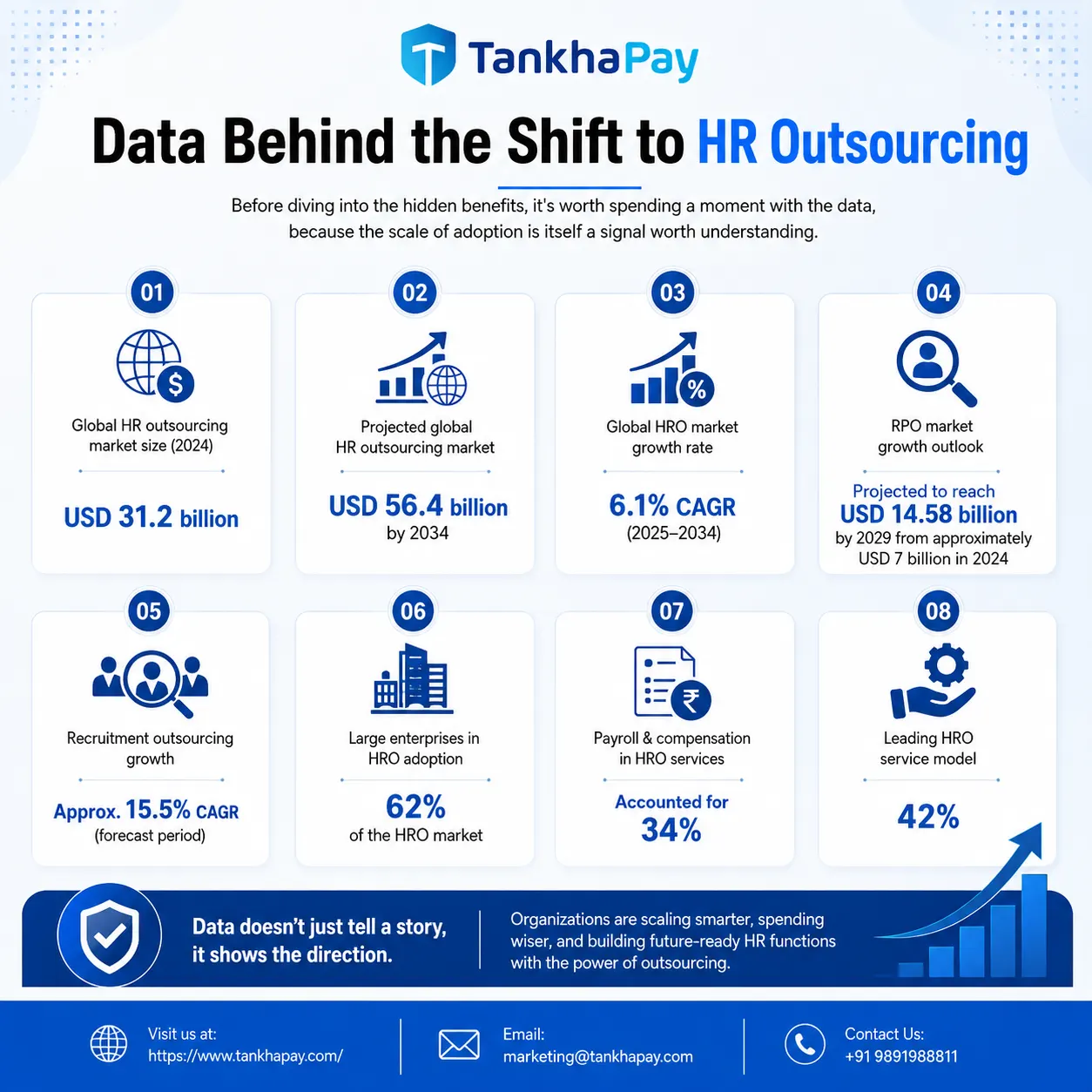
Data Behind the Shift to HR Outsourcing
Before diving into the hidden benefits, it’s worth spending a moment with the data, because the scale of adoption is itself a signal worth understanding.
| Metric | Data Point |
|---|---|
| Global HR outsourcing market size (2024) | USD 31.2 billion |
| Projected global HR outsourcing market | USD 56.4 billion by 2034 |
| Global HRO market growth rate | 6.1% CAGR (2025–2034) |
| RPO market growth outlook | Projected to reach USD 14.58 billion by 2029 from approximately USD 7 billion in 2024 |
| Recruitment outsourcing growth | Approx. 15.5% CAGR (forecast period) |
| Large enterprises in HRO adoption | 62% of the HRO market |
| Payroll & compensation in HRO services | Accounted for 34% |
| Leading HRO service model | 42% |
That 93% satisfaction rate is worth pausing on. That number is amazing in any field. It suggests that when HR outsourcing works and the infrastructure is getting better and better, it keeps its promise.
But companies aren’t outsourcing HR simply because it’s satisfying. They’re doing it because the Recruitment Process Outsourcing (RPO) market alone is expected to grow from $7 billion in 2024 to $14.58 billion by 2029 at a 15.5% CAGR. That level of growth doesn’t happen unless genuine value is being created.
1: You’re Not Outsourcing Tasks. You’re Buying Market Intelligence
When you hire an HR outsourcing or staffing partner, you’re not just getting someone to do tasks. This changes the whole picture. You’re getting a lot of information about the job market, compliance issues, pay scales, and workforce trends that would take years and a lot of money to build up on your own.
For the first time since the pandemic, SSON research shows that access to skilled workers is now the biggest benefit companies say they get from outsourcing, ahead of cost savings. The talk has grown. Companies aren’t just trying to cut costs; they’re also trying to hire people who are smarter, faster, and more strategically.
For HR managed services specifically, this intelligence layer also includes workforce analytics:
- The ability to track turnover trends
- Compensation equity,
- Absenteeism patterns, and
- Productivity benchmarks in ways that an underfunded internal HR team simply cannot replicate at scale.
2: Compliance Becomes a Strength, Not a Vulnerability
Indian labour laws are highly complex and constantly evolving. Four major labour codes consolidate 29+ central labour laws on wages, industrial relations, social security, and occupational safety. There are different rules in states as well. The consequences of non-compliance are not only costly but also expose the company to significant risk as well.
It is not only the costs of penalties associated with non-compliance. Inaccuracies in processing PF returns, failure to file ESIC returns on time, and problems related to firing employees or wrongful termination are all potential threats that might cause disruption, negative reputation, and divert the attention of management from its main focus.
Payroll outsourcing and compliance outsourcing are the solutions that help the company get professional assistance in staying ahead of the legislation, rather than adjusting to it. Payroll outsourcing will save 20% of payroll each year due to fewer mistakes. For a ₹5 crore payroll, this would amount to ₹1 crore per year in unnecessary losses avoided.
3: Hiring Faster Isn’t a Metric. It’s a Competitive Advantage
One of the most important but often ignored factors in hiring performance is time-to-hire. When a critical role stays open for too long, it costs the company money and productivity. In customer-facing roles, it can even affect business outcomes directly. In technical teams, delays put more work on current employees, which raises the risk of burnout and quitting.
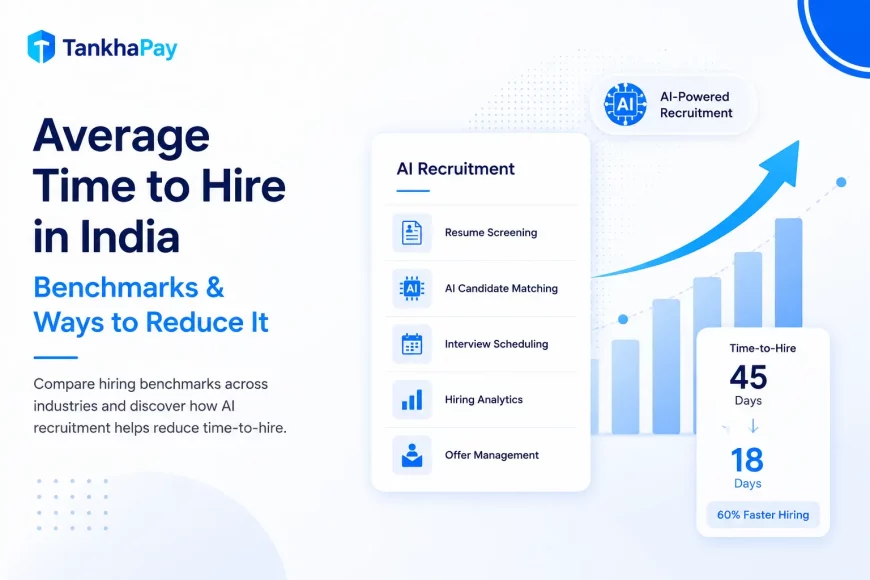
Companies in India that use ATS and AI-led screening have cut the time it takes to hire by about 30%. With the right staffing or RPO partner, you can get these benefits without having to build or manage the tech stack yourself. In areas like BFSI, where outsourcing recruitment has cut hiring times by up to 40%, the effect is even stronger. This is a big advantage in a market where 58% of companies have trouble finding skilled workers.
What this means in practice:
- Faster hiring means faster onboarding and getting the team back to work.
- Less time spent hiring lowers the risk of burnout and turnover directly.
- Processes that are always quick build trust with candidates and strengthen the employer brand.
- Over time, speed becomes a competitive edge in getting the best people to work for you.
4: The Flexible Workforce Model Changes Your Financial Profile
In the present growth scenario of India, maintaining a permanent labour force does not correspond to actual market conditions. Market requirements vary, whereas the labor force remains constant, leading to an imbalance.
Flexible staffing has moved from being a tactical choice to a core business model shift. With nearly 100 million contractual workers and gig roles driving a significant share of temporary hiring demand, companies are rethinking how work gets done at scale. Outsourcing staffing enables this shift by allowing organisations to expand or reduce their workforce in line with real demand without taking on the legal and administrative burden of managing contract workers directly.
This effect is particularly apparent in industries such as e-commerce and logistics, where the operation is scaled up by 30–35% at the peak season through temporary workers, a feat that might prove challenging for firms with just permanent employees. However, the greatest advantage of flexibility here is that it converts labour cost from fixed to variable, thus keeping in step with revenues.
The NATS Advantage: Most Businesses Are Not Using
There’s one workforce strategy that businesses with 30 or more employees are legally required to engage with but almost universally underleverage: the National Apprenticeship Training Scheme, or NATS.
Most companies treat it as a compliance checkbox. File the paperwork, enrol a few apprentices, move on. What they’re missing is that NATS, when managed properly, is one of the most cost-efficient workforce tools available to Indian businesses, and it maps almost perfectly onto everything Benefit 4 was describing.
Here’s the financial case in plain terms. There are no statutory deductions for NATS apprentices, which means no PF, no ESIC, no bonus, and no gratuity. That’s a savings of at least ₹8,000 per apprentice per month compared to a regular employee who costs the same amount.
The government also pays back 50% of the stipend, up to ₹4,500 per month for each apprentice, through the Direct Benefit Transfer system. If a company has 50 apprentices, the government could give them back ₹2.25 lakh every month, which is not coming out of your P&L.
- If the number of apprentices you hire is more than 2.5% of your total workforce, that cost also counts as CSR spending. So, the same program that helps you save money can also help you meet your social responsibility duties.
- The talent pipeline argument is equally compelling. The apprentices you train using your process and system will stick around longer and will perform faster compared to lateral employees. This will lead to fewer turnover issues, a reduced cost of hiring, and a steady labor force.
- Most businesses don’t get any of this value because NATS is hard in principle. It’s because running it is really hard. NATS portal registrations, BOAT and BOPT coordination, stipend calculations, DBT reimbursement tracking, attendance documentation, and periodic filings are all examples of the kind of administrative work that takes up a lot of HR time without producing any strategic output.
TankhaPay’s Apprenticeship Management service takes the entire NATS lifecycle off your HR team’s plate, onboarding apprentices onto the portal, managing stipend disbursements, handling BOAT/BOPT filings, tracking compliance deadlines, and maintaining audit-ready records all through a single centralized dashboard that gives you full visibility without the workload.
5: Your HR Team Gets to Do What It Was Hired For
Perhaps one of the greatest benefits of HR outsourcing is not directly related to financial savings. Instead, this benefit concerns the way that your internal HR department can change. Although you may be worried about having fewer people in the department, the real benefit is in the kind of work the department does after the process of outsourcing becomes part of your organisation’s routine.
This kind of change in the internal dynamics of your company is important since most HR executives say that they do not have enough time to focus on strategic aspects and always need to be flexible to meet new challenges. With HR outsourcing, the needed capacity to work strategically is provided.
What changes when HR is freed up:
- GHR can focus on corporate culture, leadership, and other long-term strategic activities
- Better decision-making based on people analytics and insights
The payoff is tangible. Companies with strong people analytics capabilities see up to 8% higher sales growth and 24% higher net income, outcomes that are only possible when HR has the time and space to contribute beyond operations.
Hidden Benefit #6: Technology Access Without Technology Investment
As far as small and mid-size enterprises operating in India go, the lack of adequate HR technology is indeed one of the major limitations. The latest advancements related to AI recruitment, payroll management, compliance issues, and business analytics may prove costly to adopt.
Outsourcing HR processes eliminates this limitation completely. In this way, you will have access to high-quality technologies as part of an outsourcing partnership and not necessarily have to invest in and implement them yourself. With the rapid development of the cloud-based HR systems and AI solutions, companies that use their potential via outsourcing services get ahead of the competition immediately.
What this unlocks:
- Instant access to cutting-edge HR technologies without any significant expenses
- Faster and more efficient recruiting
The impact shows up quickly. AI can automate 40–60% of routine payroll tasks and reduce processing time by up to 50%. By working with the right partner, you benefit from these efficiencies instantly, without having to build the infrastructure yourself.
Why All of This Matters Even More in India
India’s workforce dynamics amplify every benefit on this list. The numbers tell a compelling story.
India’s staffing and workforce solutions sector continues to expand as organisations adopt more flexible hiring models, outsource recruitment operations, and scale teams more efficiently across industries.
Meanwhile, the country faces a documented skill gap; the National Skill Development Corporation highlighted a shortage of approximately 35 million skilled workers. Which makes access to a well-maintained talent network even more valuable.
The non-metro cities today contribute over 40% of the job openings, claims the Reserve Bank of India, as firms begin their expansion process by going after Tier-2 and Tier-3 cities. The employee turnover in such cities is typically lower, the cost of living is low, and the talent pool is less competitive compared to metro areas; however, recruiting in such cities needs local knowledge that the HR department of most firms lacks.
Payroll outsourcing goes from being an optional choice to becoming essential when firms have employees in more than one state and try to handle things like payroll processing, PF, ESIC, and professional taxes without any specialised knowledge within the company.
Asia-Pacific is expected to remain one of the fastest-growing regions for HR outsourcing, supported by expanding digital adoption, workforce transformation, and rising demand for outsourced HR services. The businesses that build strong outsourcing relationships now will be structurally better positioned to absorb that growth.
How TankhaPay Brings All of This Together
Every benefit this article has covered, smarter compliance, flexible workforce management, technology access, NATS administration, requires one thing to actually work: a platform that handles all of it without creating new complexity in the process.
That’s what TankhaPay does. It was designed with the understanding that you might be an HR manager trying to keep track of contractor compliance, a finance team that wants to see clean payroll across several states, an operations head managing a mix of permanent and temporary employees, or a business owner who just wants payroll to run smoothly every month without having to chase it down.
One system. Every workforce type. Compliance included. No paperwork left on your team’s plate.
The Benefits That Show Up Later
The clear advantages of HR outsourcing include savings on costs, saving time, and achieving compliance. These benefits will be felt right away, and they can also be measured rather easily. They are tangible and impactful enough to make the choice of their own merit for most organisations.
But the benefits that truly transform a company’s direction appear at a later stage.
These include increased intelligence, faster hiring, greater labour force flexibility, stronger internal teams, and technological advancements.
Their impact appears through improved hiring results in two quarters’ time.
Improved compliance outcomes become visible one year later.
Enhanced bottom-line performance can be clearly seen in financial statements.
Organisations that get it realise that HR outsourcing should not be viewed in the same manner as other business expenses. Instead, they should approach it much the same as they would any other business investment, discussing all its advantages and opportunities.
This is relevant when considering challenges the organisations will face in 2026, including shrinking talent pools, increasing regulatory complexity, and constant advancements in technology impacting HR processes and results.
FAQs
1. How does Payroll Outsourcing reduce risk beyond just saving time?
Apart from simplifying the salary calculation process, Payroll Outsourcing provides significant advantages in terms of reducing risks. In India, laws regarding PF, ESIC, and taxes keep changing. Outsourcing payroll processes ensures accuracy and timely submission of forms to avoid fines and bad publicity. See Payroll Outsourcing Cost for what this actually costs in India
2. What makes HR Managed Services different from traditional HR support?
Unlike the more simplistic nature of human resource management services, which simply deal with the processing of tasks, Human Resource Managed Services offer structured processes, analysis, and oversight.
These services help you make the most out of HR.
3. In what way do the staffing and recruitment partners help with the hiring of candidates?
Through experienced staffing and recruitment partners, it takes less time to hire candidates because the partners are able to screen candidates using better criteria and also connect candidates that have been screened already with the company.
4. What circumstances would require a business to combine HR managed services and payroll outsourcing at once?
The most opportune time for such an arrangement would be during business expansion. Using combined payroll and HR-managed services, there will be a seamless relationship between compliance, payroll, and staffing needs.
5. In what way is NATS unique when compared to regular outsourcing firms?
While other outsourcing firms usually use their services to outsource some of the work involved in running the company.
NATS uses outsourcing to partner with business organisations to help them grow and become more resilient.
TankhaPay, developed by Akal Information Systems (est. 2000, CMMI Level 5, ISO 27001), is India’s only payroll platform combining payroll software, managed payroll outsourcing, domestic and international EOR, NATS apprenticeship management, and global talent mobility under one platform. Trusted by 1,000+ enterprise clients including Bank of Baroda and UIDAI.